Hubble’s nine lenses show Roman what to hunt for in dark matter
NASA has released a nine-panel gallery of gravitational lenses seen by Hubble, a preview of what the new Roman telescope will find in far greater numbers.
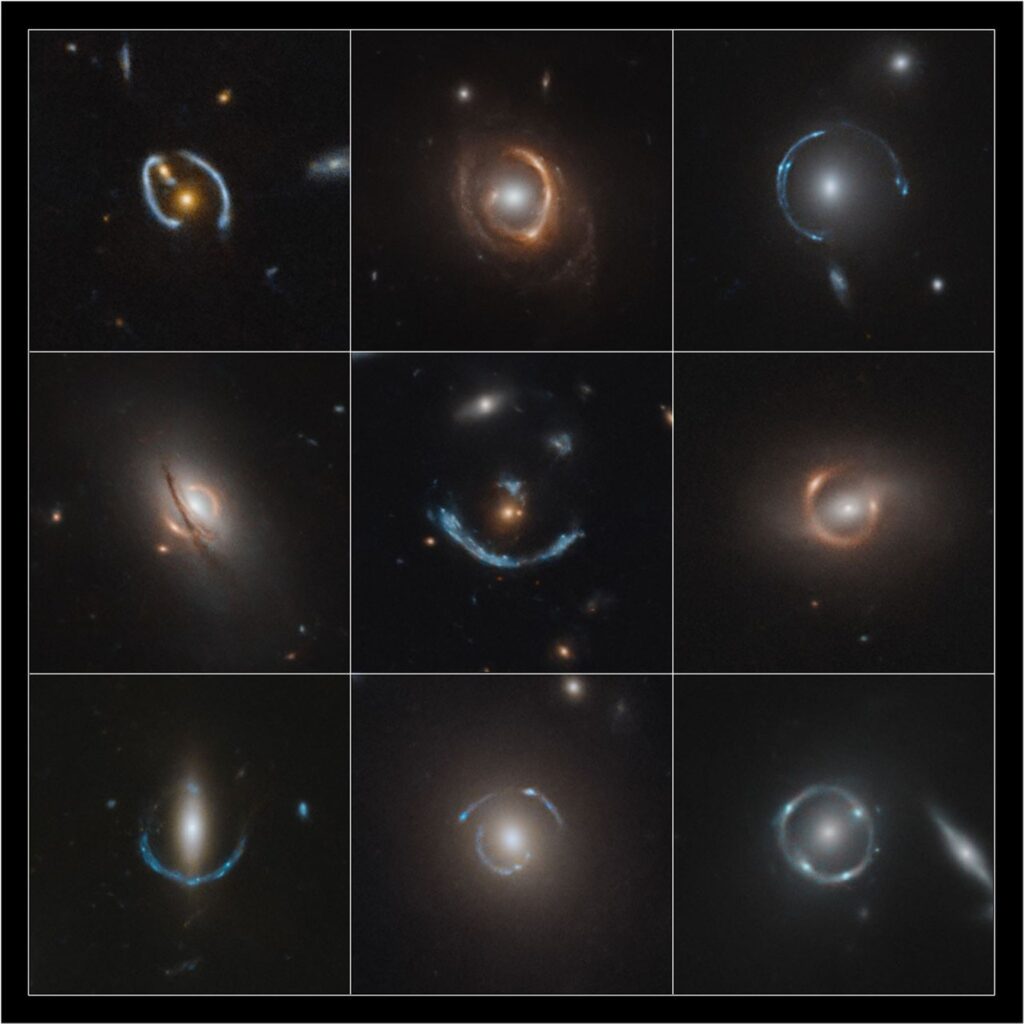
NASA has published a gallery of nine gravitational lenses imaged by the Hubble Space Telescope, chosen to show the variety that the newly launched Nancy Grace Roman Space Telescope will survey. Astronomers will use them to weigh galaxies and test ideas about dark matter.
According to NASA, the gallery lays the groundwork for follow-up observations by Roman, which launched in August 2026.
What a gravitational lens looks like in practice
A gravitational lens forms when the gravity of a massive foreground object, such as a galaxy or a cluster of galaxies, bends and magnifies the light of a more distant galaxy behind it. The effect works like a giant lens in space and lets astronomers see objects farther away than any telescope could reach alone. Albert Einstein first predicted it.
In these nine systems, a distant background galaxy lines up with a foreground galaxy. The result is distorted, magnified images of the background galaxy, seen as arcs around the foreground one. The amount of distortion tells astronomers how much mass the foreground galaxy holds and how it is spread out, including the invisible dark matter.
NASA points to several panels that show how different these systems can be:
- Panel A is an arc-counterarc configuration: the background galaxy appears as a duplicated pair of arcs, magnified by a pair of foreground galaxies.
- Panel F is an Einstein ring, where the alignment is so precise that the lensed galaxy almost fully encircles the foreground galaxy.
- Panels I and C each show a quadruply lensed galaxy, meaning the background galaxy is replicated four times.
- Panel D has a visible dust lane in the foreground galaxy, which NASA calls rare in a lensing galaxy. The lensed galaxy could be an Einstein ring that the dust is “breaking” from our view.
Colors carry information too. Bluish arcs indicate young stars and reddish arcs older ones, so comparing them helps show how galaxies evolved earlier in the universe. Most foreground galaxies are ellipticals, which are older, denser and more compact, but NASA notes that panels B and F appear to have spiral arms, and the foreground galaxy in panel G looks elongated. Such differences let researchers explore the paths these galaxies took.
The lenses were first detected with the Dark Energy Spectroscopic Instrument at Kitt Peak, then observed by Hubble, and Roman will observe them next.
Hunting small clumps of dark matter
The scientific prize is dark matter, the unseen material that makes up most of a galaxy’s mass. The cold dark matter theory predicts many small clumps of between a million and a billion solar masses. By comparison, NASA gives the dark matter halo of the Milky Way as about 1.3 trillion solar masses.
Such clumps would leave small imperfections in the lensed arcs. With Hubble’s sharp images and precise lens models, researchers expect to detect them, and finding them would support the cold dark matter theory. NASA says the team also intends to build an AI tool from the Hubble images to search for similar arcs in Roman’s data.
Why the two telescopes split the work
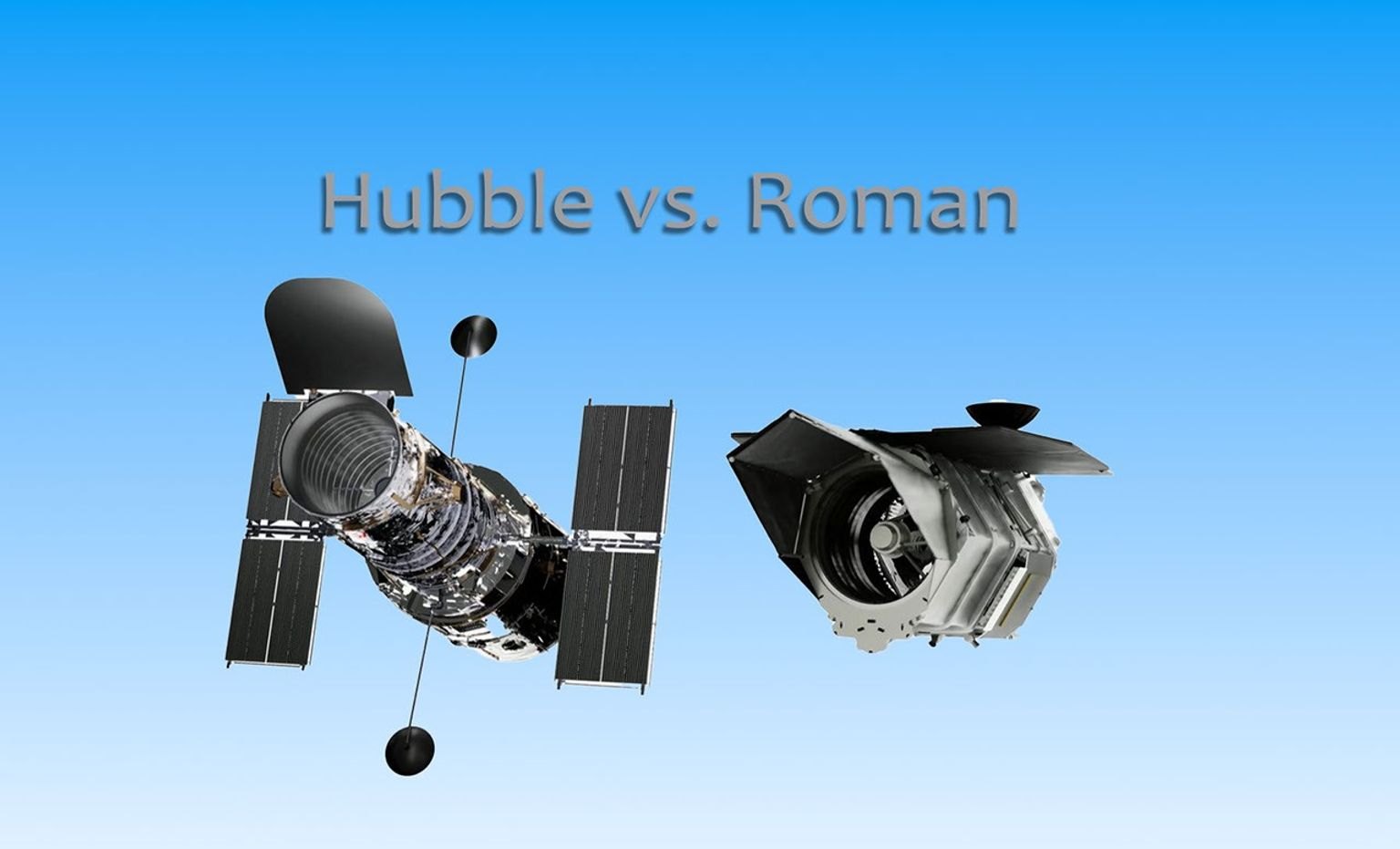
Hubble sees mostly visible and ultraviolet light with some infrared, giving a high-resolution view of single objects. Roman sees mainly infrared and some visible light over a much larger area, building panoramas. In NASA’s words, Hubble gets the better view of an individual lens, while Roman can capture many more of them.
NASA’s Roman mission page says the telescope will have a field of view at least 100 times larger than Hubble’s. That is what turns lens hunting from a handful of cases into a statistical sample, which is what the dark matter test needs: a few clumps in one lens prove little, while a pattern across many lenses can.
Infrared light is also less blocked by dust. For panel D, Roman could show whether the arcs close into a fuller Einstein ring behind the dust lane. If Roman spots an especially interesting lens, researchers may return to Hubble for visible and ultraviolet follow-up of that single object.
What to watch as Roman’s lens catalog grows
NASA did not give dates for the lens observations, so the markers to follow are Roman’s first science images and any lens candidates in them. Roman’s mission page describes the telescope as in commissioning, so full survey data will come later. Two results would matter most: whether the small clumps predicted by cold dark matter turn up in the arcs, and how many new lenses Roman finds beyond the Hubble set.
Hubble has also been busy closer to home; see our report on Hubble’s measurements of interstellar comet 3I/ATLAS. NASA frames the lens work as an example of its Great Observatories (Hubble, Chandra, Webb and now Roman) working together to build a fuller picture of the cosmos.