Red aurora over Germany shows rays linking it to the green glow below
Photos taken over Göttingen and Braunschweig in May 2024 show bright rays running from a red aurora into the green one below, which points to a common cause. Researchers want more pictures.
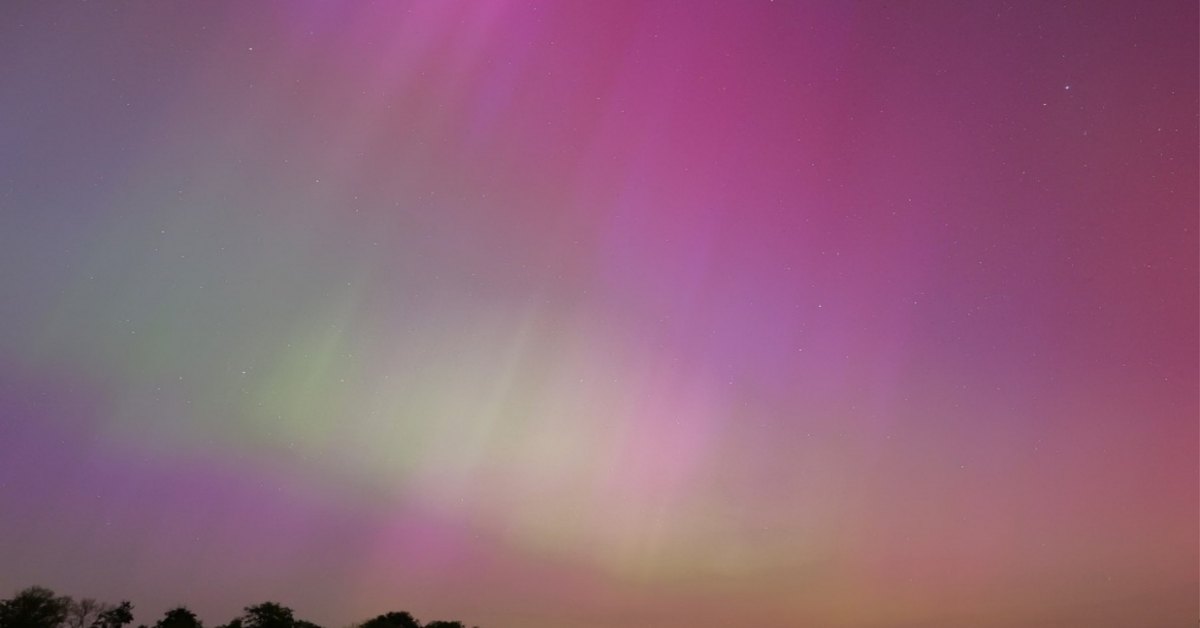
Photographs taken over Göttingen and Braunschweig during the May 10, 2024 solar storm show bright rays joining a red aurora to the green one below it. According to the Max Planck Society, this suggests fast electrons cause both colors.
Rays nobody had reported before
When the storm arrived, scientists from the Max Planck Institute for Solar System Research (MPS), the University of Göttingen, the Fraunhofer institute IST and the Technical University of Braunschweig headed outside with their cameras. Auroras are rare at this latitude. MPS Director Sami K. Solanki said he had not originally planned to use his photos for science.
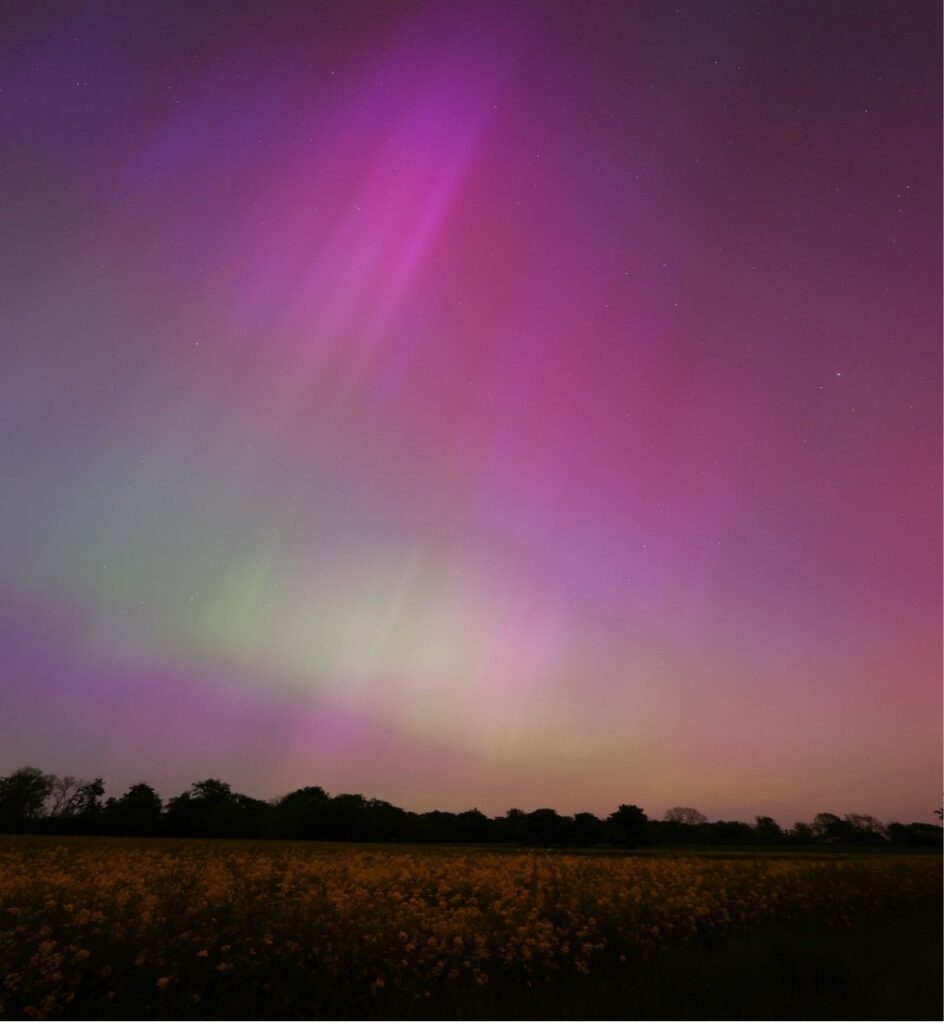
The pictures showed a reddish glow above the green aurora, with bright rays running down from the red into the green. Bruce T. Tsurutani, a former scientist at NASA’s Jet Propulsion Laboratory and first author of the study in Annales Geophysicae, said such continuous rays “have not been reported in any scientific paper”. The team, coordinated by Yasuhito Narita of the Technical University of Braunschweig, compared the images with solar wind data and measurements of disturbances in Earth’s magnetic field.
One process, two colors
Green auroras are the familiar kind. Fast electrons from Earth’s magnetosphere, the region around the planet controlled by its magnetic field, travel along field lines. They reach 130 to 85 kilometers above the surface and set off collisions that make oxygen atoms glow green.
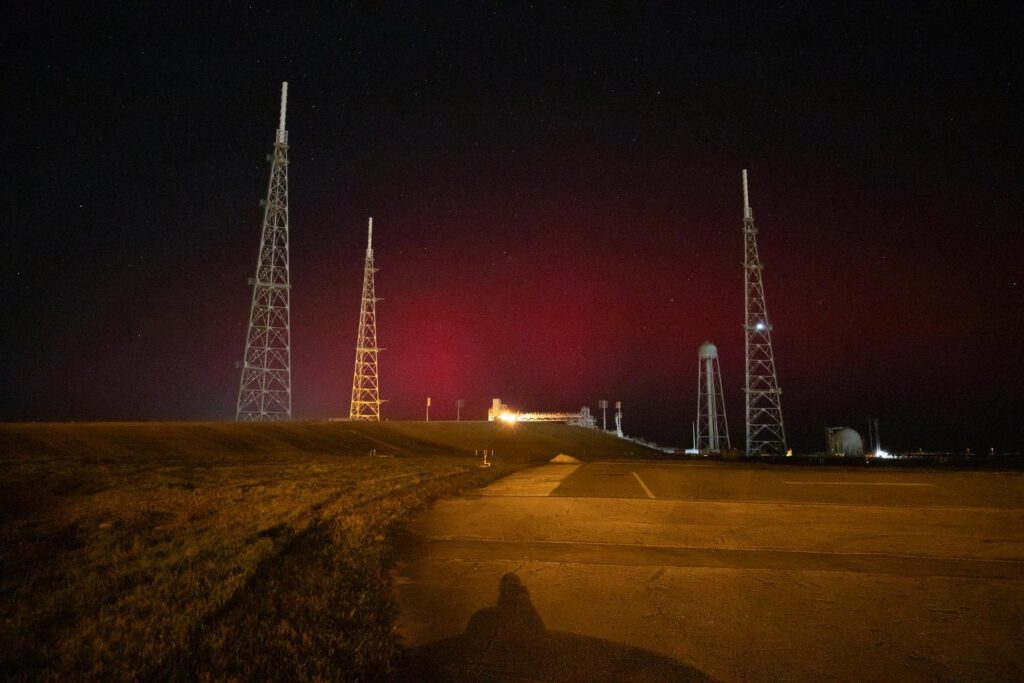
Red auroras are harder to explain. They appear during intense magnetic storms at middle latitudes, typically at altitudes from 800 to 200 kilometers. Many theories exist, but the Max Planck Society notes that satellites rarely pass through the region where they form, so the theories have been hard to test.
Narita says rays extending from red to green suggest “the same physical process is at work in both cases”. The analysis indicates that high-energy electrons likely triggered both colors almost at the same time. Red auroras, like green ones, can therefore be caused by electrons streaming down from the Sun’s storm.
Why ground photos are valuable for this puzzle
Without satellites in the right place, scientists have little direct data on red auroras, so ordinary cameras fill a gap. Context shows how unusual the night was. The study calls the storm the second most intense magnetic storm of the space age, which began in 1958. ESA’s space weather service describes it as the most powerful to hit Earth since March 1989. NOAA’s scale rates the strongest storms G5, “Extreme”; for how to read such warnings, see our guide to the Kp index and aurora alerts.
The photographs also show how far a storm of this size pushes the lights from their usual home. Auroras normally sit in a ring around the poles, and on most nights the northern lights forecast for Germany is a no. Since 2024 they have been seen several more times over southern Lower Saxony, according to the release. That gives researchers more chances, but only if someone is shooting at the right moment and with the right settings.
How to send in your own aurora photos
The sun is currently moving toward a calmer phase of its 11-year cycle, but the researchers note that unusually intense eruptions can still occur. Anyone with a smartphone or camera can help.
- Use an exposure time of no more than 6 seconds. Longer exposures blur the rays that carried the key evidence.
- Photos can be sent to Yasuhito Narita at [email protected] or to Bruce Tsurutani at [email protected].
- The team says many other features of red auroras are also worth documenting.
The study also involved the Indian Institute of Geomagnetism, the University of Science and Technology of China and the British Antarctic Survey.