
A mid-infrared telescope sees a flare’s magnetic field drop by about 200 gauss
Chinese astronomers used a mid-infrared solar telescope to measure the field under an X1.5 flare. It weakened during the flare, but the cause may be a rise in the height at which the light forms.
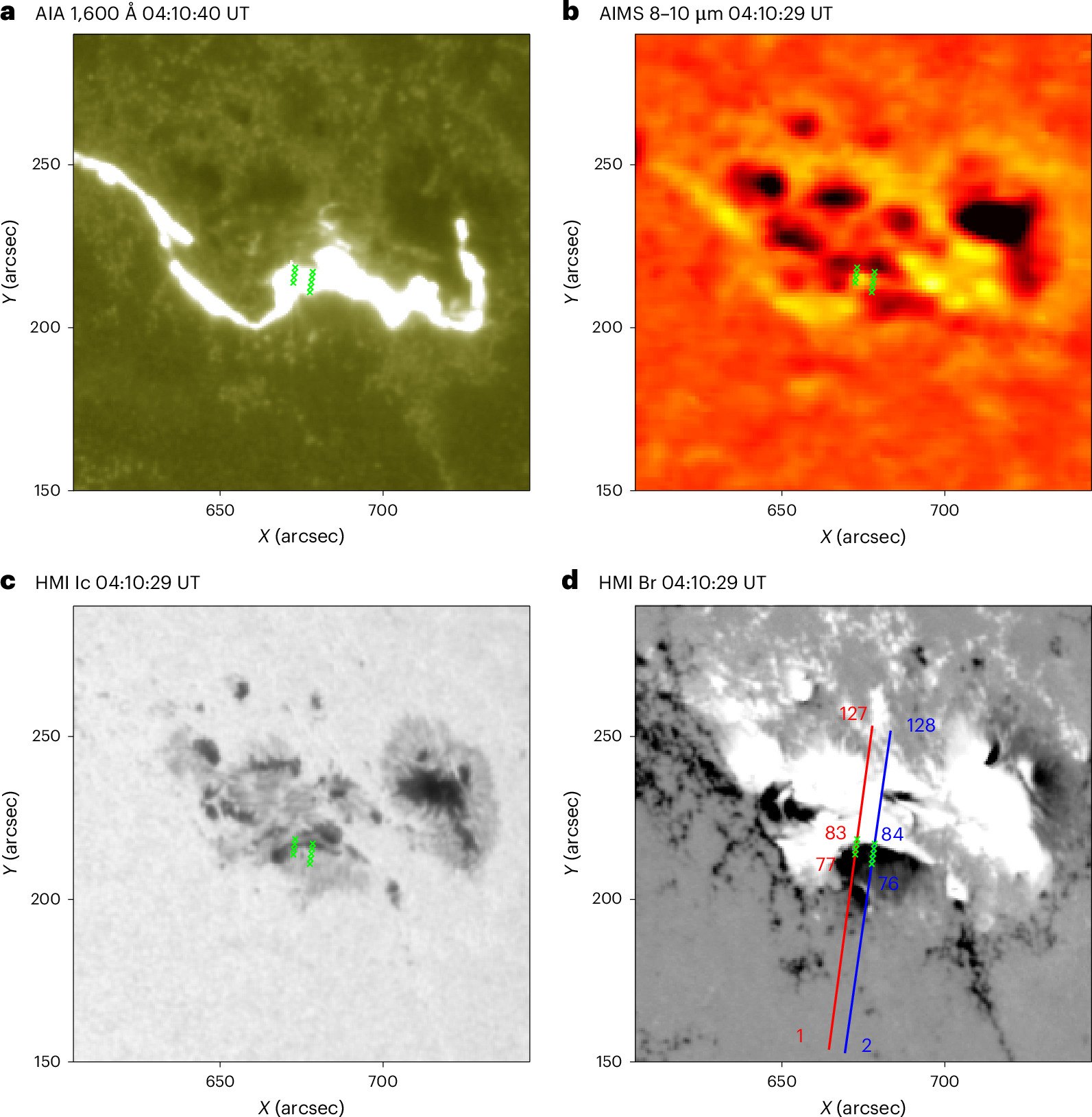
A team led by the National Astronomical Observatories of the Chinese Academy of Sciences has measured how the magnetic field changed under a powerful solar flare, using a telescope that works in the mid-infrared. The field appeared to weaken during the flare, according to a paper in Nature Astronomy.
The authors say the drop may not be a real loss of magnetic field. It could instead come from the light being emitted from higher up in the Sun’s atmosphere.
A flare watched through a magnetically sensitive infrared line
Solar flares are sudden releases of magnetic energy in the Sun’s atmosphere. Despite decades of study, the paper says, the way the magnetic field itself varies during a flare remains poorly understood.
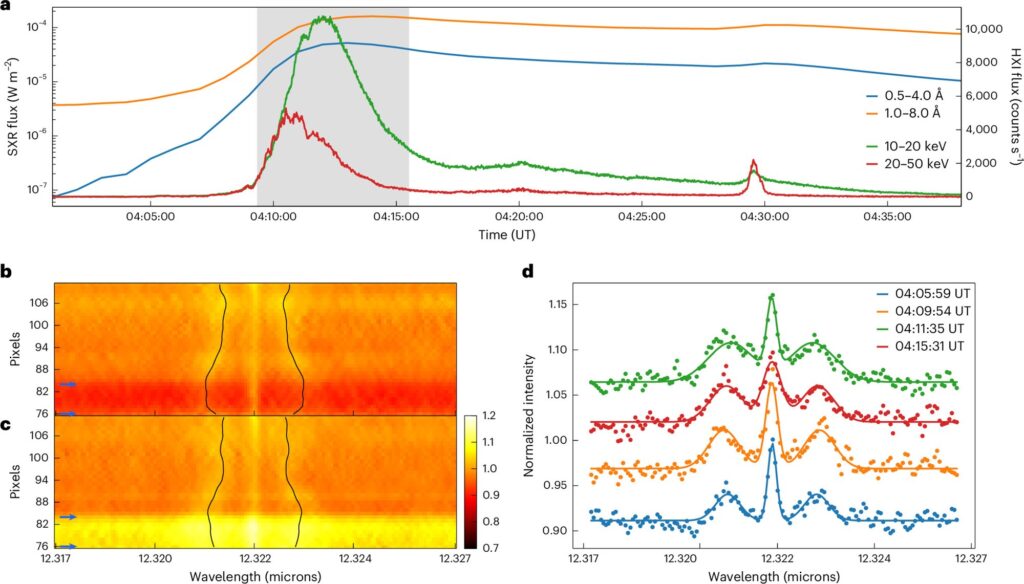
The team used AIMS, a mid-infrared solar telescope in Lenghu, in China’s Qinghai province. It observed the Mg I 12.32-micron line, a spectral line of neutral magnesium. A spectral line is a narrow band of light that an atom emits or absorbs; in a magnetic field it splits into several components (the Zeeman effect, first applied to sunspots by George Ellery Hale in 1908). This line is very sensitive to the effect, so the field strength can be read directly from how far apart the components sit.
The target was an X1.5-class flare on 30 December 2024 in NOAA Active Region 13936. X-class is the strongest category on the GOES X-ray scale. Data used for the event cover 04:01 to 04:38 UT, and the flare was also followed by the Solar Dynamics Observatory, GOES and China’s ASO-S satellite, whose hard X-ray imager records the high-energy emission from flares.
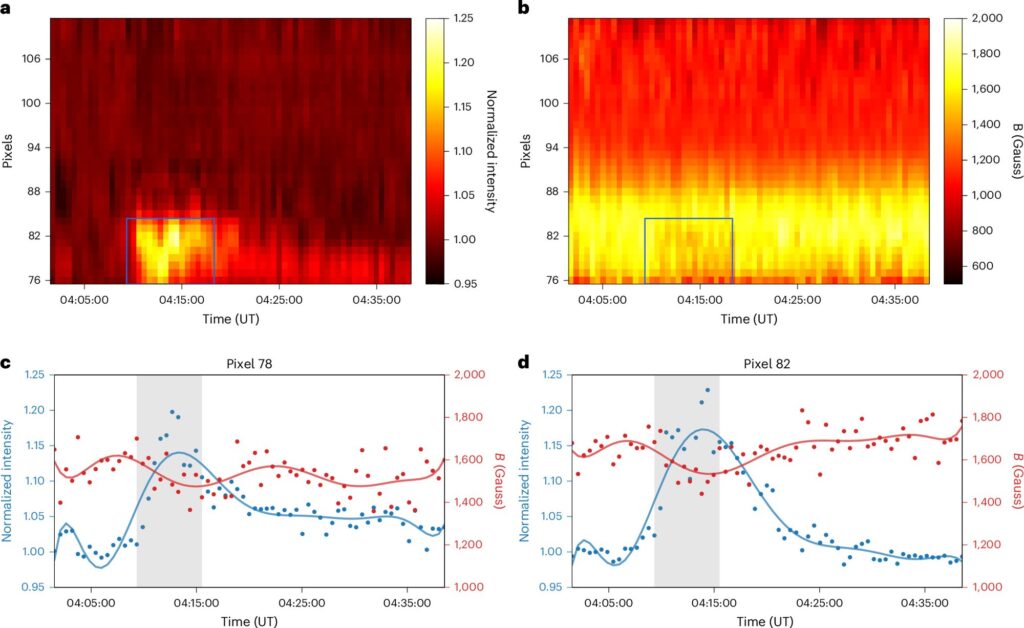
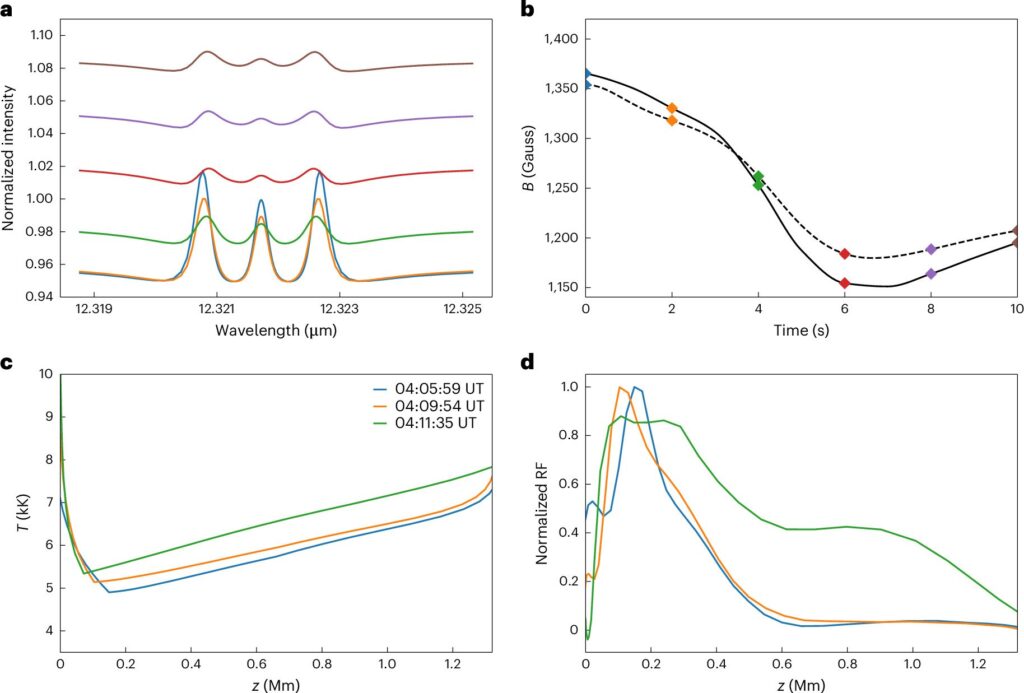
In the impulsive phase, when the flare releases most of its energy, the team found an apparent weakening of the field beneath the bright flare ribbons, the two glowing strips that mark where the energy hits the lower atmosphere. The extended data tables give 04:09:20 to 04:15:31 UT as the interval in which the fitted field decreases. A figure of the fitting shows the field falling from about 1,350 to about 1,150 gauss (gauss is the unit for magnetic field strength).
Why the field may only look weaker
The authors tested their result with radiative-hydrodynamic simulations, which model how a flare heats the atmosphere and changes the light it emits, and with atmospheric inversions, which work backward from an observed spectrum to the conditions that produced it. Both indicate that the height at which the Mg I 12.32-micron line forms increases during the flare.
That matters because magnetic field strength normally falls with height above a sunspot. If the line comes from a higher layer, the same field would read weaker. The team suggests the apparent change probably comes either from this higher line-formation altitude or from a real redistribution of the magnetic field. The paper does not settle which, and it presents the result as a demonstration that mid-infrared wavelengths can trace the field during flares.
Technical significance: A new window on the field during flares
Most flare magnetic measurements come from visible and near-infrared lines, and the paper’s reference list includes studies using such lines with ground-based telescopes and the Daniel K. Inouye Solar Telescope. A mid-infrared line brings a stronger Zeeman signal, so the field can be measured from line separation, without relying on weaker polarization signals.
AIMS itself is new. China Daily reported in October 2025 that it had become operational as the first solar magnetic-field telescope working in the mid-infrared, at a site of about 4,000 meters altitude. Earlier, CAS said its chief engineer put the vector-field measurement precision beyond the 10 gauss level. Against that, the roughly 200 gauss change reported here is large, though the paper gives the formal uncertainties from its spectral fits.
The result also shows a limit. A line that forms higher during a flare is measuring a different layer, so field changes must be separated from height changes before they can be tied to flare energy release. The authors say the work advances understanding of how flares build up and release energy.