Hubble catches a rocky planet slipping behind its star for the first time
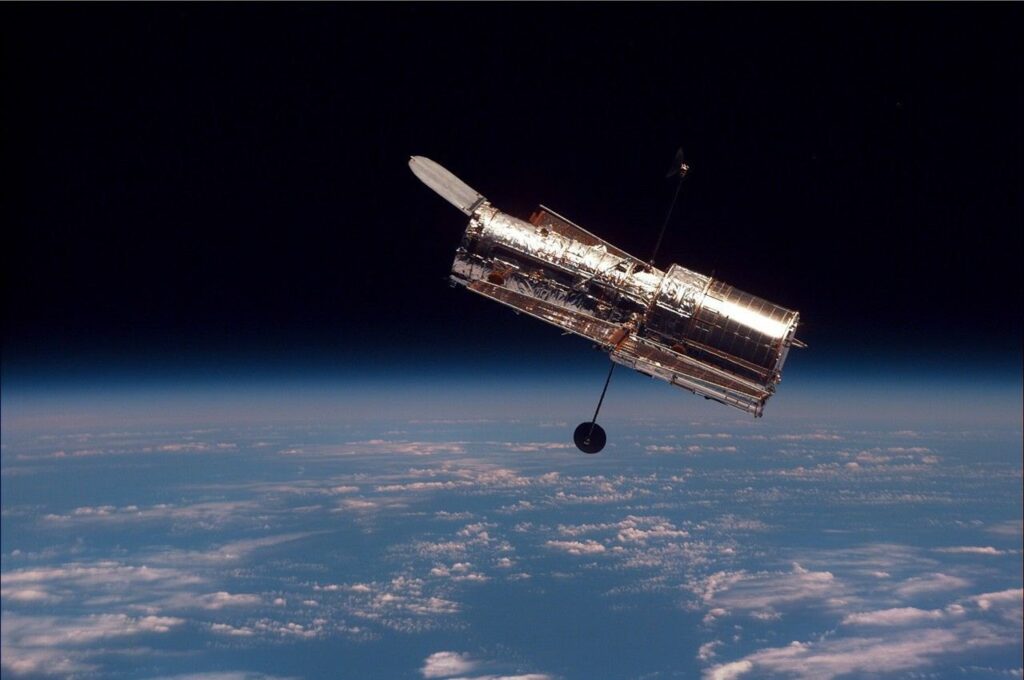
Hubble has recorded a rocky exoplanet passing behind its star for the first time. The lava world TOI-2431b has a dayside near 2524 K, and the data cannot yet say whether it has an atmosphere.
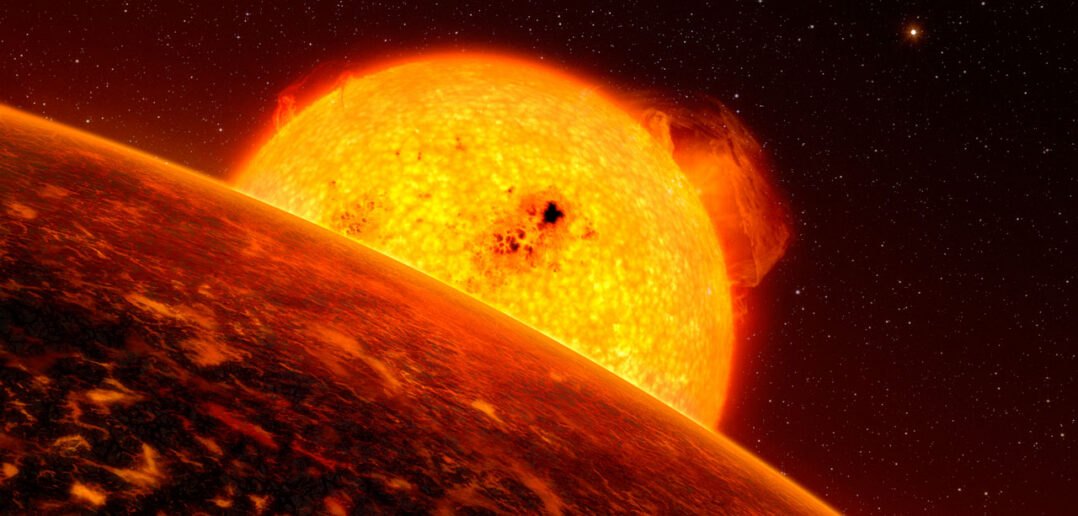
For the first time, the Hubble Space Telescope has recorded a rocky exoplanet disappearing behind its star, AAS Nova reports. The planet, lava world TOI-2431b, has a dayside near 2524 K.
A planet seen vanishing behind its star
Most of the thousands of known exoplanets were found through transits, when a planet crosses in front of its star and dims it slightly. A secondary eclipse is the opposite event: the planet passes behind the star, and the combined light of the two drops by a tiny amount. That drop reveals how much light the planet itself gives off, which in turn tells astronomers about its dayside temperature, how reflective its surface is and what its atmosphere is like. Far fewer planets have been caught this way.
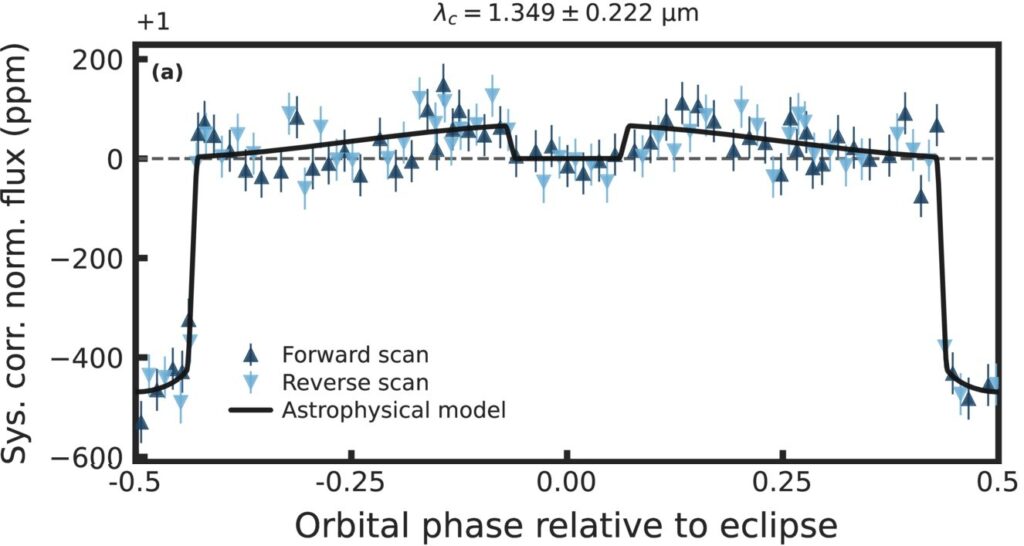
The result comes from a team led by Sebastian Zieba of the Center for Astrophysics | Harvard & Smithsonian, published in The Astrophysical Journal Letters. TOI-2431b circles a K-type star (a star somewhat cooler and smaller than the Sun) every 5.4 hours. According to AAS Nova, that makes it the shortest-period planet with both a measured mass, 6.2 Earth masses, and a measured radius, 1.54 Earth radii.
The team paired Hubble’s near-infrared measurements with visible-light data from the Transiting Exoplanet Survey Satellite (TESS), the mission that spotted the planet in 2019. The paper’s abstract says the Hubble data came from its Wide Field Camera 3 and form a phase curve, a record of the system’s brightness across the whole orbit. In the paper, the Hubble eclipse depth is 69 parts per million and the TESS one 37 parts per million, meaning the planet adds only a few hundredths of a percent to the system’s light.
Hot enough to melt rock, and not cooling itself
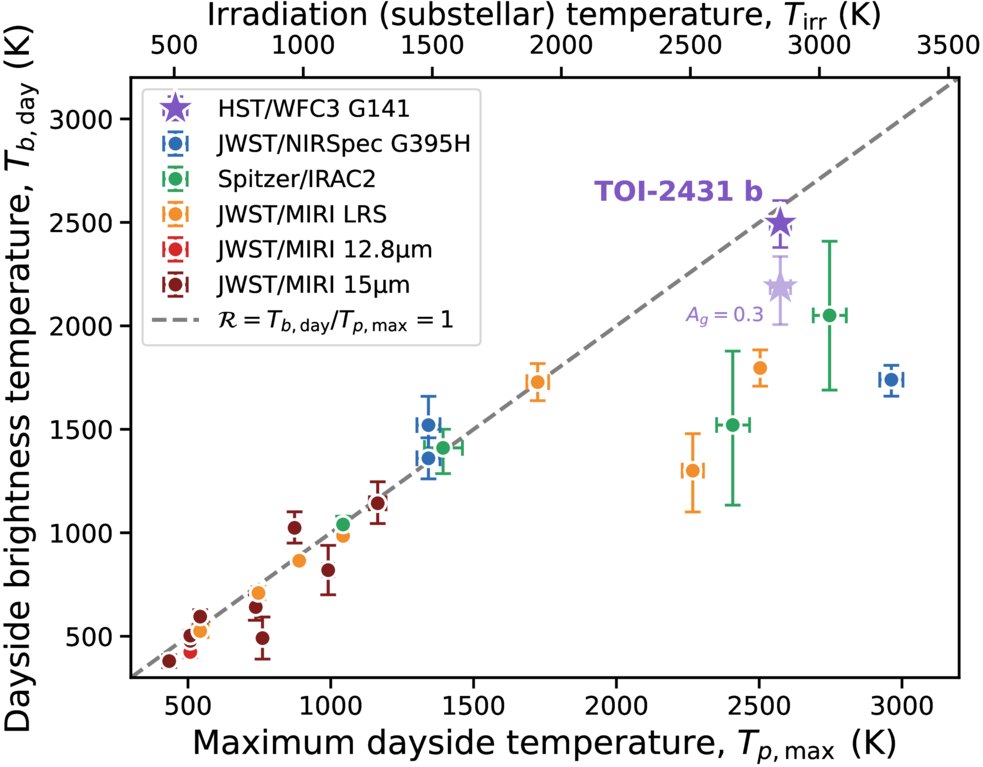
The eclipse points to a dayside brightness temperature of 2524 K, enough to melt many kinds of rock. This is roughly what a planet would show if it absorbed all the starlight reaching it and moved none of that heat to its night side. That makes TOI-2431b stand out. Other lava worlds observed so far generally look cooler than that limit, which suggests something is lowering their dayside temperatures: a reflective surface, clouds, or efficient heat transport to the night side.
Lava worlds orbit so close to their stars that radiation and stellar winds should have stripped away their original atmospheres. Observations have shown that some can still hold an atmosphere, but a very different one from Earth’s, made of superheated rock vapor.
Atmosphere or bare rock: Hubble cannot tell
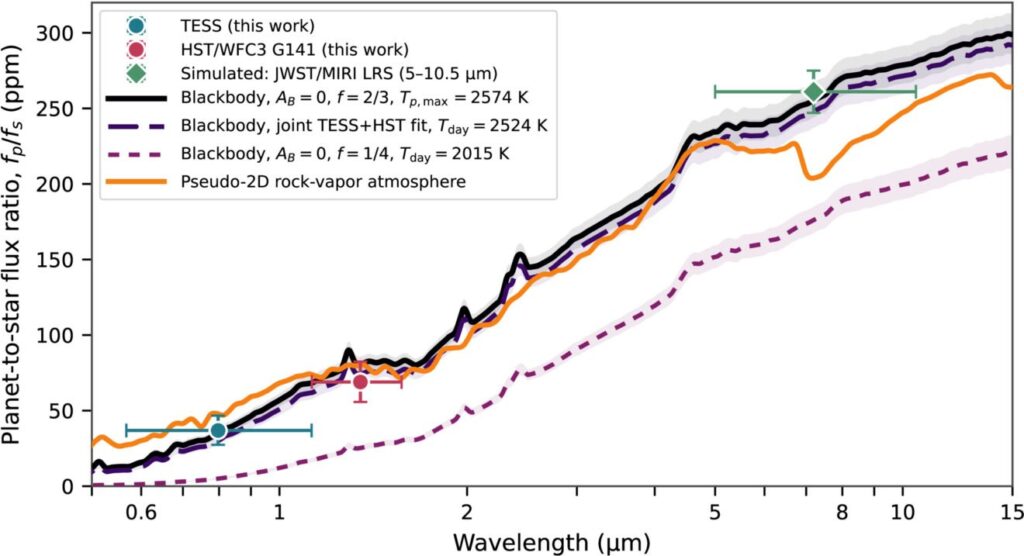
The team modeled a rock-vapor atmosphere for TOI-2431b and found that its emission would look much like that of a bare planet at the wavelengths Hubble and TESS cover. At those wavelengths, thermal glow from the planet and starlight reflected by it cannot be separated either. So the data are consistent with no atmosphere, but they do not rule out an atmosphere or a somewhat reflective surface. The paper puts an upper limit on the planet’s Bond albedo (the share of incoming starlight it reflects) of 0.32.
The paper adds that the phase curve is consistent with no emission from the night side and no measurable shift of the hottest spot, which fits poor day-to-night heat transport.
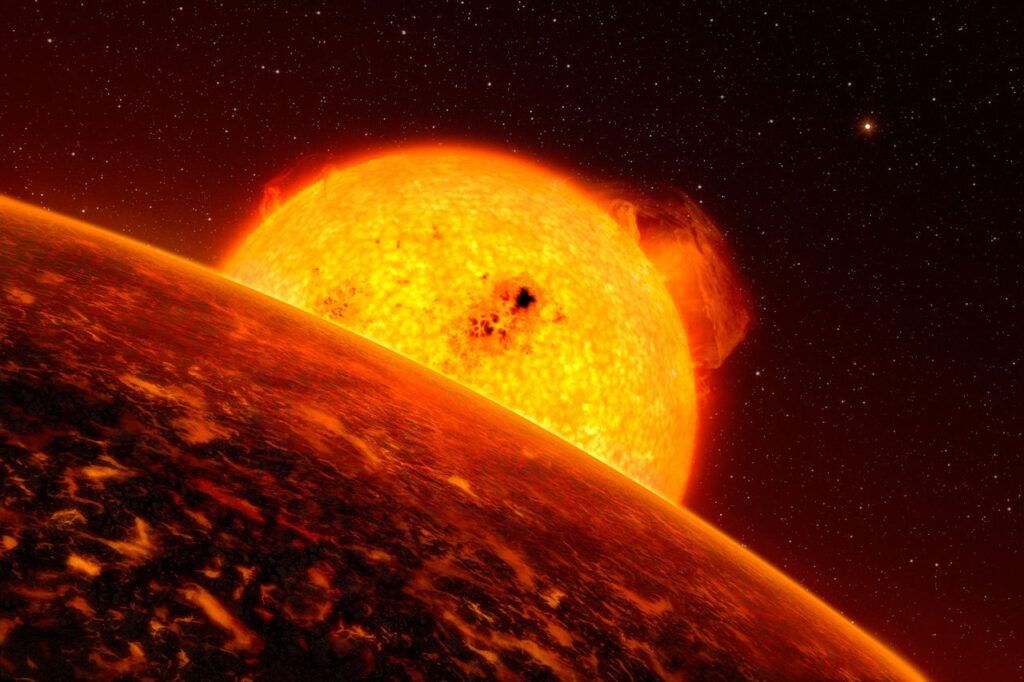
Hubble’s record on small, hot worlds
This is a first for Hubble on this kind of target, and it comes from a single 11-orbit visit in February 2022, according to the paper. That sets it apart from the telescope’s recent work on other small bodies, which has leaned on different instruments: its Cosmic Origins Spectrograph measured the sulfur-to-oxygen ratio in interstellar comet 3I/ATLAS at below 0.4% in December 2025 and below 0.1% in January 2026. Together the two results show Hubble still producing firsts in its fourth decade by pushing old instruments onto new targets.
The planet’s own record is short but notable. TESS found it in 2019, and the new work shows that a world with a 5.4-hour year can be studied in both visible and near-infrared light, something only a few rocky planets allow.
JWST is expected to settle the atmosphere question
AAS Nova says the James Webb Space Telescope (JWST) will observe at longer infrared wavelengths where a rock-vapor atmosphere could be detected. According to the paper, a JWST program (GO 8864) will record a full orbit of the planet with its Mid-Infrared Instrument across about 5 to 12 microns, including two secondary eclipses. The authors expect it to separate thermal and reflected light and to search for silicate features from molecules such as silicon monoxide and silicon dioxide.
In AAS Nova’s words, the work shows that Hubble can constrain the nature of hot rocky planets and prepares the ground for what Webb can add.