Leonid meteor shower 2026: When it peaks on November 17 and how to watch
The Leonids peak around November 17 with up to about 15 meteors an hour under dark skies, and the first quarter Moon sets before the best viewing.
Dates and facts checked on the official pages on November 11, 2026.
The Leonid meteor shower is active from November 6 to 30, 2026, and its peak falls on the night of November 16-17 and the following night. The International Meteor Organization (IMO) puts the expected maximum at 23:45 UTC on November 17. NASA advises watching in the early morning hours of November 17 and 18, after the Moon has set.
This is a modest year: about 15 meteors an hour at best under dark skies, and most people will see fewer. Go outside after midnight local time, away from lights, and look at a wide patch of sky rather than at one spot.
Peak timing: November 17 at 23:45 UTC, with activity on both sides
A meteor shower does not switch on and off. Earth crosses a stream of comet dust over many days, and the “peak” is the moment when Earth passes through the densest part. For the Leonids, the IMO lists the regular maximum at 23:45 UTC on November 17, 2026. It also notes an earlier estimate of about 16:00 UTC the same day, so the exact hour is uncertain by several hours.
NASA’s Leonids page describes the peak night as November 16-17, while NASA’s November skywatching guide recommends the mornings of November 17 and 18. Taken together, the nights of November 16-17, 17-18 and 18-19 are all worth trying, with November 17-18 the one that matches the IMO maximum most closely.
| Where you are | IMO maximum, 23:45 UTC on Nov. 17, in local time | Best window |
|---|---|---|
| US East Coast (EST, UTC-5) | 6:45 pm on Nov. 17 | After midnight into the early hours of Nov. 18 |
| US Pacific coast (PST, UTC-8) | 3:45 pm on Nov. 17 | After midnight into the early hours of Nov. 18 |
| UK and western Europe (GMT, UTC+0) | 11:45 pm on Nov. 17 | Late evening until dawn on Nov. 18 |
| Central Europe (CET, UTC+1) | 12:45 am on Nov. 18 | Around and after local midnight |
Figures checked on November 11, 2026, against the IMO 2026 meteor shower calendar. Local times are converted from UTC by simple offset.
In the Americas the maximum itself arrives in the evening or afternoon, when Leo is low or below the horizon. That is why NASA points to the pre-dawn hours, when the constellation is high and the sky is darkest.
What to expect: About 15 meteors an hour at best, and why you may see fewer
The IMO quotes a zenithal hourly rate (ZHR) of about 15. ZHR is the number of meteors one observer would count in an hour under a perfectly dark, clear sky with the shower’s radiant, the point the meteors appear to fly out from, directly overhead. Real conditions are never that good, so actual counts are lower. NASA says the same: around 15 an hour in ideal conditions, fewer for most viewers.
Leonids are fast. The IMO gives their entry speed as 71 km/s, which is why they are bright and often leave short-lived glowing trails. NASA adds that the shower can produce fireballs, and Earth-grazers, which are long, low meteors that skim the upper atmosphere near the horizon.
The Leonids are rare among showers because of a storm every 33 years
The shower comes from dust left by comet 55P/Tempel-Tuttle, which takes about 33 years to orbit the Sun, according to NASA. When Earth meets a fresh, dense trail, the result is a meteor storm of at least 1,000 meteors an hour. NASA lists the last Leonid storm as 2002.
No storm is expected in 2026. The comet’s next closest approach to the Sun is on May 20, 2031, and the IMO says the dust we meet now lies ahead of the comet. Model calculations by Vaubaillon and Sato, cited by the IMO, find several encounters with low-density trails between November 17 and 19. Vaubaillon concludes that the number of particles will not be enough for a significant outburst, while Sato suggests a modest rise in activity.
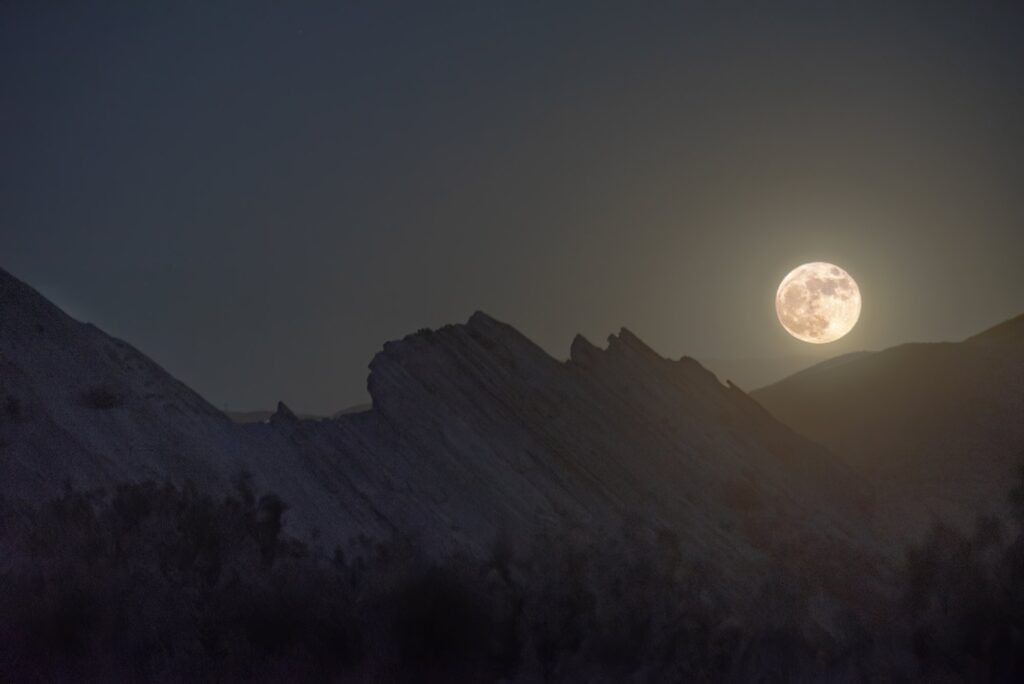
The first quarter Moon sets before the darkest hours
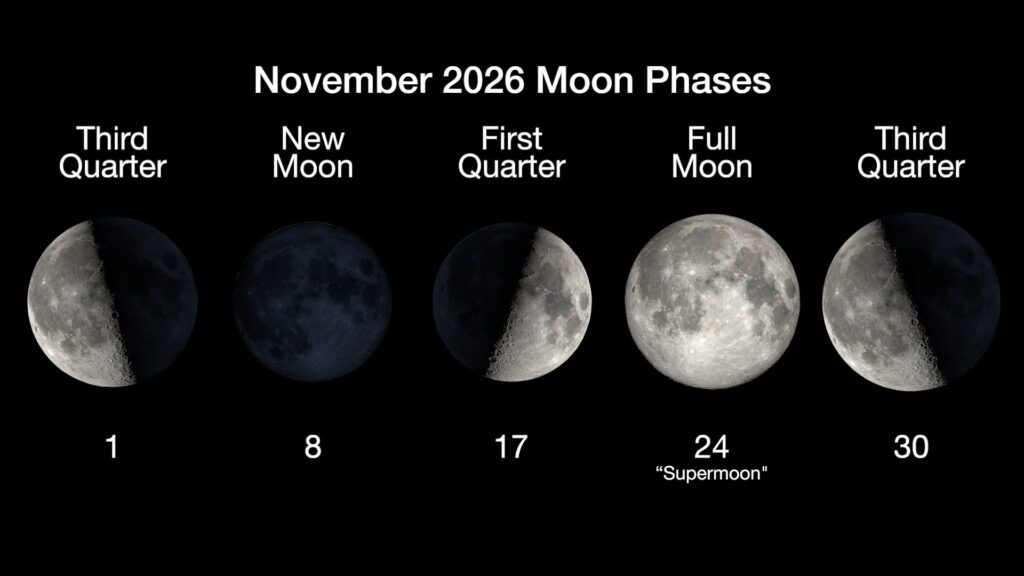
The Moon is a half-lit disk on November 17, the date of First Quarter in NASA’s November 2026 phase list. A first quarter Moon is high in the evening sky and sets around the middle of the night, so its light competes with the fainter meteors early on. The IMO notes that the Leonid maximum falls when the Moon is near first quarter.
The practical result is that the hours after moonset are the best. Moonset time depends on your location, so check tonight’s Moon phase and moonset for your city before you plan. New Moon was on November 8, and the supermoon Full Moon arrives on November 24, so the shower sits between the two.
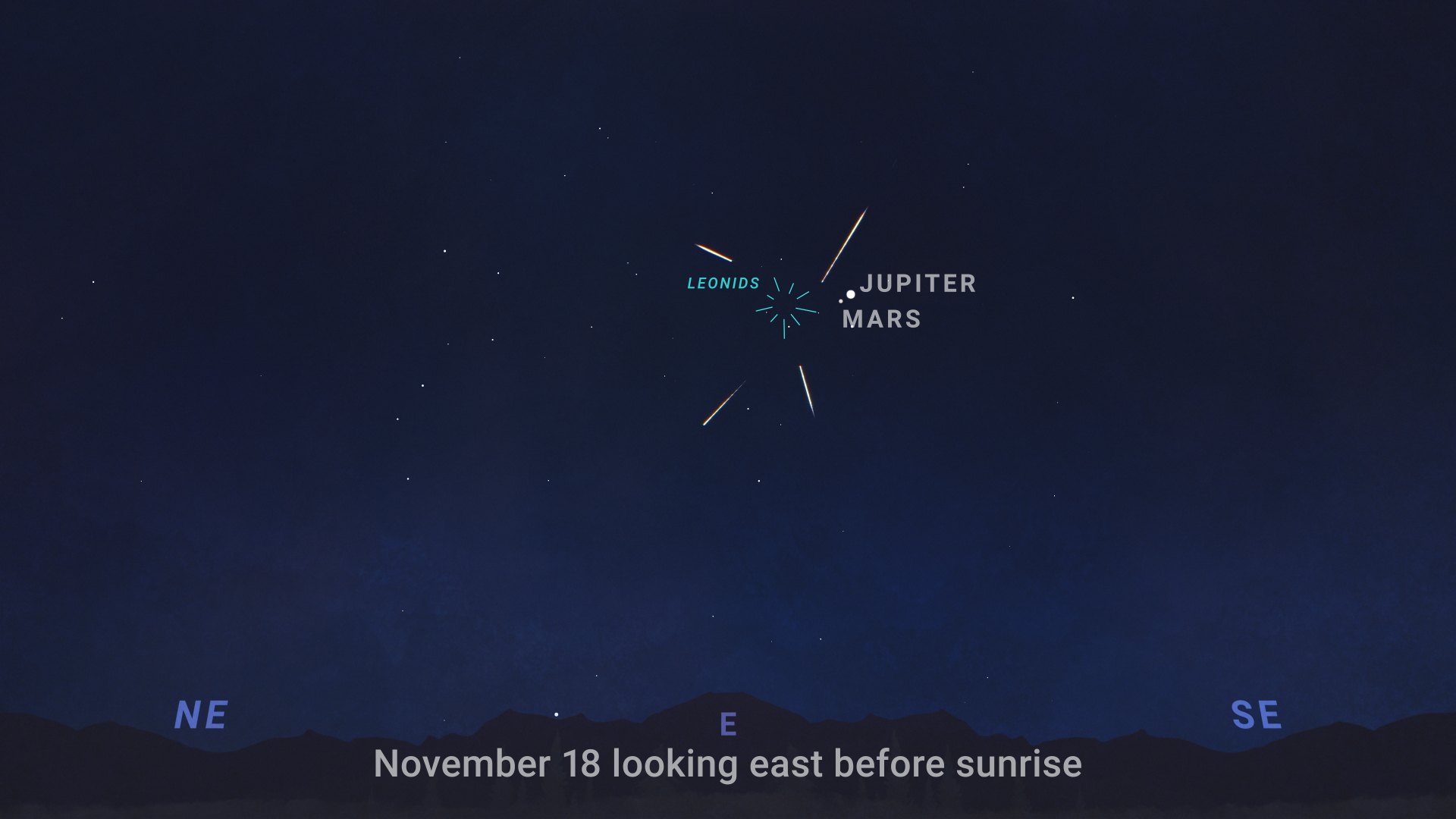
NASA’s sky chart below shows where to look.
Where to look: Face away from Leo and take in as much sky as you can
The meteors appear to radiate from the constellation Leo, the shower’s namesake. The IMO gives the radiant position as right ascension 152 degrees and declination +22 degrees. NASA advises against staring at the radiant: meteors near it look short because they are coming almost straight toward you. The longer, more dramatic streaks appear farther from it.
Use this routine, based on NASA’s guidance:
- Pick a dark site away from city and street lights, with a wide view of the sky. The darkness of the spot matters more than which state or city it is in.
- Check the cloud forecast for your site; clouds end the night faster than the Moon does.
- Dress for winter and bring a sleeping bag, blanket or lawn chair.
- Lie on your back with your feet toward the east and look up to take in as much sky as possible.
- Give your eyes about 30 minutes to adapt to the dark and avoid looking at your phone, or use a red light.
- Start around midnight local time and keep watching until dawn.
No telescope or binoculars are needed; they narrow the view and make you miss meteors.
Any clear, dark night from November 6 to 30 can show a Leonid, wherever you are
The Leonids are active from November 6 to 30, 2026, so a clear night anywhere in that range can show an occasional Leonid, with the best chances around November 16-19. Whether you see any depends on three things: the date, the Moon and the weather. The shower is visible from both hemispheres, and the same rules apply in Florida, Michigan, Utah, Hawaii or any other place: a dark sky, no clouds, and the hours after moonset.
For the weather, use your national weather service’s cloud forecast for your own location. The Northern Taurids, which NASA lists as peaking around November 12, overlap the early part of the Leonid window, so a few slower meteors seen earlier in the week are not Leonids.
The meteor shower calendar for 2026 and 2027 lists every major peak, and NASA’s November sky guide covers the Taurids, Mars and Jupiter and the supermoon. On the night itself, NASA’s Leonids page is the official place to look for any update.
Common questions
When is the Leonid meteor shower peak in 2026?
The IMO gives the maximum as 23:45 UTC on November 17. NASA describes the peak night as November 16-17 and recommends the early morning hours of November 17 and 18. The shower is active from November 6 to 30.
Can the Leonids be seen tonight?
If tonight falls between November 6 and 30 and your sky is clear and dark, a few Leonids are possible, with the best odds from November 16 to 19. The Moon, clouds and light pollution decide how many you see. The meteor shower calendar linked above shows which showers are active on other nights.
What time is best to watch?
After midnight local time and after the Moon sets, until dawn. NASA recommends the early morning hours of November 17 and 18.
Where in the sky is the Leonid radiant?
In the constellation Leo, at right ascension 152 degrees and declination +22 degrees, according to the IMO. You do not need to find it: the meteors can appear anywhere in the sky, and NASA suggests looking at as much of the sky as possible.
Will there be a Leonid meteor storm in 2026?
No. Storms of 1,000 or more meteors an hour happen roughly every 33 years, and the last was in 2002. The IMO expects about 15 an hour at best, with low-density dust trails that may give a modest increase.