Webb finds thousands of newborn stars wrapped in smoky clouds of the Large Magellanic Cloud
ESA's new Webb Picture of the Month shows N159, a nebula in a neighboring galaxy where thousands of stars are forming, and a paper that sorts its young stars by age.
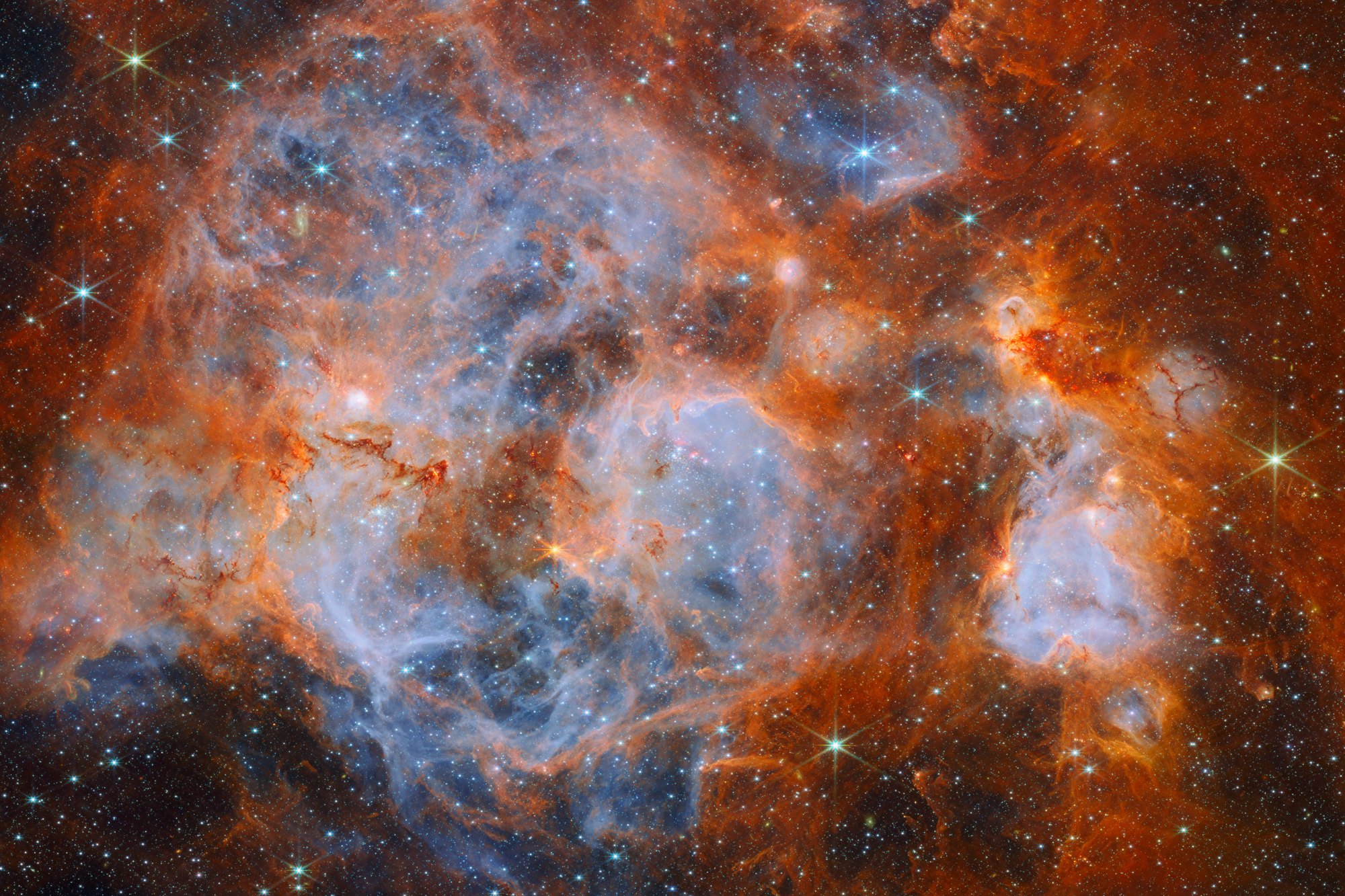
The NASA/ESA/CSA James Webb Space Telescope has imaged N159, a star-forming nebula 161,000 light-years away in the Large Magellanic Cloud, a small galaxy orbiting ours. ESA published the view on 22 October 2026 as its Picture of the Month.
Where the stars are hiding in N159
N159, formally named LHA 120-N 159, spans about 230 light-years in the image. It is an H II region: a cloud of hydrogen gas that has been ionized, meaning stripped of electrons, by the ultraviolet light of hot, massive young stars. Those stars form when giant clouds of cold hydrogen collapse under their own gravity, and their light makes the gas glow.
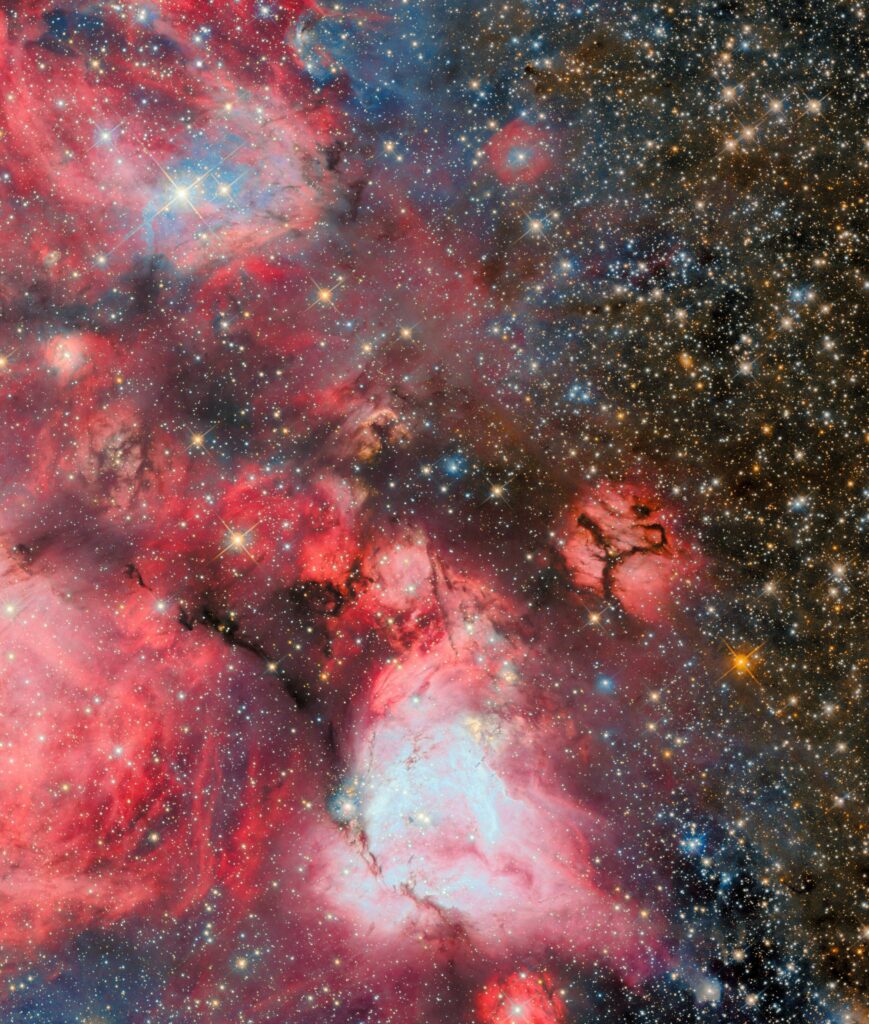
Webb’s Near-Infrared Camera (NIRCam) shows how those stars shape their surroundings. Their winds carve cavities and push the gas into dense ridges. ESA describes the colors this way:
- Light orange clouds are glowing polycyclic aromatic hydrocarbons, carbon-based molecules.
- Pale blue pools are ionized hydrogen.
- Dark red filaments are cool molecular hydrogen, the densest part of the nebula.
The red filaments matter because they shield new stars from harsh radiation and stellar winds. Zooming in, ESA says, reveals stars as points of light embedded in the filaments and in small pillars of orange gas reaching into the blue bubbles. Eventually those structures will melt away and leave the finished stars behind.
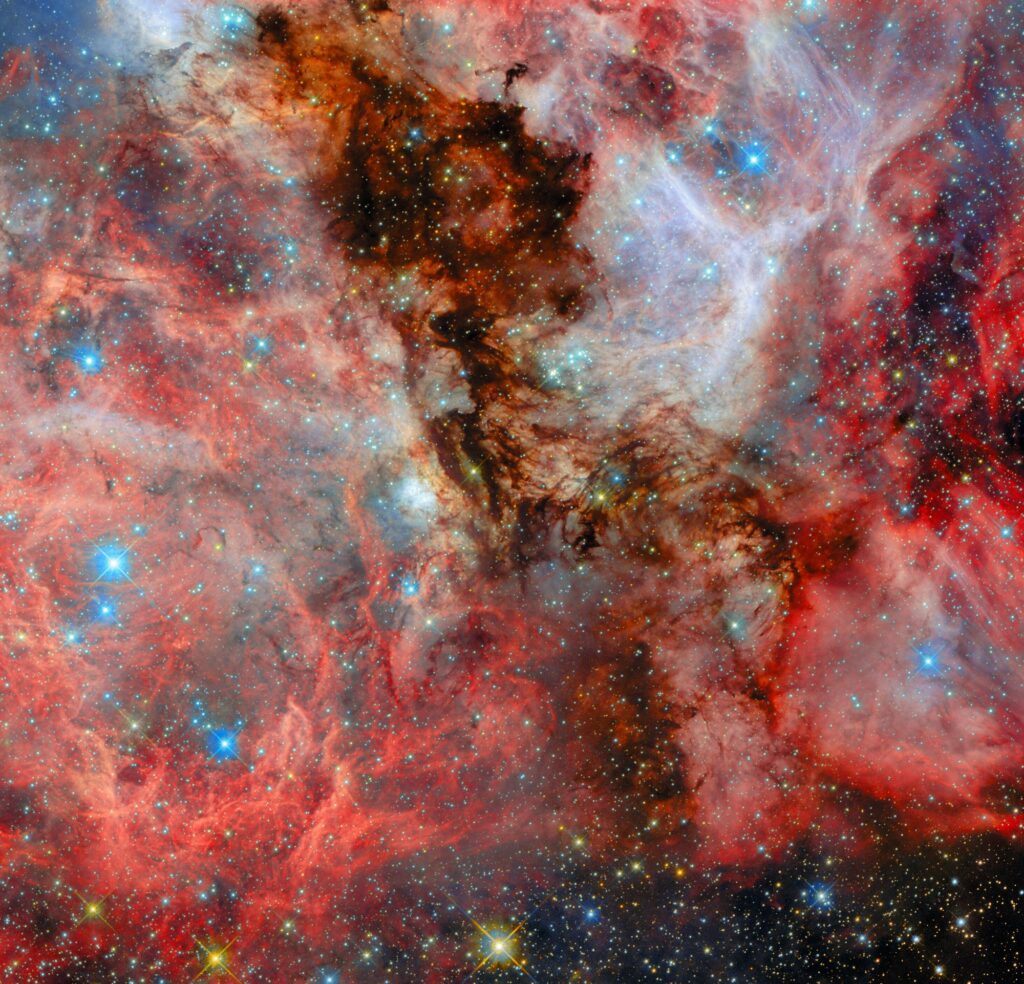
The bright spot on the left is the Papillon Nebula, an exceptionally compact blob of ionized hydrogen thought to be linked to the formation of massive stars. The Hubble Space Telescope first resolved it in 1999.
Sorting young stars from finished ones
The data come from Webb observing programme 5114, which compares stars at different stages of life across N159. A resulting paper reports that astronomers detected extremely dim stars less than a tenth as massive as the Sun. They could also tell large, hot, fully evolved stars apart from young stellar objects, stars still wrapped in the thick clouds where they were born.
The western part of N159 holds more young stellar objects in a more concentrated area. According to ESA, that shows the west is at an earlier stage of collapsing to form stars. With an age below three million years, N159 ranks among the youngest stellar nurseries in the Large Magellanic Cloud and holds thousands of stars that have only just begun to form. Because every stage of the sequence is happening at once, ESA calls it a unique place to watch a collapsing molecular cloud evolve.
A galaxy that resembles the young Universe
The Large Magellanic Cloud has a significantly lower metallicity than the Milky Way. Metallicity is the share of a galaxy’s matter made of elements heavier than hydrogen and helium, which astronomers call metals. Lower metallicity is closer to conditions in the early Universe, so ESA says studying H II regions there helps researchers learn about star formation in that era. N159 sits alongside the larger N79 region and the Tarantula Nebula among the galaxy’s best-known examples.
Third look at N159 in a year
N159 has been a repeat subject for ESA’s telescopes. ESA/Hubble released two N159 images in late 2025: one on 24 November, covering one side of the cloud, and one on 29 December covering the neighboring region, both credited to ESA/Hubble and NASA with R. Indebetouw. The Webb view is the third picture of the region in about 11 months.
The comparison also shows how long the nebula has been studied. The Papillon Nebula was resolved in 1999, roughly 27 years before this Webb image. Together, the Hubble and Webb pictures give astronomers a growing set of views of star birth in a galaxy with fewer heavy elements than our own.
ESA credits the image to ESA/Webb, NASA and CSA, E. Sabbi and M. Zamani (ESA/Webb), and releases it under CC BY 4.0 or the ESA Standard Licence.