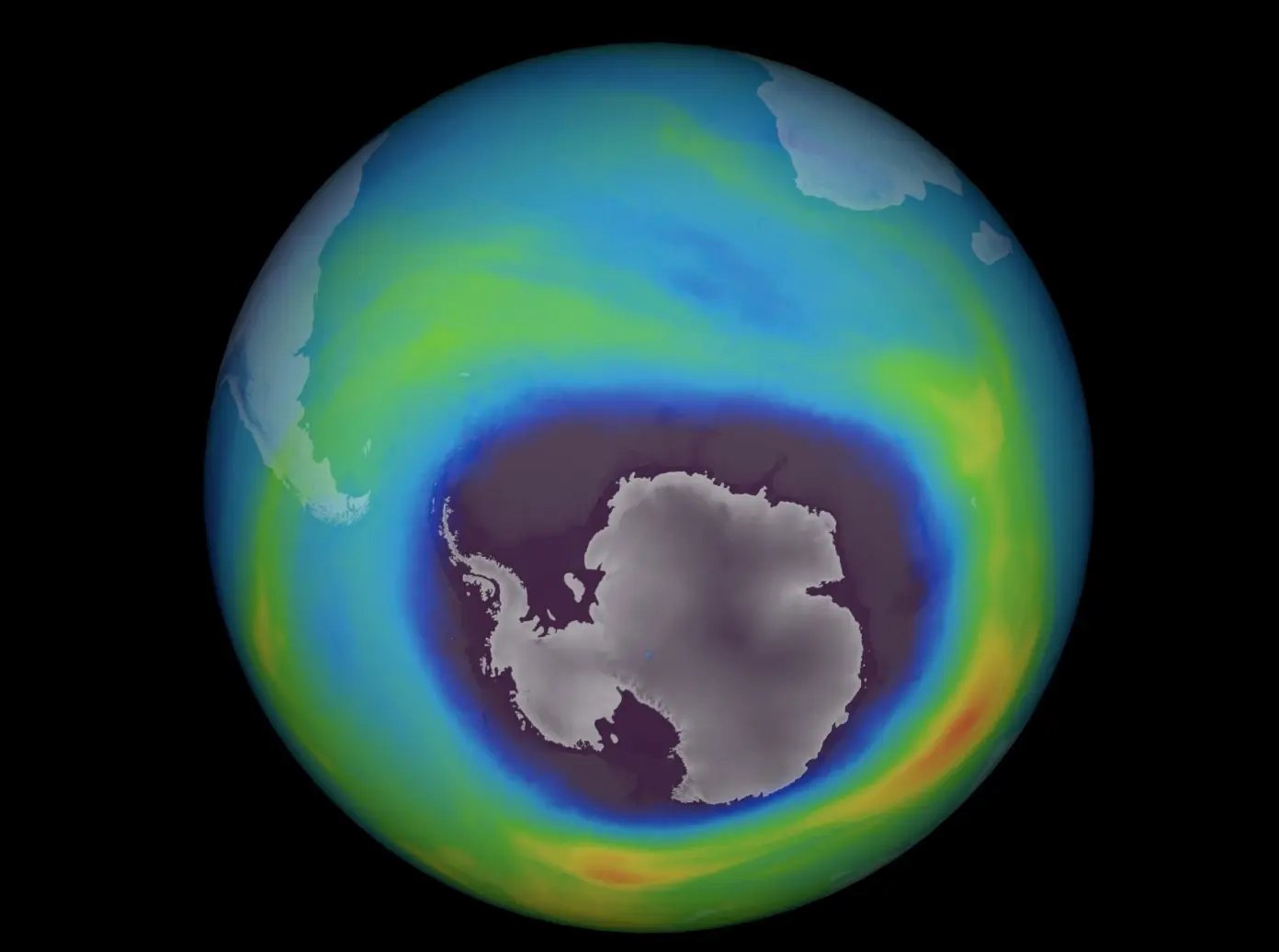
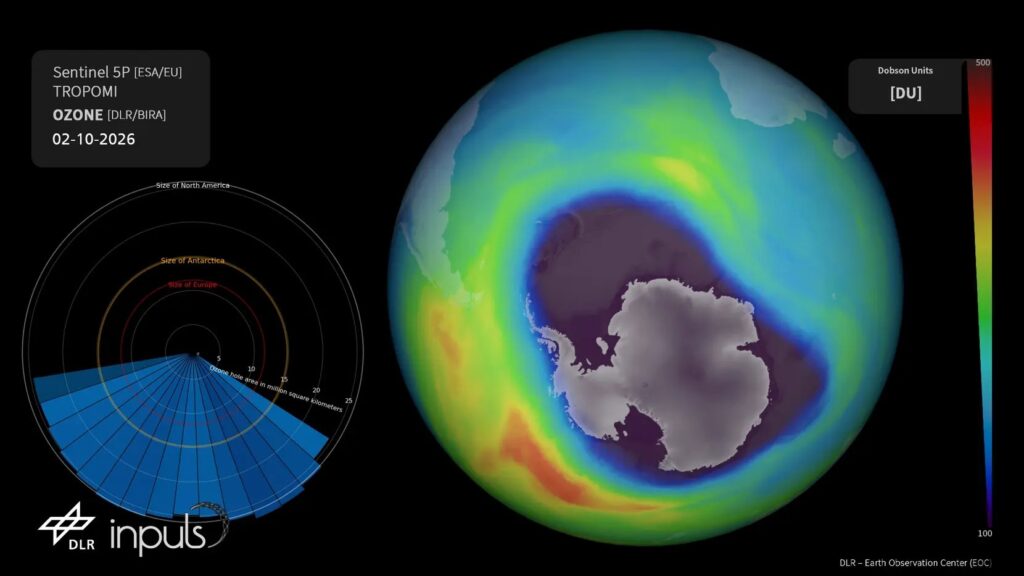
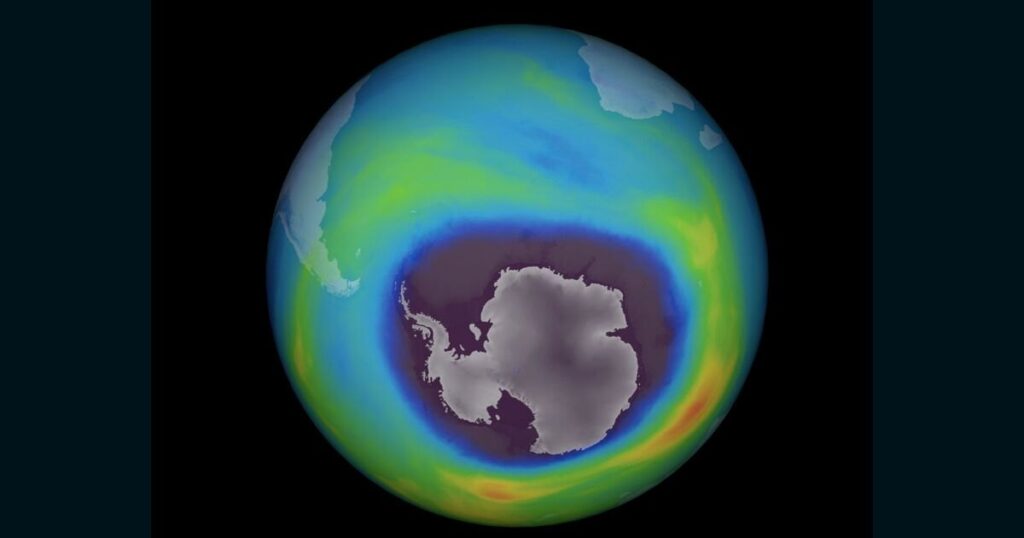
The 2026 Antarctic ozone hole is one of the largest in 48 years of records, ESA said, citing Copernicus Sentinel-5P satellite data. It covered 27.3 million sq km on 20 September, but its depth stayed close to average.
A hole bigger than the continent beneath it
The ozone layer is a thin band of gas high in the stratosphere that absorbs much of the Sun’s harmful ultraviolet light. Each southern spring, chemical reactions thin it sharply over Antarctica. This thinning is called the ozone hole.
Image: ESA
ESA says the hole usually forms in August, grows through September and peaks between mid-September and mid-October. As the stratosphere warms, depletion slows, the polar vortex (the ring of strong winds that circles the pole in winter) weakens and breaks down, and the hole normally closes by the end of December.
This year the vortex stayed strong and persistent. That kept Antarctic stratospheric temperatures cold enough for ozone loss for longer, so the hole grew beyond its usual extent. By 20 September it covered 27.3 million sq km, which ESA describes as far larger than Antarctica itself. That is about 6.5 million sq km, or 31%, above the average of the last 20 years for that date.
Image: ESA
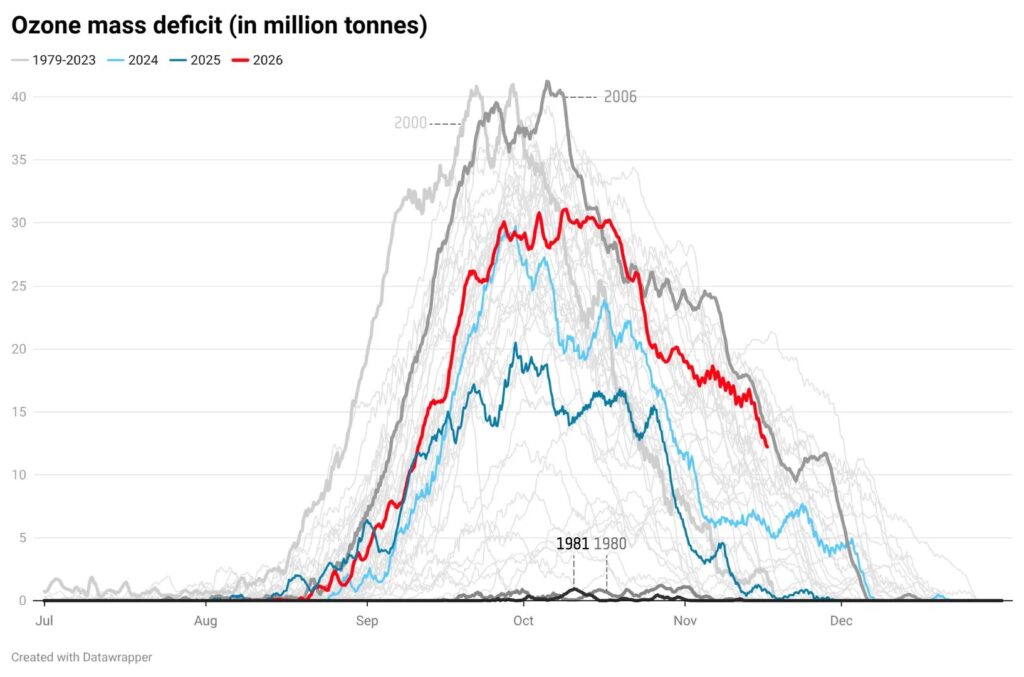
The contrast with last year is sharp. ESA notes that the 2025 hole was the fifth smallest since 1992.
the long-term recovery of the ozone layer remains on track
Image: ESA
Wide but shallow: Why area is only half the story
Scientists judge a hole by two measures: its area, meaning how far it spreads, and its depth, meaning how much ozone is actually lost inside it. A hole can be wide without being deeply emptied.
According to ESA, Sentinel-5P data show exactly that this year. The hole covered more area than usual, but its depth stayed close to average, so it is not as deep as other large holes on record. ESA stresses that the size of the hole varies naturally from year to year.
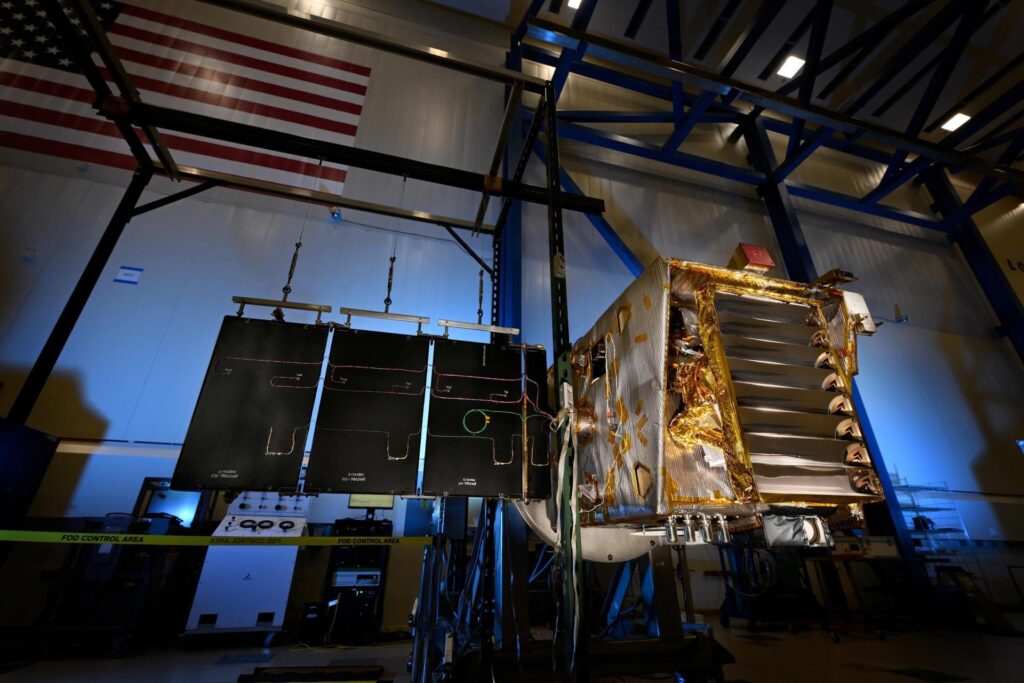
The satellite behind the measurements, Sentinel-5P (short for Sentinel-5 Precursor), launched in October 2017 and was the first Copernicus satellite dedicated to monitoring the atmosphere. Its TROPOMI instrument is a spectrometer that reads the chemical fingerprints of gases across the spectrum, so it can image stratospheric ozone and pollutants at finer detail than earlier sensors. Satellites matter here because ground stations are few in places like Antarctica.
The Montreal Protocol is still doing its job
Our earlier report on NASA and NOAA’s assessment adds useful numbers for judging how worried to be. NASA and NOAA ranked the 2026 hole as the seventh largest on record, with a single-day peak of 27.1 million sq km on 18 September. Balloon measurements at the South Pole found ozone overhead bottomed out at 105 Dobson units (the standard unit for the thickness of the ozone column) on 17 October. The lowest value ever recorded there is 92, in October 2006.
The reason the layer is healing is an international treaty. The Montreal Protocol of 1987 phased out the chemicals that destroy ozone. NOAA’s Stephen Montzka said stratospheric chlorine from these substances over Antarctica has fallen by about a third from its peak. NASA-affiliated scientist Paul Newman estimated that if ozone-depleting substances were as common as at their 2000 peak, this year’s hole could have been 1 to 2 million square miles larger, roughly 3.5 million sq km at the upper end. Scientists put full recovery of the Antarctic hole in the 2070s.
The 2026 case is therefore a weather story more than a policy failure. A strong vortex and a feeble supply of atmospheric waves from below widened the hole, while the chlorine behind it is shrinking. It also shows why a long record matters: one large year does not reverse a trend that takes decades to read.
New instruments to follow the layer
ESA says satellite data can feed atmospheric models of ozone and ozone-depleting substances, which are used to assess how well international protection efforts work. Copernicus Sentinel-5, flying on the MetOp Second Generation A-type satellites, will provide long-term global measurements of atmospheric composition. The upcoming Altius mission is meant to deliver detailed vertical profiles of ozone and other gases, showing at what height the losses occur rather than only how much is missing in total.
To provide the best experiences, we use technologies like cookies to store and/or access device information. Consenting to these technologies will allow us to process data such as browsing behavior or unique IDs on this site. Not consenting or withdrawing consent, may adversely affect certain features and functions.
Functional
Always active
The technical storage or access is strictly necessary for the legitimate purpose of enabling the use of a specific service explicitly requested by the subscriber or user, or for the sole purpose of carrying out the transmission of a communication over an electronic communications network.
Preferences
The technical storage or access is necessary for the legitimate purpose of storing preferences that are not requested by the subscriber or user.
Statistics
The technical storage or access that is used exclusively for statistical purposes.The technical storage or access that is used exclusively for anonymous statistical purposes. Without a subpoena, voluntary compliance on the part of your Internet Service Provider, or additional records from a third party, information stored or retrieved for this purpose alone cannot usually be used to identify you.
Marketing
The technical storage or access is required to create user profiles to send advertising, or to track the user on a website or across several websites for similar marketing purposes.