Hubble’s new NGC 4394 portrait shows a galaxy that looks like our own Milky Way
A new NASA/ESA Hubble image of NGC 4394, a barred spiral 55 million light-years away, combines a decade-old exposure with data from a survey of 40 galaxies.
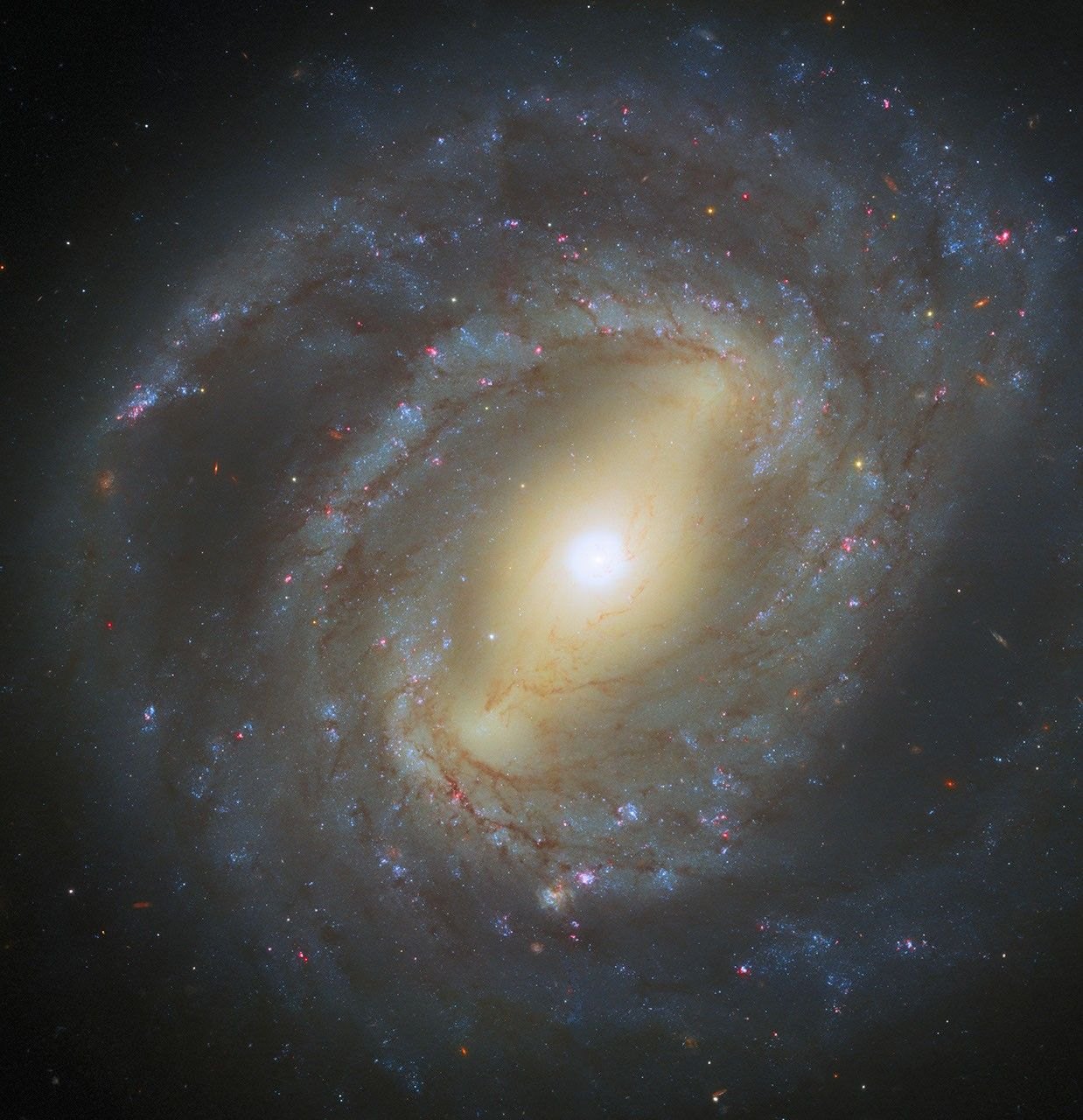
NASA and ESA released a new Hubble Space Telescope image of NGC 4394, a barred spiral galaxy about 55 million light-years away. NASA says it closely resembles what the Milky Way would look like seen face-on.
A bar of stars across the heart of a nearby galaxy
NGC 4394 lies in the constellation Coma Berenices (Berenice’s Hair). A galactic bar is a straight band of stars running through a galaxy’s center, and it stands out against the curved spiral arms around it. In the image, a compact, bright white core sits inside a yellow bar. Thin, dark dust filaments circle outward into two spiral arms dotted with blue and pink patches, which mark young stars and star formation.
At 55 million light-years, NGC 4394 counts as relatively nearby. It is one of more than 1,000 galaxies in the Virgo Cluster, the galaxy cluster closest to us. NASA notes that the galaxy and the Milky Way share spiral arms and a central bar. Both might also host a LINER, short for low-ionization nuclear emission-line region. That is a zone near a galaxy’s center where the spectrum, the light split into its component colors, carries the marks of particular ionized or neutral atoms. Where LINERs come from is still unsettled, NASA says, though a hungry central black hole or intense star formation probably has a part in it.
Why some galaxies grow bars, and why they may not last
Bars are common: astronomers put the share of nearby spiral galaxies with one at about 65 percent. According to NASA, the leading explanations start with a galaxy’s disk of stars becoming unstable, perhaps through gravitational tugs from passing galaxies, interactions among the stars themselves or other forces. When that happens, the round orbits of stars stretch into ovals, and a bar appears.
Bars are more widespread in today’s universe than they were several billion years ago. NASA adds that research points to this being a passing phase: a bar that grows heavier can turn unstable in its own right.
Two Hubble programs in one picture
The image combines old and new data. A previous NGC 4394 image was released a decade ago from an observing program (number 10515, led by E. Peng) that targeted the neighboring galaxy Messier 85. One Hubble instrument examined the odd mix of star clusters in Messier 85, while the Advanced Camera for Surveys recorded a parallel patch of sky that happened to contain NGC 4394.
The new image also draws on a recent program (number 18103, led by D. Thilker). Its goal is to learn how galaxies crowded into dense clusters stop forming stars, and whether the process differs for isolated galaxies out in the field. For this work the team turned to Hubble’s Wide Field Camera 3, which is sensitive across a broad range of wavelengths, and used it to date individual star clusters. In all, 40 galaxies were examined this way, NGC 4394 among them. The credit line reads ESA/Hubble & NASA, E. Peng, D. Thilker and the MAUVE-HST Team.
What an archive picture does for working astronomers
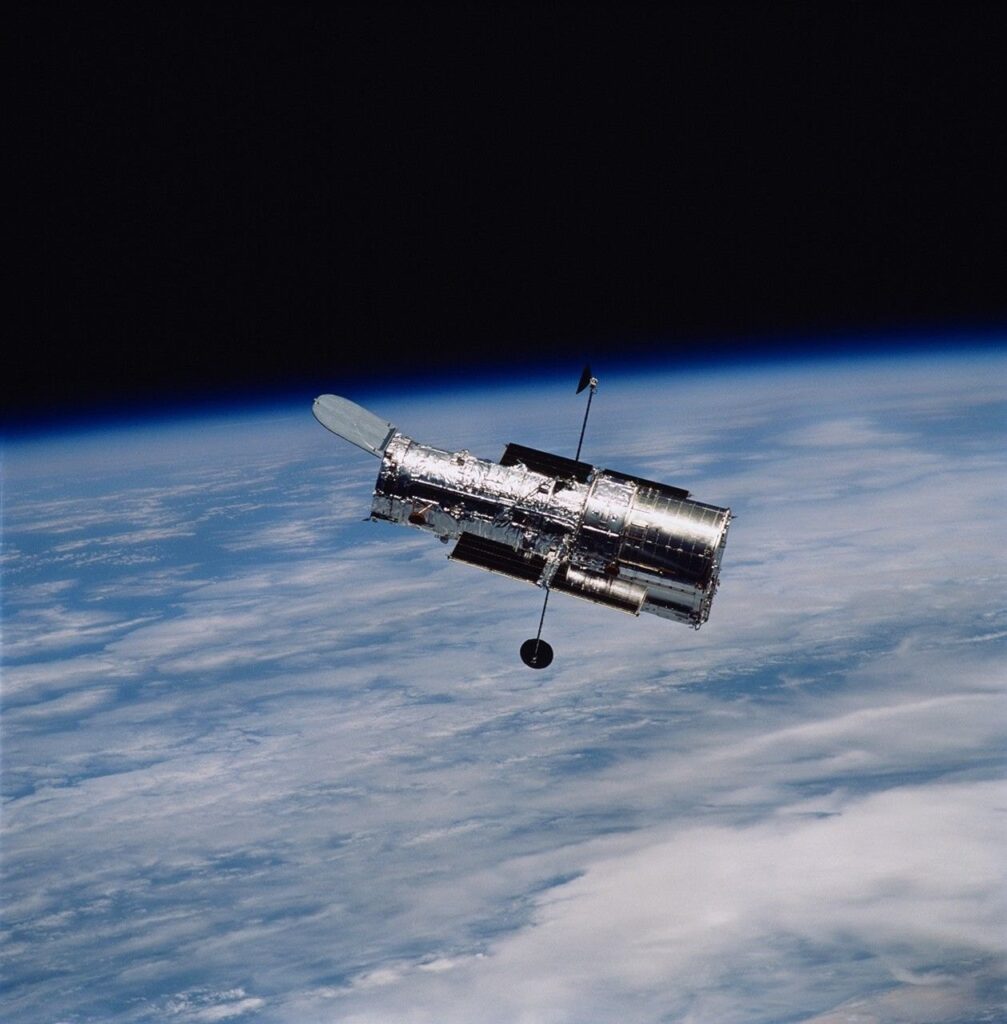
The image shows how a telescope that launched in 1990 keeps getting more out of the same sky. A chance parallel exposure taken a decade ago became useful again once a new survey added fresh color and cluster-age data. For astronomers who study how galaxies stop forming stars, a target that sits in the Virgo Cluster and resembles the Milky Way is a convenient comparison, because it can be studied in detail at a relatively short distance.
Hubble’s archive is also feeding other fields. In November, we reported that Hubble’s nine gravitational lenses are being used to show NASA’s Roman telescope what to hunt for in dark matter. And ESA’s Euclid recently found a quasar from 630 million years after the Big Bang, a new distance record. Those cases look back across the universe; a galaxy like NGC 4394 is a rare chance to see a spiral much like our own from the outside.