Euclid finds a quasar from 630 million years after the Big Bang, a new distance record
A team led from the Max Planck Institute for Astronomy found the quasar J1504+6252 in Euclid data. It is the first quasar with a redshift above eight, and its black hole weighs several hundred million Suns.
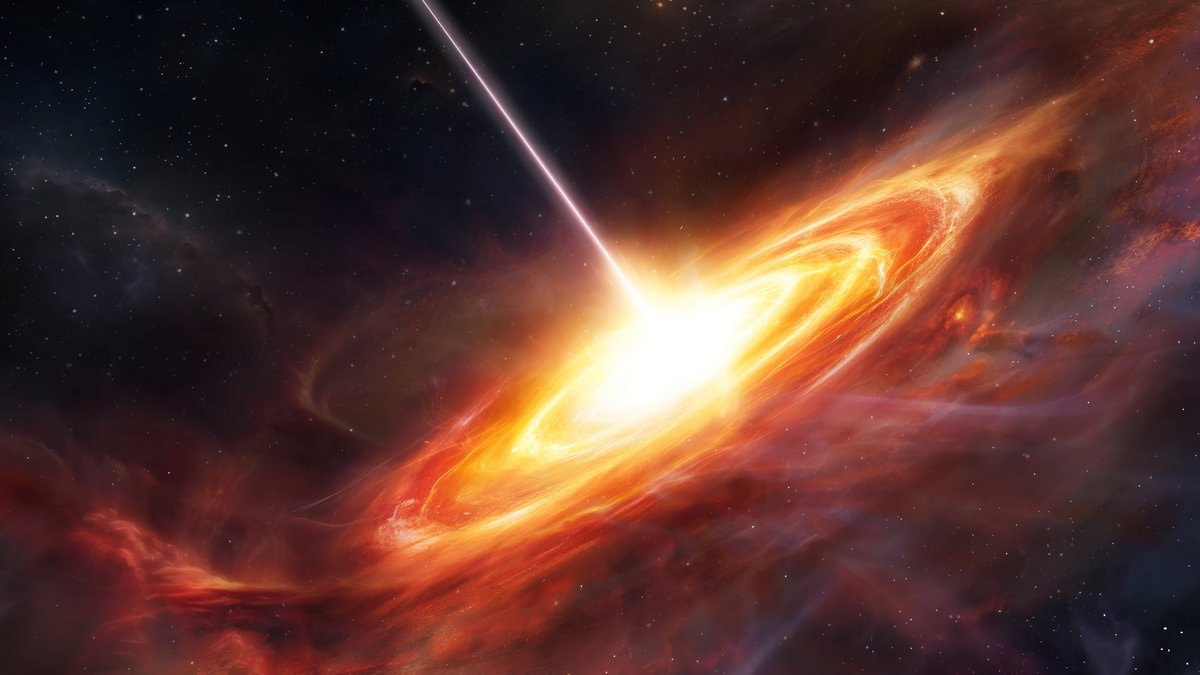
Astronomers led from the Max Planck Institute for Astronomy have found the most distant quasar known, seen as it was 630 million years after the Big Bang. The object, J1504+6252, was spotted in ESA’s Euclid data and confirmed with the James Webb Space Telescope, according to the Max Planck Society.
A red dot picked out of millions of objects
A quasar is the extremely bright core of a galaxy, where a supermassive black hole is pulling in gas. The gas swirls and heats up until it outshines the whole galaxy around it, before it falls in. Astronomers call that feeding process accretion.
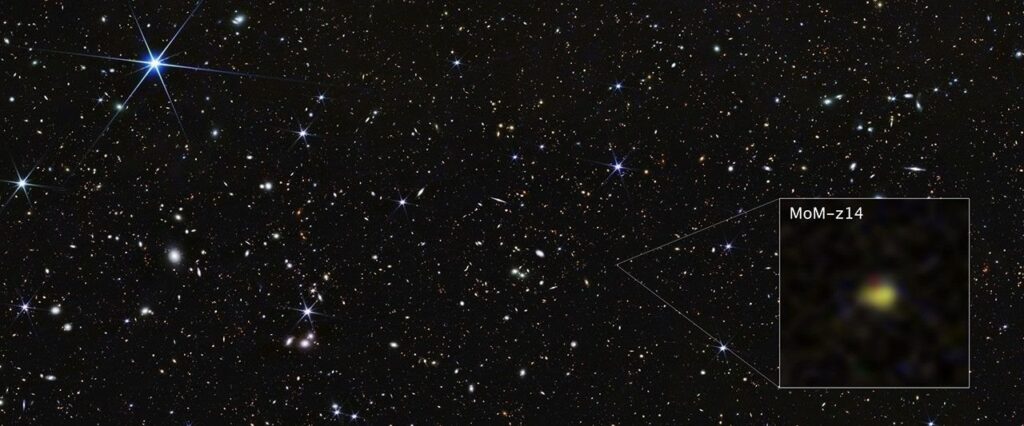
The team, led by Julien Wolf, first at the Max Planck Institute for Astronomy in Heidelberg and now at the European Southern Observatory, found the quasar in the Euclid Wide Survey. It stood out as a red dot among millions of objects in about 18 months of data. The team nicknamed it Dún Aonghasa, after a prehistoric cliff-top fort on the island of Inis Mór, off the west coast of Ireland.
Follow-up observations with ground-based and space telescopes confirmed what it was. Silvia Belladitta, who is also at INAF in Bologna, was responsible for the Large Binocular Telescope observations that confirmed the high redshift. Webb then gave the final value, z = 8.13.
Redshift measures how much the light from an object has been stretched by the expansion of the universe on its way to us. The larger the number, the more distant and older the light. At z = 8.13, Dún Aonghasa is the first quasar with a redshift above eight, and it existed 40 million years earlier than the previous record holder. The universe today is about 13.8 billion years old. The black hole at its center has a mass of several hundred million times that of the Sun.
A black hole that is feeding slowly, yet is already huge
The record matters because of what it says about how black holes grow. “The closer to the Big Bang we find them, the faster their black holes must have grown or the more massive they must have been at birth – or both,” said Wolf.
The team calculated which formation scenarios could produce a black hole this massive so early. With reasonable growth rates, the result fits the direct collapse idea. In that picture a massive gas cloud collapses under its own gravity and forms a black hole straight away, which then keeps growing.
There is a catch. Growth is normally capped by the Eddington limit: as infalling gas heats up, its radiation pushes outward and holds back further gas. Dún Aonghasa is currently growing well below that limit. Had it always grown that slowly, it would have needed an extremely massive starting seed, which current formation models struggle to explain. So the black hole probably grew much faster in the past, perhaps even beyond the Eddington limit.
The team adds that the conditions for direct collapse must have been rare then, which could explain why so few quasars have been found beyond z = 7.5. If quasars turn up at much earlier times, only a few hundred million years after the Big Bang, even direct collapse may not be enough. Astronomers might then have to consider primordial black holes, hypothetical objects formed right after the Big Bang that would give gas a massive seed to build on.
How the record compares with other early black holes
For scale, a pair of quasars we reported on earlier, found by NOIRLab with Webb and Gemini North, is seen 900 million years after the Big Bang. Their black holes weigh about 1.5 billion and 400 million solar masses. Dún Aonghasa is roughly 270 million years closer to the beginning, and its black hole, at several hundred million solar masses, sits at the lighter end of that range.
The sample is also still small. The Webb survey behind that earlier pair, called Aether, observed 200 quasars, which NOIRLab described as 43 percent of the known quasars at that epoch. Against that, the Euclid team published its first 31 quasars from the first billion years only a few months before this discovery, including the previous record holder. Euclid is therefore adding to a thin census quickly.
Eduardo Bañados, a research group leader at the institute, said that “it is unclear how far back in time these supermassive black holes powering luminous quasars exist, but Euclid has a good chance of finding out what that limit is.” Belladitta said a further record may come “sooner than we think.”
The mission behind the survey
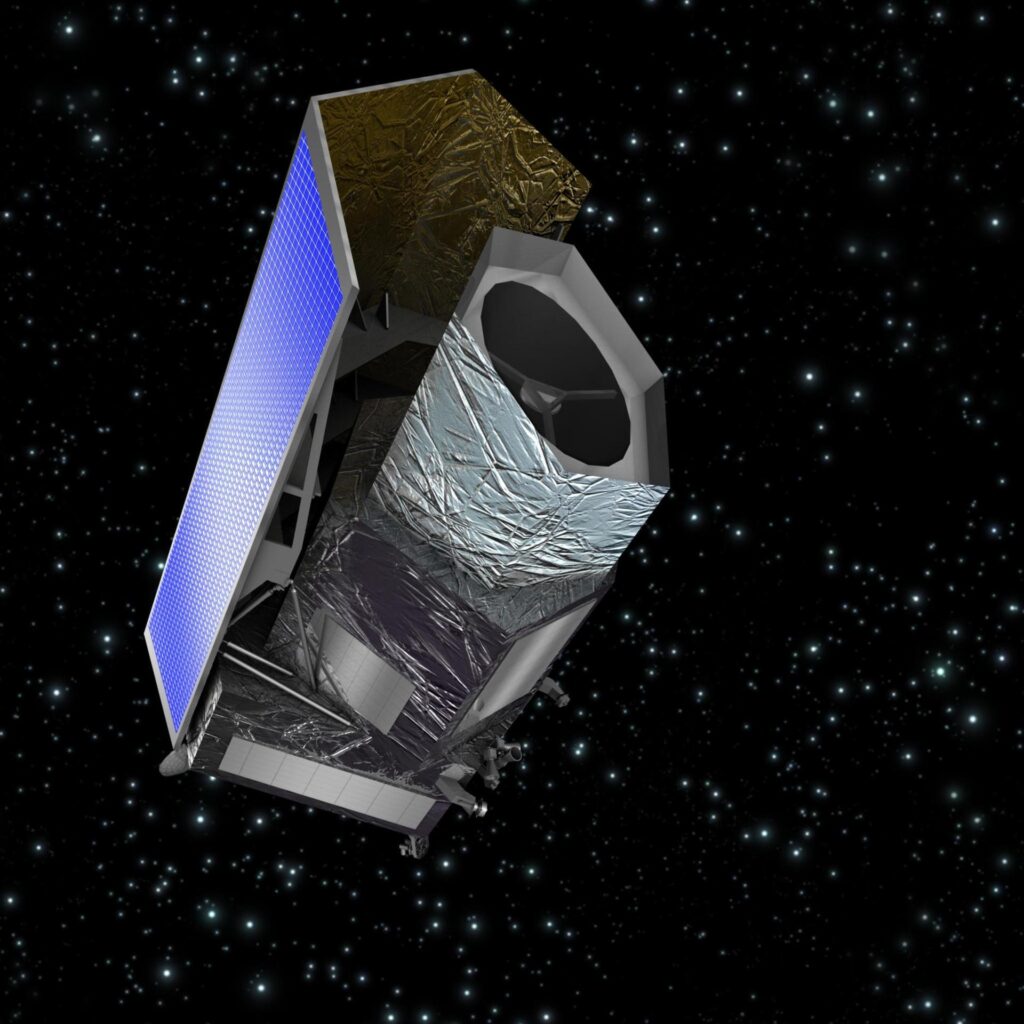
Euclid is a European mission built and operated by the European Space Agency, with contributions from its member states and NASA. NASA provided the detectors of the Near-Infrared Spectrometer and Photometer. The Euclid Consortium of more than 2,000 scientists from 300 institutes is responsible for the instruments and the scientific data analysis. Thales Alenia Space was prime contractor for the satellite, and Airbus Defence and Space developed the payload module, including the telescope.