Dragonfly’s seven science cameras are now on the rotorcraft that will fly over Titan
All seven DragonCam cameras are installed on NASA's Dragonfly at Johns Hopkins APL, giving the Titan-bound rotorcraft its first working eyes ahead of a July 2028 launch.
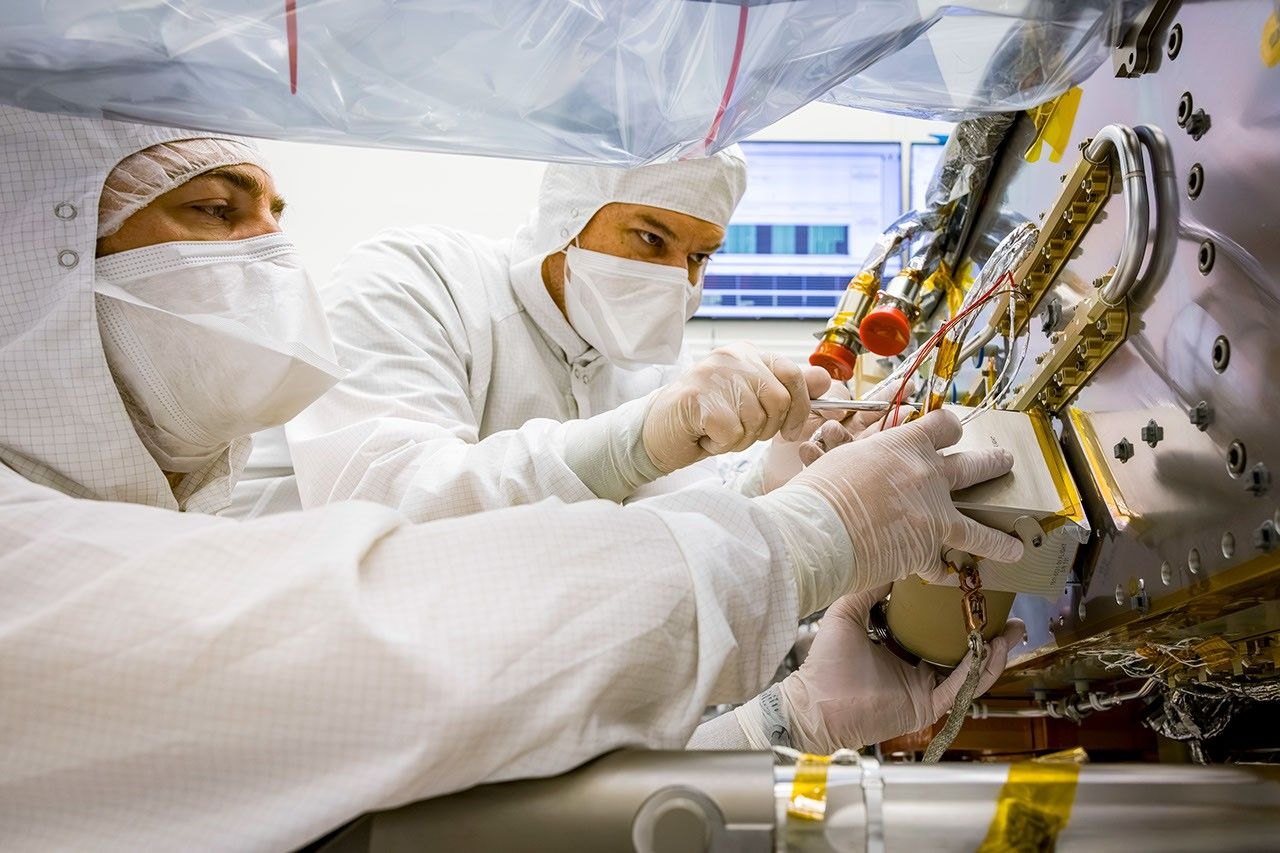
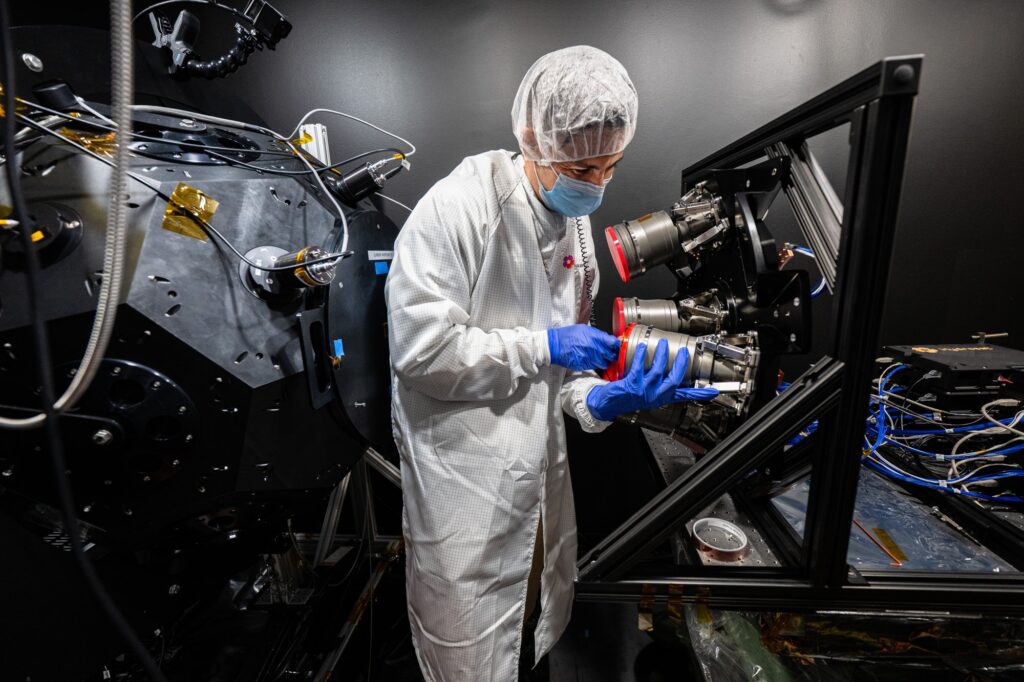
NASA’s Dragonfly rotorcraft now has its science cameras. By mid-November, all seven cameras of the DragonCam suite were installed, tested and integrated at the Johns Hopkins Applied Physics Laboratory, according to NASA.
Dragonfly is a car-sized, multi-rotor aircraft being assembled in Laurel, Maryland, to explore Titan, Saturn’s largest moon. The cameras were developed and built by Malin Space Science Systems, and they are the first science instruments to arrive for integration.
Seven cameras, each with a different job
DragonCam is designed to image Titan’s surface at several scales, both while the rotorcraft flies and after it lands. Two forward-mounted cameras, a wide-angle camera (WAC) with a 90-degree field of view and a medium-angle camera (MAC) that sees part of the same scene at higher resolution, give a stereoscopic view ahead of the lander. Two more WACs on the sides allow panoramas of the landscape.
Two downward-facing WACs look at the ground under the rotorcraft. Their images will help the team decide whether a spot is safe for deploying the sampling drill, called DrACO (Drill for Acquisition of Complex Organics), and a seismometer. A high-resolution microscopic imager will aim at the drill site and resolve sand grains only millimeters across.
NASA says each camera looks out through a window in a foam enclosure. That enclosure shields the cameras and the rotorcraft’s interior from Titan’s cryogenic surface, where temperatures reach minus 290 degrees Fahrenheit.
Lighting a world that is dark and hazy
Titan’s surface is dim, so Dragonfly brings its own light. An LED array built at APL spans the spectrum from infrared to ultraviolet. Because different materials reflect different colors, the lights let scientists make inferences about what the surface is made of. They also allow the camera to show Titan roughly as human eyes would see it.
Titan’s night lasts nearly eight Earth days. NASA says that during it, ultraviolet light may let DragonCam identify organic molecules, which are carbon-based compounds, that fluoresce, meaning they glow when hit by UV light.
“One of the most exciting things about Dragonfly is that we’ll be able to see Titan from perspectives we’ve never had before.”
That is how Elizabeth Turtle, Dragonfly’s principal investigator at APL, described the cameras. Carolyn Ernst, the DragonCam instrument scientist at APL, said the images will give context for the samples DrACO collects at multiple sites, helping relate each sample to the broader landscape.
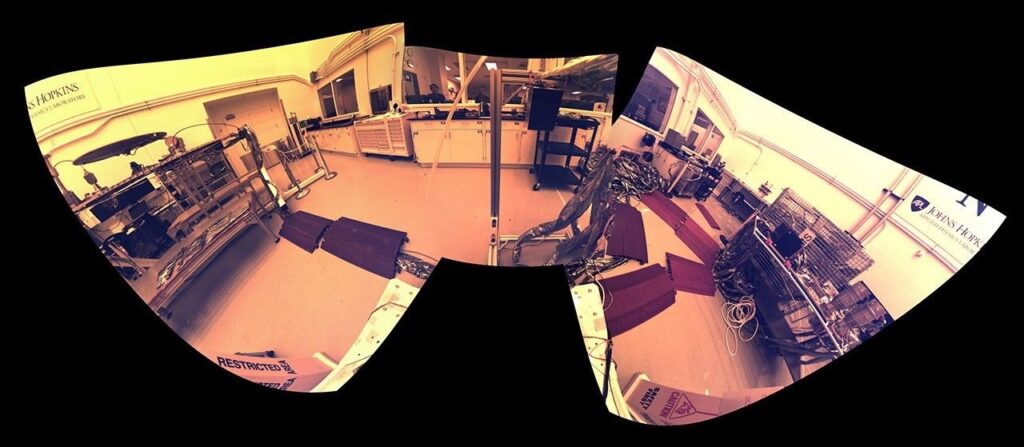
The team has already tested the system. NASA published a three-image panorama of the APL cleanroom taken on Nov. 9, 2026, shortly after installation. It has a yellow tint because DragonCam records light differently than the human eye does. Two navigation cameras, also from Malin, were installed earlier this summer.
A mission built around short hops
The cameras matter more for an aircraft than for a rover. According to NASA’s Dragonfly mission page, the rotorcraft is expected to make one flight every one to two Titan days, a Titan day being about 16 Earth days, and to cover several miles on each flight. The planned mission lasts 3.3 years. Each stop has to be judged from images before the next leap, so cameras that switch between flight views and close-up ground imaging are central to the plan.
The mission page also says Dragonfly was selected in 2019 as the fourth mission of NASA’s New Frontiers program, which funds mid-sized planetary missions led by a principal investigator. A wheeled rover creeps across one landing area, while a rotorcraft can reach widely separated places. NASA lists dunes and Selk Crater among the geologically interesting areas it will visit.
Four more instrument packages to come
Four more science packages are still to arrive at APL: a gamma-ray and neutron spectrometer (DraGNS), a geophysics and weather package (DraGMet), a mass spectrometer (DraMS) and the DrACO drill. NASA expects them to be delivered, integrated and tested across the coming months. Liftoff is planned for July 2028, with arrival at Titan expected in late 2034.