Comet 3I/ATLAS explained: Discovery, orbit, composition and its exit from the solar system
3I/ATLAS is the third known object to arrive from another star system. It has passed the Sun and Earth and is now leaving the solar system for good.
Dates and facts checked on the official pages on October 24, 2026.
Comet 3I/ATLAS is an icy body that formed around another star and passed through our solar system in 2025 and 2026. It is the third interstellar object ever confirmed, after 1I/’Oumuamua and 2I/Borisov. According to NASA, it has already passed the Sun and Earth, never came closer to us than about 170 million miles, and will not return.
The name is a code. The “3” means third, the “I” means interstellar (from outside the solar system), and “ATLAS” is the survey telescope that found it.
A survey telescope in Chile found it on July 1, 2025
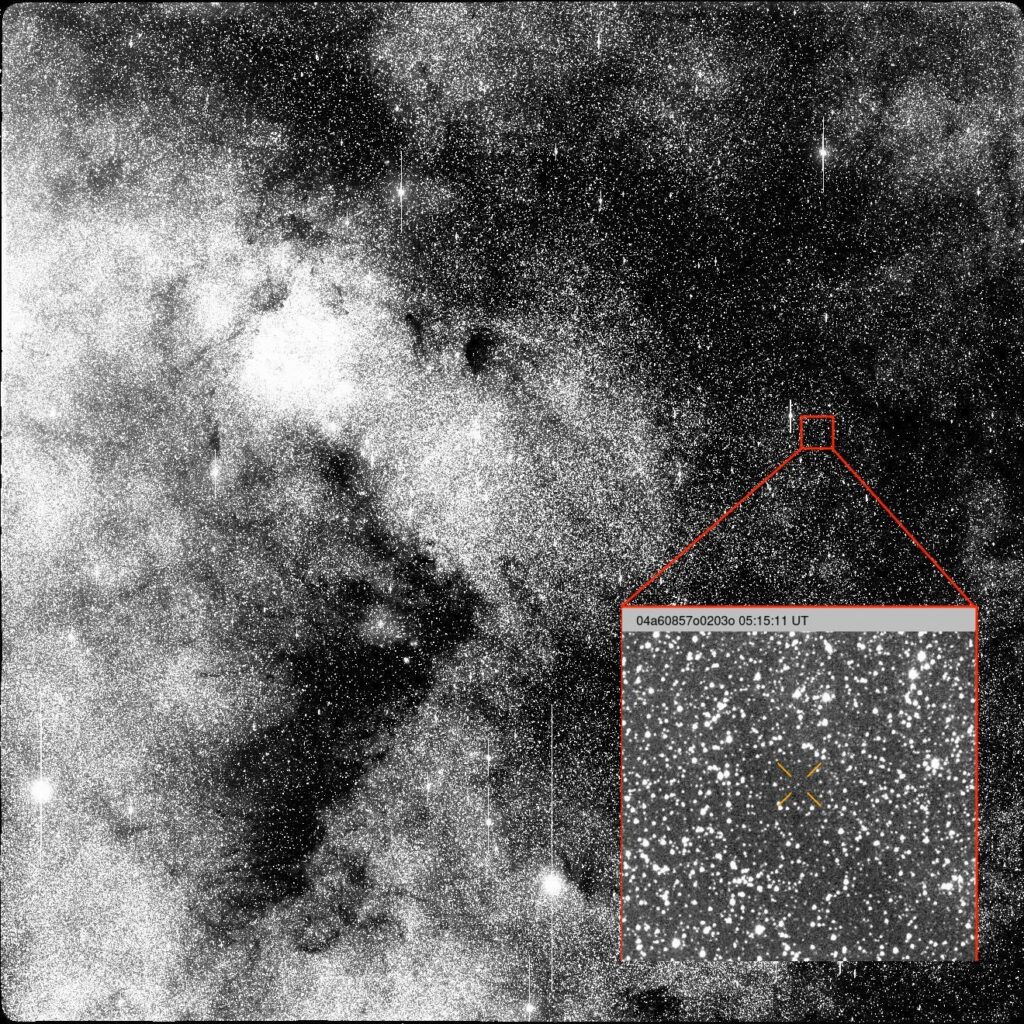
NASA says the Asteroid Terrestrial-impact Last Alert System (ATLAS), a NASA-funded survey telescope in Rio Hurtado, Chile, reported the object to the Minor Planet Center on July 1, 2025. The Minor Planet Center is the international clearinghouse for positions of small bodies.
Astronomers then searched older images. Pre-discovery observations reach back to June 14, 2025, from three ATLAS telescopes and the Zwicky Transient Facility at Caltech. ESA says it reacted the same day, using telescopes in Hawaii, Chile and Australia.
The object was classed as a comet because it showed a coma, the bright cloud of gas and dust that ice releases as it warms.
Its orbit proves it came from outside the solar system
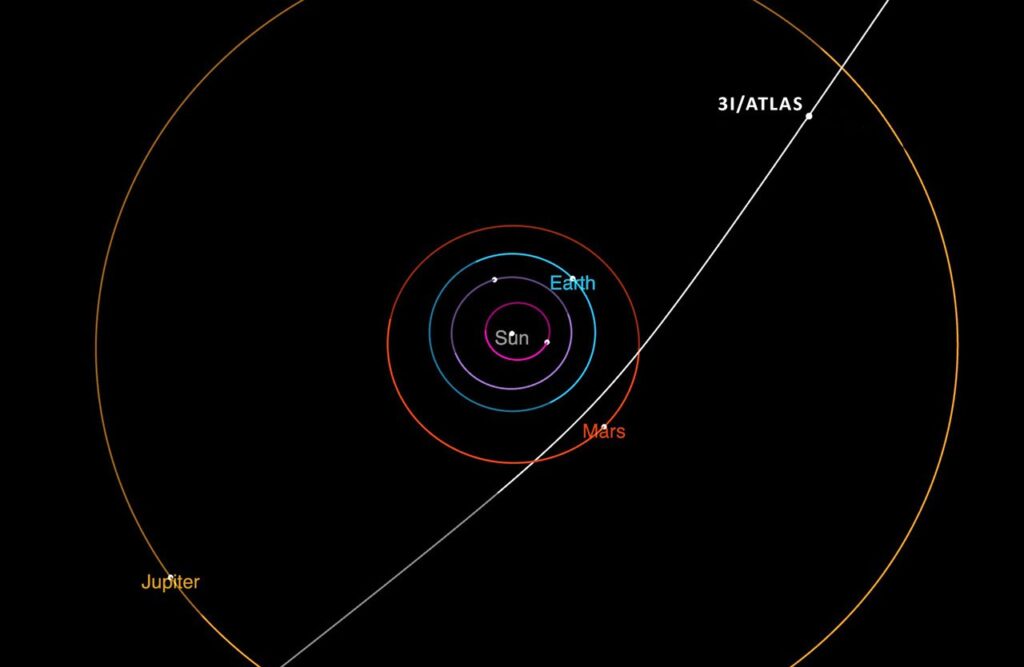
Bodies bound to the Sun follow closed, oval paths. 3I/ATLAS follows a hyperbolic orbit, an open curve that never loops back. Tracing that path backward leads outside the solar system, which is the reason it counts as interstellar.
Gravity from the Sun speeds up anything that falls toward it. NASA gives the comet’s speed as about 137,000 mph (221,000 km/h) at discovery and about 153,000 mph (246,000 km/h) at its closest point to the Sun. NASA adds that it left the solar system at the same speed at which it came in.
Distances in this guide use the astronomical unit (AU), the average Earth-Sun distance, about 93 million miles.
| Event | Date | Distance |
|---|---|---|
| Discovery reported | July 1, 2025 | Hubble later imaged it from 277 million miles on July 21, 2025 |
| Closest to the Sun (perihelion) | Oct. 30, 2025 | About 1.4 AU (130 million miles) |
| Reappeared beyond the Sun | Early December 2025 | Outbound leg begins |
| Closest to Earth | Dec. 19, 2025 (about 1.8 AU on this date) | About 170 million miles (270 million km) |
| Passage by Jupiter | March 2026 | NASA gives no distance |
Figures checked October 24, 2026 against NASA’s 3I/ATLAS pages.
It never threatened Earth, and Mars saw it much closer
NASA states plainly that the comet posed no danger to Earth. Its closest approach to us was 1.8 AU, nearly twice the distance between Earth and the Sun.
Spacecraft elsewhere in the solar system got a nearer look than anyone on Earth. NASA lists Mars Reconnaissance Orbiter, which observed it from about 18.6 million miles. Europa Clipper watched from about 102 million miles on Nov. 6, 2025, and Lucy from about 240 million miles on Sept. 16, 2025.
NASA’s list of observers also includes Hubble, Webb, TESS, Swift, SPHEREx, Perseverance, MAVEN, Psyche, Parker Solar Probe, PUNCH and SOHO. MAVEN imaged hydrogen atoms around the comet. ESA says its Mars Express and ExoMars Trace Gas Orbiter turned toward it in October 2025, and its Juice spacecraft in November 2025. ESA also reports that XMM-Newton and XRISM observed it, which ESA’s pages describe as the first X-ray observations of an interstellar comet.
The nucleus is somewhere between 440 meters and 5.6 kilometers wide
The nucleus is the solid core of a comet, normally hidden inside the glare of its coma. For that reason its size is hard to measure. From Hubble observations, NASA gives an upper limit of 5.6 km (3.5 miles) in diameter and a possible minimum of about 440 meters (1,444 feet).
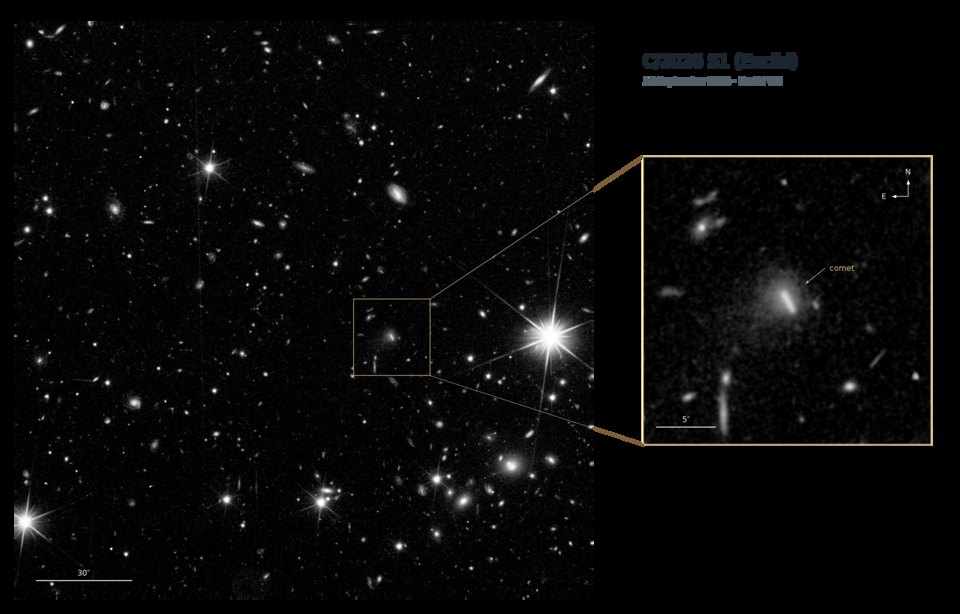
Hubble’s picture of July 21, 2025 shows a teardrop-shaped dust cloud around a bright center, with a dust tail streaming behind. The Juice team reports the comet’s gas and dust cloud spread over more than 5 million km, according to coverage of ESA’s results, and that its behavior was in line with a normal comet.
Webb and SPHEREx found water, carbon dioxide and methane
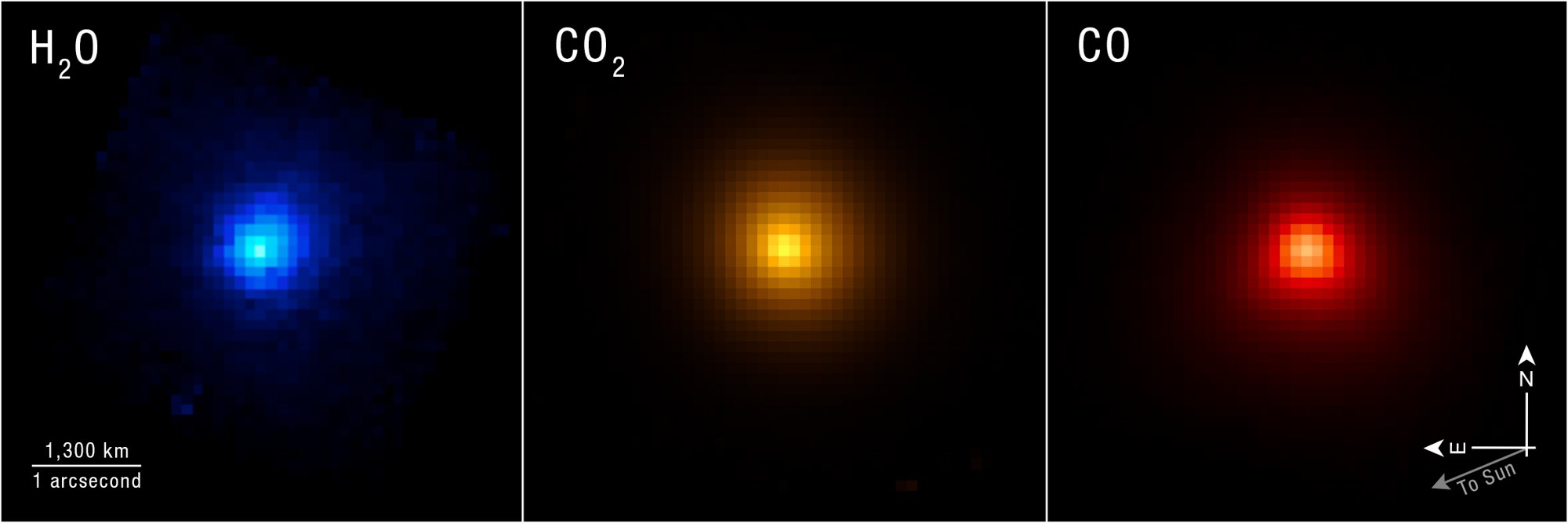
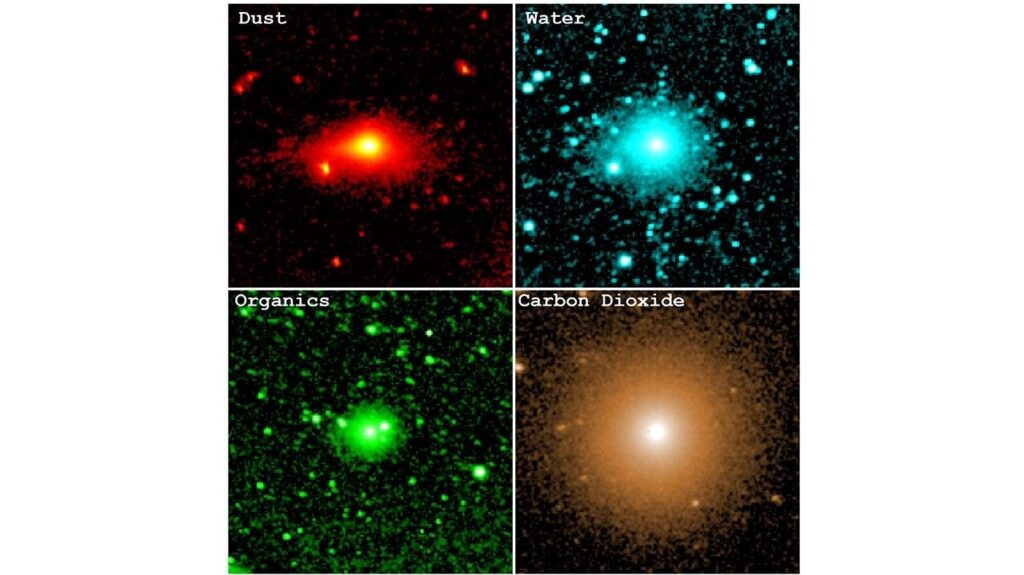
Comet ice is a record of the place where it formed. NASA says the infrared space telescope SPHEREx detected emission from dust, water, organic molecules and carbon dioxide in the coma. Webb detected methane, which NASA calls its first mid-infrared chemical fingerprint of an interstellar object.
ESA’s Juice instrument for radio-wavelength observations found that most of the water vapor came from the Sun-facing side, and reportedly from icy dust grains in the coma more than from the nucleus itself.
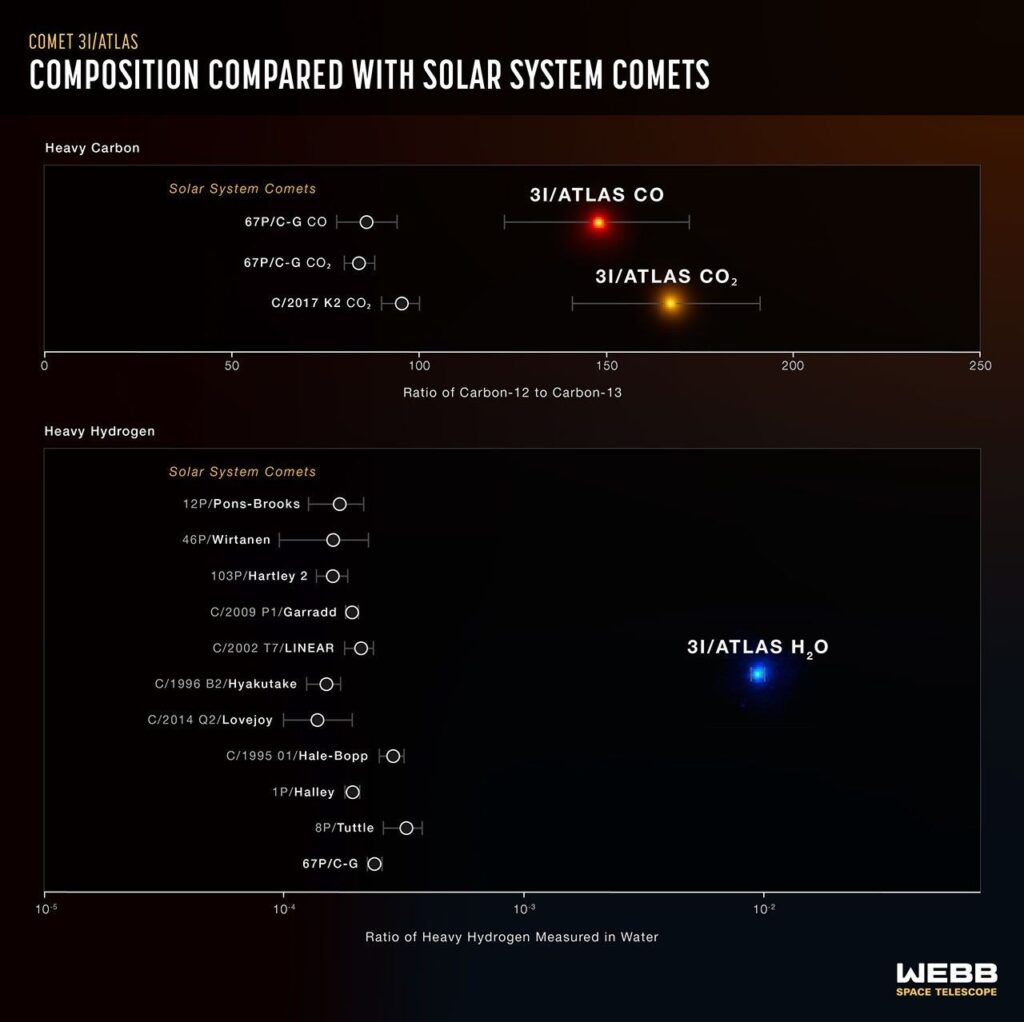
The most striking results concern heavy hydrogen. Deuterium is a heavier form of hydrogen with an extra neutron, and its share in ice depends on how cold the birthplace was. NASA reports that Webb’s NIRSpec instrument measured deuterium about 30 times higher than in solar system comets. The ratio of two forms of carbon (carbon-12 to carbon-13) is above 150 for carbon monoxide and about 170 for carbon dioxide, while three solar system comets measured fall just below 100.
A later paper led by NASA Goddard’s Nathan Roth in Nature Astronomy found methane with a deuterium share 13 times that of comet 67P, the highest ever measured for methane. The details are in our report on 3I/ATLAS methane and its heavy hydrogen.
The ice may be 10 to 12 billion years old
NASA’s Webb team says 3I/ATLAS may have formed 10 to 12 billion years ago, during the universe’s “cosmic noon,” when star formation was at its height. The Sun formed about 4.5 billion years ago, so the comet could be more than twice the age of our solar system. The result was published in Nature on June 22, 2026.
The age is an estimate drawn from the chemistry, and it rests on the interpretation that such ratios point to a relatively cold, dense birth cloud and a deeply frozen state. NASA does not name the star it came from. It says only that the comet formed in another star system and drifted through interstellar space for millions or even billions of years.
The comet is on its way out and will not come back
Ground-based telescopes followed 3I/ATLAS through September 2025, after which it passed too close to the Sun in the sky to observe. It reappeared on the far side of the Sun in early December 2025, and Webb data show it began moving away from the Sun that month.
NASA says it passed Jupiter in March 2026 on its way out and remained observable until spring 2026. It is no longer visible to amateur telescopes, and NASA says it will never be seen again.
A fuller look at the early space-telescope results is in our report on what Hubble, Webb and SPHEREx found as 3I/ATLAS left the inner solar system.
Common questions
What is comet 3I/ATLAS?
It is an interstellar comet, a body of ice and dust that formed around another star and crossed the solar system on an open orbit. It is the third interstellar object known, after 1I/’Oumuamua in 2017 and 2I/Borisov in 2019, according to NASA and ESA.
Is comet 3I/ATLAS the same as comet 31 ATLAS?
Yes. “31 ATLAS” is a common misspelling of 3I/ATLAS, where the character after the 3 is a capital letter I for interstellar, not the number 1.
Was comet 3I/ATLAS dangerous or artificial?
NASA says it posed no danger and came no closer than 170 million miles. Its measured behavior, with a coma of gas and dust and a tail, matches that of a comet, and ESA reports it acted like a normal comet.
Can I still see 3I/ATLAS?
No. NASA says it could be seen with a small telescope in the pre-dawn sky and stayed observable until spring 2026. It is now far outbound and is not within reach of amateur instruments.
How fast did 3I/ATLAS travel?
NASA gives about 137,000 mph at discovery and about 153,000 mph at perihelion, the closest point to the Sun.