The planets in our solar system in order: Size, distance from the Sun and what sets each apart
Our solar system has eight planets: Mercury, Venus, Earth, Mars, Jupiter, Saturn, Uranus and Neptune, with Pluto reclassified as a dwarf planet in 2006.
Dates and facts checked on the official pages on October 22, 2026.
There are eight planets in our solar system. In order from the Sun they are Mercury, Venus, Earth, Mars, Jupiter, Saturn, Uranus and Neptune. Pluto was counted as the ninth until 2006, when the International Astronomical Union (IAU) reclassified it as a dwarf planet, according to NASA.
The first four are small, rocky worlds with solid surfaces. The next four are far larger: Jupiter and Saturn are gas giants, and Uranus and Neptune are ice giants. NASA notes that the word “planet” comes from the ancient Greek “planetes,” meaning “wanderer.”
Eight planets in order, from the closest to the Sun to the farthest
Distances below are averages, because every orbit is slightly oval. One astronomical unit (AU) is the average distance between Earth and the Sun, about 93 million miles, and it is the standard yardstick for distances inside the solar system. Figures are from NASA’s planet fact pages.
| Order | Planet | Type | Average distance from the Sun | Width at the equator |
|---|---|---|---|---|
| 1 | Mercury | Rocky | 36 million miles (58 million km), 0.4 AU | 3,030 miles (4,880 km) |
| 2 | Venus | Rocky | 67 million miles (108 million km), 0.72 AU | 7,521 miles (12,104 km) |
| 3 | Earth | Rocky | About 93 million miles (150 million km), 1 AU | 7,926 miles (12,756 km) |
| 4 | Mars | Rocky | 142 million miles (228 million km), 1.5 AU | 4,212 miles (6,780 km) |
| 5 | Jupiter | Gas giant | 484 million miles (778 million km), 5.2 AU | About 86,900 miles (139,800 km) |
| 6 | Saturn | Gas giant | 886 million miles (1.4 billion km), 9.5 AU | 74,897 miles (120,500 km) |
| 7 | Uranus | Ice giant | 1.8 billion miles (2.9 billion km), 19 AU | 31,763 miles (51,118 km) |
| 8 | Neptune | Ice giant | 2.8 billion miles (4.5 billion km), 30 AU | 30,775 miles (49,528 km) |
Figures checked against NASA’s planet pages on October 22, 2026.
The gaps grow quickly. Neptune sits about 30 times farther from the Sun than Earth does, so sunlight there is far fainter and the planet is intensely cold.
Ranked by size: Jupiter first, Mercury last
From biggest to smallest the order is Jupiter, Saturn, Uranus, Neptune, Earth, Venus, Mars and Mercury. NASA’s planet overview gives the same ranking: Jupiter largest, Saturn second, Uranus third, Neptune fourth, Earth fifth, Venus sixth, Mars seventh and Mercury the smallest.
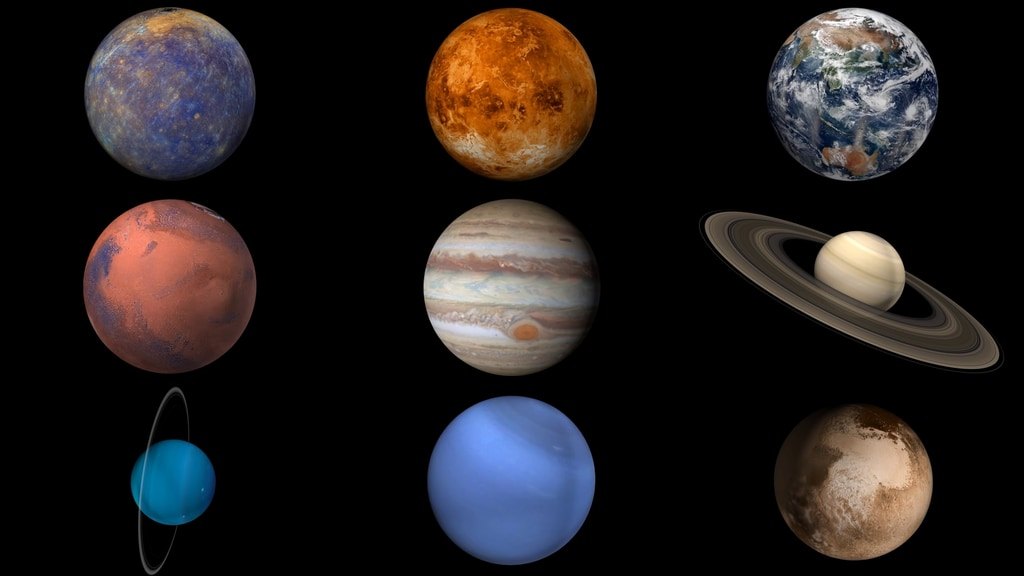
Two comparisons make the scale easier to grasp. Jupiter is roughly 11 times wider than Earth, while Mercury is only a little more than a third of Earth’s width and slightly larger than Earth’s Moon. Uranus and Neptune are close twins in size, about four times Earth’s width each, with Uranus the slightly wider.
The four rocky planets: From scorched Mercury to icy Mars
Mercury is the closest planet and the fastest, circling the Sun in about 88 Earth days. It has no moons, and its temperatures swing from about 800 degrees F (430 C) by day to about -290 degrees F (-180 C) at night. A single day, from one sunrise to the next, lasts about 176 Earth days. NASA says it was named for the swiftest of the ancient Roman gods.
Venus is almost Earth’s size but far from Earth-like. Its surface is about 872 degrees F (467 C), the hottest of any planet, even hotter than Mercury. It also spins backward compared with Earth, so the Sun rises in the west, and one rotation takes about 243 Earth days, longer than its 225-day year. Its surface and clouds are covered in more detail in our look at volcanic activity on Venus. NASA notes the Romans named it for their goddess of love and beauty, known to the ancient Greeks as Aphrodite.
Earth is the only planet known to have liquid water on its surface. Oceans cover about 71% of the planet and hold 97% of its water, according to NASA. It is also the only planet whose English name does not come from Greek or Roman mythology: the name comes from Old English and Germanic roots meaning roughly “the ground.”
Mars is a cold desert with a rusty-red look, which led the Romans to name it for their god of war. A Martian day, called a sol, lasts 24.6 hours, close to Earth’s, but its year is 687 Earth days. Temperatures range from about 70 degrees F (20 C) down to about -225 degrees F (-153 C). Its two small moons, Phobos and Deimos, may be captured asteroids. More detail is in Mars facts: distance, temperature and weather.
Jupiter and Saturn are the gas giants, and only one wears famous rings
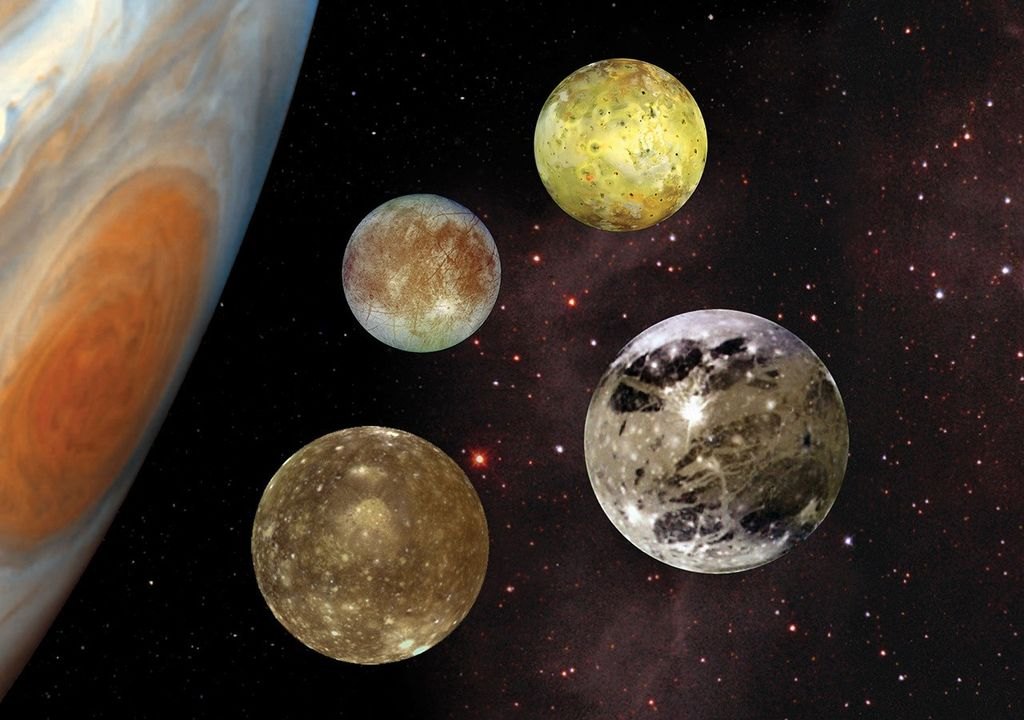
A gas giant is a planet made mostly of hydrogen and helium with no solid surface to stand on. Jupiter is the largest planet by far, with a day of only about 9.9 hours and a year of about 12 Earth years. Its Great Red Spot is a storm larger than Earth that has been observed for more than 300 years; gravity measurements from NASA’s Juno spacecraft suggest it reaches about 300 miles (500 km) below the cloud tops.
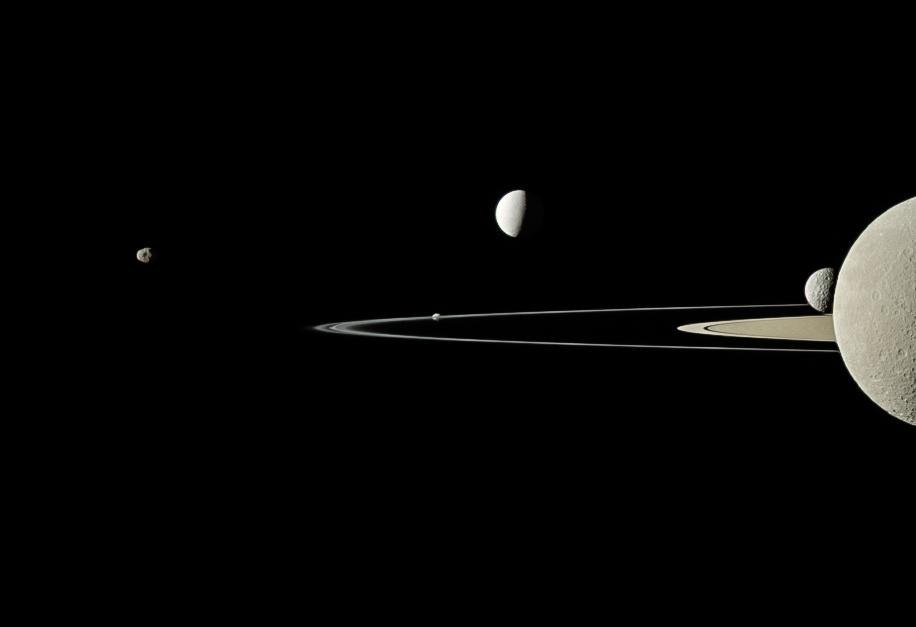
Saturn is the second largest and has the most spectacular ring system. The rings extend up to 175,000 miles (282,000 km) from the planet, and the main rings, labeled A, B and C, are separated by the Cassini Division, a gap about 2,920 miles (4,700 km) wide. Saturn also has a six-sided jet stream around its north pole. One orbit takes about 29.4 Earth years. NASA says it is named for the Roman god of agriculture and wealth, who was the father of Jupiter.
Uranus and Neptune are ice giants with sideways spin and supersonic winds
An ice giant is a giant planet with a large share of heavier materials, such as water, methane and ammonia, beneath its gas layers. Both are too faint to see without a telescope.
Uranus rolls around the Sun on its side. Its axis is tilted 97.77 degrees, so its poles take turns pointing almost straight at the Sun over an 84-year orbit. NASA lists 13 faint rings and 28 known moons. Astronomer William Herschel first wanted to call the planet Georgium Sidus, after King George III, but the name Uranus, after the Greek sky god, was suggested by astronomer Johann Bode.
Neptune is the most distant planet and takes about 165 Earth years to orbit once. Its winds exceed 1,200 mph (2,000 km/h), about three times Jupiter’s strongest winds and nine times Earth’s. Its largest moon, Triton, orbits in the opposite direction to the planet’s rotation. NASA says the planet is named for the Roman god of the sea, and its moons for lesser Greek sea gods and nymphs.
All four giants have rings, but moon counts keep rising
The question of which planets have rings has a clear answer: Jupiter, Saturn, Uranus and Neptune. Saturn’s are the brightest and largest. Jupiter’s, found by Voyager 1 in 1979, are made of small, dark particles and are hard to see except when backlit by the Sun. Neptune has at least five main rings, named Galle, Leverrier, Lassell, Arago and Adams, plus four prominent arcs in the outermost ring. Mercury, Venus, Earth and Mars have none.
Moon totals change as astronomers confirm new discoveries. NASA lists none for Mercury and Venus, one for Earth, two for Mars, 16 for Neptune and 28 for Uranus, and 115 officially recognized by the IAU for Jupiter. For Saturn, NASA’s page gives 274 confirmed as of March 2025, with more awaiting confirmation. Our report on which planets have the most moons covers the latest tally.
How the planets move: One direction around the Sun, at very different speeds
All eight planets circle the Sun, and the farther out a planet is, the longer its year. Mercury finishes an orbit in 88 Earth days, Earth in 365.25 days, Mars in 687 days, Jupiter in about 12 years and Neptune in about 165 years. Neptune has therefore not completed a single orbit since its discovery was announced in 1846.
Spin is a separate matter. Most planets rotate in the same direction as Earth, but Venus spins backward, and Uranus lies on its side. Day length also varies enormously: about 9.9 hours on Jupiter and 16 hours on Neptune, against roughly 59 Earth days for one turn of Mercury.
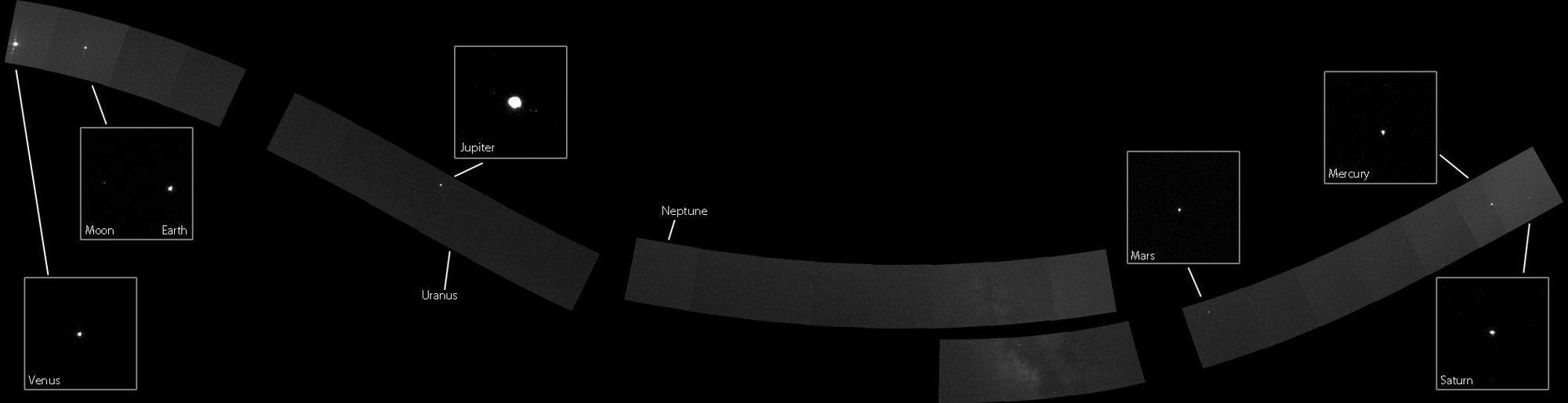
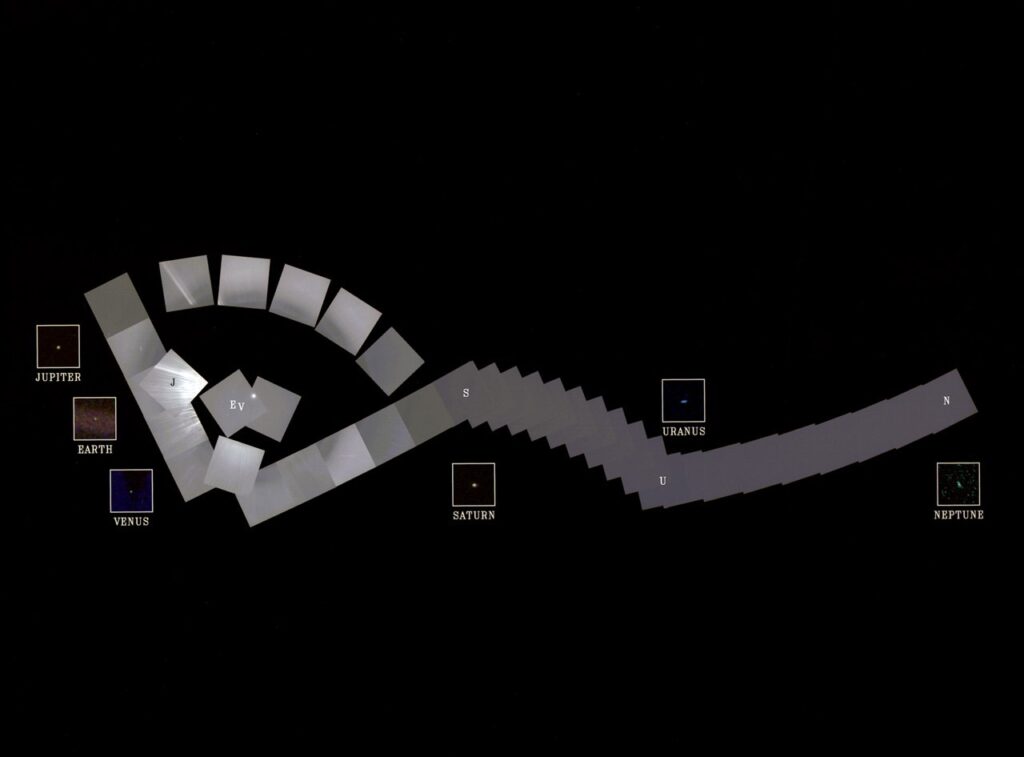
The best portrait of the whole family is a mosaic from NASA’s Voyager 1 spacecraft. On February 14, 1990, it photographed six planets from the outer solar system, according to NASA; Mercury was too close to the Sun, Mars was washed out by scattered sunlight and Pluto was too faint. In 2010 the MESSENGER spacecraft completed the opposite view, looking outward from the inner solar system, with most images taken on November 3, 2010.
Pluto, dwarf planets and planets around other stars
Pluto lies in the Kuiper Belt, an icy region beyond Neptune. NASA says the IAU reclassified it as a dwarf planet in 2006. It has five known moons, and its largest, Charon, is roughly half Pluto’s size.
Planets outside our solar system are called exoplanets: NASA defines an exoplanet as any planet beyond our solar system. Most orbit other stars, though some, called rogue planets, orbit none. NASA’s exoplanet page, updated October 19, 2026, says it has confirmed more than 6,000, and a later passage on the page gives a figure of 6,300+. Examples it names include Proxima Centauri b, 51 Pegasi b and Kepler-7b.
Common questions
How many planets are in our solar system?
Eight: Mercury, Venus, Earth, Mars, Jupiter, Saturn, Uranus and Neptune. The older figure of nine counted Pluto, which the IAU reclassified as a dwarf planet in 2006, according to NASA.
What are the planets in order from the Sun, and how far away is each in miles?
Average distances are about 36 million miles for Mercury, 67 million for Venus, 93 million for Earth, 142 million for Mars, 484 million for Jupiter, 886 million for Saturn, 1.8 billion for Uranus and 2.8 billion for Neptune.
Which planets are the biggest and smallest?
Jupiter is the largest, followed by Saturn, Uranus, Neptune, Earth, Venus and Mars. Mercury is the smallest planet, only slightly larger than Earth’s Moon.
How did the planets get their names?
Five were known to the ancients and carry Roman god names, according to NASA’s fact pages: Mercury, Venus, Mars, Jupiter and Saturn. Neptune is also named for a Roman god, Uranus for a Greek one, and Earth’s name simply means “the ground.” Venus was Aphrodite to the ancient Greeks.