A marsquake from 2021 shows Mars’s giant canyon is still slipping
Imperial College London researchers traced a 2021 marsquake detected by NASA's InSight to a deep fault beneath Valles Marineris, the largest canyon system in the solar system.

Researchers at Imperial College London and Columbia University say Valles Marineris, the largest canyon system in the solar system, is still tectonically active. They traced a marsquake recorded by NASA’s InSight lander to rocks slipping along a deep fault beneath it.
One quake from the far side of Mars
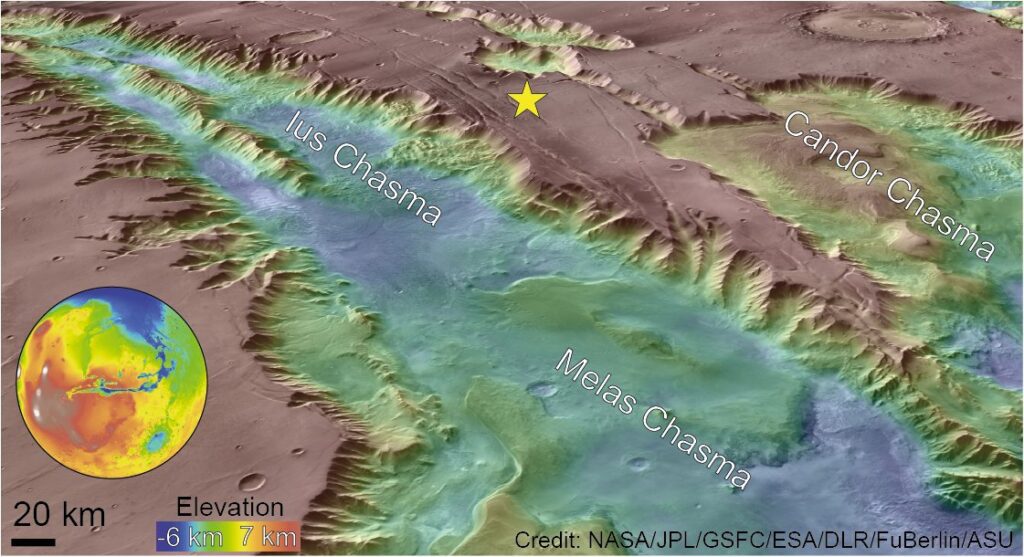
The event, labeled S0976a, was recorded by InSight on 25 August 2021, according to Imperial College London. It came from the opposite side of Mars from the lander and was the only marsquake of the whole mission that could be located in the western hemisphere. Earlier work had placed it near western Valles Marineris, but what caused it was unclear.
The new study, published in Nature Communications, was led by Jung-Hun Song, a postdoctoral researcher in Imperial’s Department of Earth Science and Engineering. Dr Folarin Kolawole of Columbia University is a co-author, and Dr Doyeon Kim of Imperial is the senior author.
The team analyzed how the quake’s seismic waves, the vibrations that travel through a planet’s interior, crossed Mars, and used them to reconstruct the motion at the source. The best match was a strike-slip event. That means two blocks of crust slid horizontally past each other along a steep fault that reaches deep into the planet. The rupture happened roughly 20 to 40 km beneath the surface.

Ruling out impacts and landslides
A marsquake can have other causes, so the researchers tested them. Meteoroid impacts, landslides and other mass movements could not reproduce the waves InSight recorded. Satellite images also showed no fresh impact crater and no large new landslide in the source region. That leaves a fault slipping at depth as the explanation.
The canyon itself is huge. Imperial gives its size as about 3,900 km long, up to 600 km wide and more than 9 km deep. Compared with the Grand Canyon, that is roughly 9 times longer, over 20 times wider and about 5 times deeper.
Old faults waking up on a plate-free planet
Unlike Earth, Mars has no moving tectonic plates. Its outer shell behaves like a single, slowly cooling lid. The researchers say the orientation of the fault suggests ancient structures are slipping again. They point to three possible drivers: the long-term cooling of the planet, stresses from the nearby Tharsis volcanic region, and effects from the canyon itself.
Valles Marineris is not the only active spot. Imperial notes that InSight data have also revealed active faulting beneath Cerberus Fossae and southern Elysium Planitia. The seismic waves from S0976a also passed through the Martian core, which helps scientists study the deep interior.
What a living Mars means for the next landers
InSight touched down in Elysium Planitia on 26 November 2018, and NASA ended the mission on 15 December 2022, according to NASA’s mission page. Its seismometer, which NASA’s robotic arm placed on the surface, was a single instrument at a single location. That is why one well-located quake from the other hemisphere matters: it shows seismic activity is not confined to the regions near the lander.
For future missions, this is a practical point. Mars is not a geologically dead world, so places chosen for landers, and any long-lived stations, sit on a planet that still flexes and slips. A single quake does not give a hazard map, and the study does not claim one. It does show that the canyon region, a prime target for science because of its exposed rock layers, deserves to be treated as active ground.
Surface activity on Mars is also being considered in other ways. Our earlier report on thinner Mars helicopter blades that could stretch one flight from 0.7 to 18.7 km shows how future explorers may cover far more ground than InSight ever could from a fixed spot.