Which planets have rings? Saturn, Jupiter, Uranus and Neptune compared
Saturn, Jupiter, Uranus and Neptune all have rings, but only Saturn's are bright enough to see in a small telescope; here is how the four systems differ.
Dates and facts checked on the official pages on October 22, 2026.
Four planets in our solar system have rings: Saturn, Jupiter, Uranus and Neptune. These are the four giant planets, the ones far larger than Earth. Saturn’s rings are by far the brightest and the only ones easy to see from Earth; the other three are faint and mostly dark.
The rocky planets closer to the Sun (Mercury, Venus, Earth and Mars) have no rings. For the full line-up of worlds, see the planets in our solar system in order.
Saturn, Jupiter, Uranus and Neptune side by side
A planetary ring is a flat band of countless separate particles, from dust grains to boulders, each circling the planet on its own orbit. Rings are not solid sheets. The four systems differ widely in brightness, makeup and age.
| Planet | Rings known | How NASA describes them | A defining detail |
|---|---|---|---|
| Saturn | 7 named rings, A to G, plus a very faint Phoebe ring | Billions of chunks of ice and rock | Extend up to 282,000 km from the planet but are typically only about 10 m thick |
| Jupiter | 5 components | Small, dark particles | Discovered by Voyager 1 in 1979 |
| Uranus | 13 known rings | Mostly narrow and dark grey, with two dusty outer rings | The planet is tilted 97.77 degrees, so it rolls around the Sun on its side |
| Neptune | At least 5 main rings and 4 prominent arcs | Thought to be relatively young and short-lived | The outer ring has clumps of dust called arcs |
Figures checked on NASA Science and NASA’s Planetary Fact Sheets on October 22, 2026.
Saturn’s rings: Bright ice reaching 282,000 km from the planet
Saturn’s rings are mostly water ice, which reflects sunlight well and is why they shine. NASA describes the particles as ranging from dust-sized grains to chunks as big as a house, with a few as large as mountains.
The three main rings are named A, B and C. The fainter D, E, F and G rings were found later, so the letters follow the order of discovery, not distance from Saturn. NASA’s fact sheet places the C ring’s inner edge about 74,658 km from Saturn’s center and the A ring’s outer edge about 136,780 km out. The brightest and widest, the B ring, spans roughly 92,000 to 117,500 km.
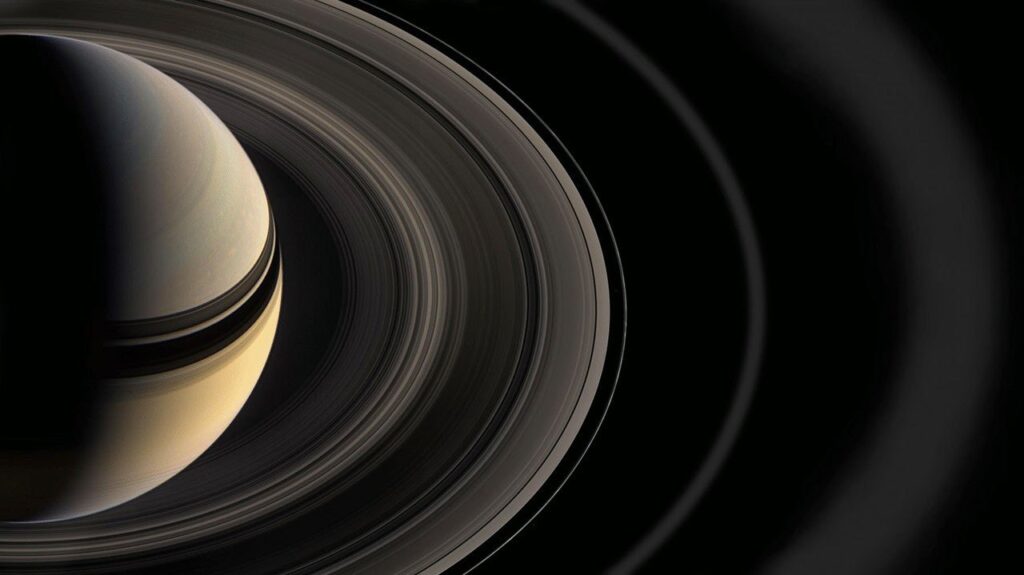
Between the A and B rings is the Cassini Division, a dark gap about 4,700 km wide. It is easy to spot in a good backyard telescope.
The rings are enormously wide yet extremely thin. NASA gives a typical vertical height of about 10 meters for the main rings. Because of that, the rings seem to vanish when Earth passes through their plane and views them exactly edge-on, as NASA’s Astronomy Picture of the Day explained in November 2025 using a Cassini image.
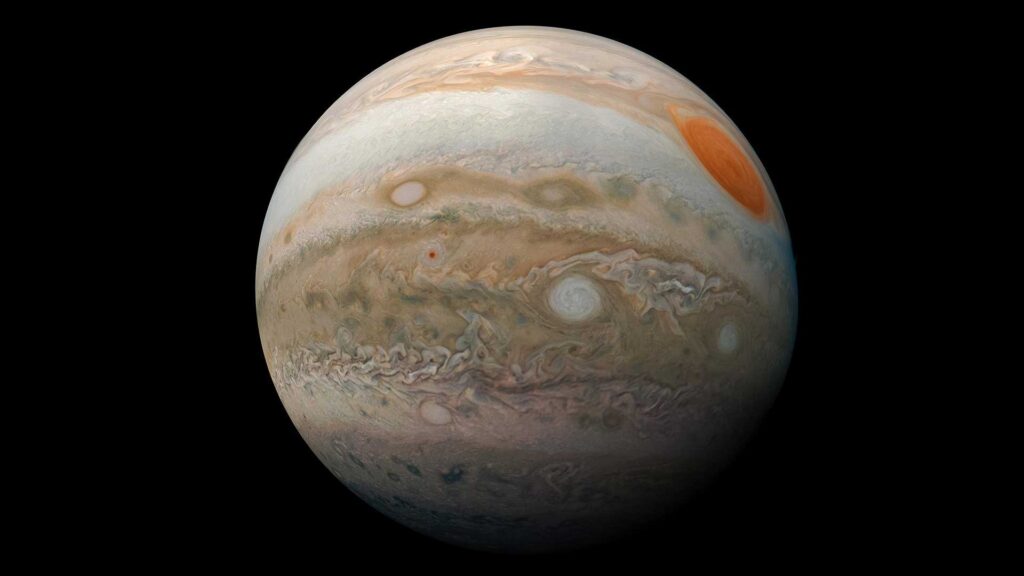
Jupiter’s rings are faint dust, found by a spacecraft in 1979
Jupiter’s rings are so dim that nobody knew about them until NASA’s Voyager 1 spacecraft found them in 1979. NASA calls the discovery a surprise. The particles are small and dark, and the rings are hard to see except when backlit by the Sun. Planetary scientists gauge how dense a ring is with a number called optical depth; NASA lists the main ring at 5 x 10⁻⁶, a tiny value that means almost all light passes straight through.
NASA’s fact sheet lists five components, working outward from the planet:
- The halo, about 89,400 to 123,000 km from Jupiter’s center and roughly 10,000 km thick.
- The main ring, 123,000 to 128,940 km, under about 100 km thick.
- The Amalthea ring, out to 181,350 km.
- The Thebe ring, out to 221,900 km.
- The Thebe extension, out to 280,000 km.
Where does the dust come from? According to NASA, data from the Galileo spacecraft suggest that meteoroids (small space rocks) striking Jupiter’s small inner moons knock loose the dust that forms the rings. In other words, the rings are continually resupplied rather than being a leftover. Jupiter’s moons are covered in our look at which planets have the most moons.
Uranus has 13 rings, mostly narrow and dark
NASA says Uranus is surrounded by 13 faint rings. Nine are the main rings and two are fainter dusty rings that Voyager 2 discovered during its 1986 flyby. Two more faint outer rings were first found with the Hubble Space Telescope in 2007.
NASA’s description of the colors helps tell them apart. The inner rings are mostly narrow and dark grey. The inner of the two outer rings is reddish, similar to dusty rings elsewhere in the solar system. The outermost ring is blue, like Saturn’s E ring.
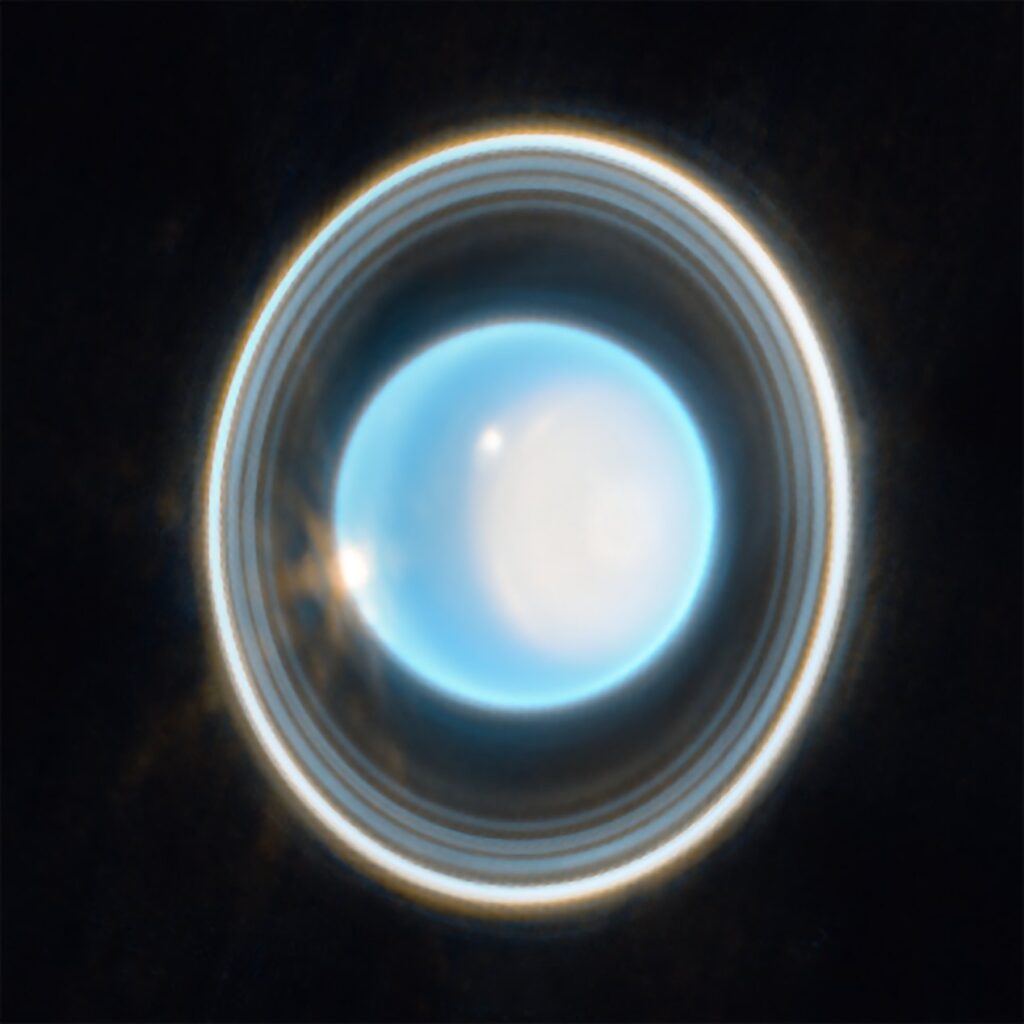
Uranus takes 84 years to orbit the Sun and spins tipped almost on its side. That is why the Webb telescope image looks like a bullseye of nested rings around the planet rather than a flat band.
Webb’s near-infrared camera took that image on February 6, 2023, with a 12-minute exposure. It shows 11 of the 13 rings. The two faint outer rings found by Hubble are expected to appear in future Webb images, according to NASA. Webb’s view of the dusty rings, previously seen only by Voyager 2 and the Keck Observatory, showed the telescope’s sensitivity to faint material.
Neptune’s rings have clumps of dust called arcs
NASA’s Voyager 2 spacecraft imaged Neptune’s rings during its encounter in August 1989, and it remains the only spacecraft to have visited the planet. NASA lists at least five main rings, named Galle, Le Verrier, Lassell, Arago and Adams, working outward from the planet.
The outermost, the Adams ring, is unusual. Part of it is bunched into four prominent arcs named Liberté, Egalité, Fraternité and Courage, which NASA describes as clumps of dust. NASA’s fact sheet places the Adams ring about 62,933 km from Neptune’s center, with a width of roughly 15 km. The planet itself has an equatorial radius of 24,766 km, so the ring sits well over twice that far out.
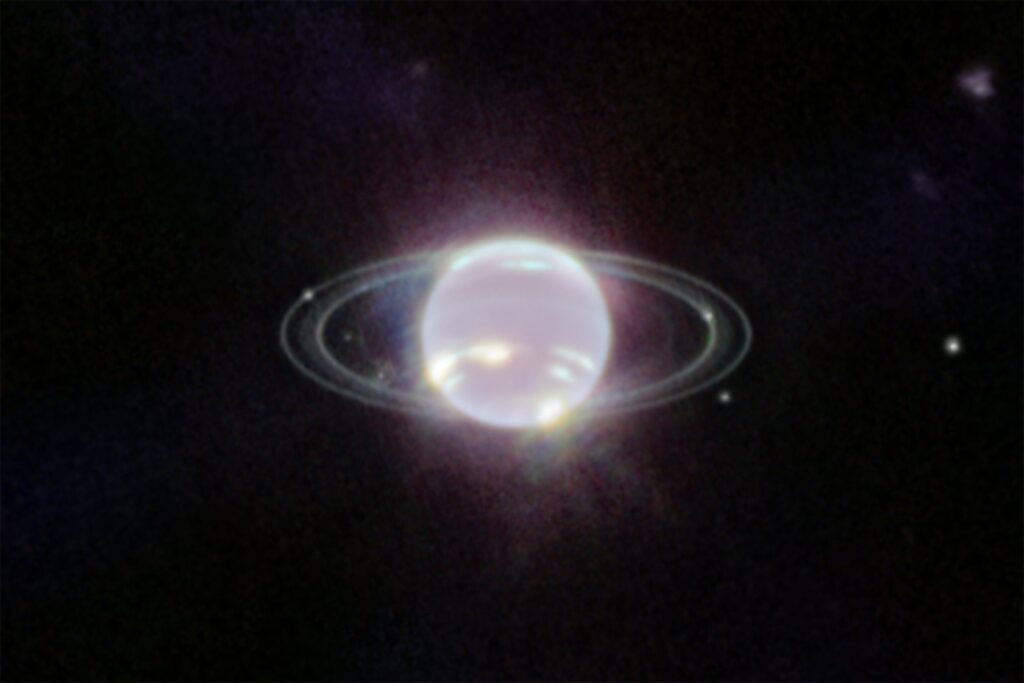
NASA’s Webb telescope imaged Neptune on July 12, 2022, and released the picture on September 21, 2022. The close-up shows the rings in sharp detail along with bright methane-ice clouds in the southern hemisphere and six of the planet’s 14 moons. Because Neptune’s methane gas absorbs near-infrared light, the planet itself looks dark in this image, which makes the thin rings stand out.
How old are the rings, and why do planets have them?
The origin of rings is not settled, and the answer differs by planet. For Saturn, NASA describes the leading explanation as follows: comets, asteroids or moons strayed too close, Saturn’s gravity tore them apart, and the debris spread into orbit as rings.
Age is a separate question. Cassini, a NASA orbiter that studied Saturn from 2004 until the mission ended on September 15, 2017, made 22 dives between the planet and the rings in its final months. Gravity measurements from those dives showed the rings are lighter than expected, which matters because lighter rings would have been darkened by space debris over a shorter time. NASA reported in January 2019 that the rings formed between 10 million and 100 million years ago. That is far younger than Saturn itself, which is roughly 4.5 billion years old.
Not every researcher agrees on that range. Other studies have proposed ages of a few hundred million years or more, so the figure remains an active debate.
For Jupiter, the rings come from moon dust, as described above. For Neptune, NASA says the rings are thought to be relatively young and short-lived.
The best images of each ring system
A few missions supplied the pictures that define each system:
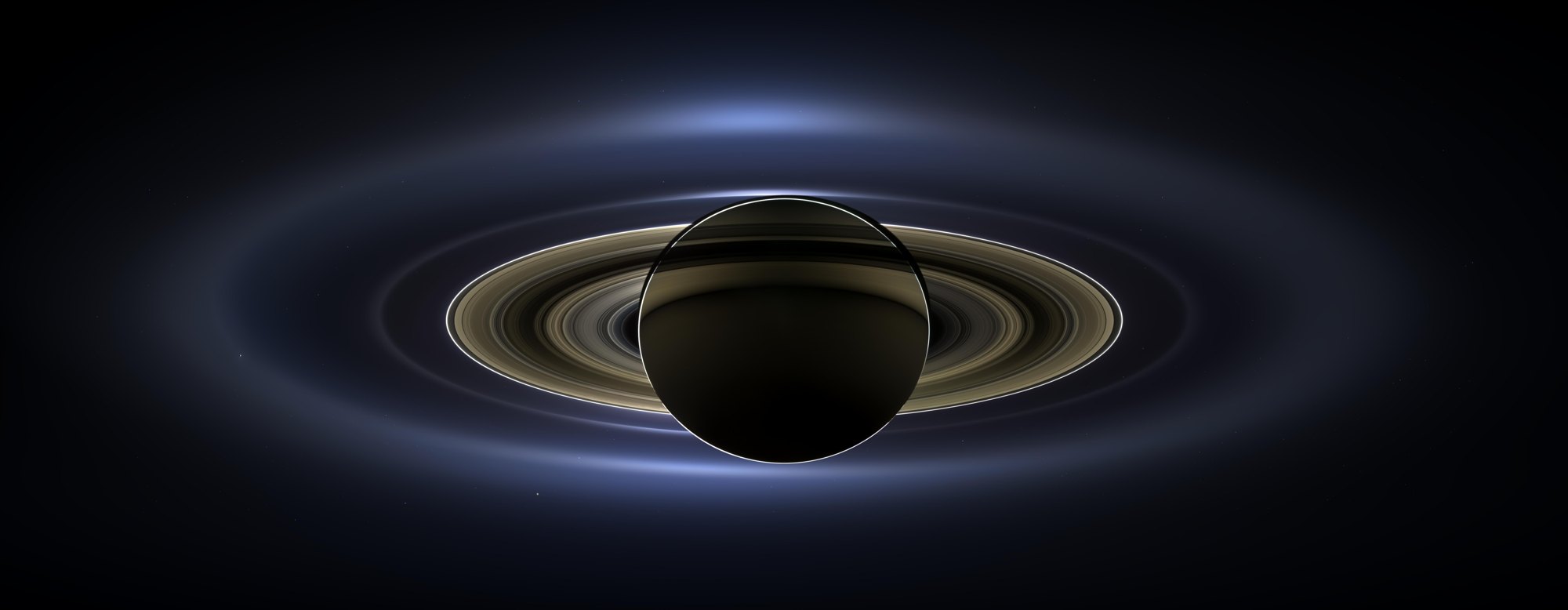
- Saturn: Cassini’s mosaic from July 19, 2013, when the spacecraft slipped into Saturn’s shadow. With the Sun blocked, the rings are backlit, and the image shows the E ring, the G ring, the F ring held narrow by the shepherd moons Pandora and Prometheus, and the faint spokes in the B ring.
- Jupiter: A Galileo mosaic from November 9, 1996, showing the main ring, the halo and the gossamer ring, deliberately overexposed so the faint outer ring shows. NASA’s Juno spacecraft has also photographed the ring from inside it.
- Uranus: Webb’s February 2023 near-infrared view of 11 rings.
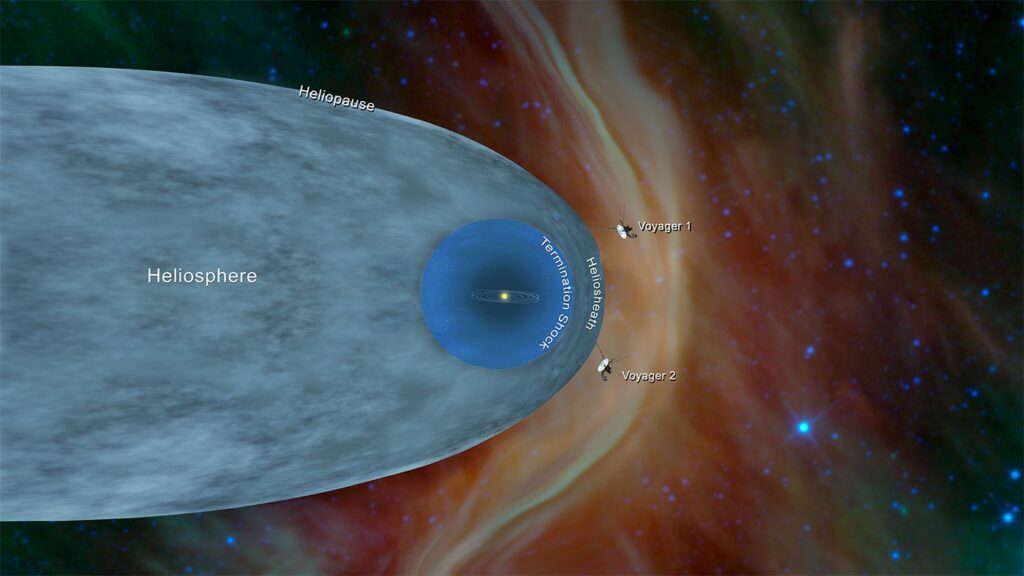
- Neptune: Webb’s July 2022 view and Voyager 2’s 1989 images. The Voyager probes are covered in our report on Voyager 1 and Voyager 2.
Common questions
Which planets have rings?
Saturn, Jupiter, Uranus and Neptune. Saturn’s rings are bright and easy to see; Jupiter’s, Uranus’s and Neptune’s are faint and dark, and some were found only by spacecraft or large telescopes.
Why do planets have rings?
Rings form from debris that stays in orbit around a planet. For Saturn, NASA points to icy bodies that wandered too close and were pulled apart by gravity, while Jupiter’s rings are dust knocked off its small inner moons by meteoroid impacts.
Do any planets in our solar system have rings besides the four giants?
NASA’s pages on the inner planets describe no rings for Mercury, Venus, Earth or Mars. The four giant planets are the ones with confirmed ring systems.
Can you see the rings from Earth?
Saturn’s rings can be seen in a small telescope. The faint rings of Jupiter, Uranus and Neptune need spacecraft or large telescopes such as Webb, and NASA notes that Saturn’s rings can seem to vanish when viewed edge-on.