Which planets have the most moons? Saturn leads with 293, ahead of Jupiter’s 115
Saturn has the most moons of any planet at 293, followed by Jupiter with 115, Uranus with 29 and Neptune with 16; Mercury and Venus have none.
Dates and facts checked on the official pages on October 21, 2026.
Saturn has the most moons of any planet, with 293 confirmed as of August 2026, according to NASA. Jupiter is second with 115, then Uranus with 29 and Neptune with 16. Mars has 2, Earth has 1, and Mercury and Venus have none.
Moon counts are not fixed. A moon only counts once astronomers have confirmed its orbit and the International Astronomical Union (IAU), the body that names and recognizes astronomical objects, officially recognizes it. The totals below are the most recent figures on NASA’s planet pages, which are the ones to trust over older lists.
Every planet’s moon count, from Mercury’s none to Saturn’s 293
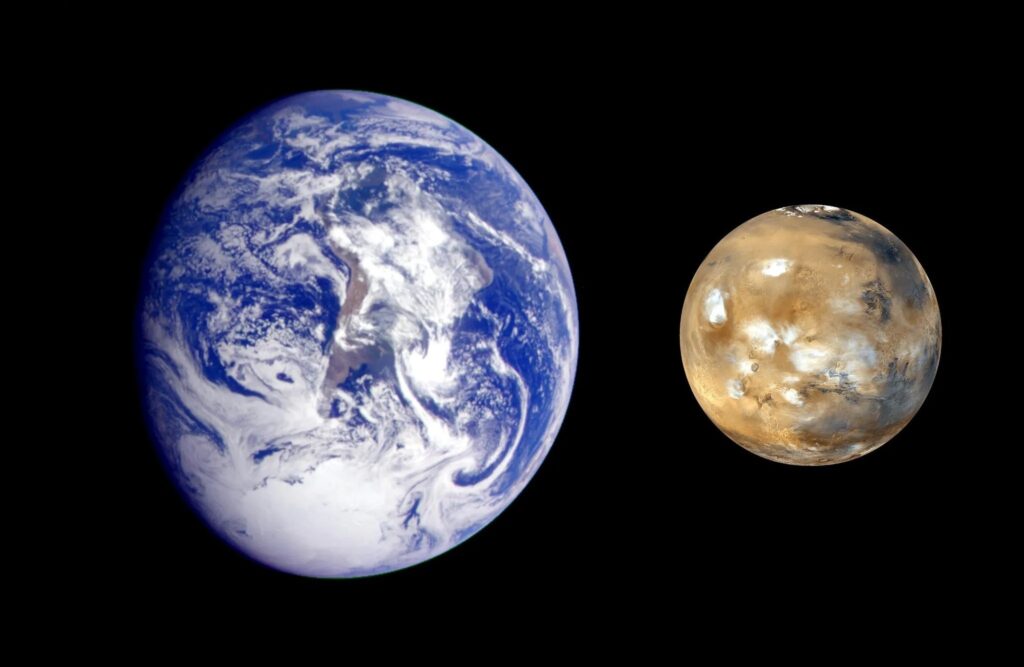
The eight planets split into two groups. The four small, rocky planets closest to the Sun have between zero and two moons. The four giants farther out have dozens or hundreds.
| Planet | Moons | Notable fact |
|---|---|---|
| Mercury | 0 | NASA states that Mercury does not have moons |
| Venus | 0 | Has an asteroid companion named Zoozve, which is not a moon |
| Earth | 1 | Average distance to the Moon is 238,855 miles (384,400 km) |
| Mars | 2 | Phobos and Deimos, discovered by Asaph Hall in August 1877 |
| Jupiter | 115 | Four large moons seen by Galileo in 1610 |
| Saturn | 293 | Count given as of August 2026 |
| Uranus | 29 | Count given as of August 2026; five major moons |
| Neptune | 16 | Largest moon, Triton, was found in 1846 |
Figures checked October 21, 2026 against NASA’s planet and moon pages. NASA’s Jupiter and Neptune pages carry no separate as-of date for their counts.
If you add the dwarf planet Pluto, which has 5 moons, it still ranks well below the four giants. The planets also keep gaining moons: Uranus’s newest, S/2023 U1, was first spotted in November 2023 and is still unnamed, according to NASA.
Why Saturn pulled ahead of Jupiter
For years Jupiter held the title. Saturn took over as astronomers found more and more tiny moons, many only a few kilometers across, that are faint and far from the planet. Most of the new additions are small captured bodies rather than large worlds, which is why the counts rise with each survey.
That also means the ranking depends on how carefully a planet has been searched. A planet with many moons is likely to have more small ones still undetected, so future counts for Saturn, Jupiter and Uranus can only go up.
Which planets have no moons, and why Venus is a special case
Only two planets have no moon: Mercury and Venus. NASA’s Mercury page says plainly that Mercury has no moons, and its Venus page says Venus is one of only two planets in the solar system without one.
Venus does have a quasi-satellite, which is an asteroid that stays close to the planet while it orbits the Sun. NASA names this object Zoozve. It travels alongside Venus but is not bound to it the way a moon is.
Earth is notable in the opposite direction. NASA describes it as the only planet in the solar system with only one moon, since Mars has two and everything beyond has many more.
The small rocky planets: Earth’s one Moon and Mars’s two
Earth’s Moon has a radius of 1,080 miles (1,738 km), which makes its diameter about 3,476 km. For tonight’s phase and rise times, the Moon phase today page has the live view.
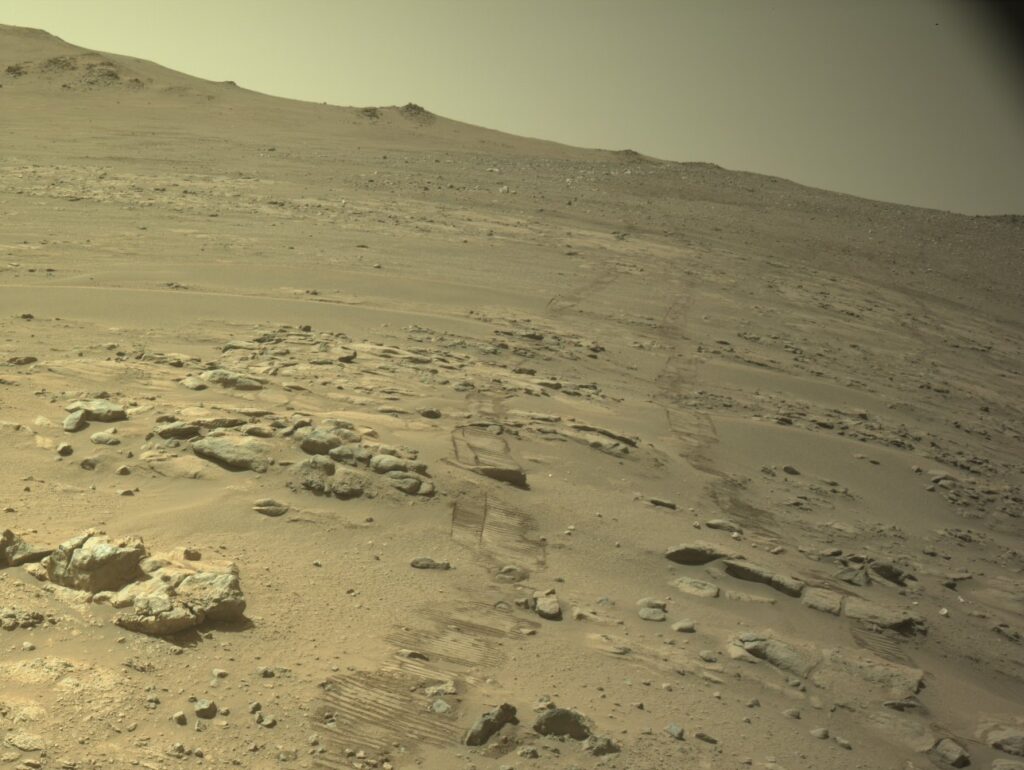
Mars’s two moons are tiny by comparison. According to NASA, Phobos, the larger one, orbits Mars three times a day and is moving closer to the planet. It will either crash into Mars in about 50 million years or break up into a ring. Deimos, the smaller one, is a small, lumpy, heavily cratered object that orbits every 30 hours. Both are thought to be captured asteroids or debris left over from the early solar system. More on the planet itself is in Mars facts, and Japan’s Martian Moons eXploration mission is aimed at Phobos.
Jupiter’s four big moons: From volcanic Io to ocean-bearing Ganymede
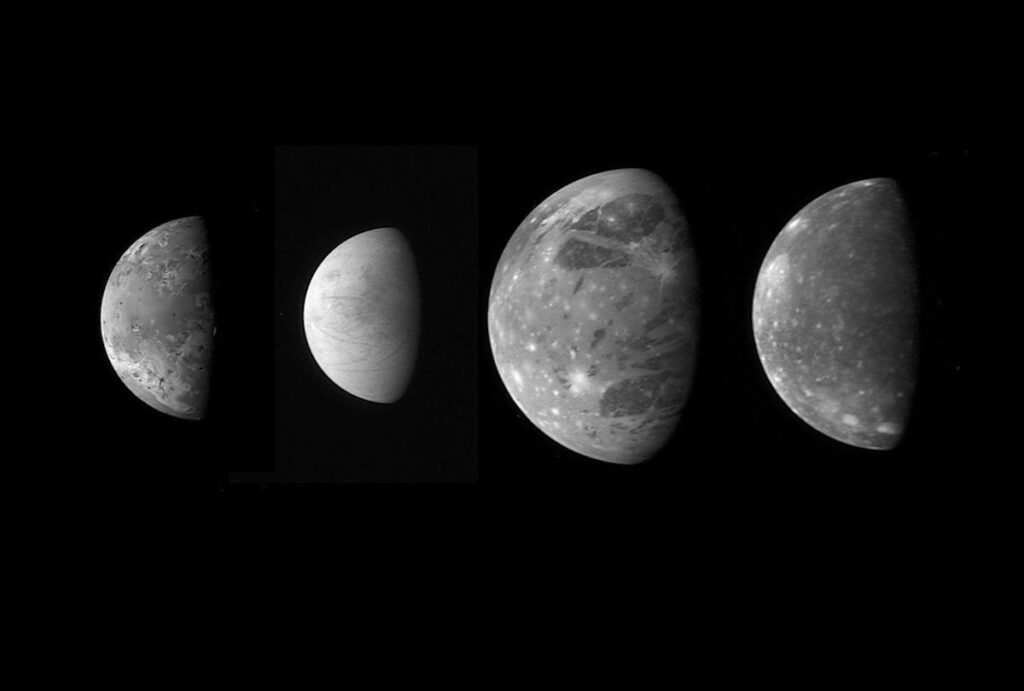
Of Jupiter’s 115 moons, four stand out. Galileo Galilei first observed them in 1610, so they are called the Galilean moons. They are large enough to be worlds in their own right.
| Moon | Diameter | Orbit around Jupiter | Known for |
|---|---|---|---|
| Io | 3,643 km | 1.77 days | Most volcanically active body in the solar system |
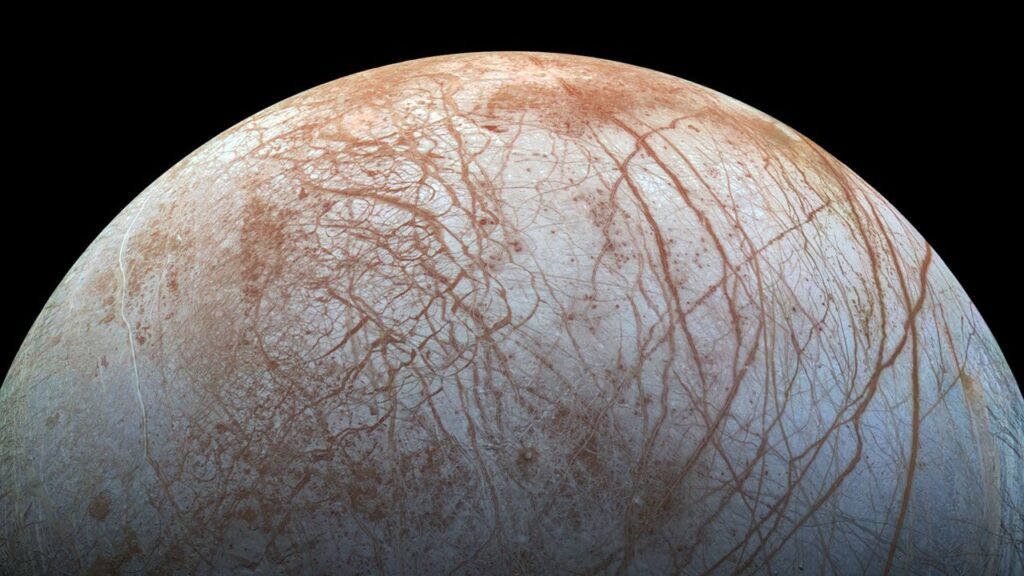
| Europa | 3,121.6 km | 3.55 days | Likely liquid-water ocean under an icy crust |
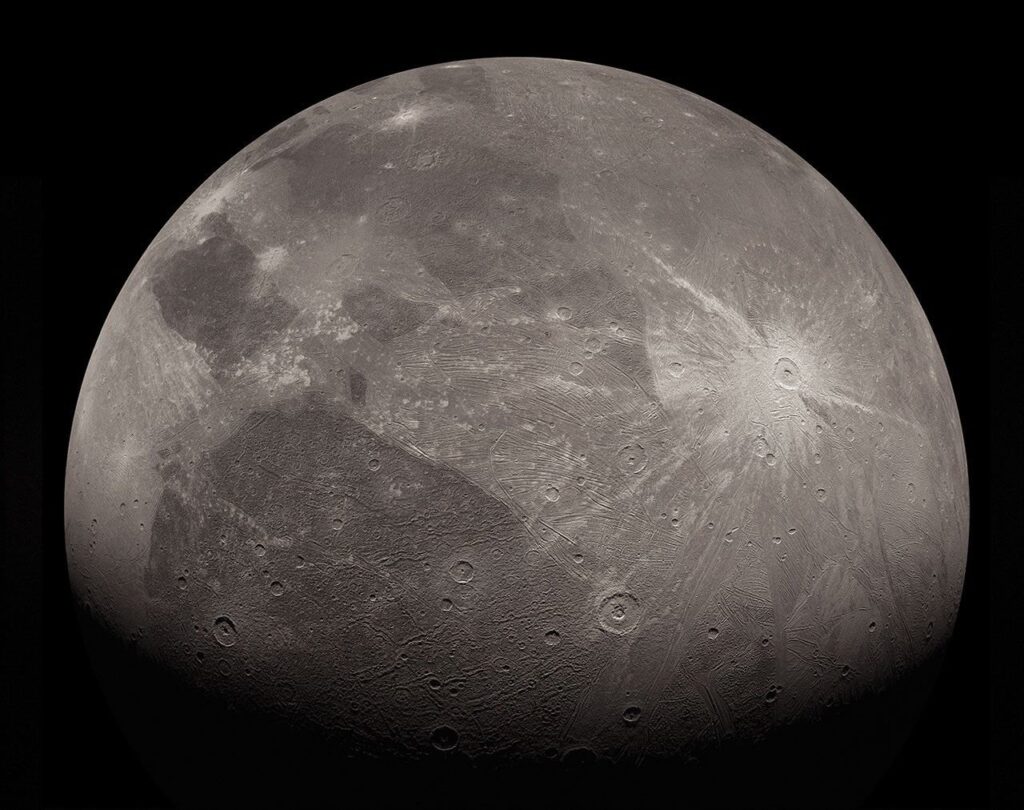
| Ganymede | 5,262.4 km | 7.15 days | Largest moon in the solar system |
| Callisto | 4,820.6 km | 16.69 days | Heavily cratered, little current surface activity |
Diameters are twice the radii in NASA’s Jovian satellite fact sheet, last updated December 6, 2023; checked October 21, 2026.
Ganymede is larger than the planet Mercury and the dwarf planet Pluto, according to NASA. It is also the only known moon with its own magnetic field, which produces auroras around its poles. NASA says there is strong evidence of an underground saltwater ocean that may hold more water than Earth’s surface.
Europa is about 90% the size of Earth’s Moon, and its possible ocean may contain ingredients for life. It is the target of NASA’s Europa Clipper mission, which launched on October 14, 2024. Callisto’s surface has very few small craters, which suggests little recent change, according to NASA.
Saturn’s moons: Titan is bigger than Mercury, and Enceladus hides an ocean
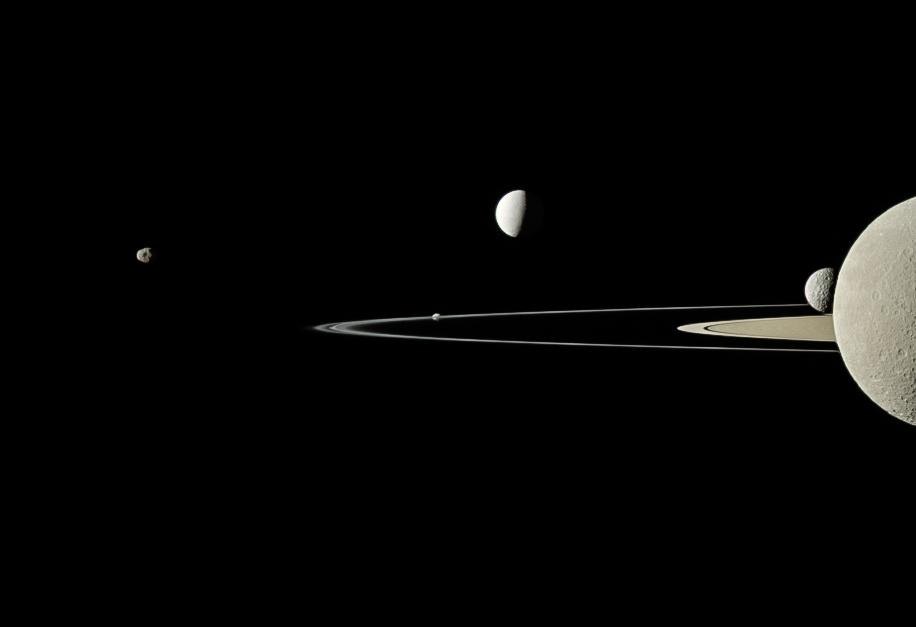
Saturn’s moons range from huge to tiny, and the seven largest were all found between 1655 and 1789.
| Moon | Diameter | Discovered | Notable feature |
|---|---|---|---|
| Titan | 5,150 km | 1655, C. Huygens | Thick atmosphere and surface lakes |
| Rhea | about 1,526 km | 1672, G.D. Cassini | Saturn’s second-largest of this group |
| Iapetus | about 1,492 km | 1671, G.D. Cassini | Slightly flattened shape |
| Dione | about 1,122 km | 1684, G.D. Cassini | Icy mid-sized moon |
| Tethys | about 1,056 km | 1684, G.D. Cassini | Giant crater on one side |
| Enceladus | about 502 km | 1789, W. Herschel | Global ocean under an icy shell |
| Mimas | about 394 km | 1789, W. Herschel | Smallest of the seven |
Diameters are doubled radii from NASA’s Saturnian satellite fact sheet (updated July 22, 2025), averaged across axes for non-round moons; discovery details from NASA’s Saturn moons page. Checked October 21, 2026.
Titan is the second-largest moon in the solar system after Ganymede and, according to NASA, larger than Mercury. It is the only moon with a thick atmosphere and the only known place besides Earth with liquid on its surface, in lakes and seas of hydrocarbons such as methane and ethane. NASA’s Dragonfly mission is set to launch to Titan in 2028 and make multiple landings over three years. The agency has not given an arrival date on the page used here.
Enceladus is small but scientifically important. NASA describes a global ocean under a thick icy shell and calls it a high-priority destination for future deep-space missions.
Uranus and Neptune: 29 and 16 moons, and the coldest surface known
Uranus has five major moons: Miranda, Ariel, Umbriel, Titania and Oberon. Miranda is the innermost and smallest of them, and Oberon is Uranus’s second-largest moon, according to NASA. The rest of its 29 are much smaller.
Neptune’s largest moon, Triton, was found by William Lassell on October 10, 1846, about two weeks after a Berlin observatory found Neptune itself. A Voyager 2 image caption on NASA’s page notes that Triton has the coldest surface known anywhere in the solar system.
Common questions
Which planets have the most moons?
Saturn is first with 293 confirmed moons and Jupiter second with 115, according to NASA. Uranus (29) and Neptune (16) follow. The totals grow as astronomers confirm more small moons.
Which planets don’t have moons?
Mercury and Venus. NASA says Mercury has no moons and that Venus is one of only two planets without one. Venus has a companion asteroid, Zoozve, that stays near it but is not a true moon.
What are the 8 planets and their moons?
Mercury 0, Venus 0, Earth 1, Mars 2, Jupiter 115, Saturn 293, Uranus 29, Neptune 16. The largest moons are Ganymede (Jupiter) and Titan (Saturn), both bigger than Mercury.
Which planets are most likely to have life?
No life has been found on any planet or moon in the solar system. NASA points to subsurface oceans on Europa, Ganymede and Enceladus, and to Titan’s hydrocarbon lakes, as reasons to study those moons, and describes Europa’s ocean as possibly containing ingredients for life. Mars is covered separately in our Mars facts guide.