Webb finds gas winds in up to half of massive galaxies at cosmic noon
An invited review of JWST observations says neutral gas winds blow from a quarter to a half of massive galaxies at cosmic noon, and powerful black hole winds look tied to rapid shutdown of star formation.
Astronomers Rebecca Davies and Sirio Belli have published a review of James Webb Space Telescope (JWST) results. It says neutral gas outflows blow from roughly 25 to 50 percent of massive galaxies at cosmic noon, and that the strongest, black hole-driven winds are tied to rapid shutdown of star formation.
What the review pulls together
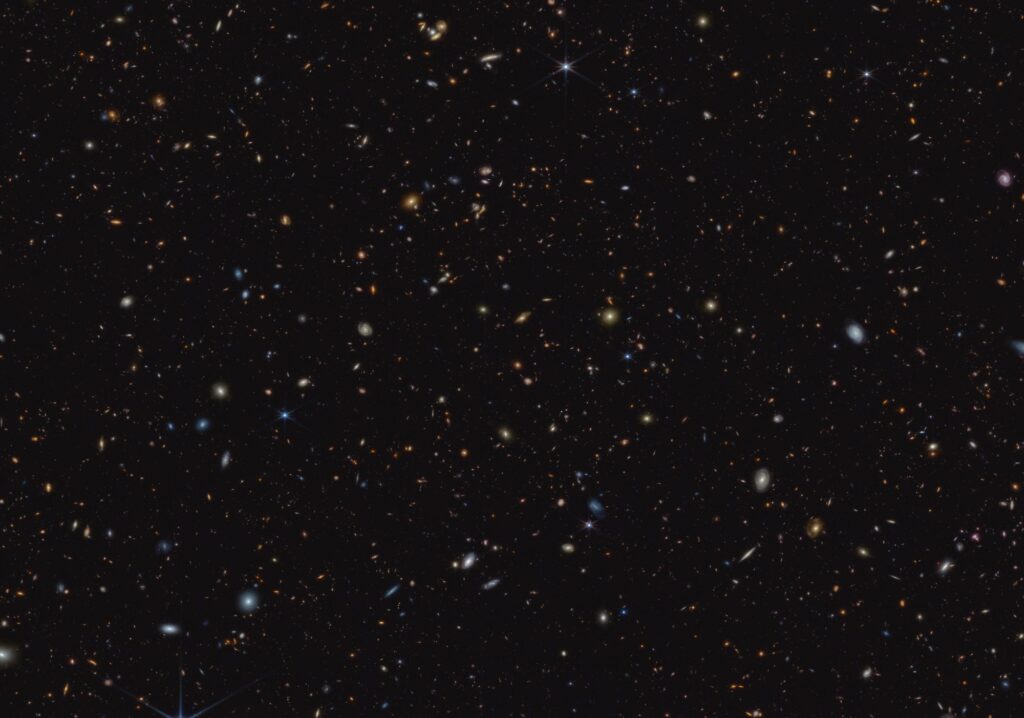
Cosmic noon is the period, roughly 10 billion years ago, when galaxies formed stars at their fastest. The review looks at massive galaxies at a redshift of about 2. Redshift measures how much the expansion of the universe has stretched light, so a higher number means a more distant, earlier galaxy. The authors define massive as more than 10 billion times the mass of the Sun in stars. The paper is an invited review for a prize collection in the journal Astrophysics & Space Science.
The central question is quenching, the process by which a galaxy stops forming stars. One long-standing idea is that an active galactic nucleus (AGN), a supermassive black hole actively swallowing gas, blows the fuel out of its galaxy. Direct evidence has been hard to get. The review combines two JWST tools. Balmer absorption lines, features in a galaxy’s spectrum from hydrogen, reveal when its stars formed, so astronomers can tell how quickly star formation stopped. Blueshifted sodium absorption, in which gas moving toward us shifts light to bluer wavelengths, reveals neutral gas flowing out.
The main findings, as the authors summarize them:
- Outflows are present in a subset of massive galaxies, and whether a galaxy has one does not depend on its star-formation rate.
- In star-forming galaxies the wind may come from star formation, the black hole, or both. In galaxies that have already stopped forming stars, it is mostly attributed to current or past black hole activity.
- Rapid quenching appears linked to powerful AGN-driven outflows, with a mass loading factor of at least about 1 to 10. That means the wind carries off at least as much gas as the galaxy turns into stars, and possibly ten times more.
- Neutral gas makes up most of the outflowing mass. Its speed is usually below the escape velocity of the galaxy’s surrounding halo, which suggests a galactic fountain, with gas that rises and later falls back.
Why dead galaxies need more than one explanation
The fountain finding matters because gas that falls back could restart star formation. The review also reports neutral inflows and leftover cold gas in quiescent galaxies. In the authors’ reading, that means something else, such as heating by the black hole, must keep these galaxies quiet after the initial blowout. Quenching, in other words, looks like at least two jobs: clearing gas quickly, then keeping it from cooling.
The authors also discuss how measurements of winds at several gas temperatures can test computer models of feedback, how uncertain outflow rates are, and what the results imply for the early massive quiescent galaxies JWST is finding.
Single galaxies that back the case
Several individual JWST studies, all on arXiv, give the review’s statistics concrete cases. One, of the galaxy COSMOS-11142 at redshift 2.45, found a powerful neutral outflow with a mass outflow rate sufficient to quench its star formation, yet no X-ray or radio activity from the black hole. Another, of GS-10578, measured outflow speeds of about 1,000 kilometers per second, comparable to the galaxy’s escape velocity, which its authors call direct evidence of ejective feedback in a recently quenched galaxy. A survey of 14 massive quiescent galaxies at redshift of about 2 likewise tied AGN-driven multiphase outflows to rapid quenching.
The payoff is a census instead of curiosities. With a fraction of 25 to 50 percent, outflows are common enough to matter for the whole population, but not so universal that every galaxy must pass through one. The remaining difficulty is that the neutral gas seen in absorption is only one phase of the wind, and converting a spectrum into a mass outflow rate carries large systematic uncertainty, which the authors flag. That is the same kind of early growth that makes distant black holes such as the quasar pair found 900 million years after the Big Bang so interesting to study alongside their host galaxies.