Asteroid 99942 Apophis: How close it passes on April 13, 2029, and how to see it
On April 13, 2029, the asteroid Apophis passes about 32,000 km above Earth, closer than many satellites, and will be visible to the naked eye from Europe, Africa and parts of Asia.
Dates and facts checked on the official pages on October 24, 2026.
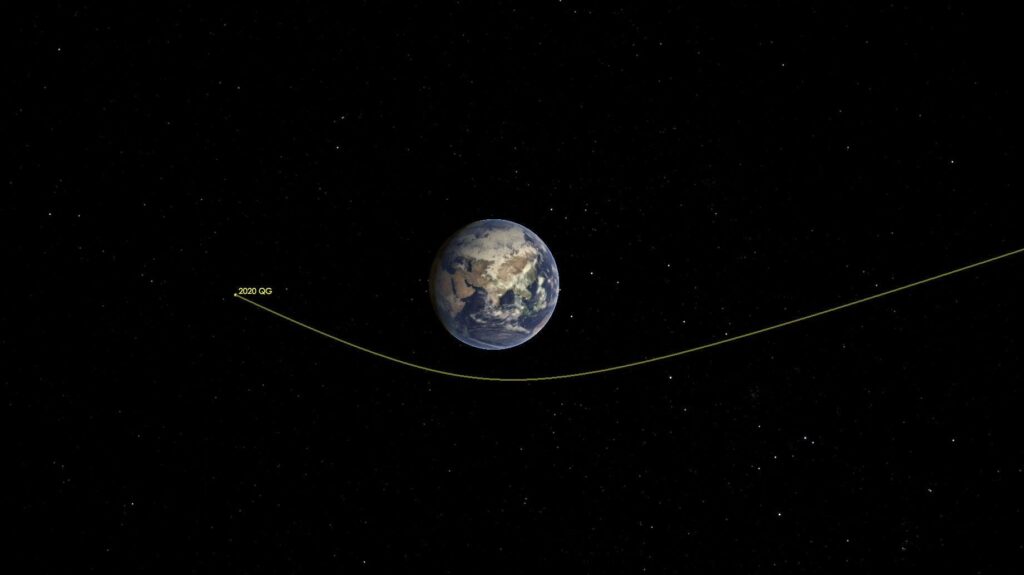
Asteroid 99942 Apophis will pass Earth on April 13, 2029, at about 32,000 km (20,000 miles) above the surface. It will not hit: NASA says Apophis poses no impact risk for at least 100 years. For a short time it will be visible to the naked eye from parts of Europe, Africa and Asia, making it the brightest and closest pass of an asteroid this size that anyone alive is likely to see.
The date, the distance and the viewing area all come from NASA and ESA. The sections below give the closest-approach time in UTC, local times for several regions, what Earth’s gravity will do to the rock, and the spacecraft that will study it.
Apophis passes closer than many satellites, with no chance of impact
Apophis is a stony asteroid, about 4.6 billion years old, that formed in the main asteroid belt between Mars and Jupiter. It was discovered on June 19, 2004, at Kitt Peak National Observatory in Arizona by Roy Tucker, David Tholen and Fabrizio Bernardi, and later received the minor planet number 99942. The name was approved in 2005.
Early orbit estimates in 2004 left open the possibility of an impact in 2029, 2036 or 2068. That is the origin of most "asteroid hitting Earth in 2029" headlines. Radar and telescope measurements since then have removed those possibilities, and NASA now states it is confident there is no impact risk for at least 100 years.
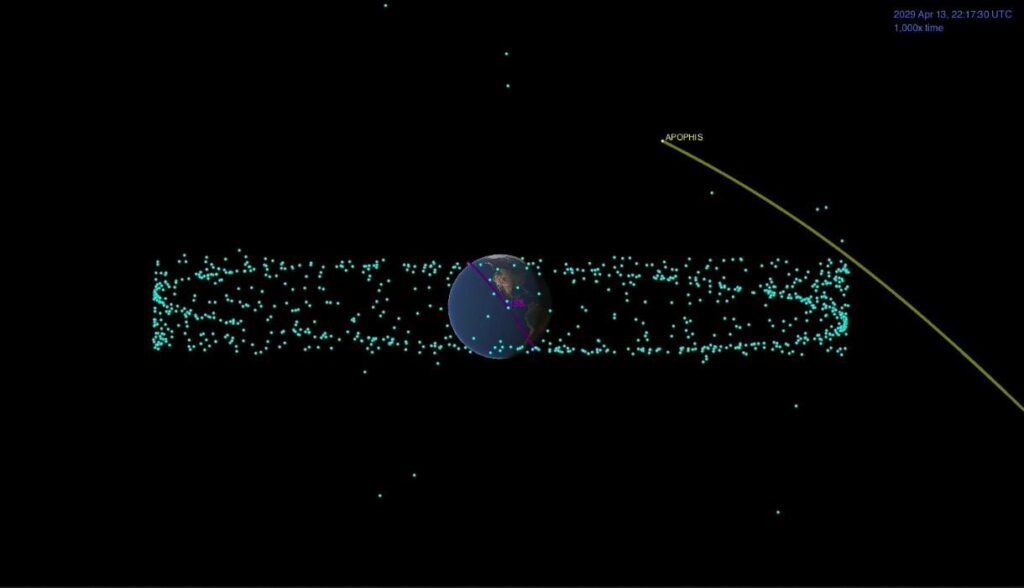
The 2029 distance of about 32,000 km sits inside the ring of geosynchronous satellites, which orbit at roughly 36,000 km above the equator. NASA says that this still threatens no one, neither people on the ground, astronauts nor spacecraft. NASA’s Center for Near Earth Object Studies (CNEOS) explains why: the asteroid’s path is tilted about 40 degrees to the equator, so it does not cross the busy satellite belt.
NASA classifies Apophis as a potentially hazardous asteroid, which is a label for any object large enough and close enough to be tracked closely. The label describes its orbit and size, not a prediction of impact.
The closest point comes at 21:45 UTC over the Atlantic
NASA’s pages give the date and the distance but not the minute. The minute comes from JPL’s Horizons system, the ephemeris service that computes positions of solar system bodies. For April 13, 2029, it puts the closest approach at 21:45 UTC, with Apophis about 38,000 km from the center of Earth. Earth’s radius is about 6,370 km, so that is roughly 31,600 km above the surface. CNEOS describes the point as lying over the mid-Atlantic.
| Moment (April 13, 2029) | UTC | London (UTC+1) | Paris (UTC+2) | New York (UTC-4) |
|---|---|---|---|---|
| Brightest in Horizons’ model | 20:30 | 21:30 | 22:30 | 4:30 p.m., daylight |
| Closest approach | 21:45 | 22:45 | 23:45 | 5:45 p.m., daylight |
Figures checked October 24, 2026, against the JPL Horizons ephemeris. Local times are converted from UTC using the clock offsets in force in April.
Apophis is a moving target, so the numbers change fast. Horizons shows the distance to Earth’s center falling from about 224,000 km at 12:00 UTC to the 38,000 km minimum, then climbing back to about 192,000 km by 06:00 UTC on April 14. The asteroid’s distance is closing at roughly 6 km/s many hours before and opening at the same rate afterward.
Who can see it: Europe, Africa and parts of Asia, but not the Americas
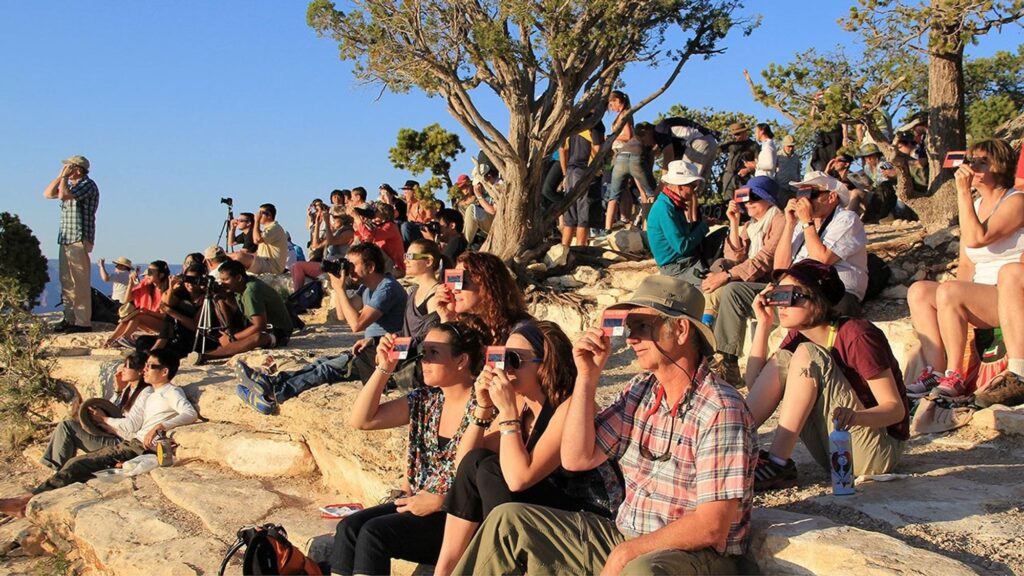
NASA says that observers in the Eastern Hemisphere can see Apophis without a telescope or binoculars, weather permitting. ESA narrows this to parts of Europe, Africa and Asia, and says the naked-eye view lasts only for a short time. At closest approach it will be on the night side of the world for those regions. For the Americas, April 13 is still daytime, so the pass cannot be seen there with the naked eye.
NASA’s CNEOS describes the view as a moderately bright point of light moving rapidly across the sky, much like a satellite but slower and steadier. Horizons models the brightness in magnitude, the astronomers’ scale where a smaller number means a brighter object and a difference of 5 is a factor of 100. By that model, Apophis peaks near magnitude 3.1 around 20:30 UTC, about the brightness of a moderately bright star, and has faded to about 3.8 at closest approach. Within two hours it has dropped beyond 5, the limit of what most people can see from a town, and by 23:00 UTC it is near 7 and needs binoculars.
The model brightness is an estimate, not a measured value, and the actual figure depends on the asteroid’s shape and how it reflects light. Treat 3 to 4 as the range to expect.
Moving that fast means the asteroid crosses the sky over hours, not in minutes. It will cross several constellations during the evening, and star charts for the date will be published in the run-up to 2029 by observatories and astronomy societies. Dark, clear skies away from city lights give the best chance.
How to plan a viewing, step by step
- Choose a location in Europe, Africa or western Asia. Locations farther west on that side of the world, such as West Africa and the Atlantic coasts, see the pass higher in a darker sky at the brightest moment.
- Convert 20:30 and 21:45 UTC to local time using the table above or a time zone converter, and plan to be outside by around 20:00 UTC.
- Find a place with a wide, dark horizon, away from lights.
- Look up the sky path for your location in the weeks before. Planetarium software with minor-planet data will show the track once the orbit is updated.
- Check the cloud forecast a day ahead. A telescope is not needed, but binoculars help you follow the object as it fades after closest approach.
Because the path crosses the sky so quickly, a sky chart with times matters more than a chart with a fixed position.
Earth’s gravity will stretch Apophis and change its orbit
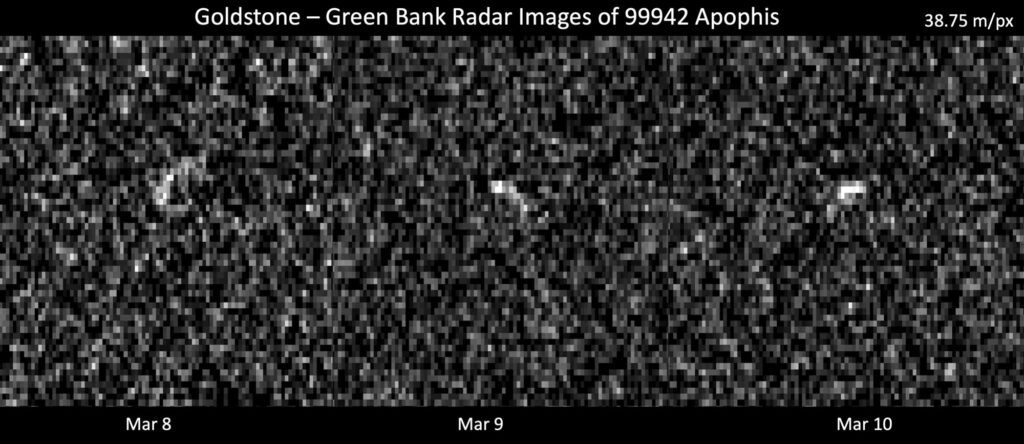
NASA gives Apophis a mean diameter of about 340 m (1,115 ft), with a long axis of at least 450 m (1,480 ft), roughly three American football fields. ESA describes it as roughly 375 m across on average. The shape is elongated, and radar images suggest it may be peanut-like, with two lobes.
Apophis does not spin around a single axis. NASA says it tumbles end over end about once every 31 hours, while also rocking about its long axis over roughly 264 hours. During the pass, Earth’s gravity will stretch and twist the rock. NASA says this will change its orbit and spin and may cause small landslides or quakes on the surface.
The orbit change is the key effect. Today Apophis circles the Sun in a little under a year (about 0.9 years) and crosses Earth’s path, which makes it an Aten-type asteroid. After 2029 NASA expects its orbit to grow to about 1.2 years, and it will be reclassified as an Apollo asteroid, a group whose orbits are larger than Earth’s.
The radar picture below was recorded in March 2021 from the Goldstone antenna in California and the Green Bank Telescope in West Virginia, when Apophis was 17 million km away.
Two spacecraft will watch it, one from before the flyby and one from after
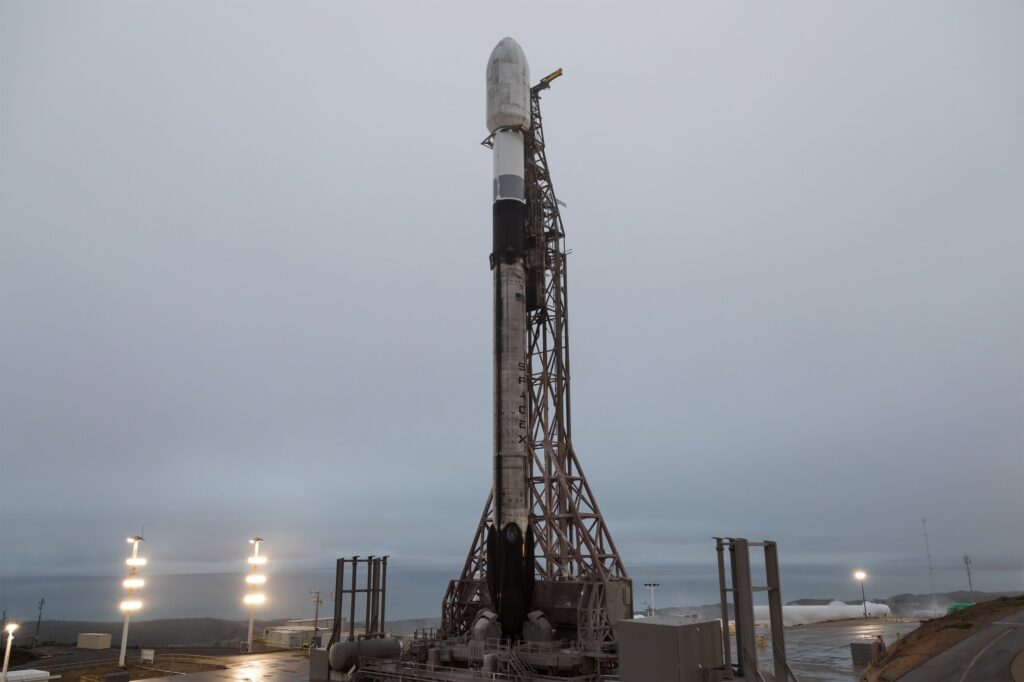
ESA’s Ramses (Rapid Apophis Mission for Space Safety) is meant to rendezvous with Apophis and accompany it through the 2029 flyby, so it can measure how Earth’s gravity changes the asteroid. According to ESA, it will carry two CubeSats, small box-shaped satellites, to be released after arrival. Launch dates for Ramses will appear in the rocket launch schedule once confirmed.
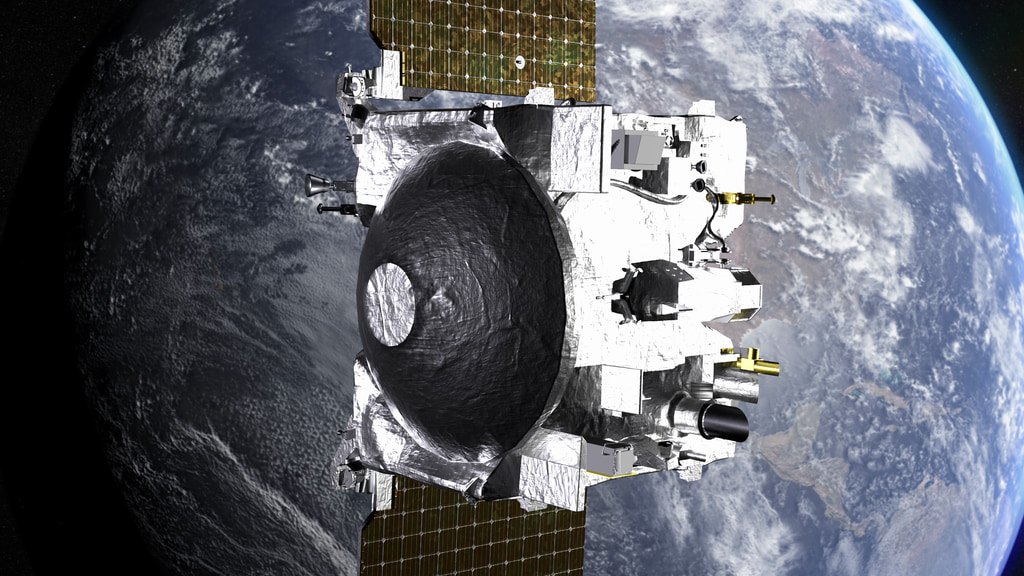
NASA has redirected OSIRIS-APEX, the spacecraft that brought a sample back from the asteroid Bennu as OSIRIS-REx, to study Apophis. NASA’s mission page lists the rendezvous for June 2029, after the flyby. The spacecraft is planned to dip toward the surface and fire its thrusters to stir up loose rocks and dust, showing material just below the surface. Together, the missions give scientists a before-and-after record of how a planet’s gravity reshapes an asteroid, useful knowledge for planetary defense.
On the ground, NASA coordinates telescope campaigns through the International Asteroid Warning Network (IAWN).
Common questions
Will Apophis hit Earth in 2029?
No. NASA says there is no risk of Apophis impacting Earth for at least 100 years. A 2.7% impact chance for 2029 was briefly calculated right after discovery in 2004, and later measurements ruled it out.
What time is Apophis closest to Earth on April 13, 2029?
JPL Horizons gives 21:45 UTC. That is 22:45 in London and 23:45 in Paris, and 5:45 p.m. in New York, where it is still daylight and the asteroid cannot be seen.
Is Apophis really closer than satellites?
Yes, closer than satellites in geosynchronous orbit, which sit at about 36,000 km. Apophis passes about 32,000 km above Earth’s surface. NASA says those satellites are not at risk.
Can people in the United States see Apophis?
Not with the naked eye. NASA and ESA describe the view as an Eastern Hemisphere event, and the closest approach falls in the late afternoon in the eastern United States. Online broadcasts are likely, and the radar and spacecraft data will be public.
Figures checked October 24, 2026.