Mars dust is finer than thought, and Perseverance has now measured it
NASA's Perseverance rover has made the first on-site measurements of fine and ultrafine Martian dust, grains small enough to reach the lungs and bloodstream of future astronauts.
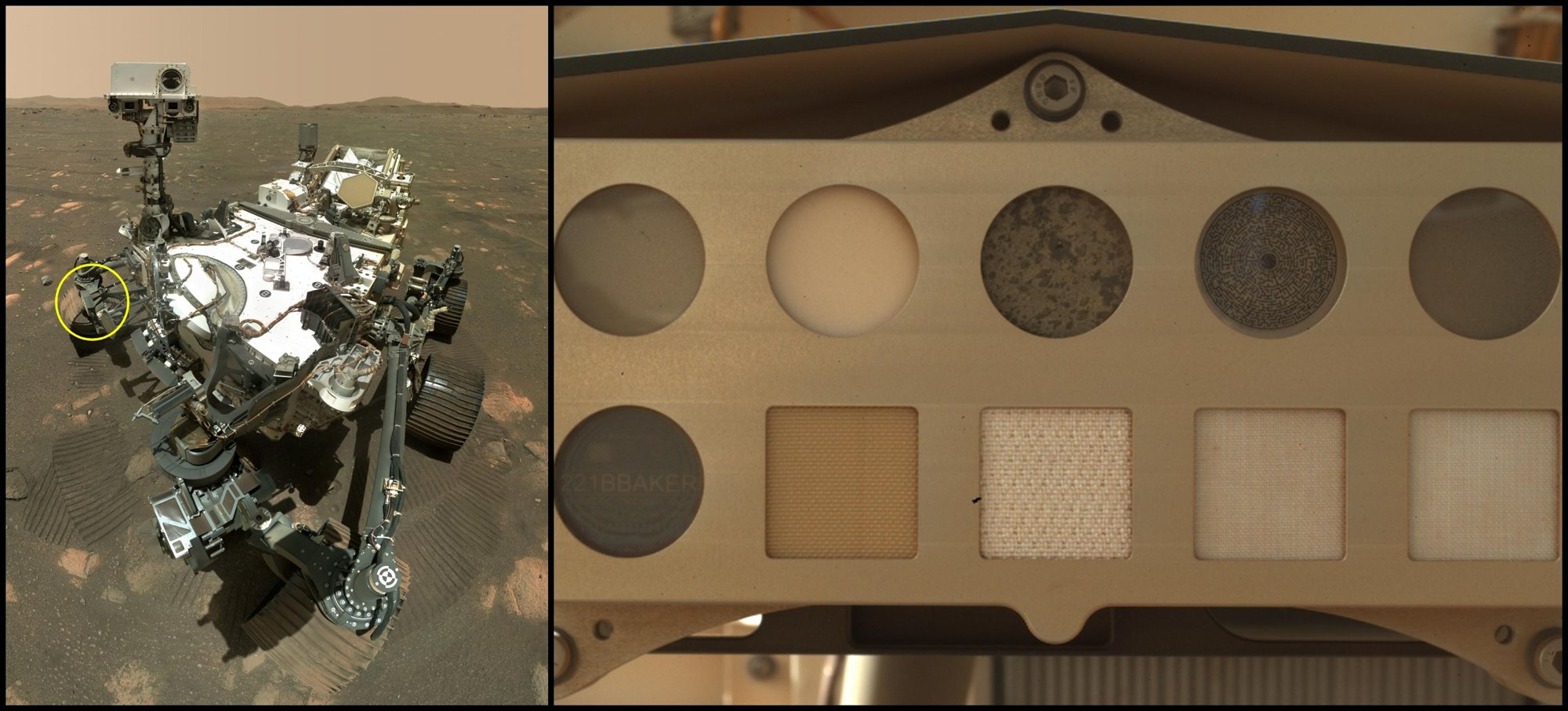
NASA’s Perseverance rover has measured Martian dust grains as small as about 100 nanometers across, finer than any measured on Mars before, NASA said. Grains this small can enter the bloodstream, so the data may shape spacesuit, habitat and crew-health rules for Mars.
The results come from the rover’s PIXL instrument and are due to be published on Oct. 27 in the Proceedings of the National Academy of Sciences. They cover 1,645 Martian days of dust sticking to material samples that the rover carries.
Spacesuit swatches as dust traps
Perseverance carries five swatches of spacesuit material, each 20 millimeters (three-quarters of an inch) square. They sit on the calibration target of SHERLOC, an instrument on the rover’s robotic arm that scans rocks for organic chemicals. The calibration target of a second instrument, PIXL, an X-ray spectrometer that maps the chemical elements in a rock, holds a piece of Teflon and a piece of basaltic glass.
The Teflon is the useful part. It contains no elements PIXL can detect directly, so any elemental signal from it must come from dust resting on its surface. The team also studied the Teflon and Vectran swatches on SHERLOC’s target. Both materials are used in spacesuits, and NASA sent them to learn how they hold up on the Martian surface.
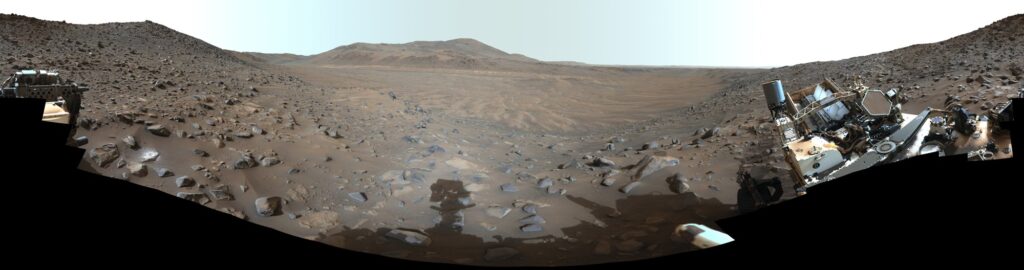
Dust has been a surface-exploration challenge since the Apollo program.
That is how Lindsay Hays, acting director of NASA’s Planetary Science Division, put it. Lunar dust scratched visors, wore down outer suit layers and damaged seals during Apollo, and some crew members reported symptoms like hay fever. Mars dust is less abrasive because wind has rounded the grains, but it is richer in sulfur, chlorine and iron than lunar dust and contains more silica.
Particles 700 times thinner than a hair
Earlier measurements on Mars could resolve grains down to about 3 micrometers (millionths of a meter). PIXL found two smaller classes: fine particles under 2.5 micrometers, and ultrafine particles of around 100 nanometers (billionths of a meter), about 700 times thinner than a human hair. On PIXL’s Teflon target and SHERLOC’s Vectran swatch, particles averaged about 2 micrometers. On PIXL’s basaltic glass and SHERLOC’s Teflon swatch, they went down to roughly 100 to 300 nanometers.
Static electricity appears to decide which grains cling to which material. Dust becomes charged as grains collide in the air, and different materials attract different sizes. The smallest particles stayed on through years of driving and drilling. In the words of lead author Scott VanBommel of Washington University in St. Louis, “The larger clumps, the Martian dust bunnies, get shaken off over time.” NASA says Teflon, common in the outer layers of suits, collects fine dust readily, while other materials hold less. That could guide the choice of materials and protective coatings.
Chemically, the dust matches the iron- and sulfur-rich composition that earlier missions found. PIXL also found it enriched in phosphorus and detected signs of calcium sulfate.
Health limits and design choices still to be set
On Earth, particles under 2.5 micrometers are linked to health problems because they can reach deep into the lungs and the bloodstream. NASA notes that studies show ultrafine particles can travel from the nose to the brain along the olfactory nerve. Martian dust is mostly silicate minerals and carries reactive compounds, including perchlorates, which can disrupt thyroid function, and reactive iron, which causes cellular damage. Scientists believe the risk depends on how much dust a person breathes and for how long.
NASA says these are the first on-site measurements of fine and ultrafine particles on Mars. It expects them to feed into indoor dust-exposure limits for astronauts, safe working habits and cleaning methods. The agency points to two habitat designs that could keep dust out of living quarters: suitports, where a suit stays mounted on the outside wall and the astronaut climbs into it from within, and airlocks with two separate chambers.
Testing on the Moon is already under way. In March 2025, an Electrodynamic Dust Shield, which uses electric fields to clear dust from surfaces, flew to the lunar surface on Firefly Aerospace’s Blue Ghost Mission 1. At the Johnson Space Center in Houston, engineers test suit parts and a handheld electrostatic dust tool in vacuum chambers with lunar soil simulant ahead of Artemis surface missions.
A rover that was built to help prepare for crews
The finding shows how long an instrument can stay useful. NASA’s mission page says the Perseverance rover landed in Jezero Crater on Feb. 18, 2021. On Oct. 11, 2026, its odometer reached 28.10 miles (45.22 kilometers), passing the off-world distance record set by the Opportunity rover. The dust on those calibration targets has therefore been collected over years of real driving and drilling, which a laboratory test would struggle to copy.
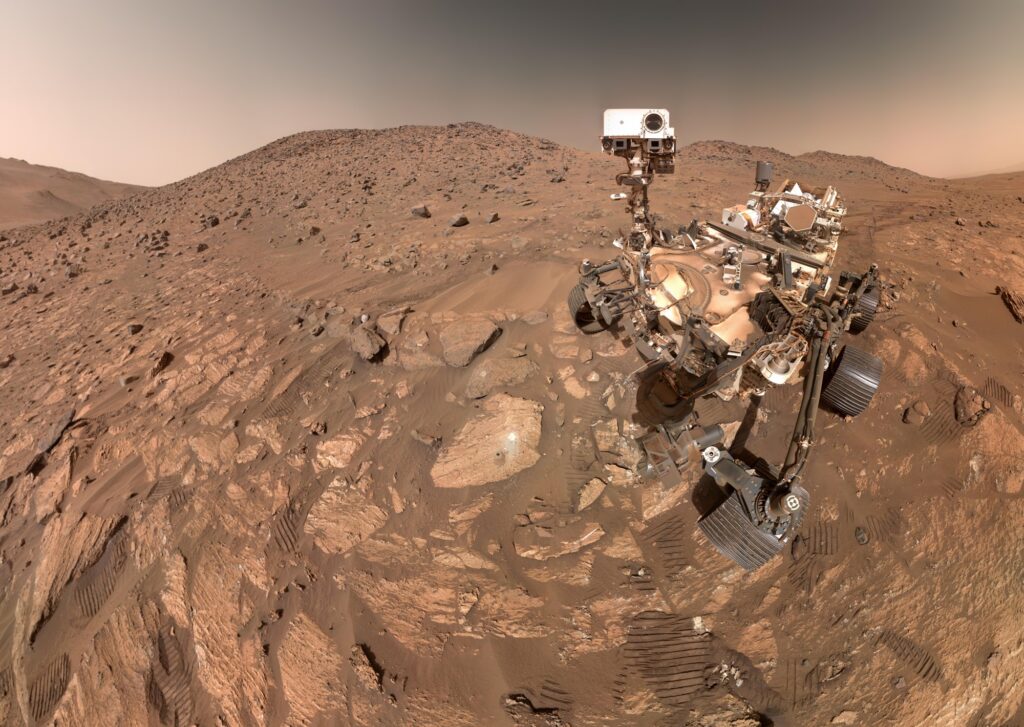
NASA’s image of Perseverance’s July 23, 2024 selfie, built from 62 separate images, shows the same dusty deck where the calibration targets sit. Katie Stack Morgan, the mission’s project scientist, said the rover’s main job is the search for signs of ancient microbial life, but that it was also designed to help prepare for human explorers, with MOXIE, Ingenuity and the spacesuit samples as examples.
What to watch is how NASA turns the numbers into rules. The PNAS paper is the next milestone. Then comes whether flight surgeons adopt tighter dust-exposure limits and whether the Moon tests of dust shields and handheld tools carry over to Mars hardware.