Chile’s CTAO gamma-ray site gets two giant telescopes, taking it to 53
The southern Cherenkov Telescope Array Observatory at Paranal in Chile will get two Large-Sized Telescopes, extending its reach to the faintest gamma-ray flashes.
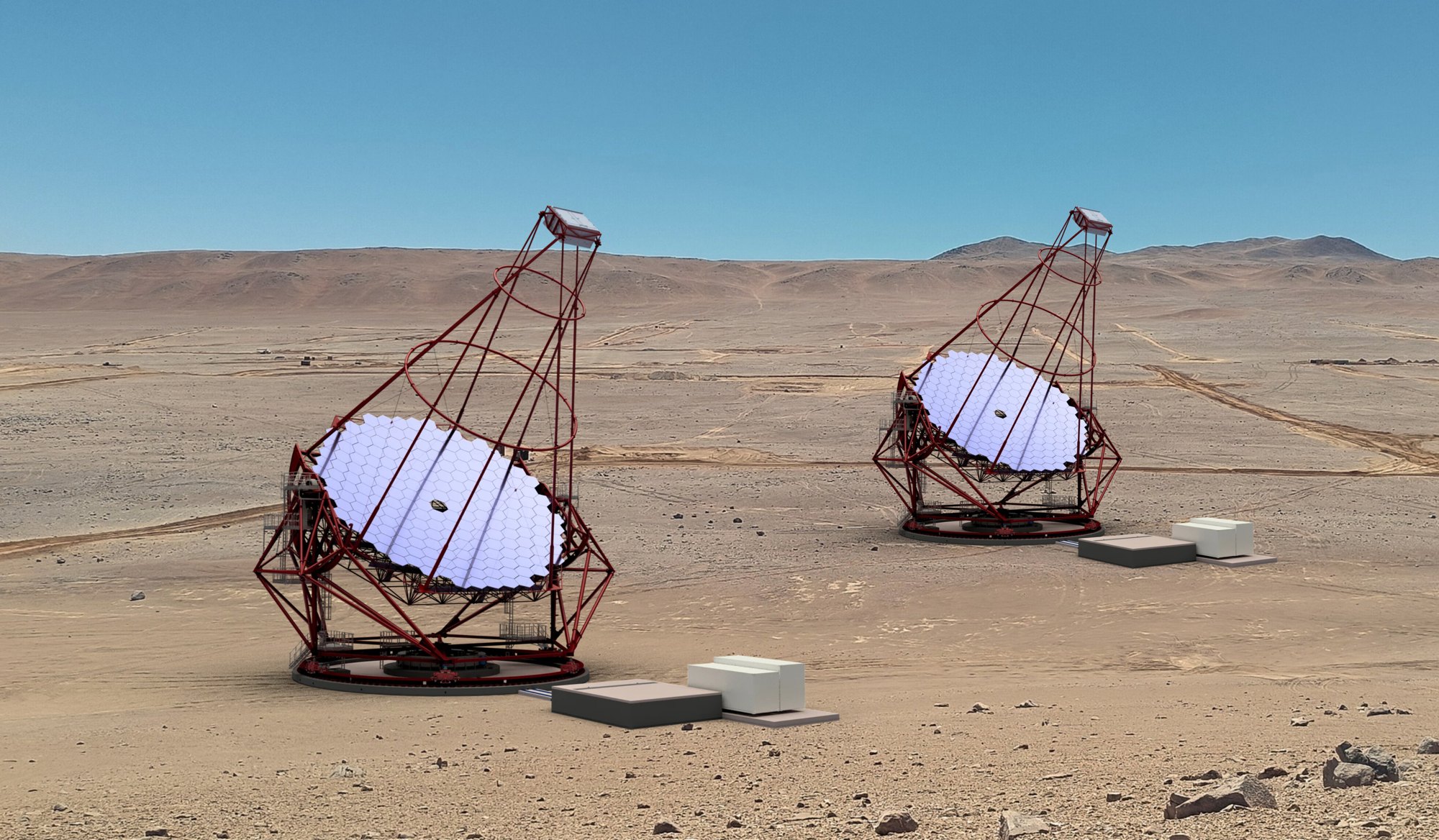
The southern site of the Cherenkov Telescope Array Observatory (CTAO) in Chile will be more powerful than planned. ESO announced that two Large-Sized Telescopes will join it at Paranal, bringing the site to 53 telescopes.
Two big dishes for the faintest flashes
Gamma rays are the most energetic form of light. They never reach the ground, because they strike the atmosphere and produce brief flashes of blue light. CTAO telescopes detect those flashes. Different sizes of telescope suit different gamma-ray energies: the weakest flashes come from low-energy gamma rays, and only the largest mirrors can collect enough of that light.
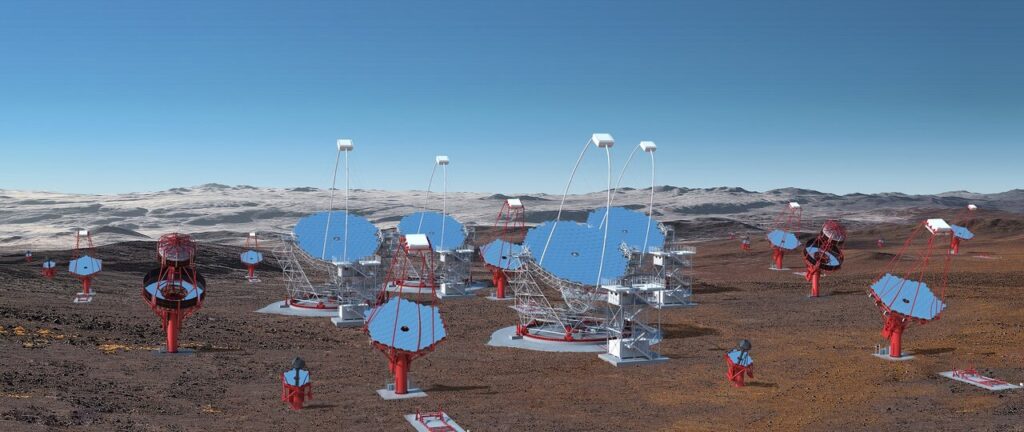
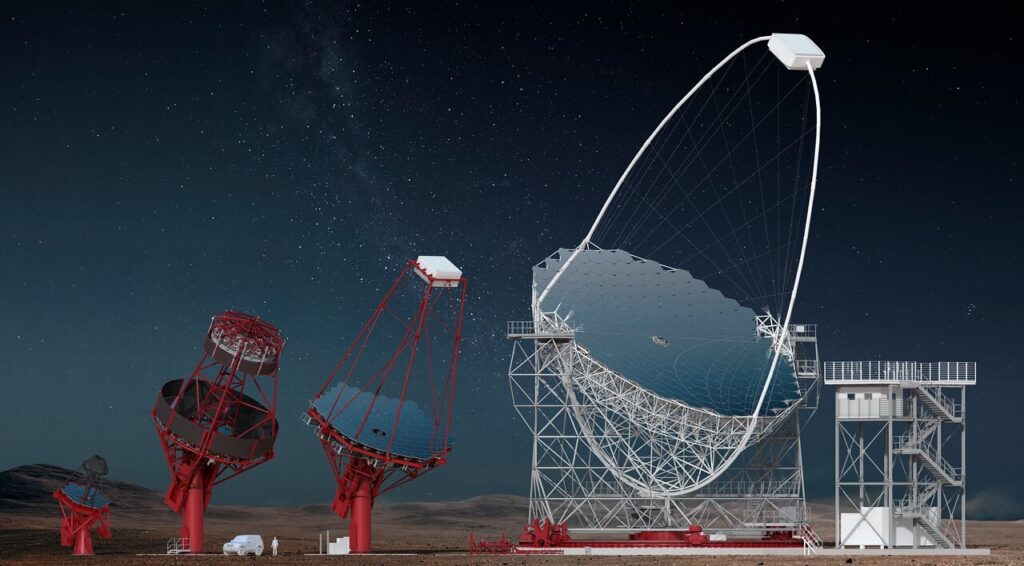
Until now, only CTAO-North, on La Palma in Spain, was planned to have Large-Sized Telescopes (LSTs). Under a new layout called the Beta Configuration, CTAO-South gets two of its own. It will then host all three telescope types: Large, Medium and Small. Across the whole observatory, CTAO will observe gamma rays from 20 GeV up to 300 TeV, and ESO notes that even the lowest of those energies is billions of times greater than that of a visible-light photon.
The southern LSTs are not copies of the northern ones. Their design, coordinated by the Italian National Institute for Astrophysics (INAF), has been optimized for conditions in the Atacama Desert.
Looking further back, and faster
Very high-energy gamma rays are often absorbed on their way across space, while lower-energy ones can arrive from much farther away. With their low-energy threshold, the LSTs will let scientists study more distant sources and look further back into cosmic history.
The LSTs are also quick. Despite their weight and size, they can swing to any point in the sky in under 30 seconds, according to ESO. That makes them well suited to catching gamma-ray bursts, brief and elusive explosions, before they fade.
The new configuration doubles the CTAO-South array’s sensitivity between 50 and 80 GeV and improves it by about 25% between 80 and 300 GeV.
Against today’s Cherenkov telescopes
The change matters most when set beside the instruments now in use. In its 2023 blog post on CTAO, ESO noted that H.E.S.S., MAGIC and VERITAS, today’s Cherenkov telescope arrays, have at most five telescopes each. It described CTAO as hundreds of times more sensitive than those current instruments.
The same post gives the scale of the hardware: dish diameters of 4 meters for Small-Sized, 12 meters for Medium-Sized and 23 meters for Large-Sized Telescopes. The southern array is to spread over roughly three square kilometers. The 51 telescopes ESO then listed for Paranal rise to 53 with the two LSTs, and the low-energy gap in the south is closed.
Adding LSTs in the south also means the observatory can follow the same low-energy sources from both hemispheres, which neither site could do alone. The sky visible from Chile differs from that visible from La Palma, so the southern LSTs open a view that the northern ones cannot give.
Roads laid, foundations next
Development of CTAO-South is well underway. Preparation work already completed includes 17 kilometers of roads and the foundations for the Small- and Medium-Sized Telescopes. On-site preparations for the LSTs have started, and ESO expects their foundation construction to be finished by the end of the year.
The extra telescopes are largely funded by the “PNRR-CTA+” project of the Italian Ministry of University and Research (MUR). INAF leads the project, working closely with the nuclear physics institute INFN, a number of Italian universities and partners abroad within the CTAO LST Collaboration.
CTAO was established by the European Commission as a European Research Infrastructure Consortium in January 2025. Its headquarters are in Bologna, Italy, and CTAO-South is operated by ESO at Paranal.