A cat-shaped dust pillar in Carina, seen by Hubble and Webb
Hubble and Webb photographed a cat-shaped pillar of dust in the Carina Nebula, and each telescope reveals details the other cannot, including a likely baby star for an eye.
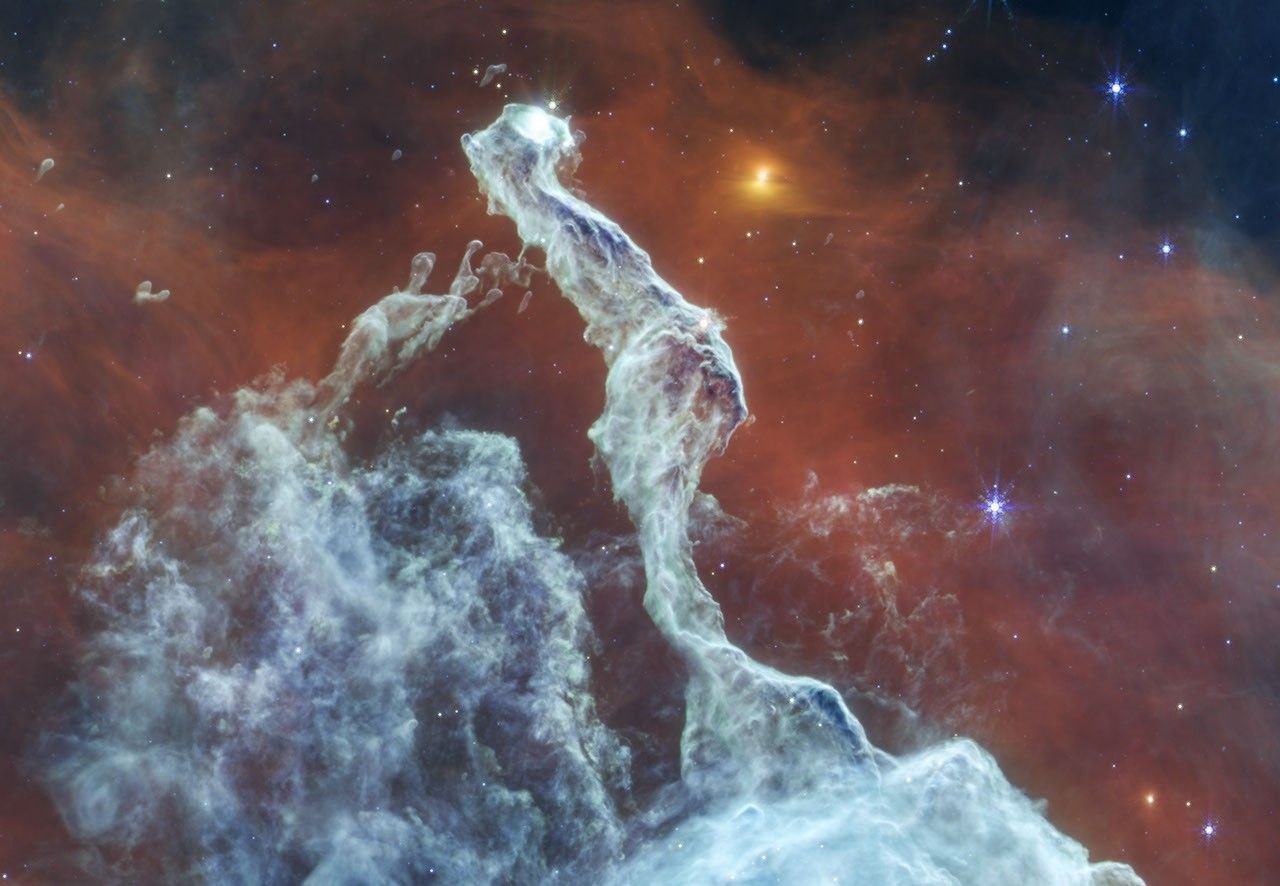
NASA’s Hubble and James Webb space telescopes have imaged a dusty pillar nicknamed the Cat’s Head Nebula, inside the Carina Nebula about 7,500 light-years away. NASA said the pillar’s “eye” may be a young star still wrapped in dust.
One cat, three different views
The Carina Nebula is a large cloud of gas and dust where new stars are forming. The small patch observed by both telescopes looks like a cat sitting with its back to the viewer, head turned to the right. NASA released the images on October 29, 2026, just ahead of Halloween.
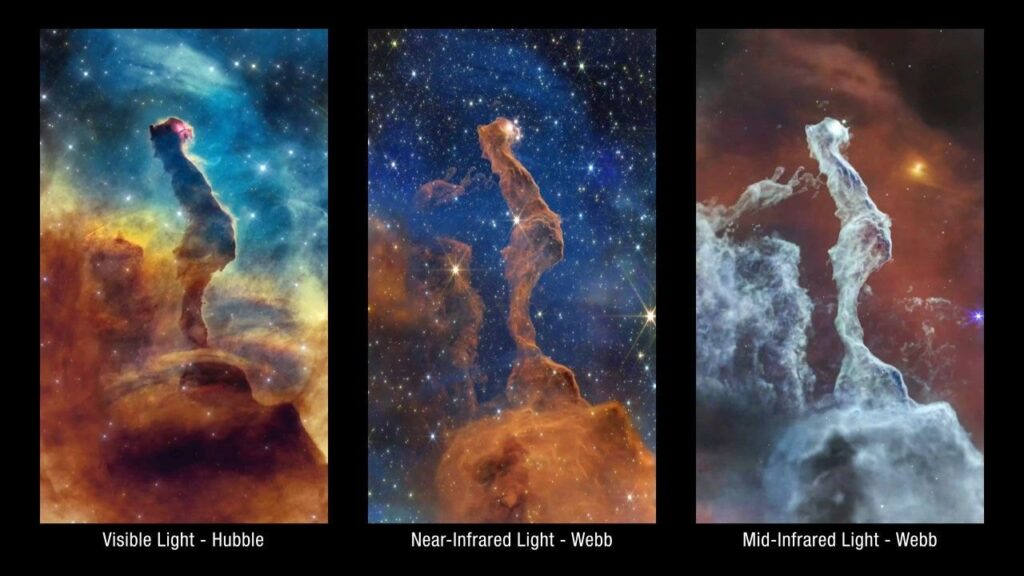
Hubble saw the scene in visible light, the kind human eyes detect. There the pillar is an opaque, dark brown column of dust. A hazy yellow ridge runs along its right edge, which NASA says fits gas lit and ionized (stripped of electrons) by ultraviolet radiation from nearby massive stars. That could be driving photoevaporation, the process in which radiation heats gas until it boils away. The surrounding haze shifts from blue and cyan at the top to yellow, orange and red at the bottom, because Hubble’s filters pick up light from oxygen, hydrogen and sulfur, plus starlight scattered by dust.
Webb looks in infrared, which passes through dust far better than visible light. In its near-infrared image the pillar turns more transparent and its surface texture appears. Ghostly wisps of dust and gas show up to the cat’s left, and a dense field of stars, plus a few faint background galaxies, fills the frame. The eye glows yellow here, and some stars remain hidden by dust even at these wavelengths.
Webb’s mid-infrared image traces warm dust and carbon-based molecules energized by starlight. Delicate globules and strands to the pillar’s left stand out. To the right of the pillar sits a bright yellow source that NASA describes as likely an infant star embedded in dust. A narrow filament appears to cross it, but NASA says the image alone cannot show whether the two are physically connected.
A shape that will not last
NASA says the cat’s head was probably carved over time by ultraviolet light and winds from the massive stars of Carina. As that radiation wears away the surrounding gas and dust, the denser material in the pillar resists, for now. The agency calls the scene temporary: it will eventually disperse as stars form and evolve. Comparing the three wavelengths lets astronomers study how star formation, which is chaotic and hard to observe directly, plays out in one small region.
A small patch of a much larger star factory
This is not the first time Webb has looked at the Carina Nebula. When NASA unveiled the telescope’s first full-color images on July 12, 2022, one of them showed the “Cosmic Cliffs,” the edge of a gas cavity in the nearby region NGC 3324. According to NASA’s Webb release, that region lies roughly 7,600 light-years away and its tallest “peaks” are about 7 light-years high. A light-year is the distance light travels in a year, nearly 9.5 trillion kilometers.
Against the Cosmic Cliffs, the Cat’s Head is a much smaller target, and NASA calls it a relatively small, dusty filament within the larger nebula. Its value comes from the pairing: Hubble, working since 1990, supplies the visible-light view, while Webb, a collaboration of NASA, ESA and the Canadian Space Agency, supplies two infrared views of the same patch. Seeing the same pillar in three kinds of light is what lets the dust, glowing gas and buried stars be told apart.
The forces sculpting the pillar come from some of the heaviest stars known. In its description of an earlier Hubble image of Carina, NASA says the region holds at least twelve giants that each weigh between 50 and 100 times as much as our Sun.
NASA credits the image processing to Joseph DePasquale of the Space Telescope Science Institute in Baltimore, which runs Hubble science operations for NASA. Goddard Space Flight Center in Greenbelt, Maryland manages Hubble and its operations. The agency also published a flight-through video and a visualization comparing the three images.