3I/ATLAS carries methane with 13 times more heavy hydrogen than any comet we have measured
Webb spectra of interstellar object 3I/ATLAS show methane with 3.18% heavy hydrogen, higher than any methane measured in the Solar System and 13 times the level in comet 67P.
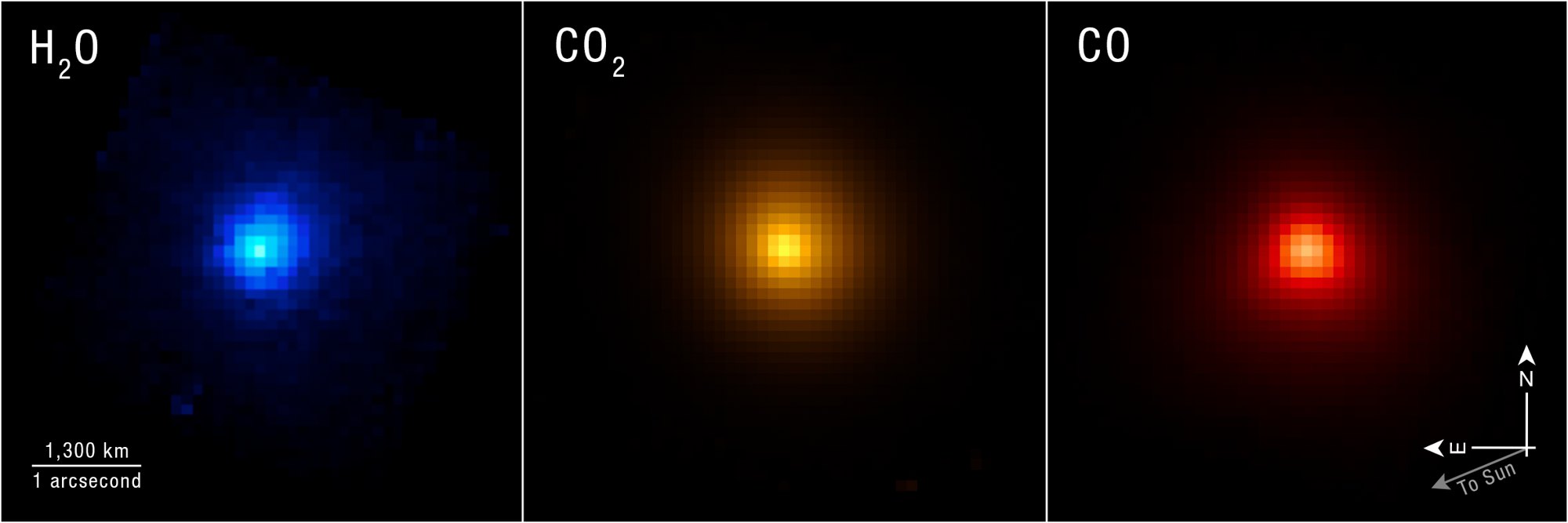
Astronomers using the James Webb Space Telescope have found that methane in interstellar object 3I/ATLAS holds 3.18% heavy hydrogen, a higher share than any methane measured in the Solar System, according to a paper in Nature Astronomy.
A heavy-hydrogen fingerprint in the comet’s gas
Hydrogen comes in two forms: ordinary hydrogen, and deuterium, a heavier version with an extra neutron. The share of deuterium relative to hydrogen is called the D/H ratio. It records how cold the place was where a molecule formed, because very cold gas and ice favor the heavy version.
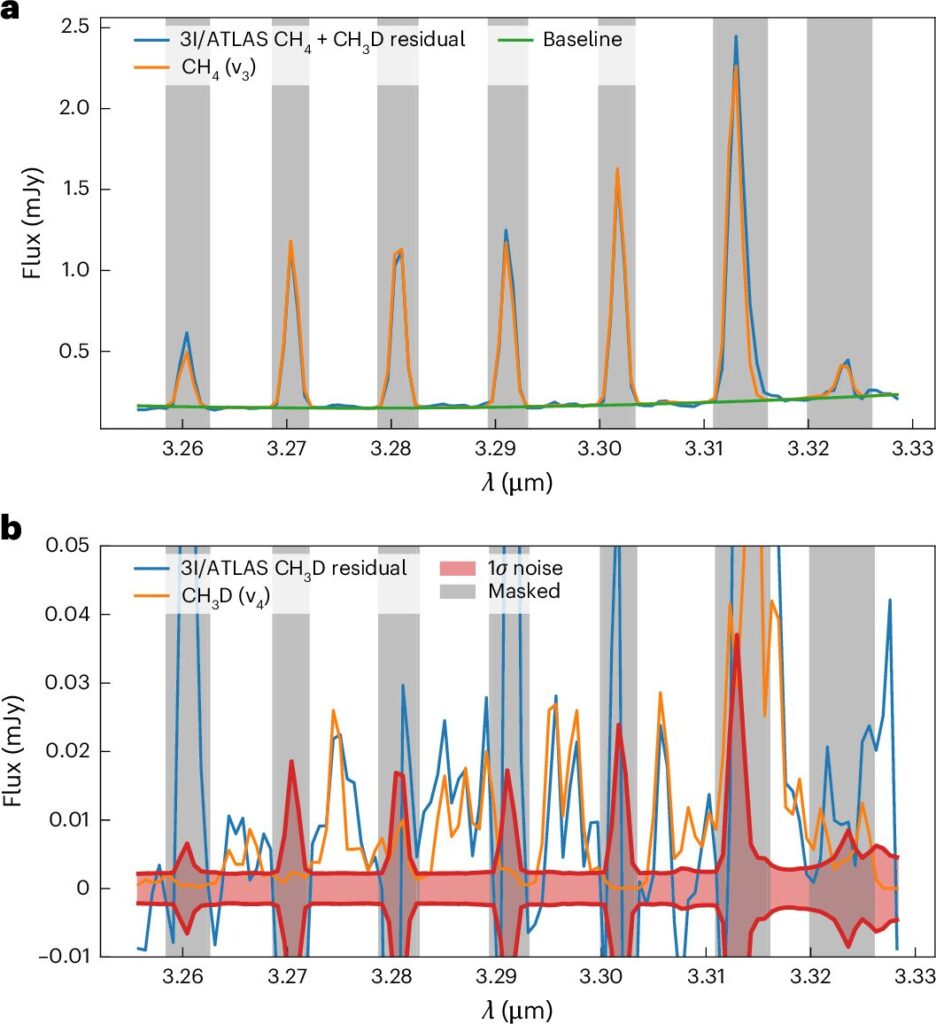
The team, led by Nathan X. Roth of NASA’s Goddard Space Flight Center, studied near-infrared spectra of the comet’s coma, the cloud of gas and dust around its nucleus. Each molecule absorbs and emits light at set wavelengths, so a spectrum shows what the cloud contains. The researchers measured methane (CH4) and its deuterated twin, CH3D, and found D/H = (3.18 ± 0.30)%. The data come from Webb program 5094 and are public in the Mikulski Archive for Space Telescopes.
Only one comet has had deuterated methane detected before: 67P/Churyumov-Gerasimenko, which the Rosetta spacecraft studied up close. The 3I/ATLAS value is a factor of 13 ± 2 higher than the 67P figure. The authors call the detection of deuterated organic molecules in an interstellar object “exceedingly rare”.
Organic molecules soak up more heavy hydrogen than water
In both 3I/ATLAS and 67P, methane carries more deuterium than water does. The paper says this matches other Solar System bodies and the nearby interstellar medium, where organic molecules can be enriched by up to ten times more than water.
Methane’s D/H has not been pinned down in any other source outside our Solar System. The nearest comparisons are methanol and formaldehyde, two other carbon-based molecules, measured around stars that are still forming. The 3I/ATLAS methane looks like those.
The authors conclude that the ice is consistent with forming in a cold, low-metallicity environment under strong cosmic ray bombardment. Metallicity is the share of elements heavier than hydrogen and helium, so a low-metallicity setting means a gas cloud or young system with few heavy elements. Cosmic rays are fast charged particles that drive chemistry in cold clouds. The paper does not say which star or cloud the object came from.
One more measurement pointing the same way
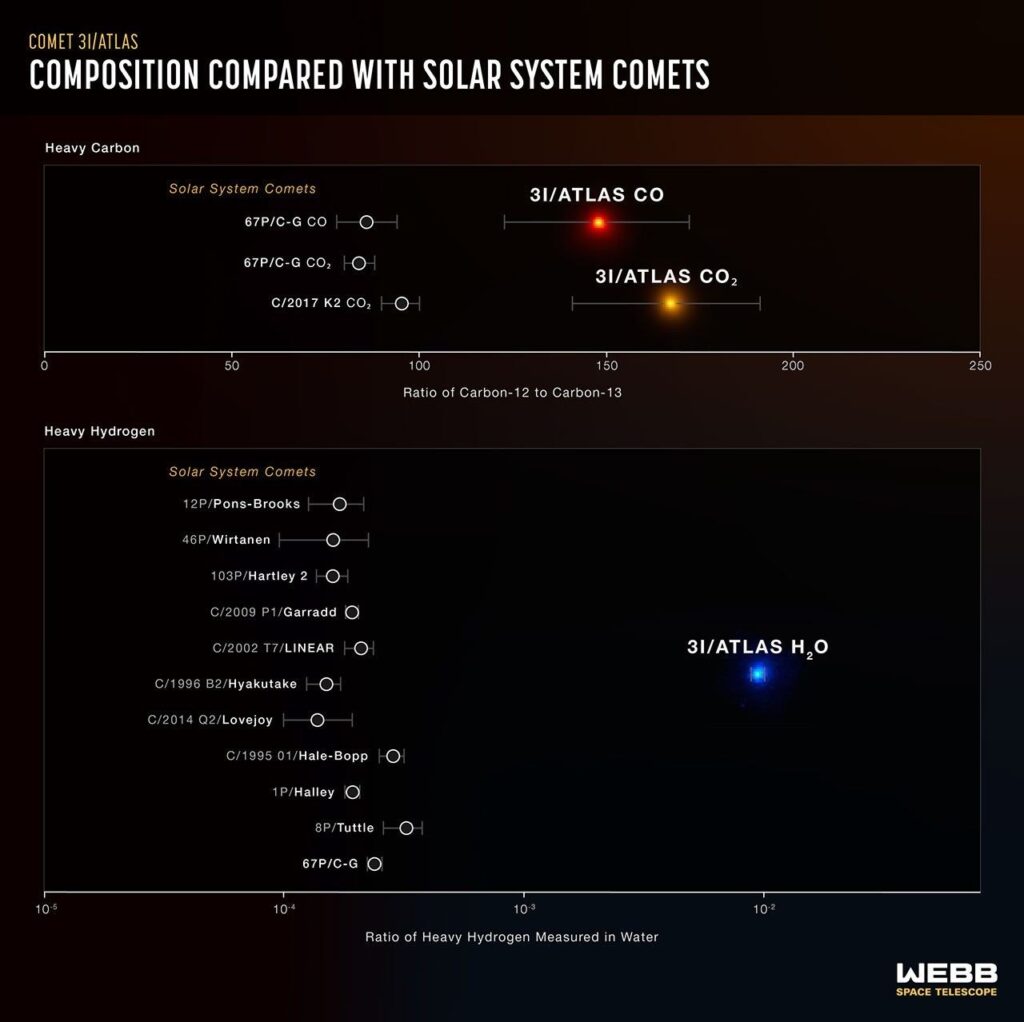
This result adds to earlier Webb work. NASA reported in June 2026 that Webb’s Near-Infrared Spectrograph found deuterium in 3I/ATLAS about 30 times higher than in Solar System comets, and that the comet’s carbon-12 to carbon-13 ratios exceed 150, against just under 100 in Solar System comets. The NASA team estimated the comet formed 10 to 12 billion years ago, during the era of peak star formation known as cosmic noon.
The D/H ratio in methane itself is observationally unconstrained in extrasolar sources to date
That sentence from the paper’s abstract shows the limit of the comparison. Without methane measurements around other stars, the 3I/ATLAS value can be set against comets and star-forming regions, but not against other planetary systems. Each new D/H measurement in the object’s gas (water, methanol, now methane) tightens the same story: this ice formed colder and in a different chemical setting than the material that built our own comets.
What would sharpen the picture is a methane D/H from another interstellar visitor, or from more distant star-forming regions, which would show whether 3.18% is typical of ice from other systems or unusual even for them. The object has already left the inner Solar System, as we covered in our report on what Hubble, Webb and SPHEREx found about 3I/ATLAS, so the archived Webb data remain the main source. The authors have released the spectra and modeling scripts openly on Zenodo, so other teams can test the retrieval.
For background on why deuterium links back to the birth of planets, see our piece on water in planet-forming disks and its tie to Earth’s water.