Hubble finds almost no sulfur around interstellar comet 3I/ATLAS
Hubble spectra from December 2025 and January 2026 show the coma of 3I/ATLAS holds far less sulfur than solar system comets, a clue to how it formed.
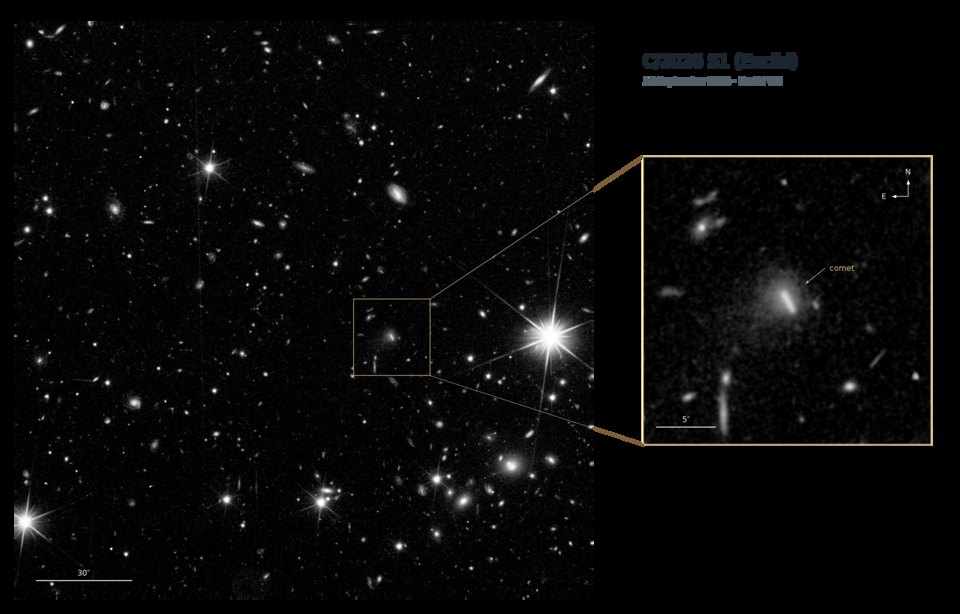
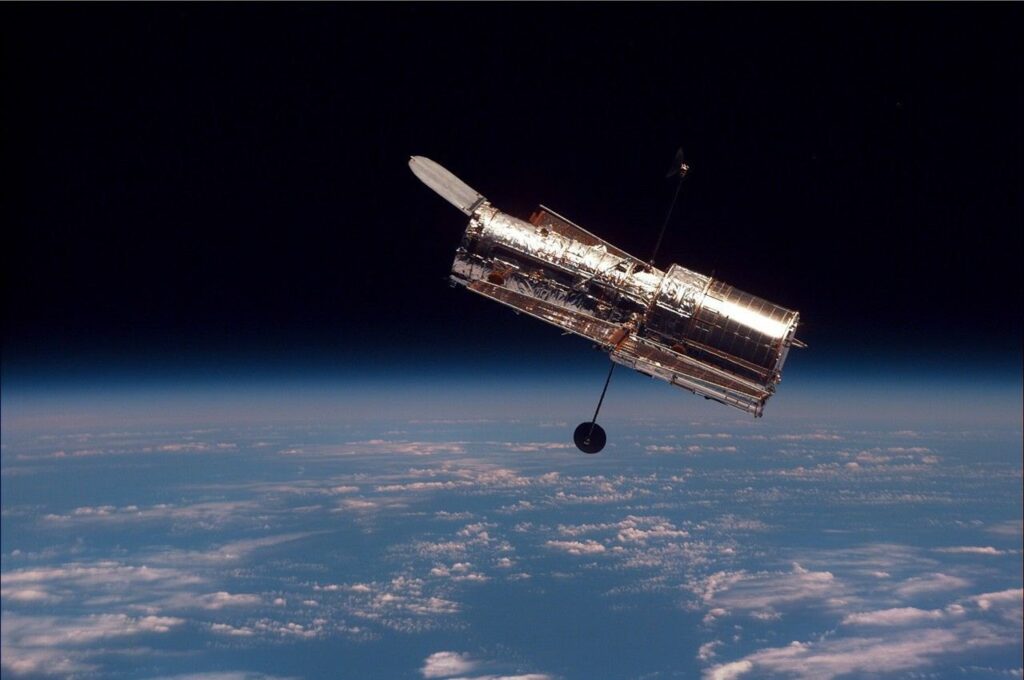
Hubble Space Telescope observations of interstellar comet 3I/ATLAS found almost no atomic sulfur in its gas cloud, according to a paper in The Astrophysical Journal Letters. The sulfur-to-oxygen ratio is below 0.4% in December 2025 and below 0.1% in January 2026.
A sulfur search with Hubble’s ultraviolet spectrograph
Sulfur is one of the elements life depends on, yet astronomers cannot account for where most of it hides in planet-forming systems. Gas in the disks around young stars holds far less than expected. Comets in our own solar system carry a sulfur-to-oxygen ratio of about 1%, below the Sun’s 3% but still high. Their gas clouds, called comae, also hold more atomic sulfur than known sulfur-bearing molecules can explain. That suggests a hidden reservoir, possibly solid iron sulfide or chains of sulfur atoms. An interstellar comet offers a chance to test whether such a reservoir is common elsewhere.
The team, led by John Noonan of Auburn University and including researchers from NASA Goddard, NASA’s Jet Propulsion Laboratory and ESA’s Planetary Defence Office, used Hubble’s Cosmic Origins Spectrograph. The instrument splits ultraviolet light into a spectrum, which can reveal individual atoms and molecules. The first set of observations ran on December 22-23, 2025, with 4,341 seconds of exposure. The second was on January 9, 2026, with 7,235 seconds.
The observing plan did not go smoothly. Hubble was running on a single gyroscope, which kept it from taking spectra until after the comet’s closest approach to the Sun. A first attempt on December 16-17 missed the target because the comet’s predicted position had drifted in the three weeks since the ephemeris (the table of predicted positions) was delivered. Another instrument, the Space Telescope Imaging Spectrograph, never acquired the comet.
Carbon monoxide fell by a factor of about four
The spectra clearly show carbon monoxide (CO), which glows in ultraviolet light when sunlight excites it. The researchers built a new model of that glow using NASA’s Planetary Spectrum Generator. They used a CO outflow speed of 345 meters per second measured by the ALMA radio telescope array, instead of assuming a speed.
That gives a CO production rate of 3.8 ± 0.3 × 1027 molecules per second in December, with a gas temperature of 92 ± 20 K. In January it was 1.1 ± 0.4 × 1027. The December figure agrees within one standard deviation with a same-day measurement from the James Webb Space Telescope’s NIRSpec instrument, which the authors call notable given the new model.
The spectra also show atomic carbon, but no atomic sulfur. Using three times the noise level as the limit, the team set maximum sulfur brightness at 0.3 rayleighs (a unit of faint light) in December and 0.14 in January. The January upper limit rests on the solar spectrum from December, because the data for early 2026 had not yet been released.
Sulfur-bearing gas is missing, and the explanation is a guess
Only two sulfur-bearing molecules have been detected in 3I/ATLAS. Carbonyl sulfide (OCS) was seen on December 23 at 0.3% of the water output, according to the paper’s citation of a Webb study. Carbon monosulfide (CS) was seen in early November by the IRAM 30-meter telescope. Measured against CO, the OCS level is about a factor of 10 lower than in solar system comets, which the authors take as a sign of its formation conditions rather than a quirk of how the ice evaporates.
The authors propose that 3I/ATLAS formed somewhere extremely cold, shielded from ultraviolet light, or already low in sulfur, with much material inherited from a dense interstellar cloud. In that environment, they argue, sulfur would form carbonyl sulfide but little hydrogen sulfide, sulfur monoxide or sulfur dioxide. The same chemistry would lock sulfur into iron sulfide and rings of six to eight sulfur atoms, which stay solid at the comet’s distance from the Sun and would not show up as atomic sulfur. These solids are also the leading candidates for the sulfur missing from space.
The paper stresses the limits of the result. A hidden solid reservoir cannot be seen in this data, only inferred. If every sulfur-bearing molecule were enriched as much as OCS, the expected atomic sulfur would sit just above the detection threshold, so the non-detection cannot rule that out alone. The authors also note that the model does not fully fit two of the CO emission features, which could point to an unidentified emission or a flaw in the model.
Other observatories have studied the same comet. NASA’s own 3I/ATLAS page lists a Webb detection of methane, a Europa Clipper ultraviolet observation on November 6, 2025 from about 102 million miles away, and a January 2026 re-observation by the TESS telescope. Our earlier guide to the interstellar comet 3I/ATLAS covers the object’s discovery and speed.
Only one other interstellar comet, 2I/Borisov, has had comparable ultraviolet follow-up. Its CO output overtook its water after it passed the Sun, as the paper notes, and comparing the two objects will show whether low sulfur is typical of such visitors or special to 3I/ATLAS.