Curiosity at 14: A 1-kilometer climb and honeycomb rocks
Curiosity reached 1 kilometer of elevation above the Gale Crater floor on Aug. 26, 2026, and is now in its fifth extended mission, still managing a shrinking power budget.

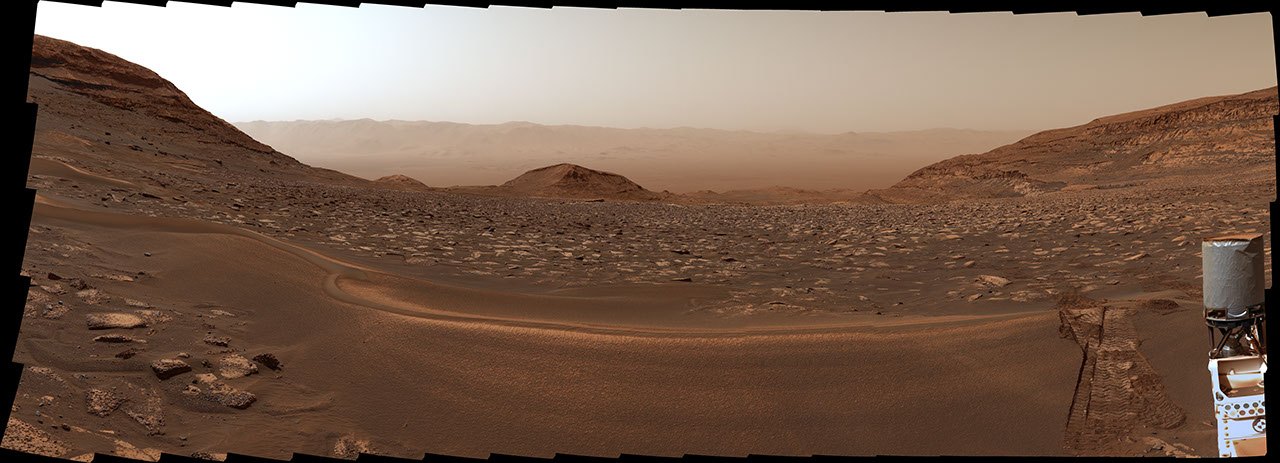
NASA’s Curiosity rover reached 1 kilometer of elevation above the floor of Gale Crater on Aug. 26, 2026, the most the rover has climbed. The mission is now in the second year of its fifth extended mission.
A kilometer up Mount Sharp
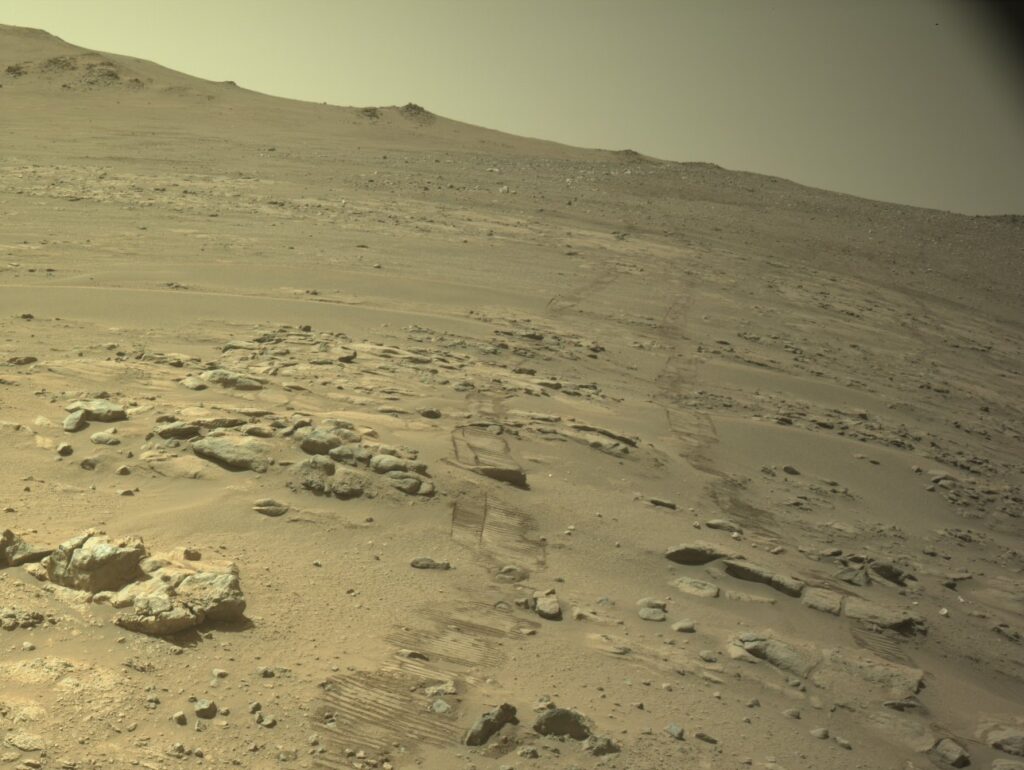
Curiosity launched on Nov. 26, 2011, and landed in Gale Crater in August 2012. It has been climbing the lower slopes of Mount Sharp, a mountain about 5 kilometers (3 miles) tall, since 2014. According to NASA’s Jet Propulsion Laboratory (JPL), the 1-kilometer mark was passed on Sol 4,996 of the mission, a sol being one Martian day. Nine days later, on Sept. 5, 2026, the rover imaged the crater floor below in a 95-frame panorama from Mastcam, the camera pair on the rover’s mast.


A few days after the milestone, on Aug. 30, 2026, the mission marked its 5,000th Martian day with a two-time-of-day navigation camera panorama taken from a sandy ridge nicknamed Chocolatal. NASA’s mission page lists Curiosity as an active mission and shows it was last updated on Sept. 29, 2026.
A sea of polygons in Valle Grande
As Curiosity began climbing a valley nicknamed Valle Grande, it photographed a field of honeycomb-like polygonal fractures. NASA’s July 29, 2026 release says the polygons measure roughly 4 to 8 centimeters (1.5 to 3 inches) across and extend as far as the rover can see in a 360-degree view taken on June 19 and 20, 2026 (sols 4,930 and 4,931). They also wrap around the sides of Miraflores, a sand-capped butte about 6 meters (20 feet) tall.

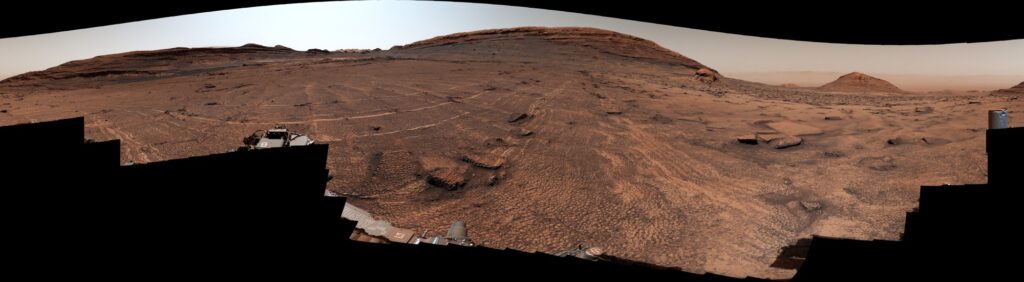
The mission had seen small patches of such shapes before, but never on this scale. Some earlier polygons clearly formed as mud cracks. NASA lists other possible causes, including repeated warming and cooling, and compression that squeezed water out of buried sediment. Project scientist Ashwin Vasavada said: “We’ve seen a lot of fascinating landscapes through Curiosity’s eyes, but this sea of polygons took our breath away.”
Wind-carved cliffs and an open question
On Oct. 6, 2026, NASA released a six-image Mastcam panorama of the yardang layer, a set of wind-carved crags in the northwestern part of Mount Sharp. Curiosity took it at 8:30 a.m. local Mars time on Aug. 11, 2026 (Sol 4,982). The layer runs about 10 miles (16 kilometers) across.

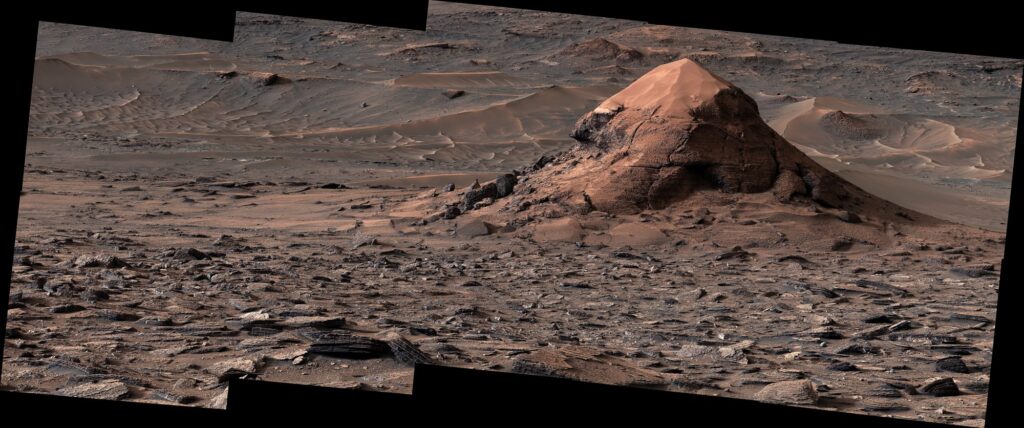
Scientists do not yet know what formed it. One hypothesis is ash from ancient volcanic eruptions. According to NASA, the rover will spend the next year or so driving through sulfate- and carbonate-rich layers, and the agency hopes to reach the base of the yardangs in 2027 and use the robotic arm to collect data there.
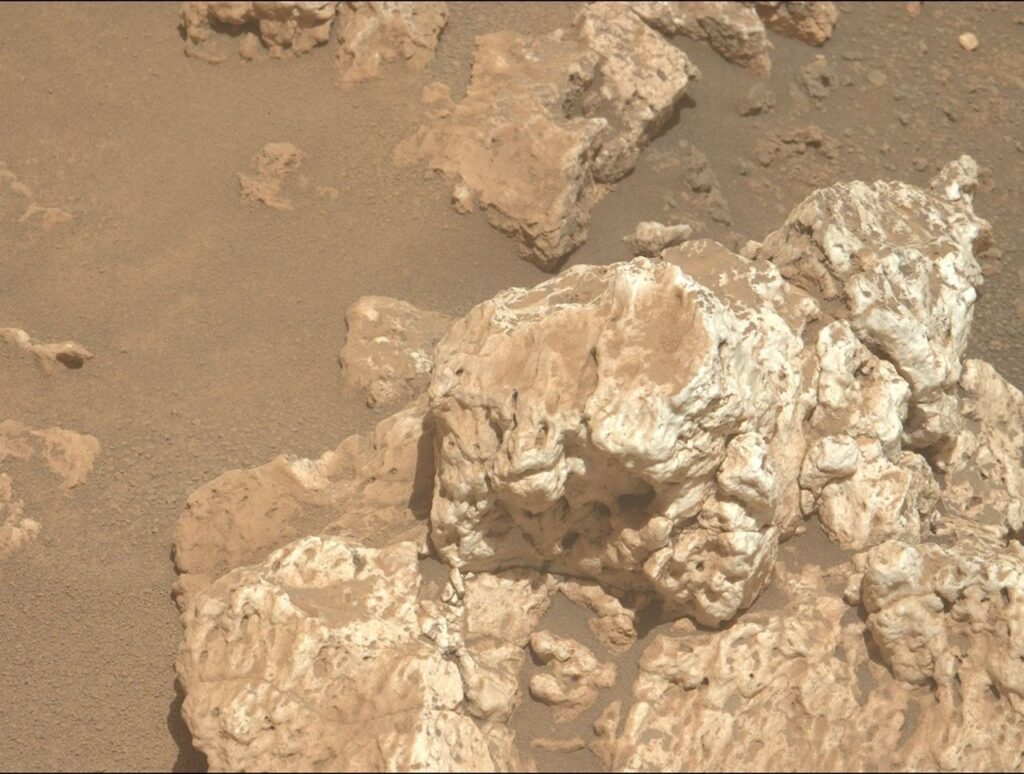
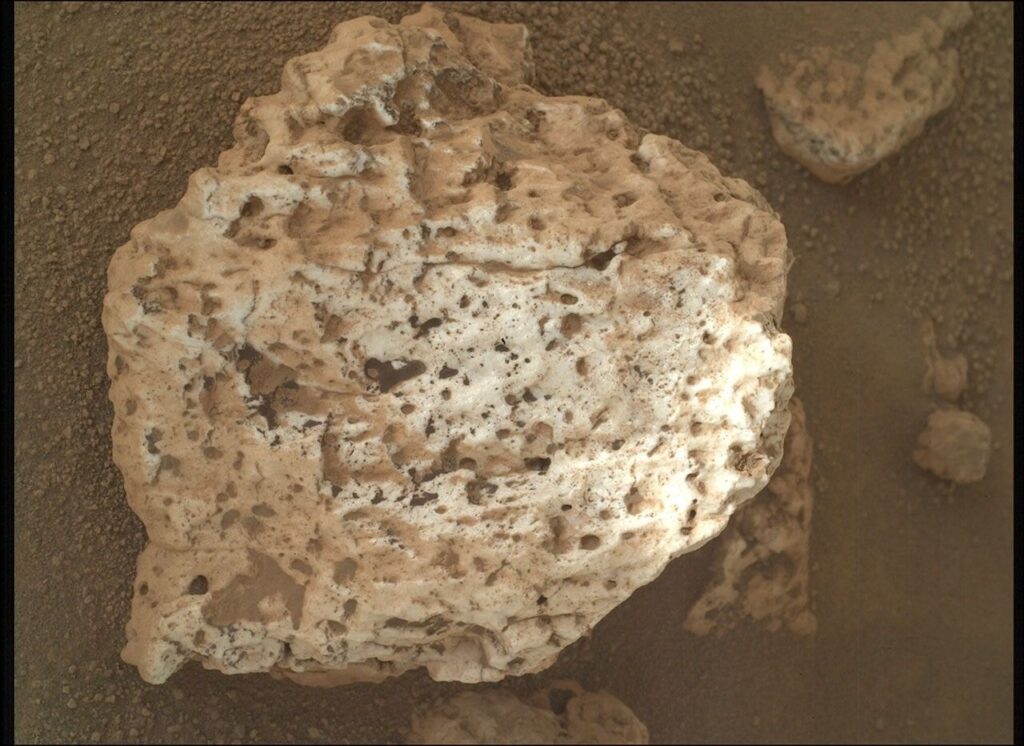
The boxwork region, which the 2025 version of this story described, has also produced results. NASA’s mission page lists a feature on the rover’s close-up view of those ridges, which it says it had explored for about six months. It also describes a drilled sample from a rock called Atacama on April 25, 2026, which stuck to the drill and was freed in early May 2026.

Doing more with a fading power source
Curiosity is powered by a multi-mission radioisotope thermoelectric generator, which turns heat from decaying plutonium into electricity. As the plutonium decays, recharging the batteries takes longer and less energy is left for science each day.
In its August 2025 report, JPL said that after tests begun in 2021, the rover can safely relay data to an orbiter while driving, moving its arm or taking images. Running tasks together shortens each day’s active time, which reduces how long heaters and instruments stay on. The rover can also go to sleep early if it finishes its work ahead of the padded schedule. JPL’s Reidar Larsen described the shift this way: “It’s as if our teenage rover is maturing, and we’re trusting it to take on more responsibility.”
JPL gave no figures for total power use or generator output, and the savings per activity are small, on the order of 10 to 20 minutes. The same report said the wheels, which have been punctured by rocks, still have years of travel left. It put the distance driven at 22 miles (35 kilometers) at the time, and a wear-reducing driving algorithm is in use.
What the climb still has to answer
The record so far shows that ancient Gale Crater had water, chemistry and nutrients able to support microbial life, according to NASA, including carbon-based molecules that are precursors to RNA and DNA. Scientists cannot yet say whether those molecules came from biological or geological processes. NASA also reports a February 2026 paper in the journal Astrobiology that argues non-biologic processes do not fully explain the organics found on Mars.
The elevation gain gives the team a longer record of the layers laid down as Mars dried. A May 2026 NASA study of 20 Curiosity samples found that differences in hematite crystallite size at different elevations may serve as a new marker of ancient climate. What formed the yardang layer, and whether it can be sampled in 2027, will be the next test of how far a power-limited rover can still go.