Mars rover finds the signature of ruby’s mineral in light-toned rocks
SuperCam on NASA's Perseverance rover detected narrow red light from chromium in corundum, the mineral rubies are made of, in pale rocks near the rim of Jezero crater.

NASA’s Perseverance rover has found a faint glow that points to corundum, the mineral that makes rubies, in light-colored rocks near the rim of Jezero crater on Mars. The rover’s laser instrument, SuperCam, picked it up, according to a NASA mission blog post by SuperCam principal investigator Roger Wiens.
A red glow that gave the mineral away
SuperCam fires a laser at rocks to study them. Because of the way it does this, it can also record luminescence, light that a material gives off after being energized. Most luminescence is spread over a wide range of colors, much like the light from commercial lighting. Two years ago, Wiens wrote, the team was startled to see strong, narrow peaks at two exact wavelengths, 692.7 and 694.1 nanometers, after zapping a pale rock.


Those two narrow peaks come from chromium atoms sitting inside the crystal structure of corundum. SuperCam can also time how long the glow lasts, which let the team confirm the light came from chromium in corundum. Chromium in corundum is what gives a ruby its color. Before SuperCam was installed on the rover, the team placed a ruby in the laser beam and watched the whole room pulse bright red.
NASA says no collectable rubies have been found on Mars. What the rover sees are small corundum crystals, which still tell scientists about the planet’s past. The results were published in Geophysical Research Letters this year by a team led by Ann Ollila. According to the paper’s listing at the US Geological Survey, it is titled “Corundum Discovered by SuperCam and the Perseverance Rover at Jezero Crater, Mars.”

Why corundum is out of place on a planet without plate tectonics
Corundum normally forms through metamorphism, where heat and pressure change existing rock, or in pegmatites, coarse-grained rocks that crystallize from the last, mineral-rich melt of cooling magma. On Earth, much of that heat and pressure comes from plate tectonics. Mars has no plate tectonics, so Wiens wrote that this is a mineral the team would not expect to find there.
The likely explanation is an impact. Wiens said large meteor and asteroid impacts can cause local metamorphism through long-term heating. Perseverance is working in very ancient terrain near the rim of Jezero crater, so some evidence of this kind of local change is to be expected there. He noted that this is the first mission to explore such terrain, “so we are learning new things.”
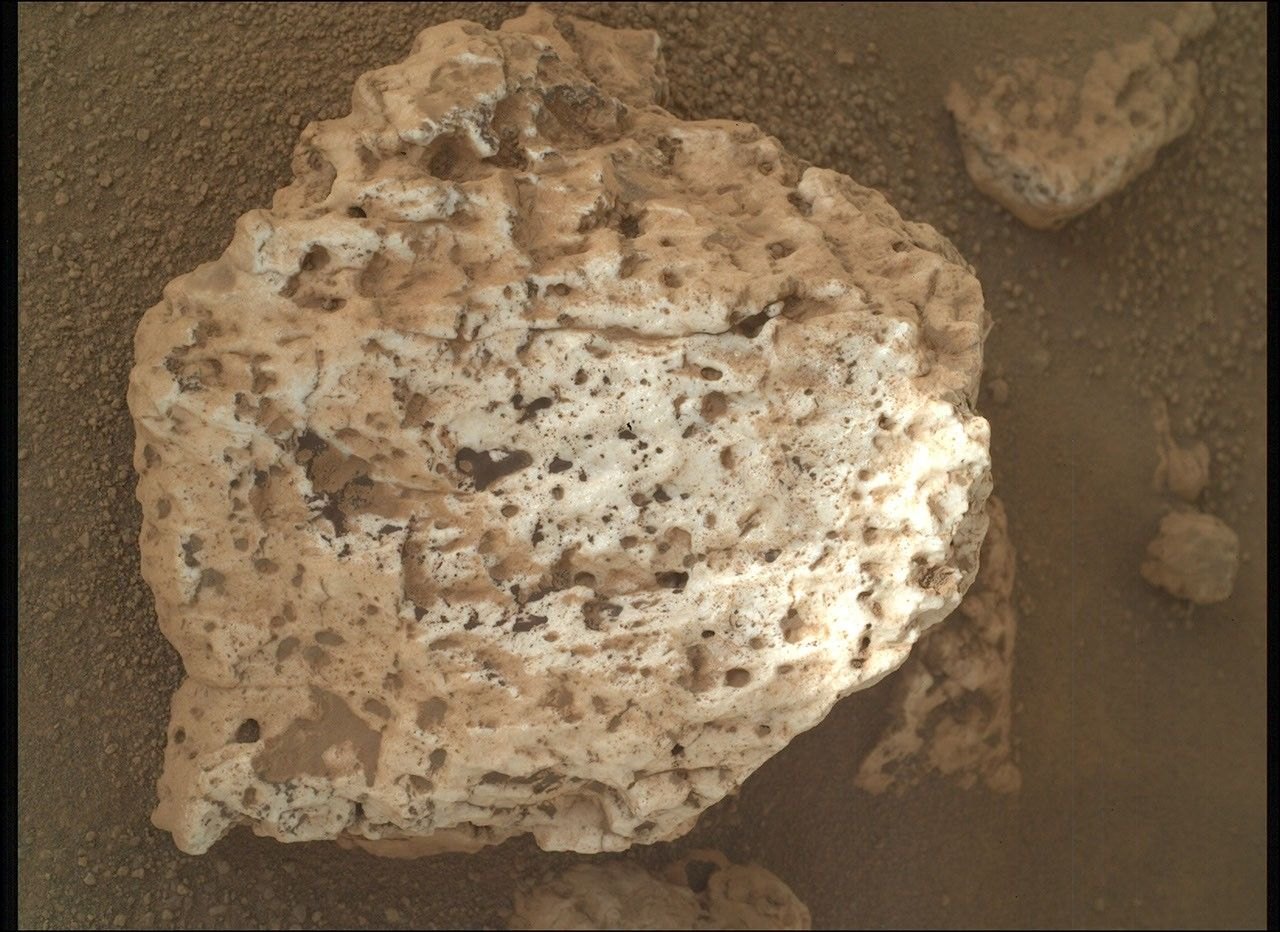
The image NASA released with the post shows a heavily pitted, light-toned float rock named “Nhlanguleni.” A float rock is a loose rock that did not form where it now sits. SHERLOC’s WATSON camera imaged it on Sol 2023 (Mars days are called sols; this one fell on October 29, 2026) at “Kapama Karula” in the “South Idubi” region. NASA’s post does not say that this particular rock contains corundum.
A technique that has gone from rare to routine
Early in the mission, the team rarely used the time-resolved luminescence technique. Wiens wrote that they now use it frequently on light-toned rocks, looking for more evidence of impact effects. That changes how SuperCam is used: a measurement that began as a side benefit of its Raman spectroscopy, which identifies minerals by how they scatter laser light, has become a regular search tool.
What the paper adds
Beyond NASA’s blog, the Geophysical Research Letters paper gives more detail. According to its record, the corundum was found in plagioclase-rich, light-toned float rocks on the rim of Jezero crater, and the authors suggest the impact that formed Jezero is a plausible source of the heat. Plagioclase is a common feldspar mineral in many igneous rocks. The paper lists a July 23, 2026 acceptance date, and the authors’ findings were first presented at the Lunar and Planetary Science Conference in March 2026.
The result adds to the picture of what Perseverance’s four-year-plus rover campaign is revealing about Mars. The more often the team repeats the measurement on pale rocks, the better it can show how widespread impact-altered material is along the crater rim.