A supernova remnant shaped like a betta fish, possibly never imaged by a major observatory
The Dark Energy Camera in Chile has produced what NOIRLab calls the most detailed view yet of SNR G295.5+09.7, a supernova remnant that may never have been imaged by a professional observatory.
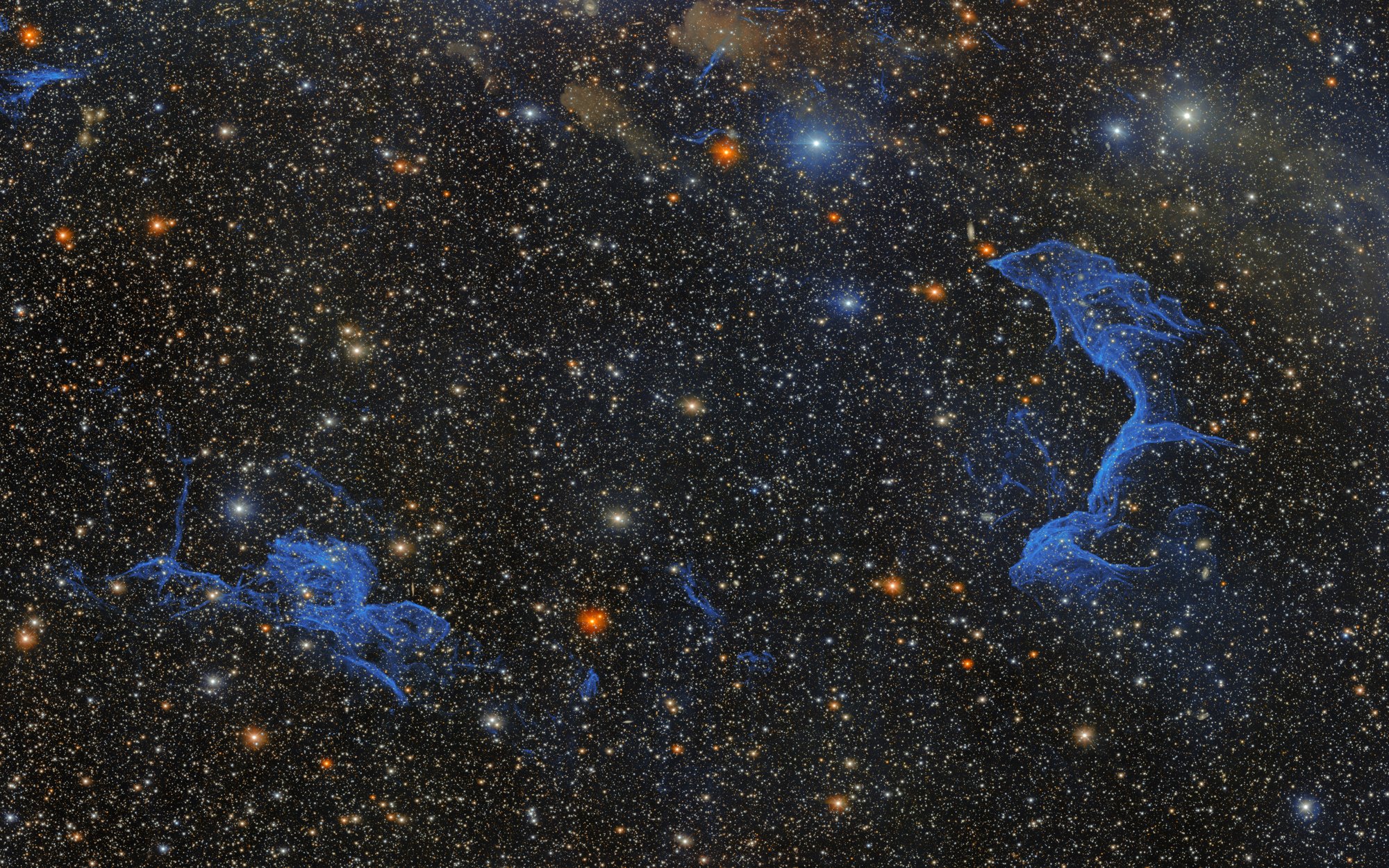
NOIRLab has released the most detailed view so far of the supernova remnant SNR G295.5+09.7, nicknamed the Betta Fish Nebula. The image comes from the Dark Energy Camera in Chile, and the nebula may never have been imaged by a professional observatory before.
Blue ribbons left by an exploded star
A supernova remnant is the glowing debris of a star that has exploded. This one appears as wispy blue ribbons that resemble the flowing tails of betta fish, hence the nickname. The data were taken with the 570-megapixel Dark Energy Camera (DECam), which is attached to the 4-meter Víctor M. Blanco Telescope, a U.S. National Science Foundation facility at Cerro Tololo Inter-American Observatory in the Chilean Andes. The camera itself was fabricated by the U.S. Department of Energy.
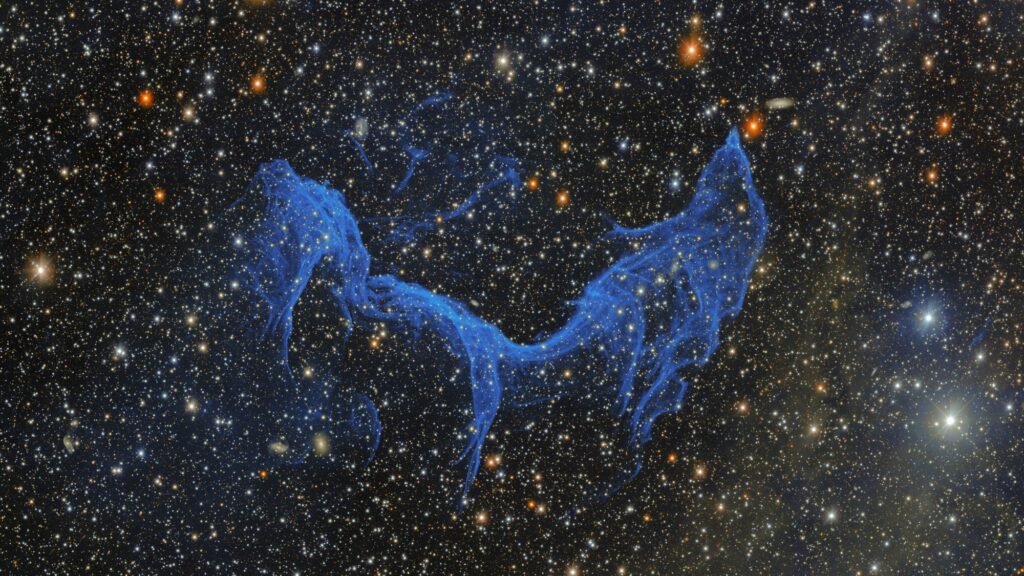
According to NOIRLab, the nebula formed when a star many times more massive than the Sun exploded. The star’s outer layers were thrown off and spread into the interstellar medium, the thin gas and dust between stars. As the ejected material slammed into that gas, it made the gas glow, producing the blue ribbons seen today.
The rest of the star collapsed under its own gravity but stopped short of becoming a black hole, because a neutron star formed. NOIRLab says this neutron star sits inside the nebula’s outer shell in the image. A neutron star squeezes roughly 1.4 solar masses into a ball about 20 kilometers (12 miles) wide. NOIRLab’s comparison is that one would fit inside Tucson, Arizona, where the observatory has its headquarters. Had the collapse gone all the way, a black hole would have formed instead.
A crowded Milky Way field with galaxies hiding in it
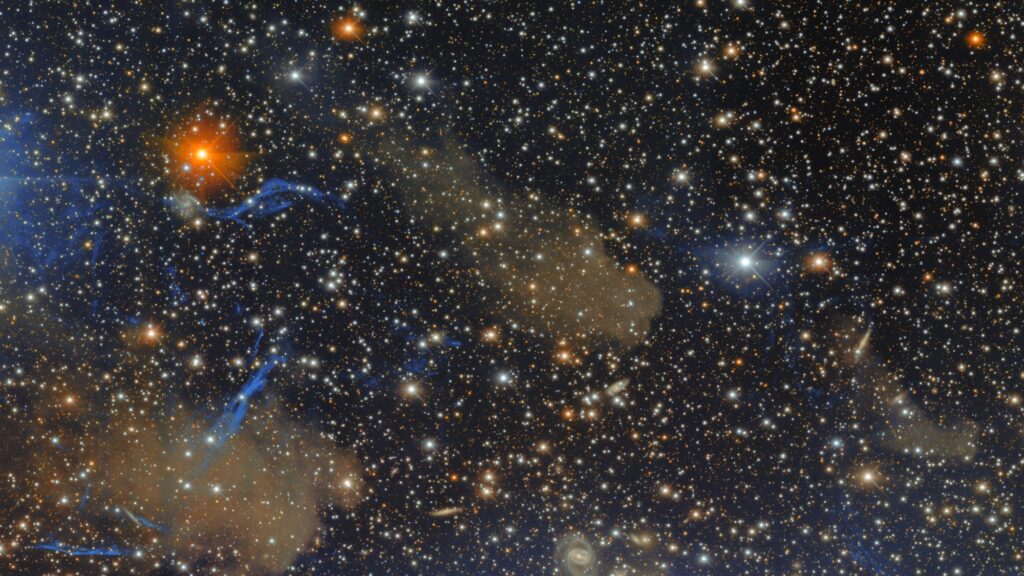
The nebula lies in the constellation Centaurus, visible from the Southern Hemisphere, almost 6800 light-years away. It sits in the Carina-Sagittarius arm, one of the Milky Way’s spiral arms, and thousands of stars from that arm fill the background. NOIRLab notes that galaxies far beyond the Milky Way are hidden among those stars, and invites readers to look for them in the zoomable version of the photo.
The hazy brown patches are interstellar clouds in our own galaxy. They resemble nebulae but are far more spread out. NOIRLab points out that the Solar System itself sits inside one, called the Local Interstellar Cloud.
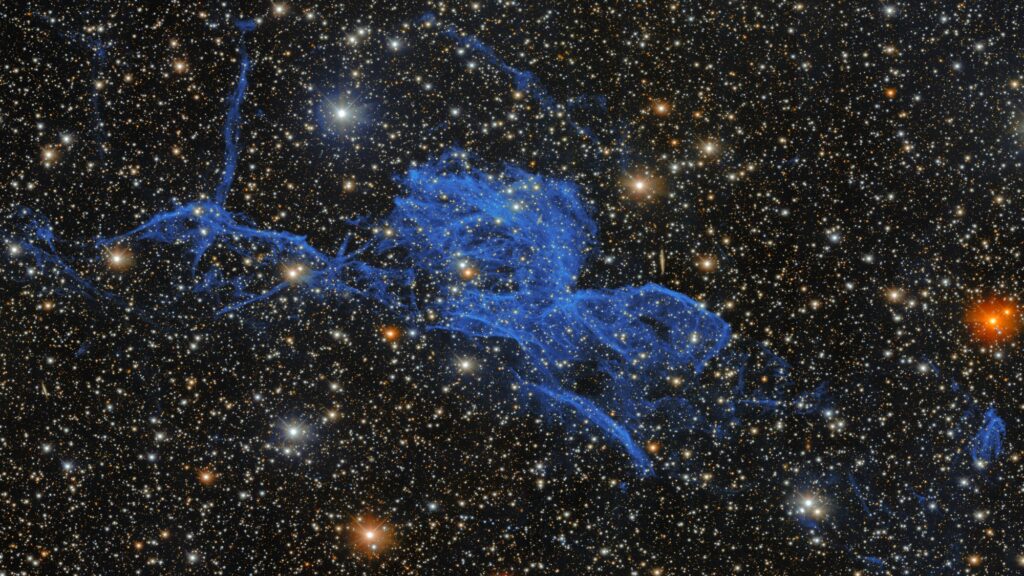
The picture belongs to the NOIRLab Legacy Imaging Program, which continues the Gemini Legacy Imaging Program begun at the International Gemini Observatory in 2002. The program sets aside telescope time on NOIRLab instruments specifically to gather data for color images meant for the public. Four close-up views and two videos, a pan and a zoom into the nebula, accompany the release.
Why a survey camera suits a sprawling remnant
NOIRLab says DECam’s wide field of view lets astronomers study nebulae in fine detail together with their surroundings. That helps with an object like this one: a remnant spread across a large patch of sky needs a wide view to capture the whole shell and enough sharpness to separate its thin filaments from the dense star field behind it.
The camera was originally built for the Dark Energy Survey. The Department of Energy funded it, and Fermilab built and tested it. Its use here shows how a survey instrument can also serve as a public-facing imager when observing time is reserved for that purpose.
Where to see more, and what else NOIRLab is watching
The release does not announce follow-up studies of the nebula or its neutron star, so for now the image itself is the news. The full-resolution and zoomable versions are on NOIRLab’s site, where the hidden background galaxies can be hunted down.
NOIRLab’s facilities are busy elsewhere too. Gemini and DECam are among the telescopes following a nearby Type Ia supernova in NGC 1433 that is still brightening. That is a different kind of explosion, the destruction of a white dwarf rather than the collapse of a massive star. NOIRLab also takes part in the NSF-DOE Vera C. Rubin Observatory, whose data led to a possible dwarf planet beyond Pluto, up to 1,500 km across.