Mars facts: How far away it is, how cold it gets, its weather and the search for life
Mars is a cold, dry, dusty world half Earth's width, between 54.6 and 401.4 million km away, where rovers are testing a rock that may hold signs of ancient life.
Dates and facts checked on the official pages on October 19, 2026.
Mars is the fourth planet from the Sun: a cold, dry, rocky world about half the width of Earth. It sits between 54.6 million and 401.4 million km (34 million to 249 million miles) from Earth, depending on where both planets are in their orbits. Its average temperature is about -59 °C (-74 °F), and its air is so thin that liquid water cannot last long on the surface.
Mars is between 54.6 and 401.4 million km from Earth, and about 228 million km from the Sun
Earth and Mars both circle the Sun, but Mars takes longer and travels on a wider path, so the gap between the two planets keeps changing. According to NASA’s planetary fact sheet, the distance ranges from a minimum of 54.6 million km to a maximum of 401.4 million km.
Mars’s average distance from the Sun is about 228 million km (142 million miles). Astronomers call the Earth-Sun distance one astronomical unit (AU), and Mars sits about 1.5 AU out. Sunlight takes about 13 minutes to reach it, according to NASA.
Mars’s orbit is noticeably oval. The point where it is closest to the Sun, called perihelion, is 206.65 million km away. The farthest point, aphelion, is 249.261 million km away. That 43 million km swing is one reason Mars has strong seasonal changes.
Mars is half Earth’s width but has nearly as much dry land
Mars has an equatorial radius of 3,396.2 km, which is 0.532 times Earth’s. NASA’s Mars page puts it at roughly half Earth’s diameter. Because Earth’s surface is mostly ocean, the surface area of Mars is nearly the same as Earth’s dry land, according to NASA.
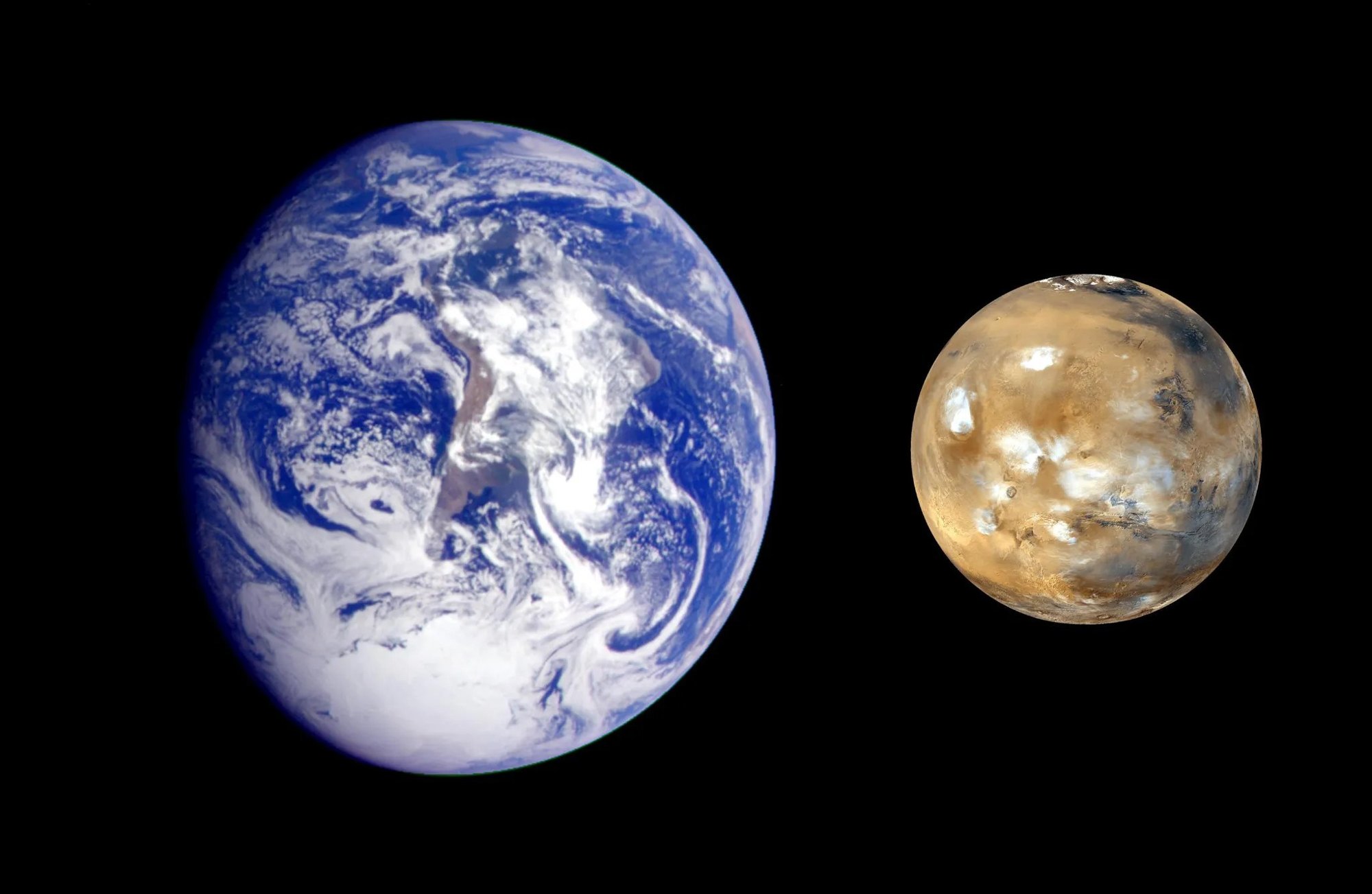
Mars is far lighter than its width suggests. Its mass is 0.107 times Earth’s and its volume 0.151 times Earth’s, so it has less rock to pull on things. For a second planet to stand beside Earth in a comparison, NASA’s image below shows the two side by side.
| Measure | Mars | Mars compared with Earth |
|---|---|---|
| Equatorial radius | 3,396.2 km | 0.532 |
| Mass | 0.64169 x 1024 kg | 0.107 |
| Mean density | 3,934 kg/m3 | 0.714 |
| Surface gravity | 3.73 m/s2 | 0.380 |
| Escape velocity | 5.03 km/s | 0.450 |
| Length of day | 24.6597 hours | 1.027 |
| Orbit period | 686.980 days | 1.881 |
Figures from NASA’s Mars fact sheet, checked October 19, 2026.
Gravity is the pull a planet puts on things at its surface. On Mars it is 0.380 times Earth’s, so a person who weighs 100 pounds on Earth would weigh about 38 pounds there. Escape velocity, the speed needed to leave the planet for good, is 5.03 km/s, which is 0.450 times Earth’s.
A Martian day is 24 hours 40 minutes, and its year lasts 687 Earth days
Mars spins once in 24.6229 hours relative to the stars. Because the planet also moves along its orbit, a full day from one noon to the next is 24.6597 hours. NASA calls a Martian day a sol, and a Martian year lasts 669.6 sols, or 687 Earth days.
Day length is close to Earth’s, which is why mission teams run on a schedule that slips about 40 minutes later each Earth day.
Temperatures swing from about 20 °C to -153 °C, and the average is -59 °C
Mars is far from the Sun and has too little air to hold in heat. NASA says temperatures can reach as high as 20 °C (70 °F) and fall as low as about -153 °C (-225 °F). NASA’s fact sheet gives a typical daily swing of 184 K to 242 K, which is -89 °C to -31 °C, and an average of about -59 °C (214 K).
The thin air also moves heat poorly. NASA notes that at the equator at midday, a standing astronaut’s feet might be near 24 °C (75 °F) while the head is near 0 °C (32 °F).
The air is 95 percent carbon dioxide and far thinner than Earth’s
Mars’s atmosphere is mostly carbon dioxide, with nitrogen and argon. Under NASA’s fact sheet, by volume it is 95.1 percent carbon dioxide, 2.59 percent nitrogen, 1.94 percent argon, 0.16 percent oxygen and 0.06 percent carbon monoxide. Water vapor makes up 210 parts per million.
Surface pressure averages 6.36 millibars, and it changes with the seasons between 4.0 and 8.7 millibars. Pressure this low means water on the surface cannot stay liquid for long. NASA states that the atmosphere is too thin for that, and also that it offers little protection from impacts.
Mars has no global magnetic field today. Some of its southern crust is strongly magnetized, which NASA says points to a magnetic field around 4 billion years ago.
Dust storms can cover much of the planet, and the dust takes months to settle
Mars’s weather is dominated by dust. Winds lift fine grains into the air, and NASA says storms can cover much of the planet, with the dust taking months to settle. Suspended dust also makes the sky look hazy and reddish.
Dust changes temperatures. In a regional storm tracked by NASA’s Mars Reconnaissance Orbiter in November 2012, the air above the storm warmed by about 25 °C (45 °F) because dust absorbed sunlight at about 25 km altitude. Meanwhile, Curiosity’s sensors recorded lower air pressure and a slight rise in overnight low temperatures, according to JPL.
Storms follow the seasons. A Martian year lasts about two Earth years, and JPL notes that the dust-storm season begins with the start of southern spring. Regional storms grew to affect vast areas of the planet in 2001 and 2007.
Two rovers measure conditions on the ground. NASA’s Mars rovers Perseverance and Curiosity are both active; Curiosity reached a 1-kilometer elevation gain on Mount Sharp on August 26, 2026, and Perseverance passed the off-world distance record of Opportunity on October 11, 2026, according to NASA.
Rusted iron makes Mars red, and its surface holds the solar system’s biggest volcano
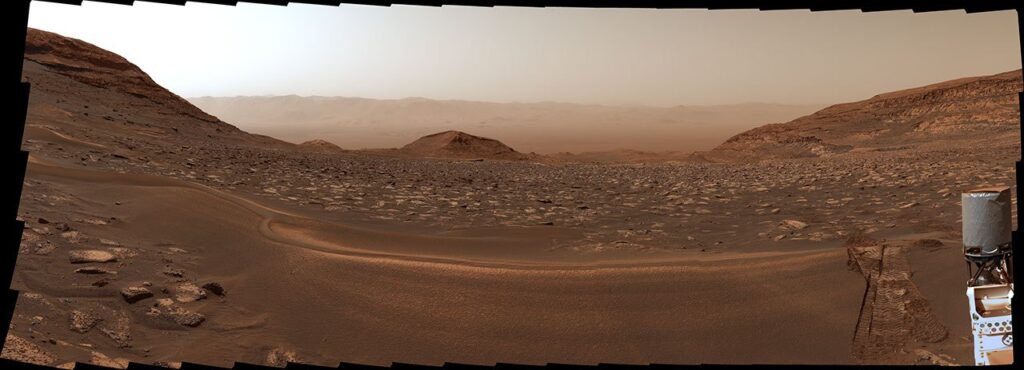
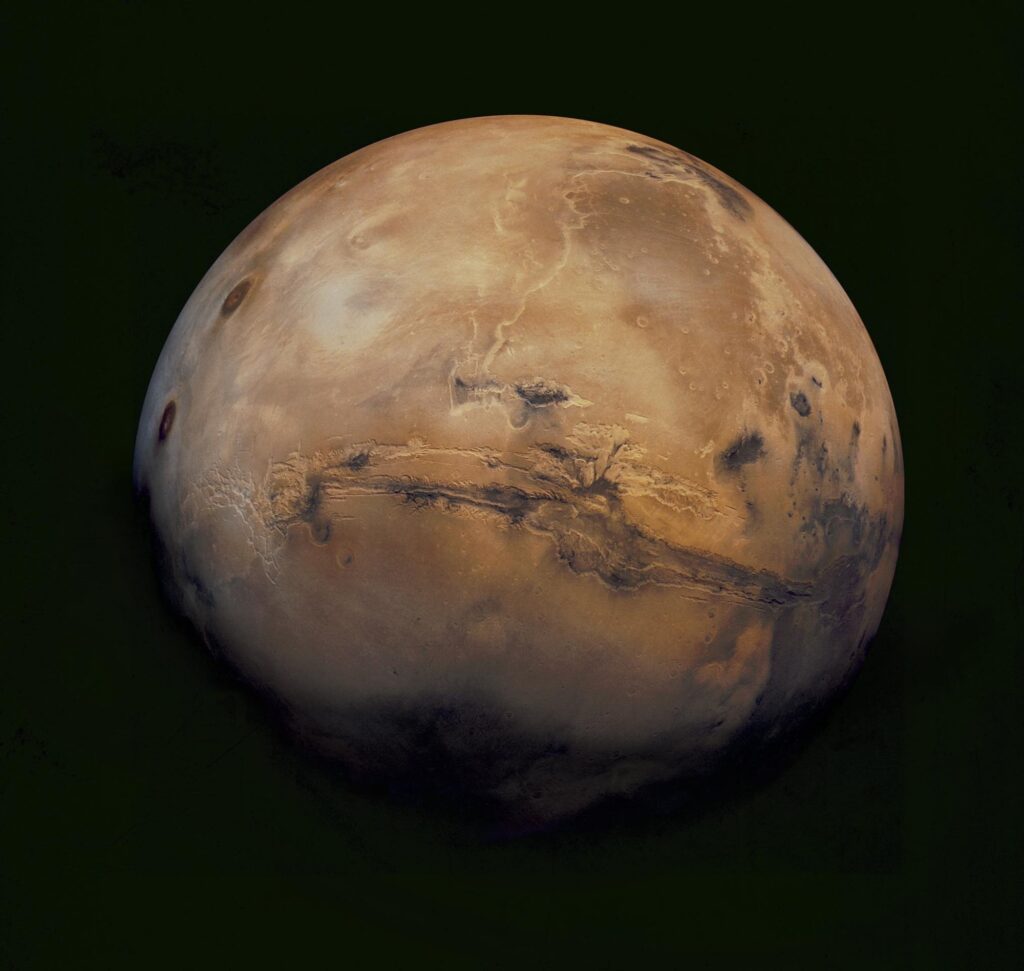
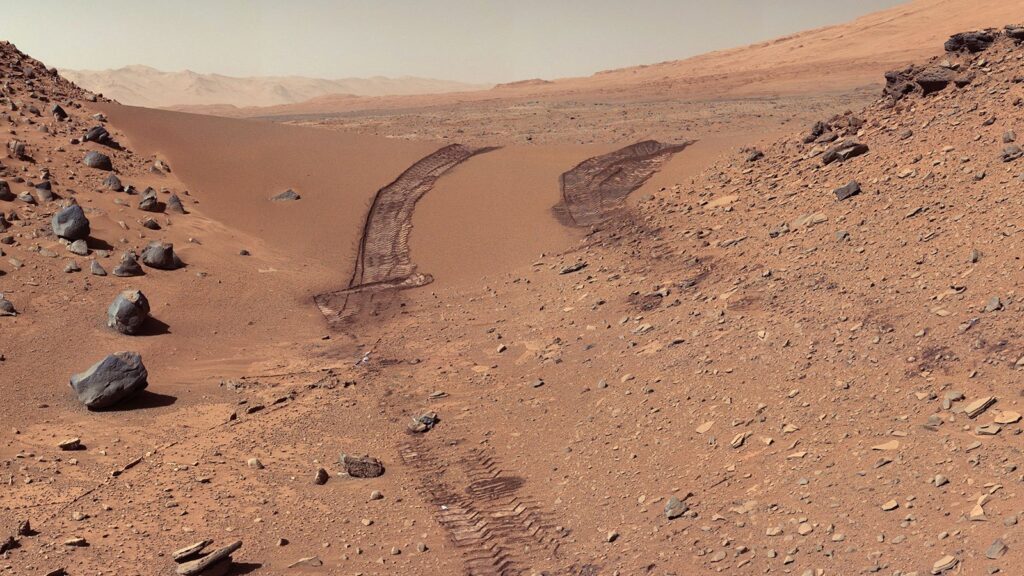
The color comes from iron. NASA says iron in the rocks, soil and dust has oxidized, meaning rusted, and the dust in the air makes the whole planet look red from far away. Up close, the surface shows browns, golds and tans.
Two features stand out. Olympus Mons is the largest volcano in the solar system, standing more than 40 km (25 miles) tall. Valles Marineris is a canyon system about 3,870 km (2,400 miles) long and up to 9.3 km (5.8 miles) deep.
Under the crust, which is 10 to 50 km thick, lies a mantle and a core of iron, nickel and sulfur with a radius of 1,500 to 2,100 km.
Phobos circles Mars three times a day and will break up or crash in about 50 million years
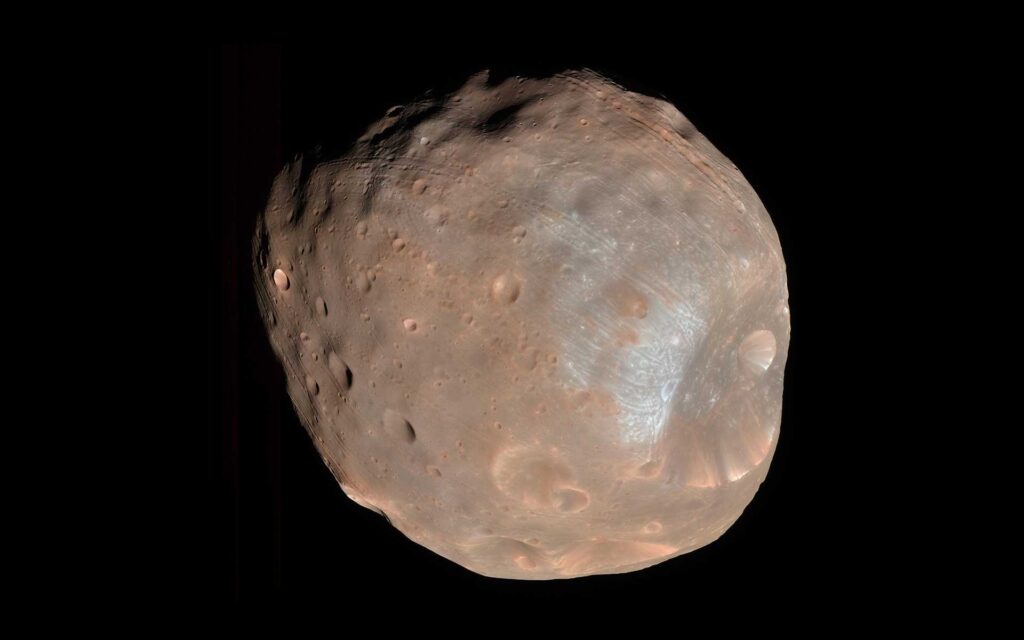
Mars has two small moons, Phobos and Deimos. NASA says they are either asteroids captured by Mars’s gravity or debris left from the early solar system.
Phobos, the larger, orbits about three times a day and is closing in on Mars by about 1.8 meters (6 feet) per century. In roughly 50 million years it will either hit Mars or break into a ring. Deimos is about half Phobos’s size, orbits about 2.5 times farther from the planet and takes about 30 hours to circle it.
Japan’s mission to study both moons and bring back Phobos material is covered in the Martian Moons eXploration mission.
Mars once had rivers and lakes, and now holds ice and a rock that may carry signs of ancient life
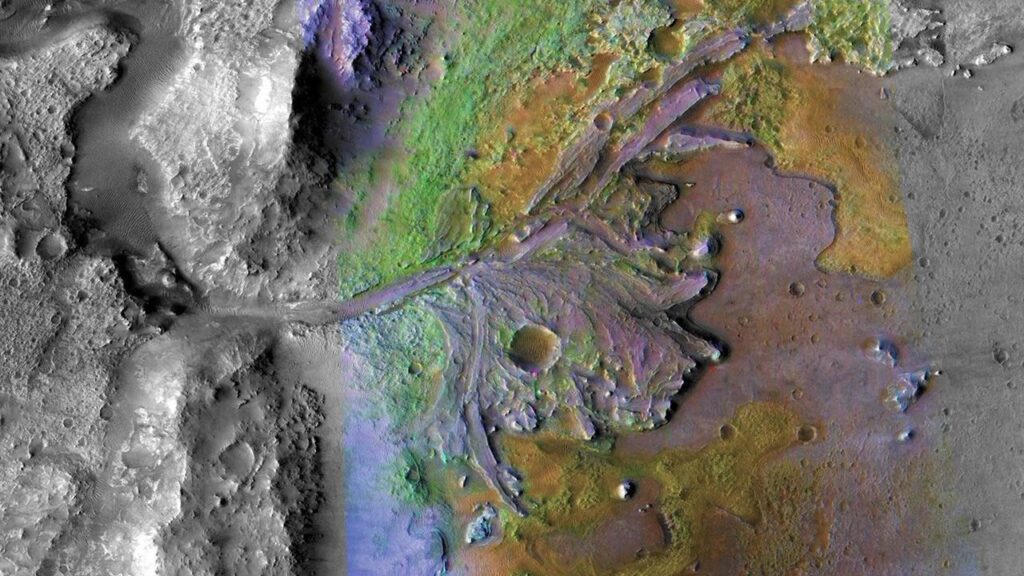
Ancient river valleys, deltas and lakebeds show that Mars was once much wetter, with floods about 3.5 billion years ago. Today, NASA says water ice lies just under the surface near the poles, and briny water flows seasonally down some slopes.
Scientists do not expect living things on Mars now. NASA states that researchers are looking for signs of life that existed long ago, when Mars was warmer and wetter.
The best lead so far comes from Perseverance, which landed on February 18, 2021, in Jezero Crater, a basin about 45 km (28 miles) wide. River channels spilled over its wall more than 3.5 billion years ago and formed a lake. In summer 2024 the rover examined a rock nicknamed Cheyava Falls, and in September 2025 the journal Nature published results showing that its Sapphire Canyon sample contains potential biosignatures. NASA describes these as clues suggesting past life may have been present, and it says more data or further study is needed before any conclusion about life.
Curiosity has also analyzed rock containing ancient organic molecules, according to NASA. Organic molecules are carbon-based compounds that life uses but that can also form without it.
Common questions
Can Mars support life?
Not today, according to NASA, which says scientists do not expect to find living things thriving there. The thin air, low pressure and cold make liquid water unstable on the surface. Mars did have lakes and rivers long ago, so researchers are searching for traces of past microbial life.
How much gravity does Mars have compared with Earth?
Mars’s surface gravity is 3.73 m/s2, which is 0.380 times Earth’s. Its mass is only 0.107 times Earth’s, and it is about half as wide.
Why is Mars called the Red Planet?
Iron in its rocks, soil and dust has rusted, and dust in the air spreads that color across the sky. From far away, the whole planet appears red.
How far is Mars from Earth?
The distance is anywhere from 54.6 million km to 401.4 million km, according to NASA’s fact sheet. The two planets are closest when they line up on the same side of the Sun, and farthest when the Sun sits between them.
How long is a day on Mars?
A day on Mars, called a sol, lasts 24.6597 hours, about 24 hours and 40 minutes. A year lasts 687 Earth days.