Uzbekistan joins the Artemis Accords, the 77th country to sign
Foreign Minister Bakhtiyor Saidov signed in Samarkand while U.S. Secretary of State Marco Rubio was visiting, lifting the group from 8 founders in 2020 to 77 countries.

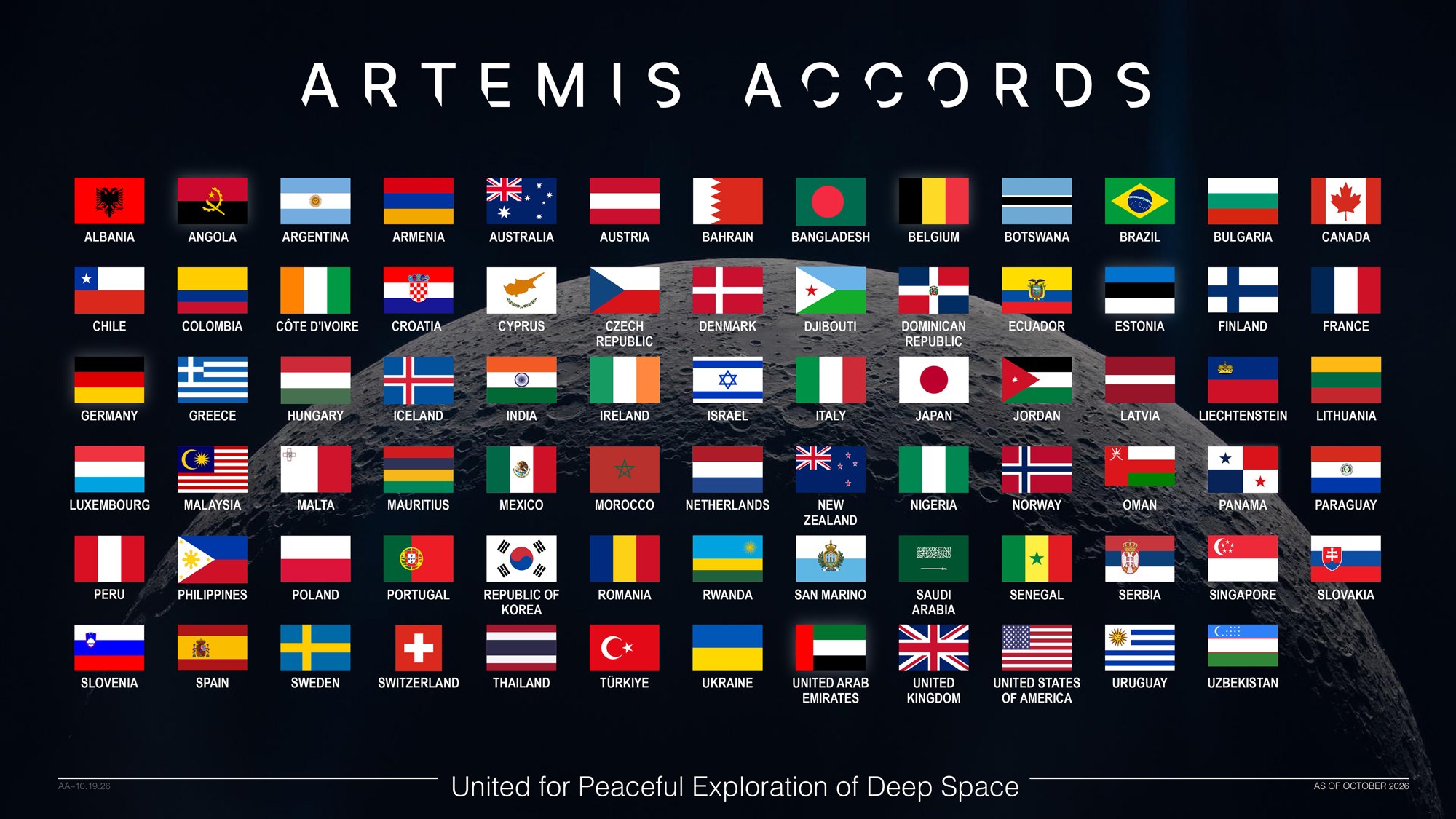
Uzbekistan became the 77th country to sign the Artemis Accords on Monday, NASA said. The accords are a set of voluntary principles for peaceful, transparent exploration of the Moon and beyond. The ceremony took place in Samarkand.
A signing during a Secretary of State visit
Uzbek Minister of Foreign Affairs Bakhtiyor Saidov signed on behalf of his country. The ceremony coincided with a trip to Uzbekistan by U.S. Secretary of State Marco Rubio, a sign that the accords are as much a diplomatic tool as a space one.

NASA Deputy Administrator Matt Anderson said Uzbekistan “joins the Artemis Accords at a pivotal moment.” He said the White House has told NASA to set up a Moon Base and keep a lasting human presence on the lunar surface, and that the accords widen the ways other nations can take part in the return to the Moon.
The accords are not a treaty with enforcement powers. Signing means committing to a short list of practices, which NASA describes as:

- exploring peaceably and transparently;
- rendering aid to those in need;
- making scientific data available to everyone;
- making sure activities do not interfere with those of others;
- preserving historically significant sites and artifacts.
A young space program with a 2028 deadline
Uzbekistan is early in building its space capability. NASA says the country is developing a national space program to grow its space industry and take part in global space forums. Uzbek students are working on the country’s first CubeSat, a small satellite used to demonstrate technology, with a launch targeted by 2028.
The two sides had already been talking. In early October, NASA officials met representatives of Uzbekistan’s Ministry of Digital Technologies and its space agency, Uzcosmos, at the 2026 International Astronautical Congress in Antalya, Türkiye. They discussed civil space cooperation. Uzbekistan is scheduled to host the same annual global space event in 2028, which gives it a reason to build its profile in the years ahead.
From 8 founders to 77 signatories in six years
NASA and the State Department created the accords in 2020 together with seven other founding nations, so eight countries started the group. Reaching 77 means roughly nine times as many signatories as at the start. NASA says it expects more countries to sign in the months and years ahead.
For a newcomer like Uzbekistan, the practical benefit is a place in a growing network around NASA’s lunar plans, not a contract. The commitments matter more as the Moon gets busier. NASA’s surface plans, covered in our report on a nuclear reactor on the Moon, call for a power source on the surface by 2030, and each new base, lander or rover raises the odds that activities overlap. The shared rules on staying out of each other’s way and protecting heritage sites are meant for exactly that.
Two dates to watch: The 2028 congress and the first CubeSat
The accords do not tie signatories to any one mission, and other agencies run their own lunar programs. ESA’s Moon line-up, described in our look at its landing cameras and ice drill, includes a drill to search for water ice. Countries with very different programs can still sign the same short set of principles.
The 2028 congress is the next clear marker. By then, Uzbekistan is due to host the world’s largest annual space gathering, and its student CubeSat is meant to be in orbit. Whether the signatory count keeps climbing before that date will show how far the accords are still attracting new members. NASA has not named the next country to sign.