Saturn’s moons: How many are there, and which are most interesting?
NASA lists 293 confirmed moons for Saturn. Titan and Enceladus stand out, thanks to Cassini and Huygens.

Dates and facts checked on the official pages on October 18, 2026.
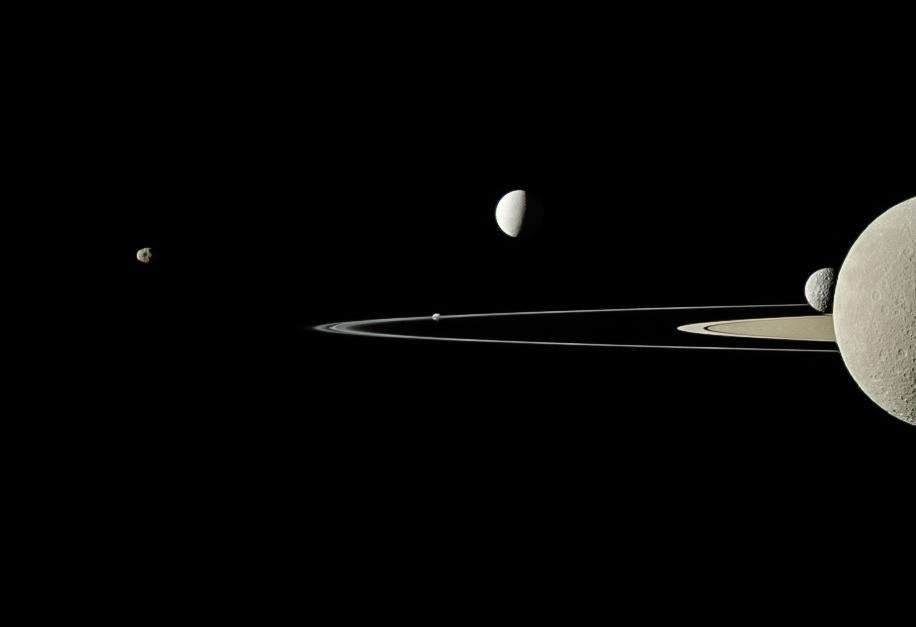
Saturn has 293 confirmed moons, according to NASA Science’s Saturn moons page, which cites the count as of August 2026. That is more than any other planet in the solar system. The largest by far is Titan, wider than the planet Mercury and the only moon with a thick atmosphere. The most closely studied small one is Enceladus, which sprays water from a global ocean.
The sections below cover the count, the biggest moons, and what the Cassini orbiter and the Huygens probe found on Titan and Enceladus. They also cover the next mission to Titan.

Saturn has 293 confirmed moons, and the number keeps rising
NASA Science lists 293 confirmed moons for Saturn as of August 2026, drawing on the Solar System Dynamics group at JPL. Its full catalog includes recent provisional designations, temporary labels given to newly found moons, such as S/2023 S58 through S/2023 S63 and S/2020 S45 through S/2020 S49, which the page ties to 2026 circulars from the Minor Planet Center.
Older NASA pages can show lower numbers. NASA’s Saturn facts page still reads 274 confirmed moons as of March 2025, and notes that other satellites were awaiting confirmation and official naming by the International Astronomical Union. The count keeps growing, so the date attached to any figure matters.
Most of the newly found moons are small. They are mostly distant, irregularly shaped bodies, and only a handful of Saturn’s moons are large enough to be pulled into a round shape.
For comparison, NASA’s Jupiter moons page, last updated on September 21, 2026, lists 115 officially recognized moons for Jupiter.

Titan is bigger than Mercury; six more moons are large enough to be round
Titan is the clear giant. NASA describes it as larger than Mercury, and as planet-sized. JPL’s physical parameters table gives these mean radii for Saturn’s biggest moons and a few well-known smaller ones:
| Moon | Mean radius (km) | What stands out |
|---|---|---|
| Titan | 2,574.76 | Thick atmosphere, hydrocarbon lakes and seas |
| Rhea | 763.50 | Saturn’s second-largest moon; Cassini found possible signs of a ring around it |
| Iapetus | 734.30 | Two-toned: one hemisphere very dark, the other bright, with a ridge along the equator |
| Dione | 561.40 | Bright ice cliffs hundreds of meters high, known as the “wisps” |
| Tethys | 531.10 | Odysseus crater, about 400 km across, and a canyon running pole to pole |
| Enceladus | 252.10 | Water plumes, global ocean |
| Mimas | 198.20 | Herschel crater, 130 km across, about a third of the moon’s width |
| Hyperion | 135.00 | Irregular, with deep craters that give it a sponge-like look |
| Phoebe | 106.50 | Orbits backward (retrograde), a sign it was captured |
Source: JPL Solar System Dynamics, satellite physical parameters; checked October 18, 2026.

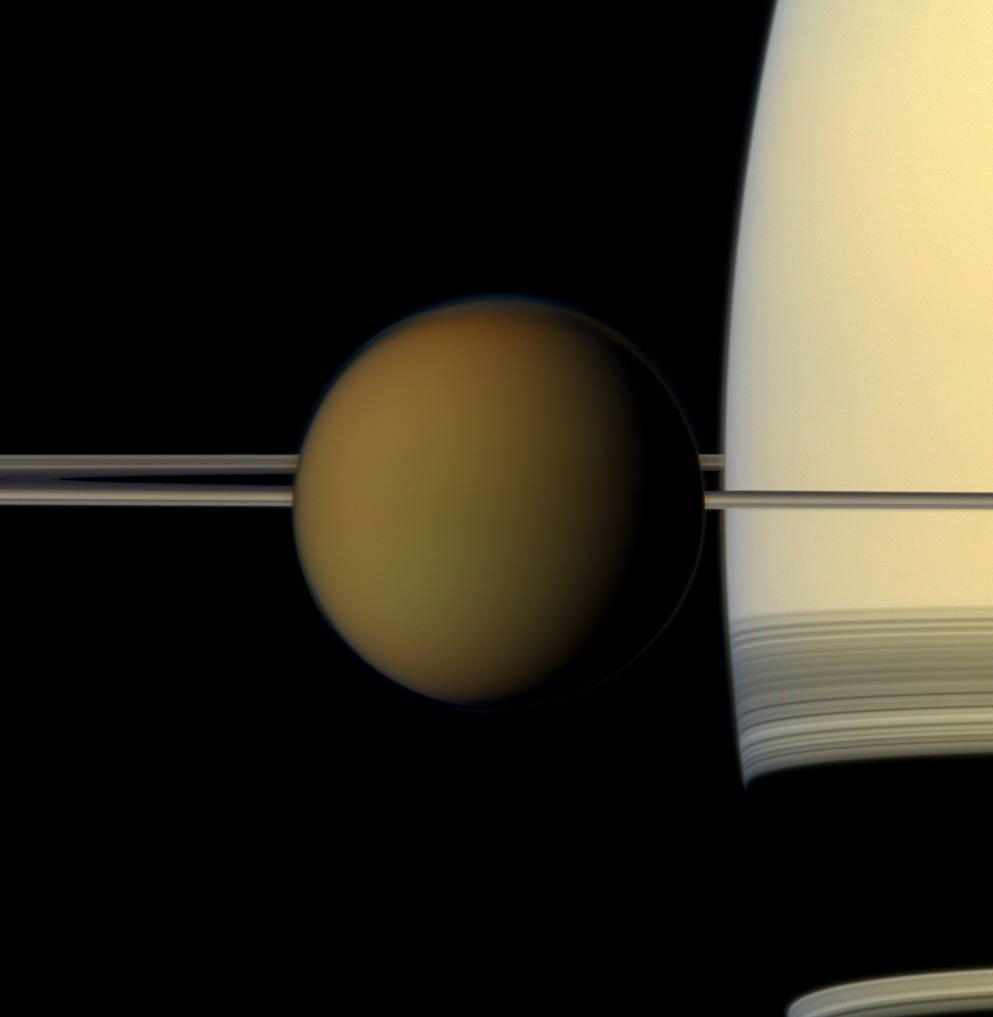
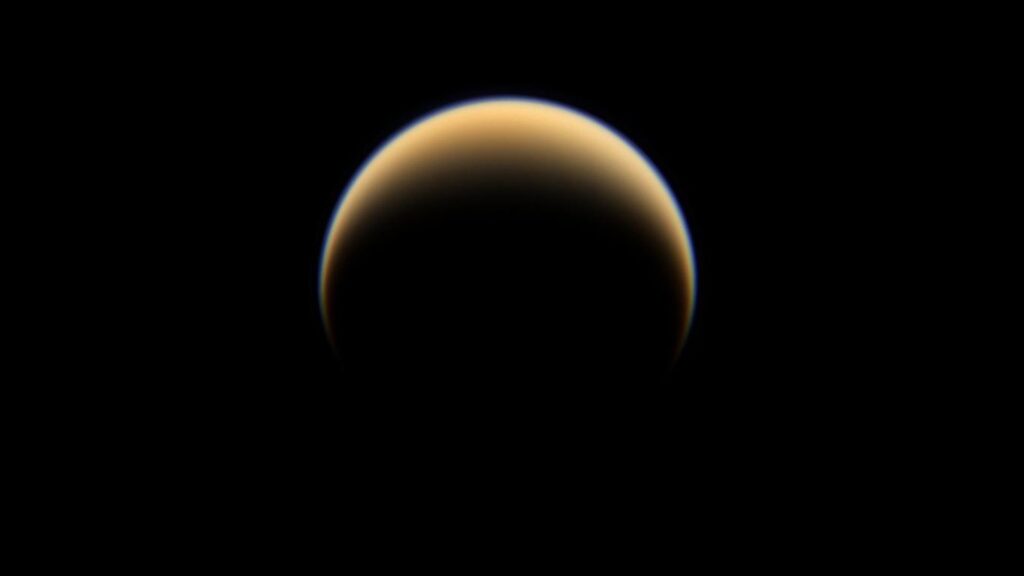
Titan’s radius is about 2,575 km, which NASA says is nearly 50 percent wider than Earth’s Moon. It orbits about 759,000 miles (1.2 million km) from Saturn and takes 15 days and 22 hours to go around.
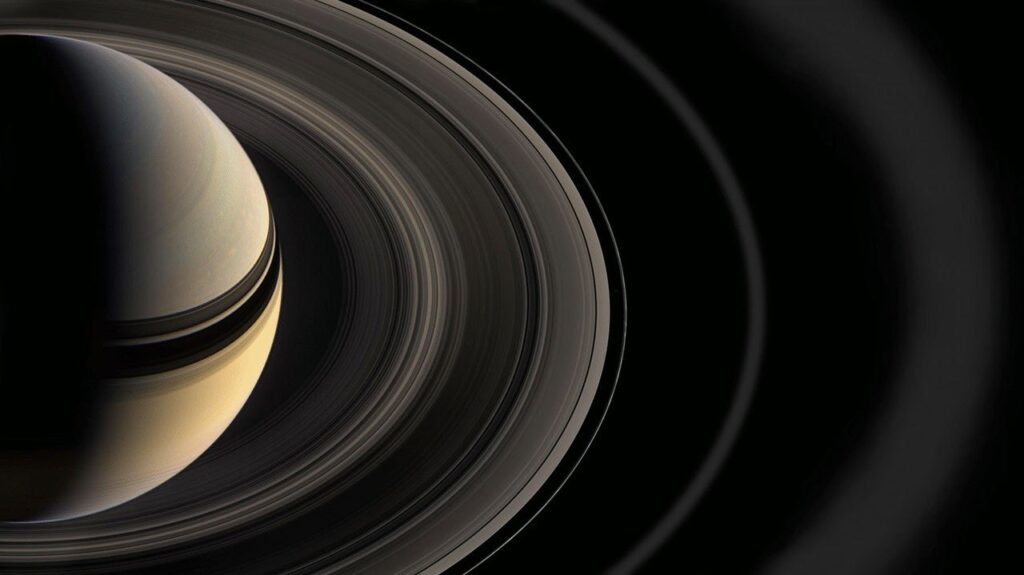
NASA’s Saturn moons page also names Prometheus, Pandora, Janus, Epimetheus, Telesto, Helene, Calypso, Atlas and Pan among the notable smaller moons. Several of them orbit close to Saturn’s rings.
Cassini and Huygens turned Titan into a place with weather, rivers and seas
The Cassini orbiter launched on October 15, 1997, and began its in-depth study of Saturn in 2004, becoming the first spacecraft to orbit the planet, according to NASA. It carried ESA’s Huygens probe to Titan.
ESA’s science pages state that Huygens was released from Cassini on December 25, 2004. It reached Titan’s outer atmosphere 20 days later, after a cruise of about 4 million km. It landed on January 14, 2005, which ESA calls the first successful attempt to land a probe on a world in the outer solar system. ESA says the descent began at about 1,270 km altitude at 09:06 UTC, slowing from roughly 18,000 to 1,400 km/h over three minutes.
NASA’s Titan page says the moon has clouds, rain, rivers, and lakes and seas of liquid hydrocarbons such as methane and ethane. Surface pressure is about 60 percent greater than on Earth, and the surface is roughly -290 degrees F (-179 degrees C), per NASA.
Cassini results listed by NASA include:
- Methane rivers flowing into a methane sea, and what NASA calls intriguing pre-biotic chemistry.
- Gravity measurements that suggest an underground ocean of liquid water, likely mixed with salts and ammonia.
- Nitrogen isotope ratios in the atmosphere that most resemble those of Oort Cloud comets. NASA says this suggests Titan formed early, from the same cold disk of gas and dust that formed the Sun.
- Data that support one model of five internal layers: a rock core, ice layers, a salty liquid water layer and an outer ice crust.
The Titan ocean is not settled. NASA’s Cassini mission page notes that a NASA study suggests Titan may not have a global ocean.
Enceladus sprays an ocean into space, and Cassini flew through it
Enceladus is about 310 miles (500 km) across, roughly as wide as Arizona, per NASA. It orbits about 148,000 miles (238,000 km) from Saturn, between Mimas and Tethys, and completes an orbit every 32.9 hours. Its ice is the most reflective of any body in the solar system.
William Herschel spotted it on August 28, 1789. Cassini discovered in 2005 that water vapor and ice particles erupt from the surface at about 800 mph (400 m/s). The jets come from warm fractures called tiger stripes and feed Saturn’s E ring.
NASA reports that the plume contains:
- Water vapor, carbon dioxide, methane and a little ammonia.
- Carbon monoxide or nitrogen, plus salts and silica.
- Organic material about 20 times denser than scientists expected.
Gravity data, from Doppler tracking and the moon’s slight wobble, indicate a global ocean. NASA gives the ice shell as about 1 to 5 km thick at the south pole and 20 to 25 km on average globally.
Silica nanograins, tiny grains of the mineral that makes up quartz, in the E ring can form only where liquid water and rock interact above about 90 degrees C (194 degrees F), according to NASA. That points to hydrothermal vents on the ocean floor, similar to those on Earth. NASA’s Cassini page says the mission revealed that Enceladus has essentially all the ingredients needed for life. That is a statement about ingredients, not a detection of life.
Cassini’s mission ended with a planned plunge on September 15, 2017
NASA says Cassini’s mission ended on September 15, 2017, during its Grand Finale, when operators deliberately plunged the spacecraft into Saturn. The reason given was to keep Saturn’s moons free of contamination from Earth, which matters most for places like Enceladus and Titan that may have habitable conditions.
Nearly all of the data described above comes from that 13-year orbital campaign, plus the Huygens descent. No spacecraft has orbited Saturn since.
Dragonfly is the next mission, a rotorcraft bound for Titan
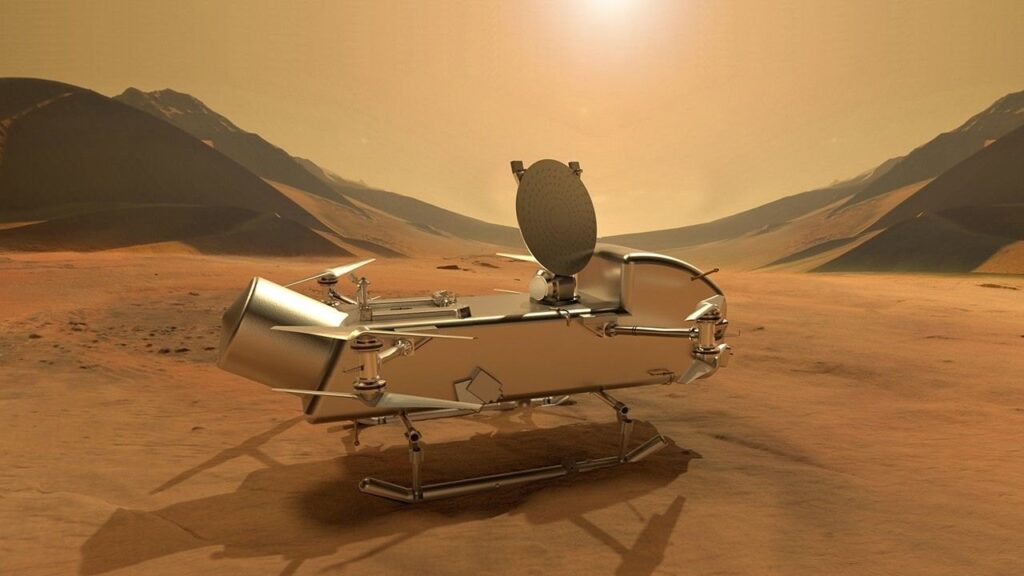
NASA’s Dragonfly page lists the launch as no earlier than July 2028 and arrival at Titan in late 2034. The rotorcraft will spend about 3.3 years on Titan, flying across the surface and making multiple landings. NASA’s Titan page describes it as a rotorcraft launching in 2028 to study Titan over three years. Both pages are NASA’s, but they round the time on Titan differently, so treat the length as approximate.
Launch dates for missions like this can move. The rocket launch schedule shows upcoming launches as they are confirmed.
Saturn’s moons are not the only ones getting a spacecraft. Japan’s Martian Moons eXploration mission is aimed at Mars’s moon Phobos, covered in the MMX launch and Phobos sample return report.
Common questions
How many moons does Saturn have?
NASA Science lists 293 confirmed moons as of August 2026. An older NASA facts page shows 274 as of March 2025, so the count has risen quickly. More candidates await confirmation and naming by the International Astronomical Union.
What is the biggest moon of Saturn?
Titan. JPL gives its mean radius as 2,574.76 km, far ahead of the next largest, Rhea, at 763.50 km. NASA says Titan is larger than Mercury.
Does Saturn or Jupiter have more moons?
Saturn. NASA lists 293 confirmed moons for Saturn and 115 officially recognized moons for Jupiter. Both counts can change as new moons are confirmed.
Could there be life on Titan or Enceladus?
No life has been found on either. NASA says Cassini showed Enceladus has essentially all the ingredients needed for life, and its Saturn facts page says Titan and Enceladus have internal oceans that could possibly support life. Dragonfly is designed to study Titan’s chemistry up close.