When is the next solar eclipse? Dates and viewing regions
The 2026 total eclipse has passed; the next is an annular eclipse on Feb. 6, 2027, and the next total one is Aug. 2, 2027, with up to 6 min 23 s of totality.


Dates and facts checked on the official pages on October 18, 2026.
The next solar eclipse is an annular eclipse on Feb. 6, 2027, visible as a ring of sunlight from Chile, Argentina and the Atlantic. The next total solar eclipse is on Aug. 2, 2027, crossing southern Spain, North Africa, Saudi Arabia and Yemen. The total eclipse of Aug. 12, 2026, over Greenland, Iceland and Spain, has already happened.
This guide lists every solar eclipse from 2026 through 2028 with dates, paths and times from NASA and ESA, then explains how to watch one without hurting your eyes.

Six solar eclipses from 2026 to 2028: Two have passed, four are ahead
NASA’s eclipse catalog lists six solar eclipses in this period. Times below are the moment of greatest eclipse in Universal Time (UT) from NASA’s yearly eclipse pages. Local clock times differ by region, so convert before planning.
| Date | Type | Greatest eclipse (UT) | Longest central phase | Where the central path runs (NASA) |
|---|---|---|---|---|
| Feb. 17, 2026 | Annular (passed) | 12:12 | 2 min 20 s | Antarctica |
| Aug. 12, 2026 | Total (passed) | 17:46 | 2 min 18 s | Arctic, Greenland, Iceland, Spain |
| Feb. 6, 2027 | Annular | 16:00 | 7 min 51 s | Chile, Argentina, Atlantic |
| Aug. 2, 2027 | Total | 10:07 | 6 min 23 s | Morocco, Spain, Algeria, Libya, Egypt, Saudi Arabia, Yemen, Somalia |
| Jan. 26, 2028 | Annular | 15:08 | 10 min 27 s | Ecuador, Peru, Brazil, Suriname, Spain, Portugal |
| Jul. 22, 2028 | Total | 02:55 | 5 min 10 s | Australia, New Zealand |
Figures checked on Oct. 18, 2026 against NASA’s eclipse pages (eclipse.gsfc.nasa.gov, Eclipses During 2026, 2027 and 2028, and the decade table).

An annular eclipse is one where the Moon is too small to cover the Sun, so a bright ring remains. In a total eclipse the Moon blocks the Sun’s face completely along a narrow path. Everyone outside the path sees only a partial eclipse.
The Aug. 12, 2026 eclipse crossed Spain at sunset, with about two minutes of totality
According to NASA, the greatest eclipse of Aug. 12, 2026 came at 17:46 UT near 65.2 degrees N, 25.2 degrees W, off Iceland’s west coast, with 2 min 18 s of totality, the stretch when the Moon fully covers the Sun, and a path 294 km wide. The Sun stood 26 degrees above the horizon at that point.

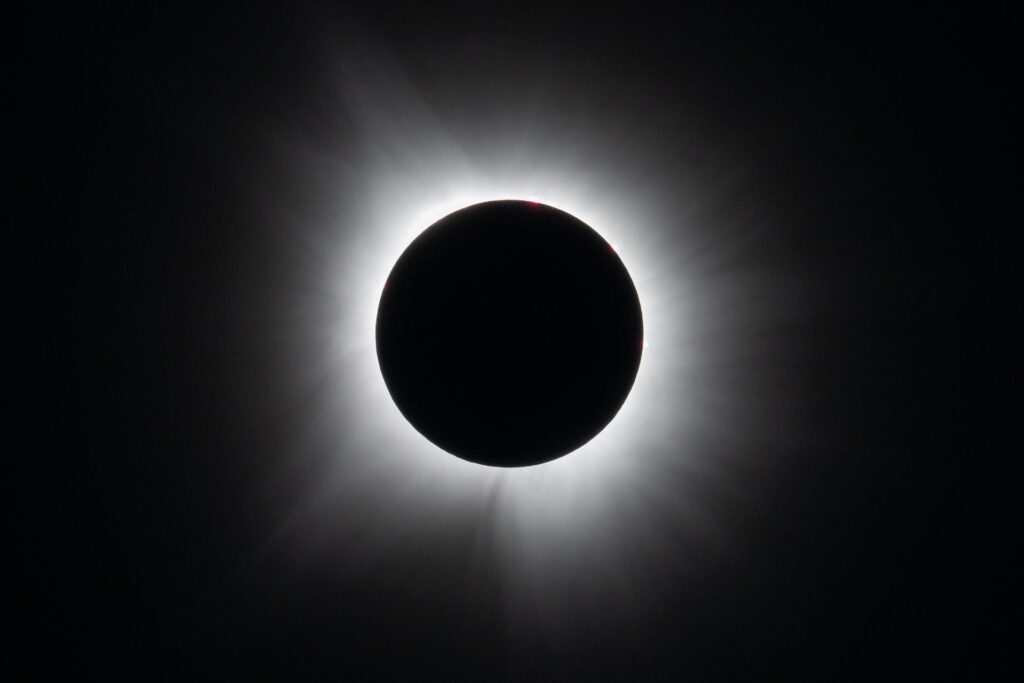
NASA’s Earth Observatory describes the view from northern Spain: in León, the partial eclipse began at 7:32 p.m. local time and ended at 9:22 p.m., with totality lasting about two minutes from 8:28 p.m. Farther east in Spain the Sun set before the eclipse ended. The rest of Europe and parts of Africa, Canada and the United States saw a partial eclipse.
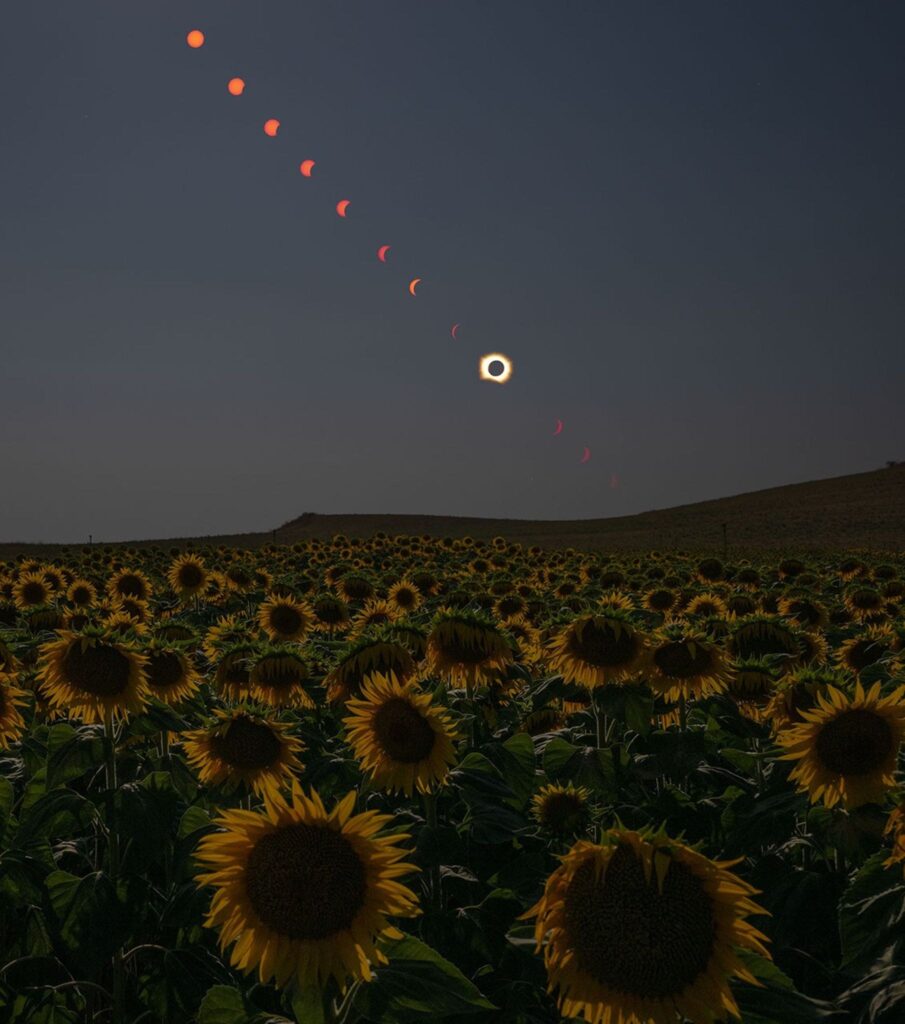
NASA also reported that its pilots flew a WB-57 jet from Iceland to image the corona, the Sun’s faint outer atmosphere, and that the NASA-supported Nationwide Eclipse Ballooning Project launched balloons to measure how Earth’s atmosphere changed during the eclipse. The photograph at the top of this article, by NASA’s Bill Ingalls, is a composite of the eclipse over San Millán de los Caballeros, Spain.
There was no total eclipse over North America in 2026: NASA’s catalog gives only a partial eclipse for northern North America on Aug. 12; the totality path did not cross the continent. No total solar eclipse is listed for the contiguous United States in 2026, 2027 or 2028.
The Feb. 6, 2027 ring crosses Chile, Argentina and the Atlantic
The next eclipse of any kind is annular. NASA lists greatest eclipse at 16:00 UT, with the central point at 31.3 degrees S, 48.5 degrees W in the South Atlantic, a path 282 km wide and a ring lasting up to 7 min 51 s. The Sun is 73 degrees high there, and the magnitude, the share of the Sun’s width covered by the Moon, is 0.928, so a ring of sunlight stays visible.
NASA’s overview says the ring is visible from Chile, Argentina, Uruguay, Brazil, Ivory Coast, Ghana, Togo, Benin and Nigeria, with a partial eclipse across much of South America, Africa and Antarctica. Annular eclipses are never safe to view without a solar filter: the ring is far too bright for the naked eye at every moment.
The Aug. 2, 2027 total eclipse runs from Spain to Yemen with up to 6 min 23 s of totality
This is the long one. NASA gives greatest eclipse at 10:07 UT (10:06:37 UT on its path table) at 25.5 degrees N, 33.2 degrees E in Egypt, with 6 min 23 s of totality, a path 258 km wide and the Sun 82 degrees high. NASA’s path table shows the central line beginning over the Atlantic at 08:26 UT and ending over the Indian Ocean at 11:48 UT.
The Moon’s shadow crosses southern Spain, then Morocco, Algeria, Tunisia, Libya and Egypt, followed by Saudi Arabia and Yemen; NASA’s decade table also lists Somalia. Partial phases reach most of Europe, much of Africa, the Middle East, Southeast Asia, eastern Canada and northern Maine.
For Spain, ESA calls the Aug. 2, 2027 event a total eclipse in the morning and notes that the next total eclipse in Europe after it falls in 2061, over Russia and Kazakhstan. ESA publishes totality maps for Spain and for the globe on its multimedia pages. For the Egyptian stretch of the path and the longest totality of the century, see the guide to the Aug. 2, 2027 total solar eclipse in Egypt.
Before you book a trip, check the exact centerline: NASA’s eclipse site provides the path table and a Google Map for each eclipse, and ESA’s map of totality in Spain shows the Spanish stretch.
Two more in 2028: An annular eclipse over Spain and a total one over Australia
Jan. 26, 2028 (annular). NASA puts greatest eclipse at 15:08 UT near 3.0 degrees N, 51.5 degrees W, off the coast of Suriname, with a path 323 km wide and a ring lasting up to 10 min 27 s, the longest in this list. The path crosses Ecuador, Peru, Brazil and Suriname, and ends over Spain and Portugal near 16:56 UT. ESA lists it as annular in Portugal and Spain.
Spain and Portugal therefore see three notable solar eclipses in under two years (August 2026 total, August 2027 total, January 2028 annular), which ESA presents together as a trio of eclipses.
Jul. 22, 2028 (total). NASA lists greatest eclipse at 02:55 UT at 15.6 degrees S, 126.7 degrees E in northwestern Australia, with up to 5 min 10 s of totality, a path 230 km wide and the Sun 53 degrees high. The central line then runs across Australia and into New Zealand. Because 02:55 UT is late morning in Australia’s west and afternoon in the east, check local times against NASA’s path table before travel.
Eclipse glasses must meet ISO 12312-2, and ordinary sunglasses do not count
NASA’s safety guidance is blunt: wear eclipse glasses or a handheld solar viewer for the whole partial or annular eclipse. Sunglasses do not protect your eyes, however dark they are.
- Buy viewers that meet the ISO 12312-2 standard and inspect them before use. Discard any that are torn or scratched.
- Supervise children who use them.
- Keep the glasses on for every partial phase. In a total eclipse, remove them only when you cannot see any part of the Sun through them, during the brief totality.
- Put them back on as soon as a bright sliver of the Sun reappears.
- Never look at the Sun through a camera, binoculars or telescope while wearing eclipse glasses. NASA warns that concentrated sunlight can burn through the filter. Use a solar filter made for the optics, fitted to the front.
- Use sunscreen and a hat, as the Sun stays bright during partial phases.
ESA gives the same rule: look directly at the Sun only through certified solar filters, or use indirect methods. During an annular eclipse the Sun is never fully covered, so the glasses stay on throughout.
A pinhole projector or a colander shows the eclipse without any filter
NASA recommends pinhole projection as a safe indirect method. Punch a small hole in a card or foil, keep the Sun behind you and look at the projected image on a nearby surface. NASA’s warning is explicit: do not look at the Sun through the pinhole.
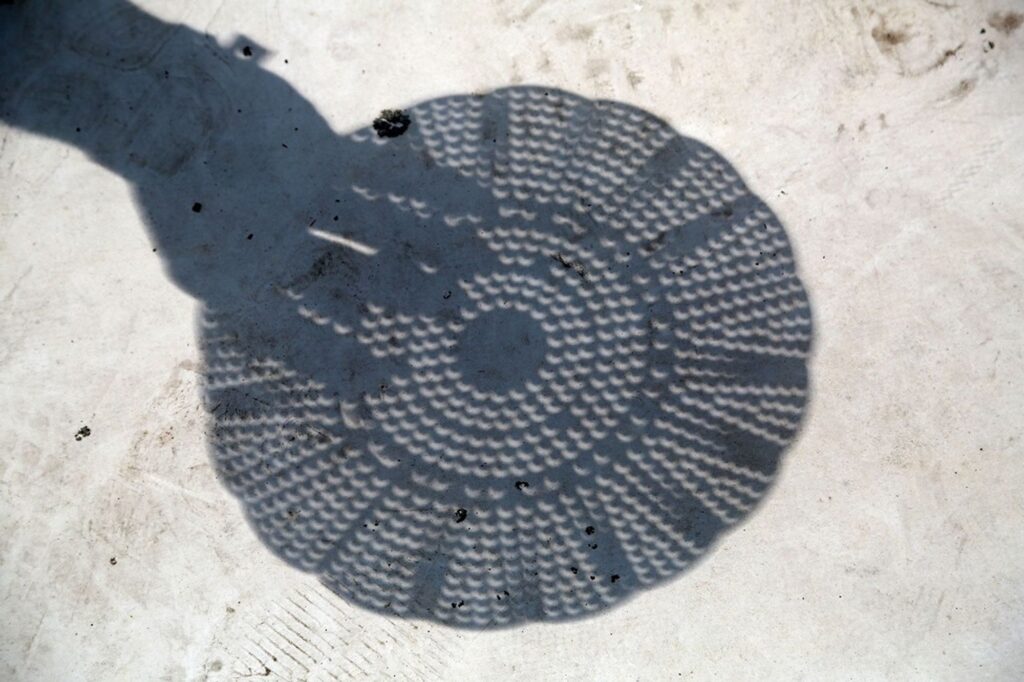
A kitchen colander does the same job with many holes, casting dozens of small crescent Suns on the ground, as NASA’s safety page illustrates. Trees do it too, and the shadows under leaves fill with crescents during the partial phases.
Common questions
When is the next solar eclipse?
The next solar eclipse is the annular eclipse of Feb. 6, 2027, with greatest eclipse at 16:00 UT. The next total solar eclipse is Aug. 2, 2027, with greatest eclipse at 10:07 UT in Egypt. Both dates come from NASA’s eclipse pages, checked on Oct. 18, 2026.
Where can I see the Aug. 2, 2027 eclipse?
Totality is visible from southern Spain, Morocco, Algeria, Tunisia, Libya, Egypt, Saudi Arabia and Yemen, according to NASA, and its table also lists Somalia. Totality is longest near the greatest eclipse point in Egypt, at up to 6 min 23 s. Most of Europe and much of Africa and the Middle East see a partial eclipse instead.
Was there a solar eclipse in Spain and Iceland in 2026?
Yes. The total eclipse of Aug. 12, 2026 crossed Greenland, Iceland and northern Spain, with up to 2 min 18 s of totality at the point of greatest eclipse. NASA says totality in León, Spain, lasted about two minutes, starting at 8:28 p.m. local time.
Are regular sunglasses safe for a solar eclipse?
No. NASA states that ordinary sunglasses do not protect your eyes, however dark they are. Use viewers that meet ISO 12312-2 and remove them only during totality of a total eclipse.
Will a total solar eclipse cross the United States soon?
Not in the period covered here. NASA’s catalog lists total eclipses in 2026, 2027 and 2028 over the Arctic, Spain and North Africa, and Australia. North America sees partial phases of the Aug. 2, 2027 eclipse in eastern Canada and northern Maine, and of the Aug. 12, 2026 eclipse in its northern parts.