NASA shortens SR-1 Freedom’s reactor boom and sets a $39.3 million cooling contract
After an October review at Glenn, NASA has fixed key parts of the first fission-powered spacecraft to leave Earth orbit, which is aimed at a late 2028 launch to Mars.

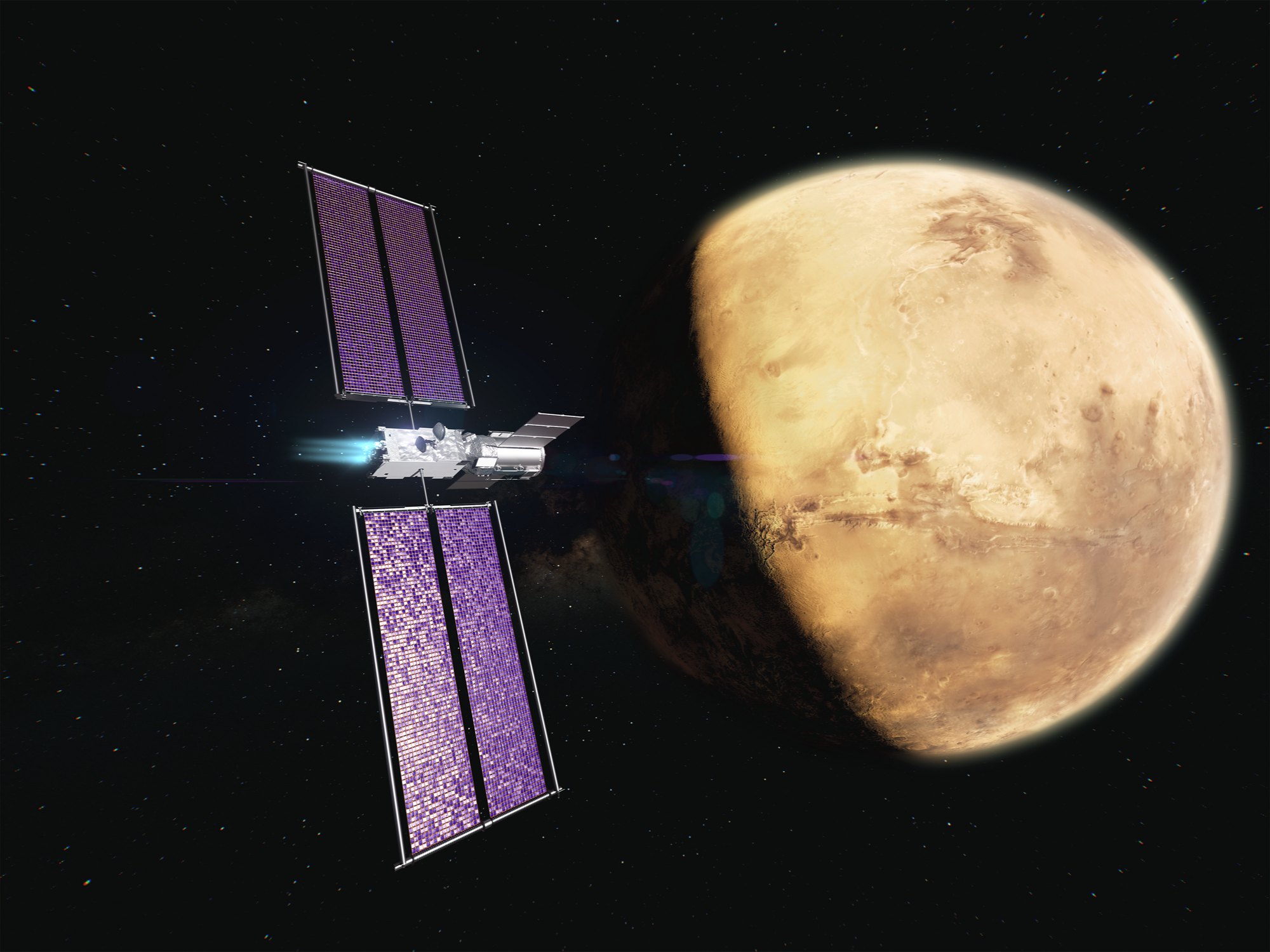
NASA has finished a major design review of Space Reactor-1 (SR-1) Freedom, the first fission-powered spacecraft meant to travel beyond Earth orbit. It will launch in late 2028 and carry the SkyFall helicopter capsule to Mars.
Experts from NASA, the U.S. Department of Energy and industry met at NASA’s Glenn Research Center in Cleveland in October. According to NASA, the meeting moved the mission from an early concept toward a defined spacecraft design.

A shorter boom and a reactor tucked closer in
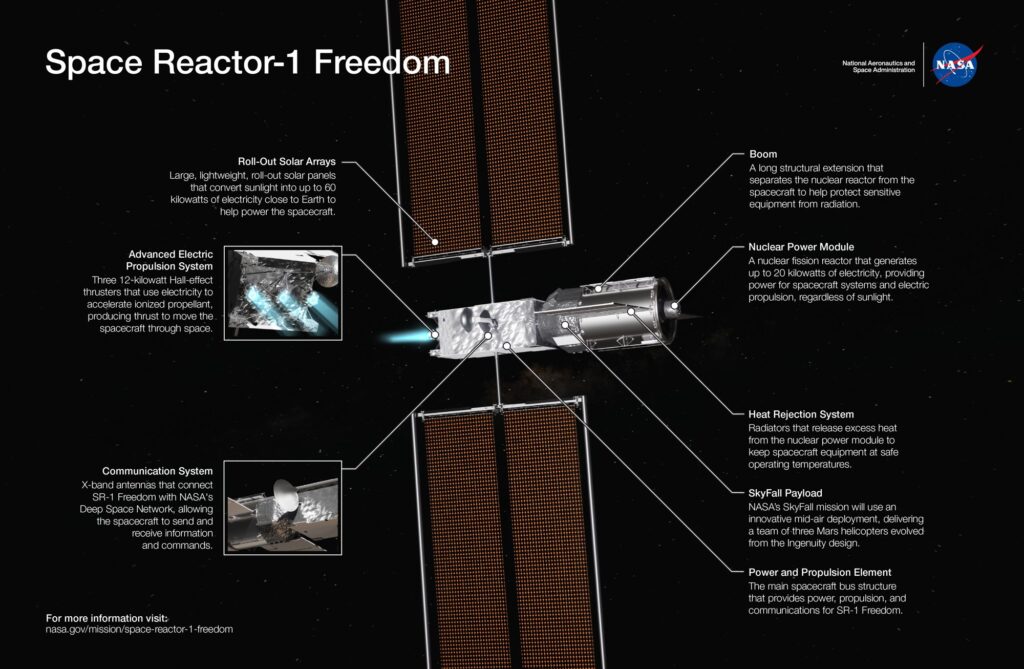
The spacecraft’s main body is called the Power and Propulsion Element. A boom, a long arm, holds the nuclear reactor away from it. Since Administrator Jared Isaacman first presented the concept at NASA’s Ignition event in March, the team has shortened that boom compared with early illustrations. NASA says this cuts weight, simplifies assembly and streamlines the design.
NASA and DOE experts also found that better shielding and spacecraft design allow the reactor to sit closer to the rest of the craft. That makes integration simpler while still protecting the electronics and the SkyFall payload from radiation.


The communications system is changing too. SR-1 Freedom will carry larger X-band antenna dishes, a radio band widely used for deep-space links, to send data back from Mars.
Several choices remain open: the number of radiator panels, the output power of the nuclear power module and how long the reactor will run.
$39.3 million to get rid of the reactor’s waste heat
A reactor produces far more heat than a spacecraft can use, and in space the excess can only be shed by radiating it away. NASA awarded a $39.3 million contract to the Johns Hopkins University Applied Physics Laboratory to build the heat rejection system for the nuclear power module. The lab is working with Advanced Cooling Technologies on the heat pipes and composite radiators.
The contract, issued under the Aerospace Research, Development, and Engineering Support II contract, covers design, build, testing and the flight hardware itself. NASA calls the system a key part of demonstrating nuclear electric propulsion, and says it will help build an industrial base for future high-power nuclear systems.
Reactor on, reactor off, reactor on again
After launch and once the craft has left Earth orbit, SR-1 Freedom will switch on the reactor and raise its power gradually. It will run for an initial period, then shut down while sending performance data to Earth. Solar arrays will power the cruise to Mars.
Once SkyFall is delivered to Mars orbit, the spacecraft will restart the reactor and collect more data. SkyFall carries three next-generation helicopters, which NASA says will study Martian geology and climate history, explore new terrain and look for signs of subsurface ice.
Program director Steve Sinacore said the mission “will be the first freight run on the railroad of the solar system.”
What is still unsettled
The open questions are the ones that decide how much the demonstration proves. A reactor that runs only for an initial period, then restarts at Mars, tests start-up and shutdown in deep space. How long it runs and at what power are still undecided, and those figures set how much performance data NASA can collect.
The mission also depends on a wider push to power spacecraft with electricity. NASA’s separate AMPERE challenge, covered earlier on this site, offers $500,000 for mid-power Hall thrusters that run on krypton, a sign that the agency wants more domestic electric propulsion options. On the surface side, NASA’s nuclear reactor on the Moon plan has been reported to shrink to 20 kilowatts as the agency opened bidding, so power levels across NASA’s fission projects are still being tuned.
Schedule is the other pressure. NASA says further work will focus on reducing risk, simplifying the design and staying on schedule for the 2028 launch, which was tied to the next Mars launch window. If the date slips, the opportunity to reach Mars with this configuration slips with it.