Webb reads dust in Cassiopeia A to find a star’s interior mixed hours before it exploded
Webb's mid-infrared map of dust in Cassiopeia A points to a merger of the star's inner layers shortly before the explosion, and offers a new way to study dead stars.

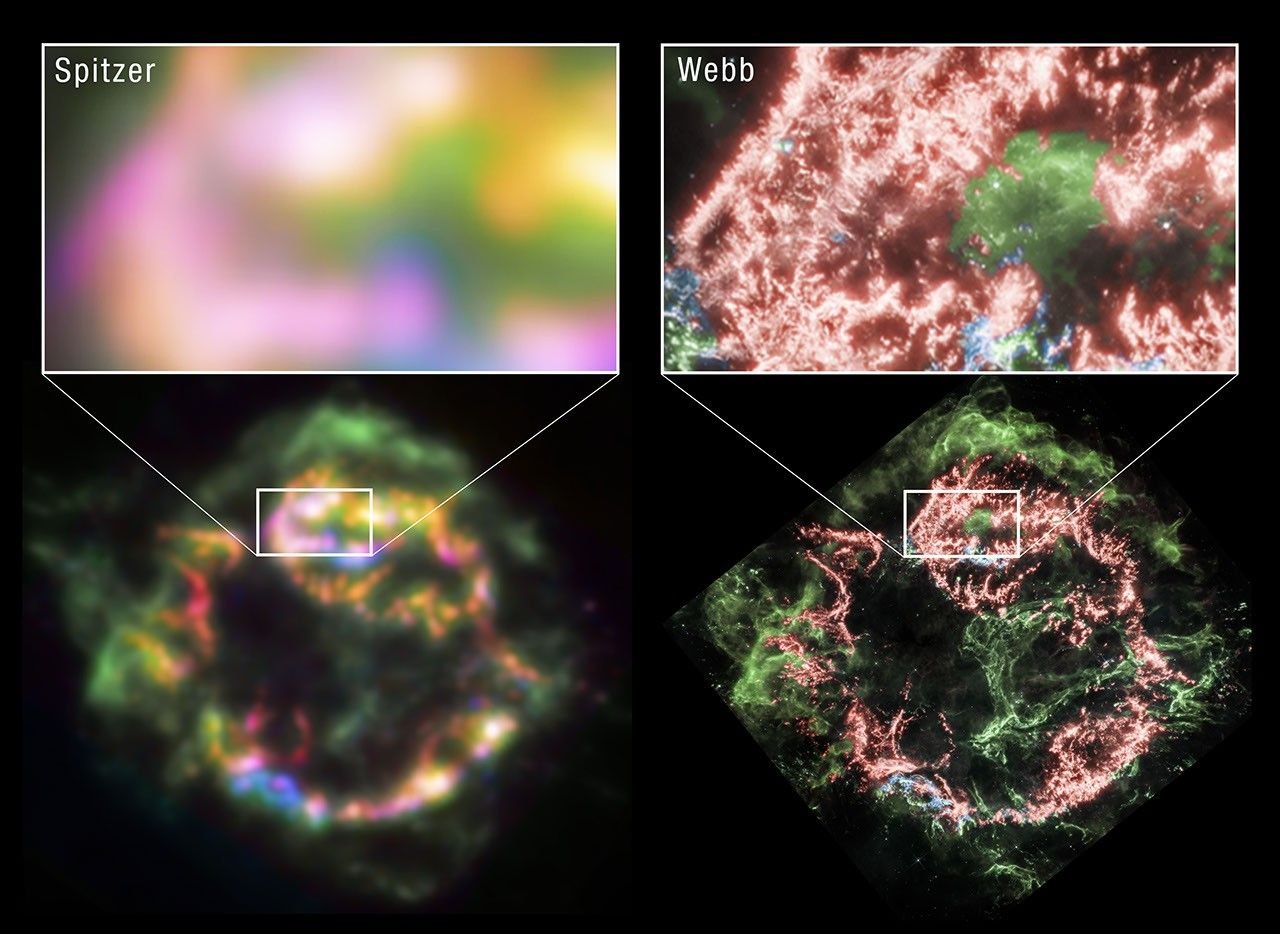
NASA’s James Webb Space Telescope has mapped the dust in the supernova remnant Cassiopeia A and found chemical evidence that the inside of its star was reshuffled, possibly just hours before the explosion, NASA reported on Nov. 23.
Dust that remembers the star’s layers
A massive star is built like an onion. As it ages, it fuses lighter elements into heavier ones in its core, stopping at iron, while lighter elements keep fusing in the surrounding layers. The result is a set of shells, each rich in different elements, that record the star’s history. When the star explodes as a supernova, those elements are flung into space, and some condense into dust grains that clump together.

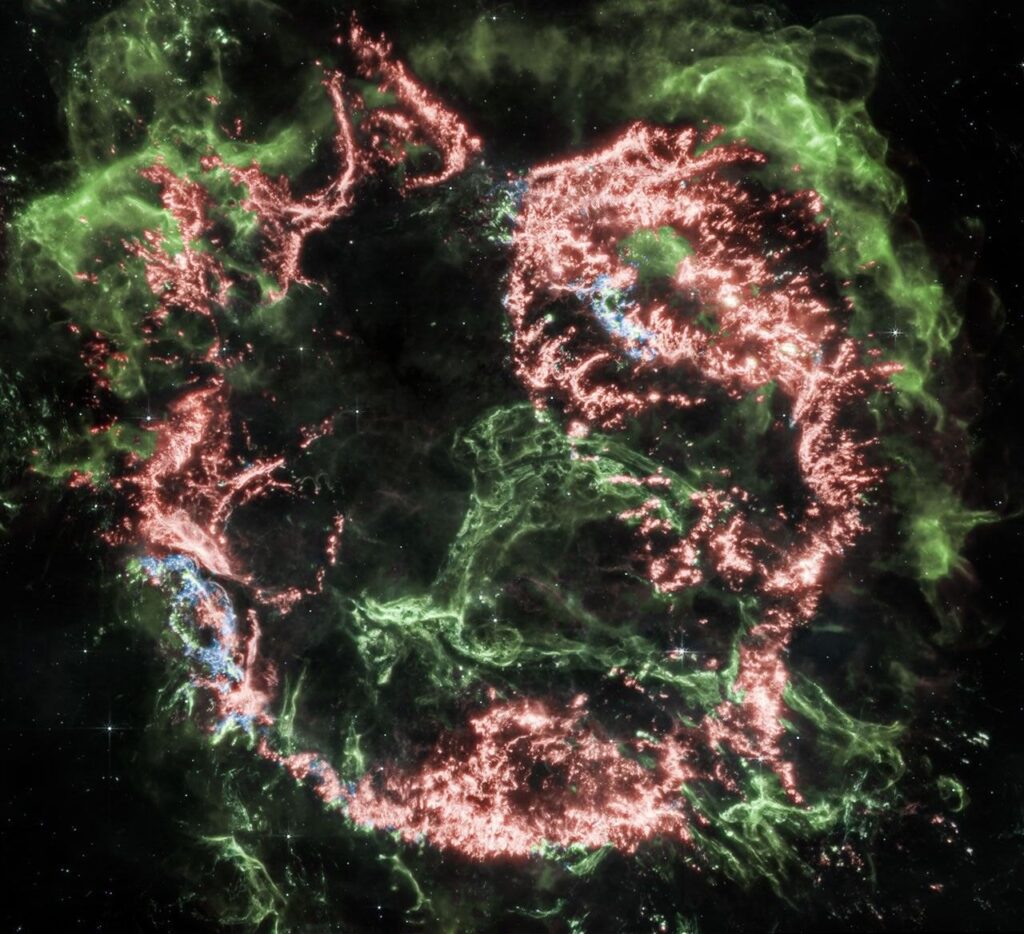
Webb’s mid-infrared observations, taken with its MIRI camera, resolved individual dust clumps in Cassiopeia A, each about the size of our solar system. By mapping what each clump is made of, the team found evidence of a shell merger: a process in which layers inside the star mix before the explosion. The results were published Monday in The Astrophysical Journal Letters.
“Material within these shells churns and circulates, which can cause the shells to merge shortly before the supernova explosion,” said lead author Tea Temim of Columbia University. In the example she gave, the oxygen-burning and carbon-burning shells combine, which changes the star’s structure and the mix of elements that ends up in the debris.

Three targets, three kinds of dust
Webb could not pick its targets blindly. NASA’s retired Spitzer Space Telescope had surveyed the remnant earlier but could not resolve fine detail, so it served as a guide to three regions worth a closer look.
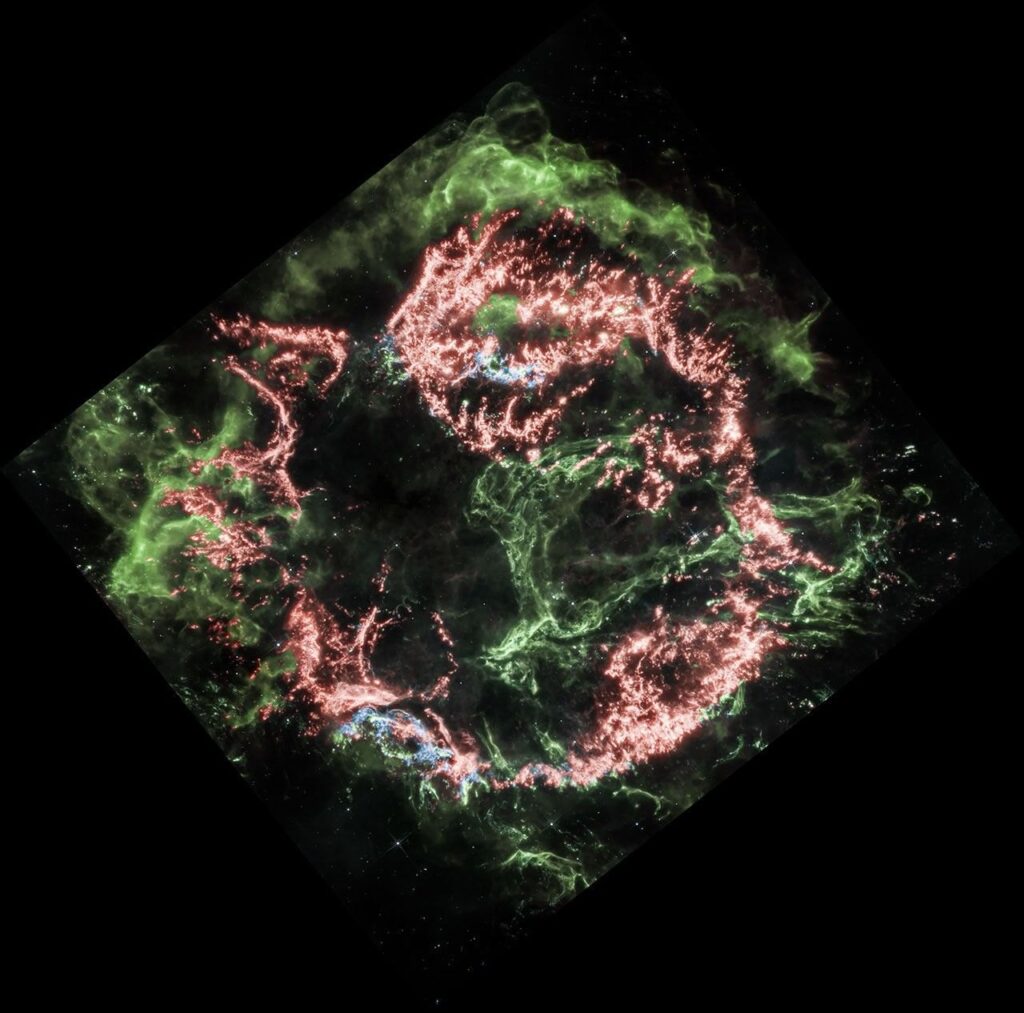
- Two sit in the reverse-shocked region, where a shock wave moving inward meets debris thrown outward by the blast. In one, the ejecta were mostly silica dust; in the other, carbon dust dominated.
- The third is the “Green Monster,” a structure first discovered by Webb. It is rich in complex magnesium silicates and, unlike the other two, came from material the star shed before it exploded rather than from the supernova itself.
The team combined the dust map with X-ray observations from NASA’s Chandra X-ray Observatory and the JAXA-led XRISM. Together, NASA said, the data indicate the merger was underway very shortly before the explosion, and that its signatures appear throughout much of the remnant.
What a 340-year-old explosion can still tell us
The science payoff is that the debris acts as a fossil record of the star’s last moments, which no telescope could watch directly. According to NASA’s 2023 description of an earlier Webb image, Cassiopeia A lies about 11,000 light-years away in the constellation Cassiopeia and spans about 10 light-years, and the explosion happened 340 years ago from Earth’s perspective. That is young for a supernova remnant, so the debris is still fresh and has not yet blended into the surrounding gas.
Dust is a harder tool to use than glowing gas, because grains form and change after the blast, and telling one clump’s chemistry from its neighbor’s needs sharp resolution. Co-author Dan Milisavljevic of Purdue University said Webb’s ability to resolve individual clumps allows more sophisticated dust chemistry. “It’s telling us about what was happening, we think, in the hours leading up to core collapse,” he said. That matters beyond one star: the shell structure at the moment of collapse decides which elements a supernova releases into the galaxy, and so what later stars and planets are made from.
NASA describes the dust-mapping approach as a new method other astronomers can use on their own supernova remnants to infer how the original star was built. Cassiopeia A is the first case, and the same chemistry-by-clump technique can in principle be repeated on other remnants.