Your name can fly to Titan on Dragonfly, but the sign-up closes Jan. 15
NASA is taking names for a microchip on Dragonfly, the rotorcraft due to launch in 2028 and reach Saturn's moon Titan in 2034. Sign-ups close on Jan. 15, 2027.


NASA is inviting the public to put their names on a microchip that will fly aboard Dragonfly, a rotorcraft (a helicopter-like aircraft) bound for Saturn’s moon Titan. Sign-ups run until 11:59 p.m. EST on Jan. 15, 2027, NASA said.
What you get for signing up
Everyone who adds a name through the “Journey to Titan” campaign receives a personalized digital boarding pass commemorating their place on the mission. The names are stored on a microchip that will ride aboard the rotorcraft. Sign-up is at go.nasa.gov/dragonfly-names.

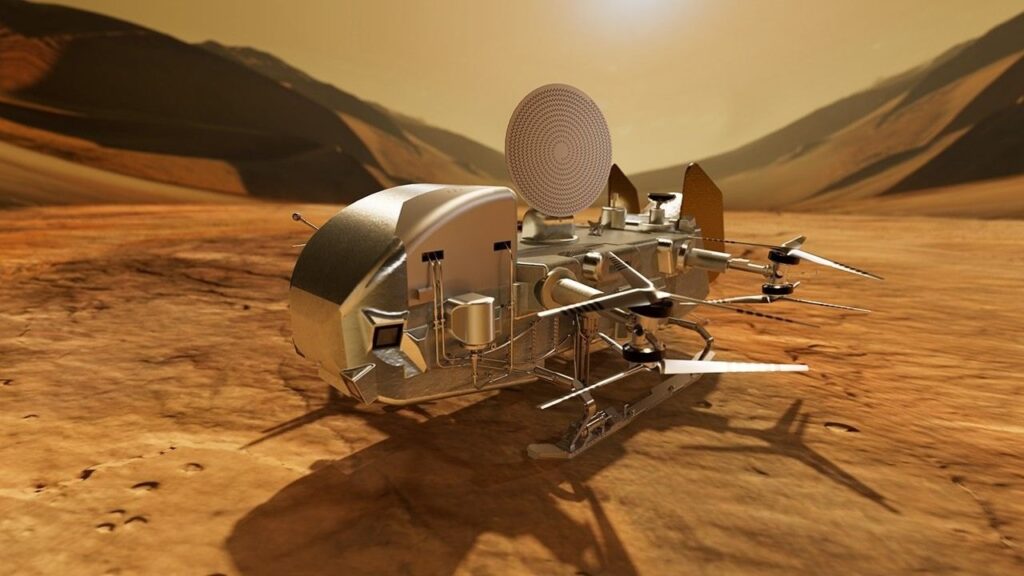
Nicky Fox, associate administrator of NASA’s Science Mission Directorate, said the agency is “excited to bring humanity along for the journey of a lifetime.” She described Dragonfly as the first-ever rotorcraft science mission, built to search for signs of habitability on a distant world that she called the most similar to our own.
A flying lab taking shape in Maryland
Engineers are putting Dragonfly together at the Johns Hopkins Applied Physics Laboratory (APL), in Laurel, Maryland. APL leads the mission for NASA, and Elizabeth Turtle of APL is the principal investigator, the scientist with overall responsibility for the science. It is the fourth mission in NASA’s New Frontiers Program, which is managed by the Marshall Space Flight Center in Huntsville, Alabama.

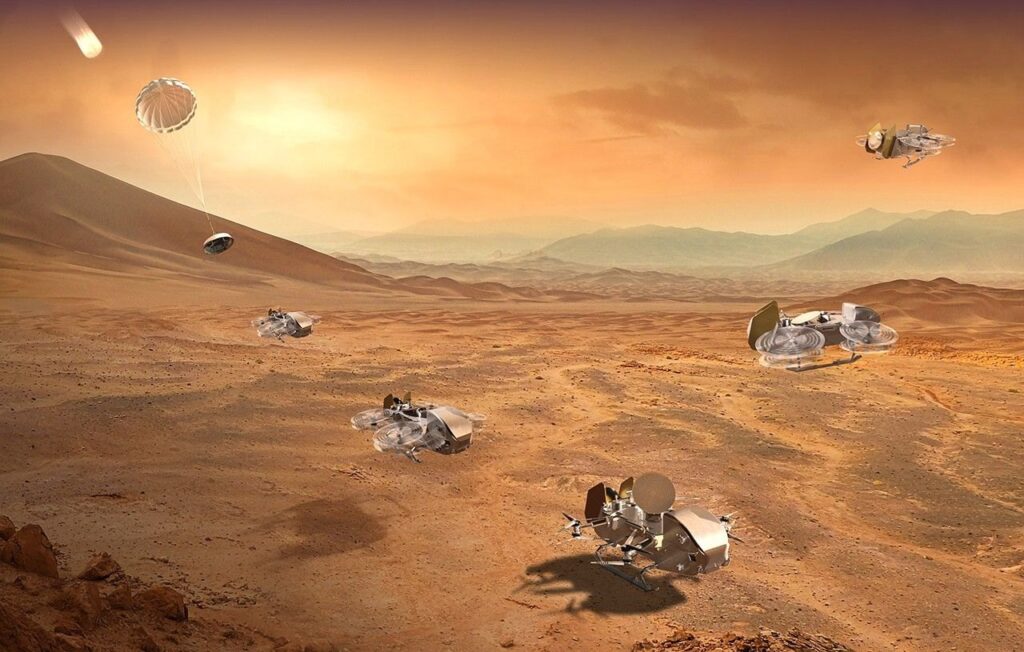
Launch is scheduled for 2028, with arrival at Titan in 2034. NASA’s mission page gives the launch as no earlier than July 2028 and the arrival as late 2034, so the chip will spend about six years in transit before it ever sees Titan’s sky.
Titan is unusual among moons. NASA points to a dense atmosphere, rivers and lakes filled with liquid methane, broad dune fields, and ground rich in organic compounds, meaning carbon-based molecules. Once there, Dragonfly will fly between sites and look for clues about prebiotic chemistry: the chemistry that came before biology. That should help scientists understand the ingredients and conditions that life needs.
Why a rotorcraft suits a moon with a thick sky
The engineering case for Dragonfly comes from Titan’s air. A rover must pick one route across rough ground, while an aircraft can hop from one geological setting to another. NASA’s mission page says the rotors will carry Dragonfly for miles across Titan, and names the dunes and Selk Crater as areas of interest. Those are very different terrains, and reaching both in one mission is the point of flying.
That mobility comes with a pace set by Titan’s long days. According to NASA, Dragonfly plans about one flight every one to two Titan days, and a Titan day lasts about 16 Earth days. The mission is planned to last 3.3 years. So the flights will be few and deliberate, with long pauses between them for measurements and for sending data home.
Flying on another world is not new: NASA flew a helicopter on Mars, and our report on thinner Mars helicopter blades covers how engineers hope to stretch one such flight from 0.7 km to 18.7 km. Dragonfly differs in being a full science mission rather than a technology demonstration. NASA says it will be the first science mission to fly across the surface of another world, carrying instruments to study Titan’s chemistry.
What happens to the names
NASA did not say how many names the chip can hold or how they will be etched. Entries are open to the public, and the deadline is the only limit the agency states. With the launch still about two years away, the list stays open through mid-January 2027.