Phobos sample return: NASA’s 15% share and the Mars moon mission launching Oct. 19
JAXA's MMX is scheduled to launch on Oct. 19 to study Phobos and Deimos, with NASA providing two instruments, tracking support and curation of about 15% of the returned sample.

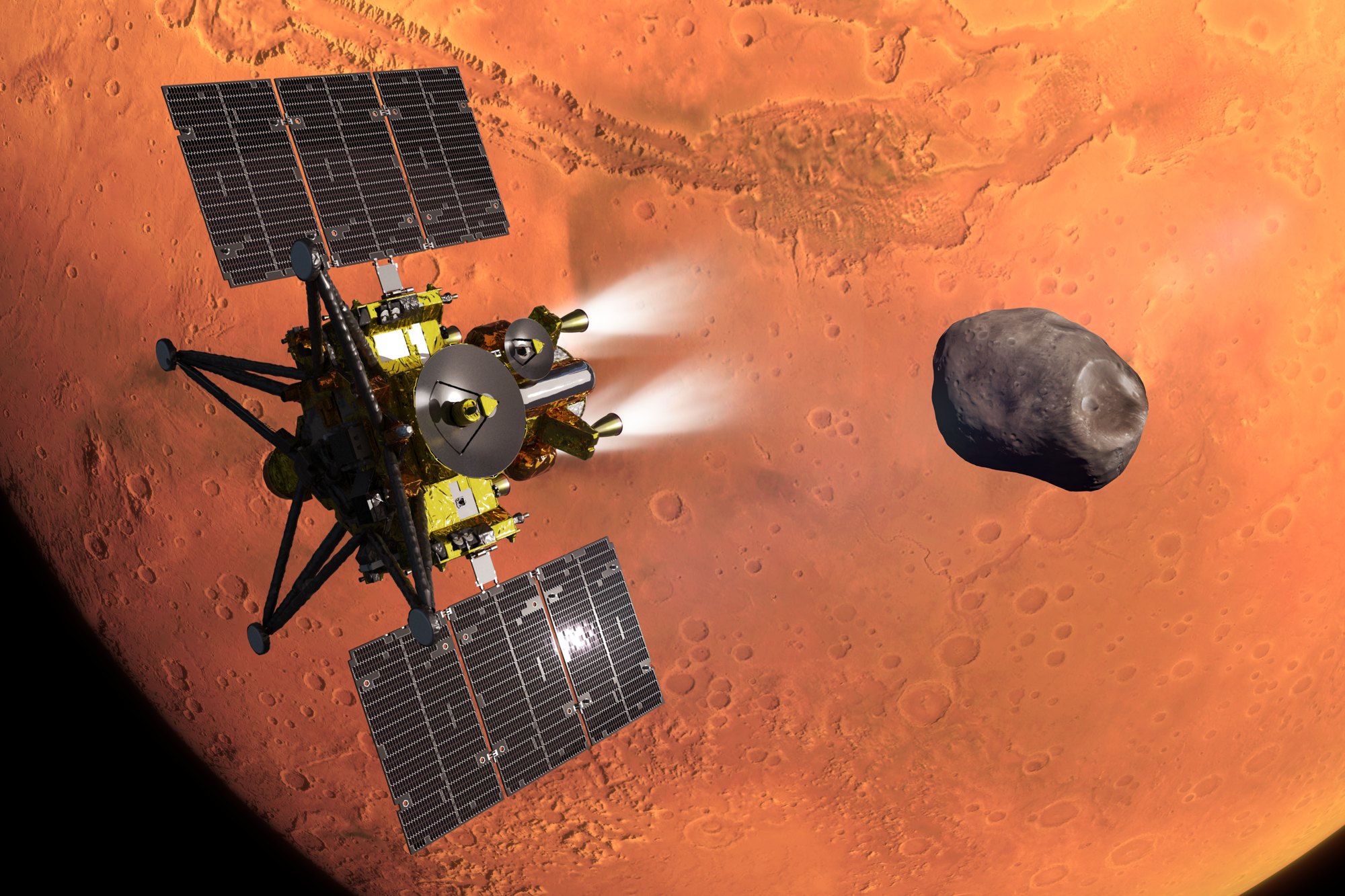
JAXA’s Martian Moons eXploration (MMX) spacecraft is scheduled to launch from Tanegashima Space Center on Oct. 19 at 19:41 UTC (3:41 p.m. EDT), NASA said. NASA supplies two payloads and will curate about 15% of the returned Phobos sample.
What NASA is contributing
The launch is targeted for 4:41 a.m. JST on Tuesday, Oct. 20. According to NASA, the mission aims to characterize and determine the origin of Mars’ moons Phobos and Deimos, and to deliver a sample of Phobos to Earth.

NASA’s hardware and services fall into four parts:
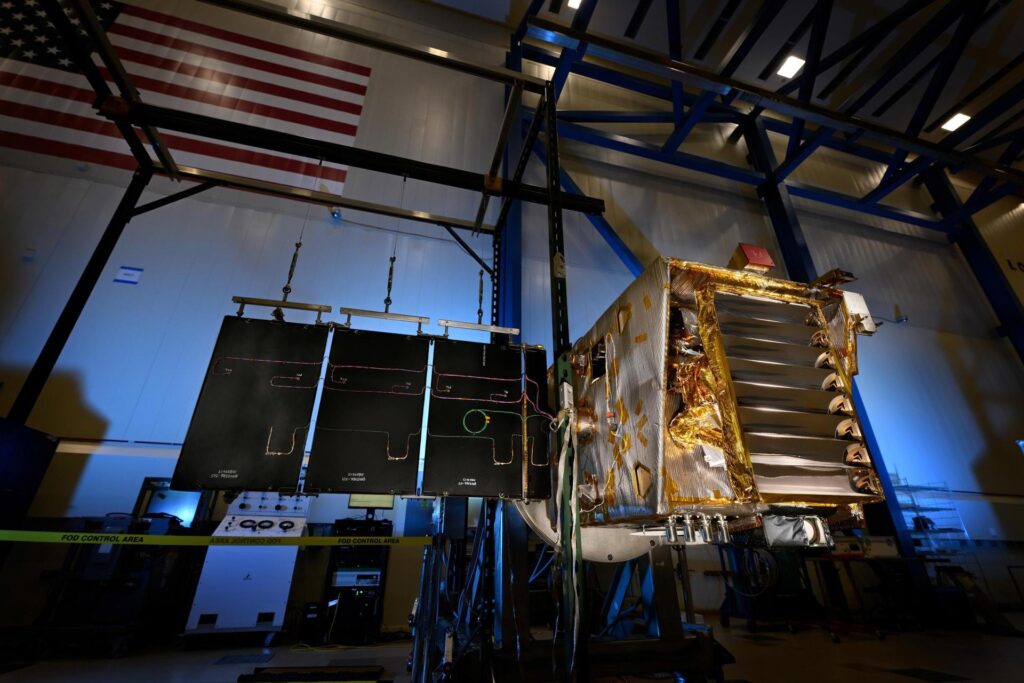
- MEGANE, the Mars-moon Exploration with Gamma rays and Neutrons spectrograph. It measures neutrons and gamma rays emitted from Phobos’ surface to determine its elemental composition. The Johns Hopkins Applied Physics Laboratory built it.
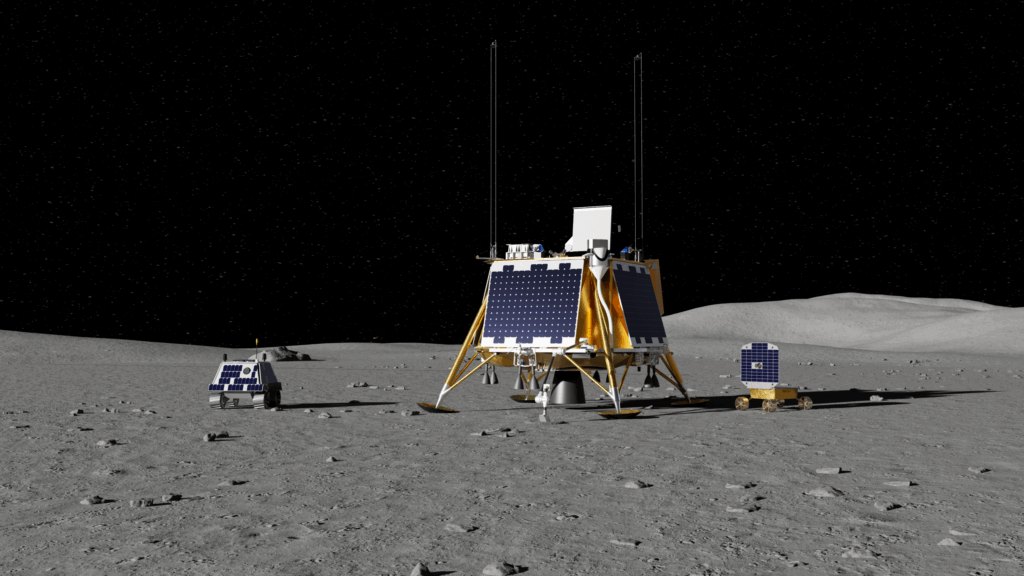
- P-Sampler, a pneumatic (gas-powered) sampler technology demonstration mounted on one of the spacecraft’s landing legs. It collects surface material using bursts of high-pressure nitrogen gas. Honeybee Robotics, a Blue Origin company, developed the mechanism.
- Communications and navigation support from the Deep Space Network.
- Funding for United States scientists on the MMX science team.
The P-Sampler complements JAXA’s own C-Sampler, which will extract cores from a few inches deeper, according to NASA. NASA’s contributions were developed under its Discovery Program, managed by Marshall Space Flight Center for the Science Mission Directorate.
The sample and the open question
NASA will obtain and curate about 15% of the total returned sample at the Astromaterials Lab at Johnson Space Center in Houston, and make it available for research for decades.

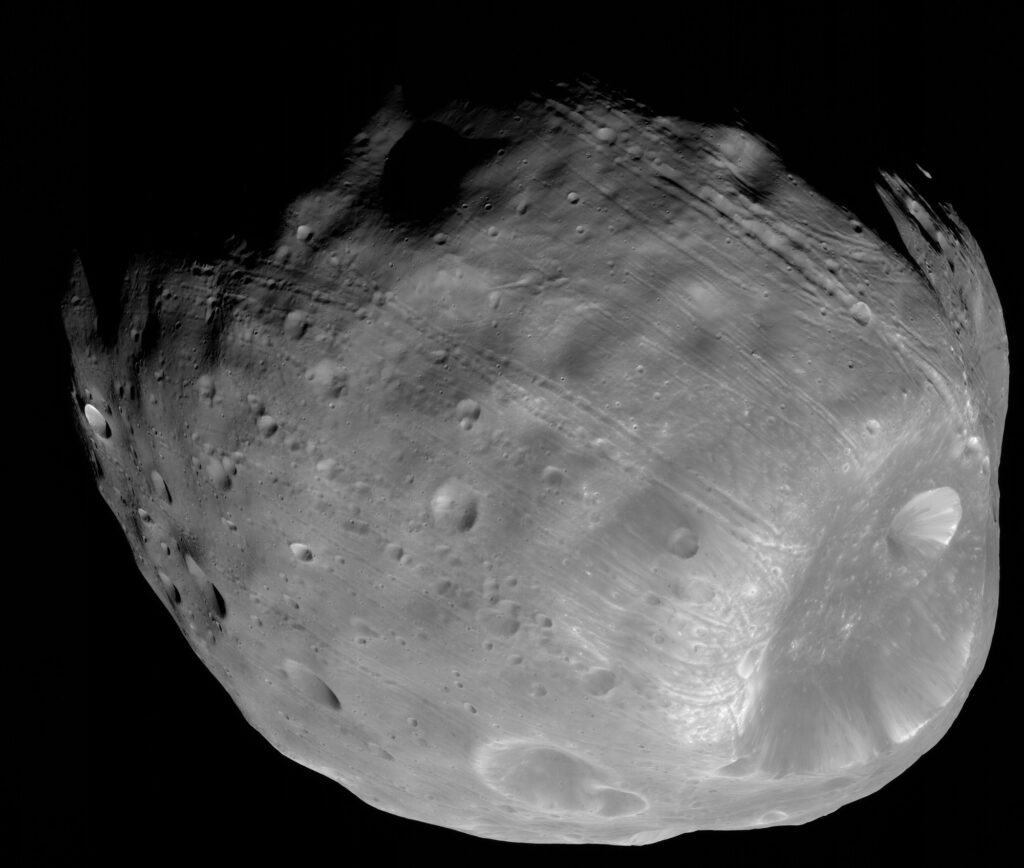
The central question is where the moons came from. Tom Statler, MMX program executive and program scientist at NASA Headquarters, said that “Phobos and Deimos may be the remains of a massive impact on Mars that sent material into orbit around the planet, or they could be ancient asteroids that were captured by Mars’ gravity billions of years ago.” In his words, a firm answer would shed light on the youthful solar system, when Earth and its inner neighbors were likely collecting much of their water and carbon-based material.
Nicky Fox, associate administrator of NASA’s Science Mission Directorate, said the samples “will bring forth paradigm-shifting science on the Mars system for generations to come.”
From Mars orbit in 2027 to a sample in 2031
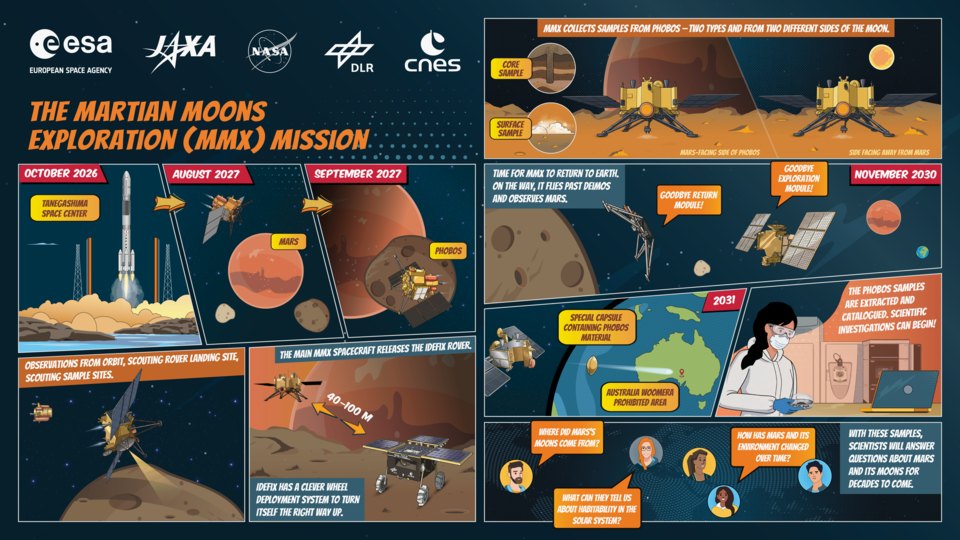
According to NASA, MMX will arrive at Mars in August 2027 and survey both moons. After a detailed survey of Phobos, it will collect a surface sample no earlier than December 2028 and deliver it to Earth in 2031. All of these dates assume the launch goes ahead as planned.
The milestones that will show if MMX stays on schedule
For a mission this long, the milestones that matter come well after launch. The first is the Oct. 19 liftoff itself.
The next markers are on ESA’s mission page. It says the return module is due back at Earth in 2031 with at least 10 grams of Phobos material, and that the IDEFIX rover, built by DLR and CNES, is released in early 2029. Because Phobos has such weak gravity, ESA says IDEFIX weighs 25 kg on Earth but only about 15 g on the moon.
Two things would change the picture. A slip in the sampling date would be the first sign that the 2031 return is under pressure. Early composition data from MEGANE once the spacecraft is at Mars would also give evidence for the impact or capture theories before any sample reaches a lab. ESA says it is working with CNES, DLR and JAXA on announcements of opportunity for European scientists to study the samples, so the 15% held in Houston will be one of several allocations.
MMX adds to a Mars program that so far relies on surface machines such as those in our earlier report on Curiosity and Perseverance. A sample from a Martian moon would be a different kind of record of the planet’s neighborhood.