ALMA finds rings and gaps in compact planet-forming disks
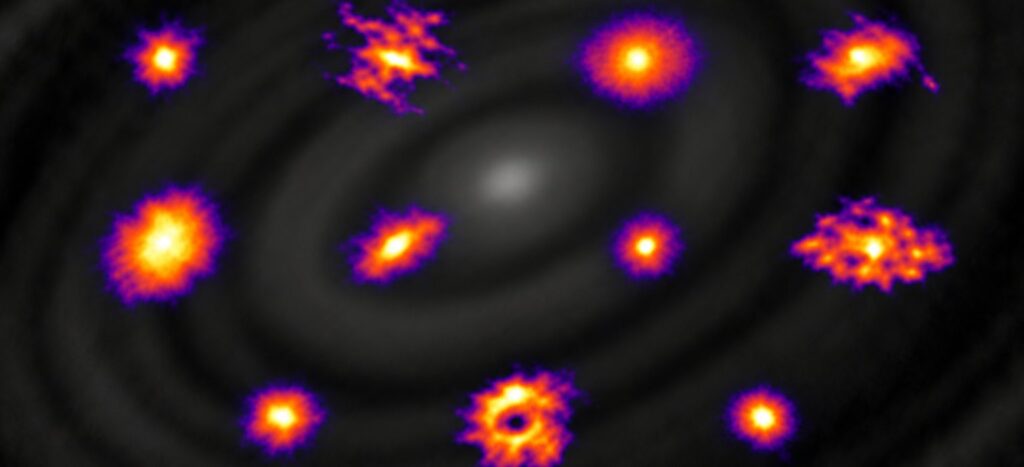
Astronomers using ALMA at its sharpest setting found substructures within 10 astronomical units in four of 11 compact disks, including a cavity just 1.6 au from its star.

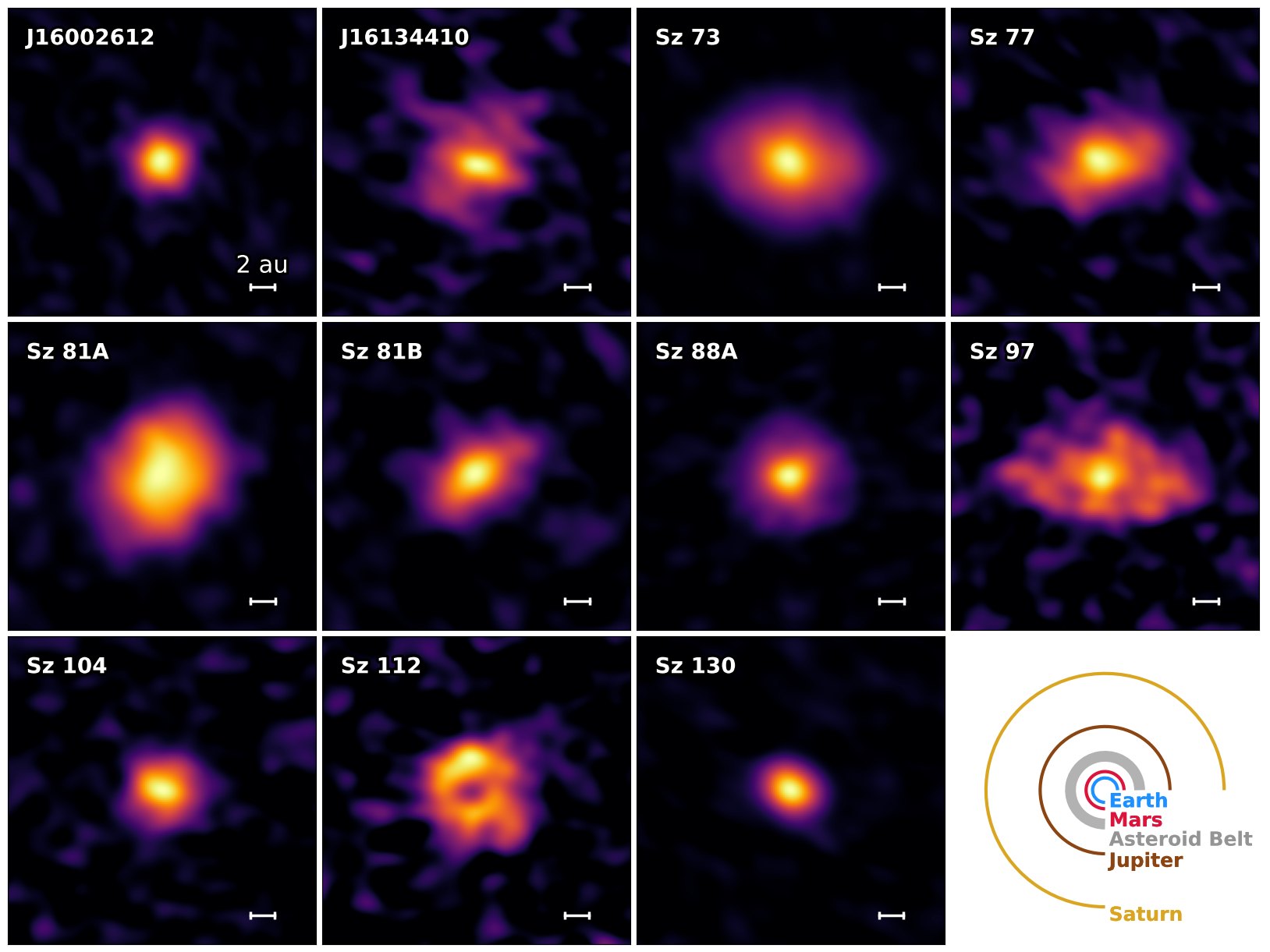
Astronomers using the Atacama Large Millimeter/submillimeter Array have found rings, gaps and cavities in compact planet-forming disks, the ALMA Observatory announced. Clear structure appeared within 10 astronomical units of the star in four of 11 disks.
Eleven small disks, imaged at two astronomical units per detail
The team was led by Pietro Curone of CATA and Universidad de Chile, with Gijs Mulders, Nienke van der Marel and Laura Pérez among the co-authors. They pointed ALMA, in its most extended antenna configuration, at 11 extremely compact protoplanetary disks in the Lupus star-forming region. The observations were made in Band 7, at a wavelength of about 0.9 millimeters, and reached an angular resolution, the smallest detail it can tell apart, of roughly 0.02 arcseconds. At the distance of Lupus, ALMA says, that equals about two astronomical units. It is the highest resolution currently available from the array at this wavelength.

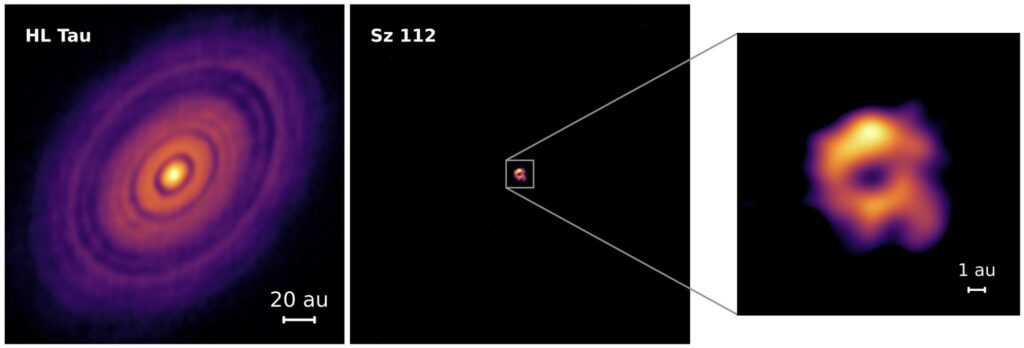
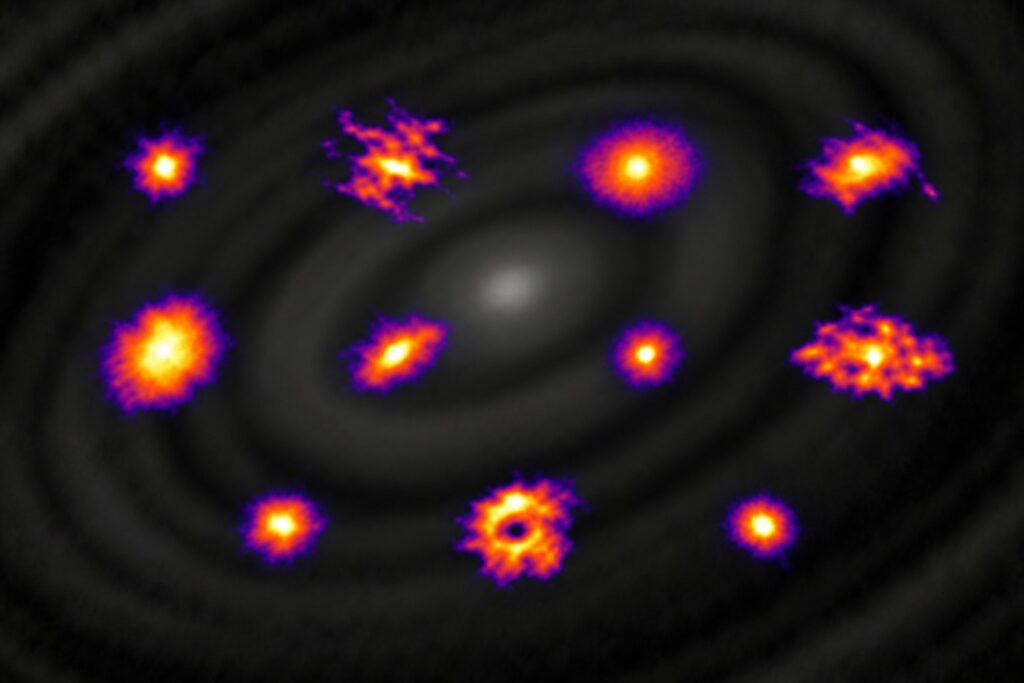
Four of the 11 disks showed clear substructure within 10 au, and three more showed hints of similar features. In Sz 112, ALMA resolved a central cavity reaching only 1.6 au from the star. The study identifies it as the smallest known transition disk, meaning a planet-forming disk with an inner cavity. The cavity is comparable in scale to Earth’s orbit.
Small disks had long looked smooth next to the ringed giants that made ALMA famous, such as HL Tau. Curone said that “at least part of that difference was an illusion caused by resolution.”

Detection rates climb with disk size and sharper vision
To check the idea, the team compared the new images with earlier ALMA surveys. Counting only disks resolved well enough to reveal structure reliably, substructures turned up in about 44% of extremely compact disks with radii of 3 to 10 au. The rate was about 55% for disks of 10 to 30 au and above 90% for disks larger than 30 au. The authors conclude that the apparent scarcity of rings and gaps in small disks comes at least partly from limited resolution rather than from a real absence.
Two of the compact systems, Sz 73 and Sz 130, also show faint rings well outside their bright cores. Four more show tentative signs of similar outer emission. Some disks classed as tiny may therefore hold extended material that is simply too faint to have been noticed.

Possible super-Earths in the making
Rings and gaps matter because solid grains drift inward and can be lost quickly unless a pressure trap, a ring where the gas pressure peaks, holds them. Van der Marel said the new data show that pressure traps can form just a few au from the star, even in the tiniest disks, and that young planets may have carved some of the gaps.
The team estimated what a single planet would need to open each gap. For structures within five au, the masses fall in the range of super-Earths and mini-Neptunes, a planet type that is hard to reach with current exoplanet surveys and with disk imaging at larger scales. The researchers stress that a ring or gap is not a direct planet detection. Other physical mechanisms can shape disks, and the data do not exclude them.
A multinational array doing a job no single country built for
The result rests on an instrument run as a partnership. According to the observatory, ALMA is a collaboration of the European Southern Observatory, the U.S. National Science Foundation and Japan’s National Institutes of Natural Sciences, in cooperation with Chile, with further contributions from Canada, Taiwan and Korea. The observatory’s own description lists 66 antennas on the Chajnantor Plateau at about 5,000 meters, which can be spread over baselines, the distances between antennas, of up to 16 kilometers. That maximum spacing is what delivers the finest resolution.
The pooled model matters because the next step needs many hours on such an array. The authors call for more compact disks to be observed at other wavelengths, using both dust and gas tracers, to learn how common these hidden structures are and whether they mark where planets form. The scientific question links to a broader one about how planetary systems acquire their ingredients, which we covered in our earlier story on how worlds got their oceans.
The work appears in The Astrophysical Journal Letters under the title “Probing Planet Formation within 10 au: Dust Substructures in Extremely Compact Protoplanetary Disks.”