Four decades of space junk damage, from Hubble’s dish to a shuttle window
NASA's Orbital Debris Program Office has put online photos of hardware pitted, holed and cracked by debris, from Hubble's antenna to a shuttle window.

NASA’s Orbital Debris Program Office has published a new impacts gallery: photos of spacecraft and shuttle parts that were struck by orbital debris, the leftover human-made fragments circling Earth. The set includes a hole punched through Hubble’s antenna dish.
What the photos show
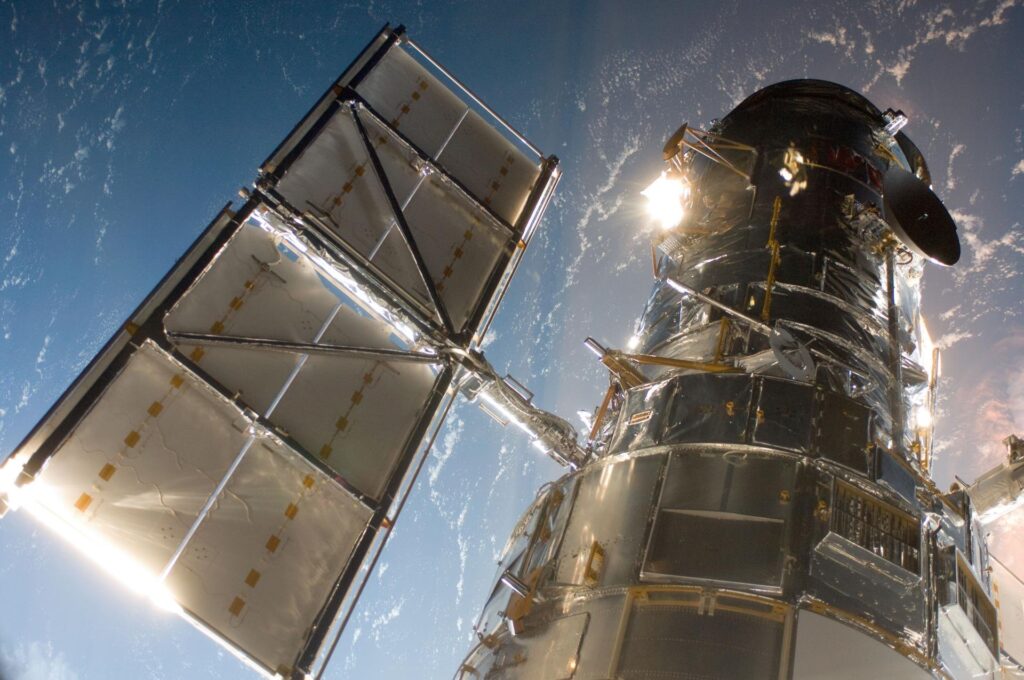
The gallery collects physical evidence rather than computer models. According to NASA’s captions, one image shows an impact that completely penetrated the antenna dish of the Hubble Space Telescope. Others show orbital debris damage seen during Hubble repairs, and parts returned after in-space servicing that carry many debris impacts. Another set looks down into an impact through-hole in the multi-layer insulation (the thin, crinkled thermal blanket wrapped around a spacecraft) on Hubble’s Bay 5.

Space shuttle hardware appears too. NASA lists a window pit from orbital debris on STS-7, a shuttle window being inspected for impacts, and damage to the vertical stabilizer (the tail fin) of the STS-92 orbiter.
Two retrieved satellites supply some of the most telling samples. The Long Duration Exposure Facility (LDEF) spent 5.7 years circling in low Earth orbit before a space shuttle collected it, and the gallery shows a close-up of one of its panels. Several metal louvers and thermal blankets came back from the Solar Max satellite after its repair, and one photo shows a debris hole in a panel of its experiment.

Not all the culprits are broken spacecraft. One picture shows solid rocket motor slag, aluminum oxide that is a byproduct of those motors, and another shows paint flakes captured by the Mir Environmental Effects Payload (MEEP). Its Orbital Debris Collector spent 18 months exposed to the space environment on the Russian station Mir. The gallery also includes ODERACS, an experiment that deployed spheres and dipoles (small rod-shaped reflectors) from the Shuttle to calibrate the Haystack orbital debris radar.
Sister galleries cover reentry, telescopes and radar
The impacts gallery is one of five NASA published on the same day, alongside ones for reentry, telescopes, radar and graphics. The reentry gallery shows hardware that survived the fall through the atmosphere, including the main propellant tank of a Delta 2 second stage and a 30 kg titanium pressurant tank from the same stage. Another caption describes the reentry of a Delta 2 third stage, a PAM-D (Payload Assist Module – Delta), on 21 January 2001.
The radar gallery lists the ground sensors that watch debris. Per NASA’s captions, the 70-m Goldstone antenna in California can detect objects as small as 2 mm when operated as a bi-static radar, with one dish transmitting and another receiving. The Haystack and HAX radars in Massachusetts each collect 600 hours of orbital debris data per year. Other entries cover Cobra Dane in Alaska, the Kiernan Reentry Measurement Site on Kwajalein Atoll and the Eglin FPS-85 radar in Florida.
Why small fragments leave real holes
The damage looks out of proportion to the particles that cause it because of speed. NASA’s Orbital Debris Program Office says debris in low Earth orbit (below 2,000 km altitude) travels at roughly 7 to 8 kilometers per second. At that speed, a flake of paint carries enough energy to pit a window, and a fragment of a few millimeters can pierce a thermal blanket.
The office’s own FAQ puts numbers on the problem: about 50,000 large, trackable objects orbit Earth, along with an estimated 100 million pieces of millimeter-sized debris. The first group can be tracked and, in some cases, dodged. The second cannot, which is why returned hardware matters. A recovered panel is one of the few ways to count impacts that no radar could see.
The policy case behind the pictures
The gallery is best read as evidence for rules about how missions are built and ended. The office says its website covers the debris environment, measurements, modeling, mitigation and related research, and it publishes the Orbital Debris Quarterly News. Holes in shielding and pits in glass are the kind of ground truth that debris models are checked against, and those models in turn feed the guidelines governing how long defunct stages may linger and how spacecraft should be protected.
The reentry images carry a second message for regulators: not everything burns up. A Delta 2 propellant tank and a titanium pressurant tank both survived the fall, which is why where and when upper stages come down remains a live issue for launch operators and national authorities alike.
NASA’s gallery pages give no explanation of why the images are being released now, and the captions are short. They do, however, assemble in one place more than four decades of hardware that flew, was hit and came home.