Hubble sees the dark ‘Cat’s Tail’ in visible light, a likely Pluto-scale crash
University of Arizona astronomers used Hubble to image the Cat's Tail in the Beta Pictoris system, the first time it has been seen in visible light, and tie it to a crash of Pluto-sized bodies.

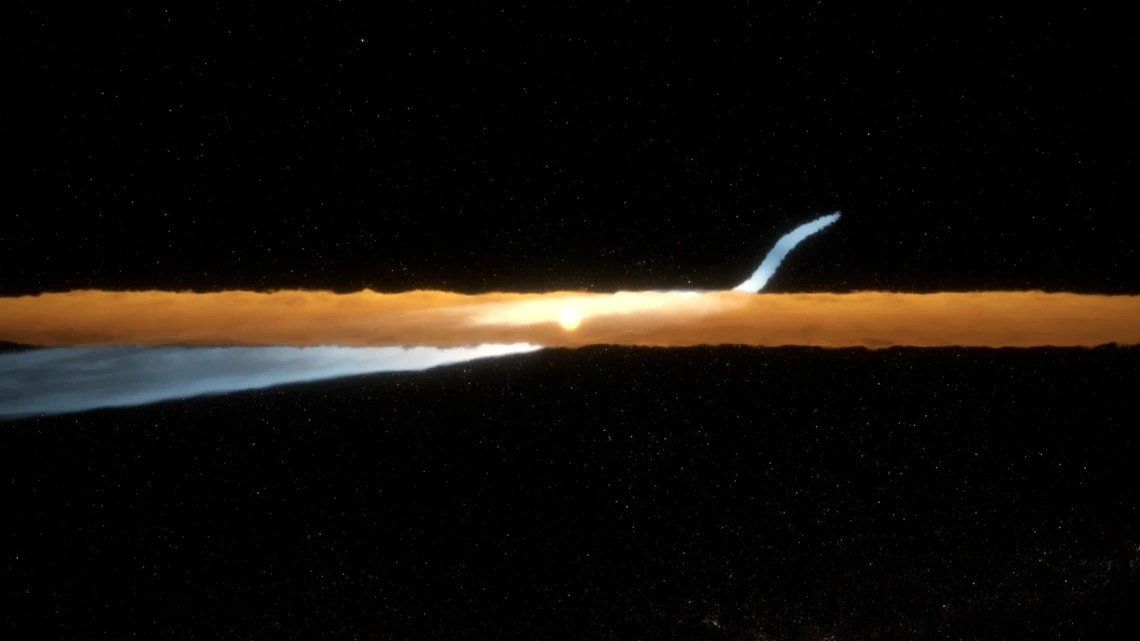
Astronomers at the University of Arizona have captured the “Cat’s Tail”, a streak of dark dust in the young Beta Pictoris system 63 light-years away, in visible light for the first time, using the Hubble Space Telescope. They link it to a collision between Pluto-sized bodies, according to the university.
A tail that hid from shorter wavelengths
Beta Pictoris is a star in the faint southern constellation Pictor, surrounded by a debris disk: a flat ring of dust and rock left over from planet formation. The system formed only a few million years ago, which makes it a close look at what planetary systems do when they are young.

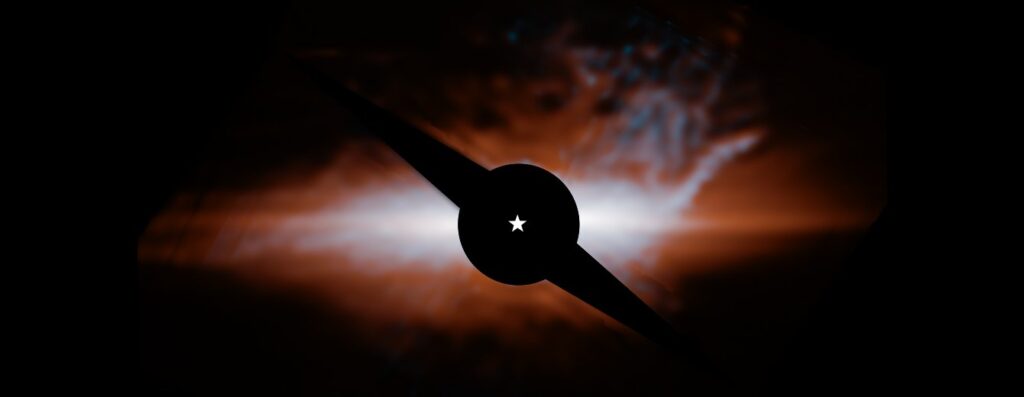
The Cat’s Tail is a structure within that disk. The James Webb Space Telescope first found it in infrared data about two years ago. The new study, led by doctoral student Arin Avsar with planetary scientists Daniel Apai and Kevin Wagner at the university’s Lunar and Planetary Laboratory and Steward Observatory, is the first to record it in visible light. The team combined new Hubble images with earlier ones spanning more than 14 years and published the results in The Astrophysical Journal Letters.
The feature may stretch up to about 1,000 astronomical units. An astronomical unit is the average distance between Earth and the Sun, so the tail could span roughly a thousand times that gap. The team says it is likely what remains after a collision between large bodies comparable to Pluto in size. Avsar said: “The Cat’s Tail is thought to be the aftermath of a collision between large bodies.”

Dark carbon dust and unusually fluffy grains
The tail is made mostly of carbon-based material the researchers call organic refractory material. It is dark and absorbs visible light, which may explain why it was hard to detect at shorter wavelengths until now. Its dust grains are about a micron across, roughly the size of a bacterium, and very porous.
How such fluffy grains form is not well understood. Wagner suggested that very high collision speeds may have vaporized the carbon, which then recondensed into loose, porous grains.
Earlier images suggested the tail trailed far behind the star. The Hubble data point to a different shape. Avsar said: “It’s essentially in the same plane of the sky as the star and possibly extends a little bit behind it.” In other words, the tail may extend sideways across our view rather than back away from the star.
The team also found a warp in the dust halo around Beta Pictoris. They believe it comes from the gravitational pull of Beta Pic b, a gas giant about 10 times the mass of Jupiter.
Two telescopes, two views of the same crash
The two observatories complement each other here. NASA said when it announced the Webb discovery in January 2024 that the tail showed up in the data from Webb’s mid-infrared instrument, and that the team’s leading explanation was a dust-producing event such as a collision of asteroids, comets or planetesimals (small building blocks of planets). NASA’s accompanying animation said such an event may have happened only about a century ago, a blink in cosmic terms.
Infrared light mostly reveals warm dust glowing by its own heat, while visible light shows dust only by the starlight it scatters. A dark, carbon-rich cloud absorbs visible light, so it is a poor scatterer, which fits why Hubble needed a deep, careful look. Seeing the same structure in both kinds of light gives astronomers a way to test what the grains are made of, rather than relying on one wavelength.
Beta Pictoris is also a landmark target. According to the Space Telescope Science Institute, its debris disk was the first dust disk ever imaged around another star, and Hubble had earlier found a second disk tilted relative to the outer one. The Cat’s Tail adds a third, much more recent feature to a system astronomers have studied for decades.
A hint of the young Kuiper Belt
The researchers connect the finding to our own solar system. The young Kuiper Belt, the icy region beyond Neptune, may have held many Pluto-sized bodies, most of which the outer giant planets likely cleared away. A collision of two such bodies around Beta Pictoris would be a rare chance to watch the aftermath of the kind of event that may once have shaped our own neighborhood.