ESCAPADE looks back at Earth from 38,500 miles, hours after its Mars-bound boost
Hours after a powered flyby slung it toward Mars, the second of NASA's twin ESCAPADE spacecraft photographed Earth in visible and infrared light from 38,500 miles away.
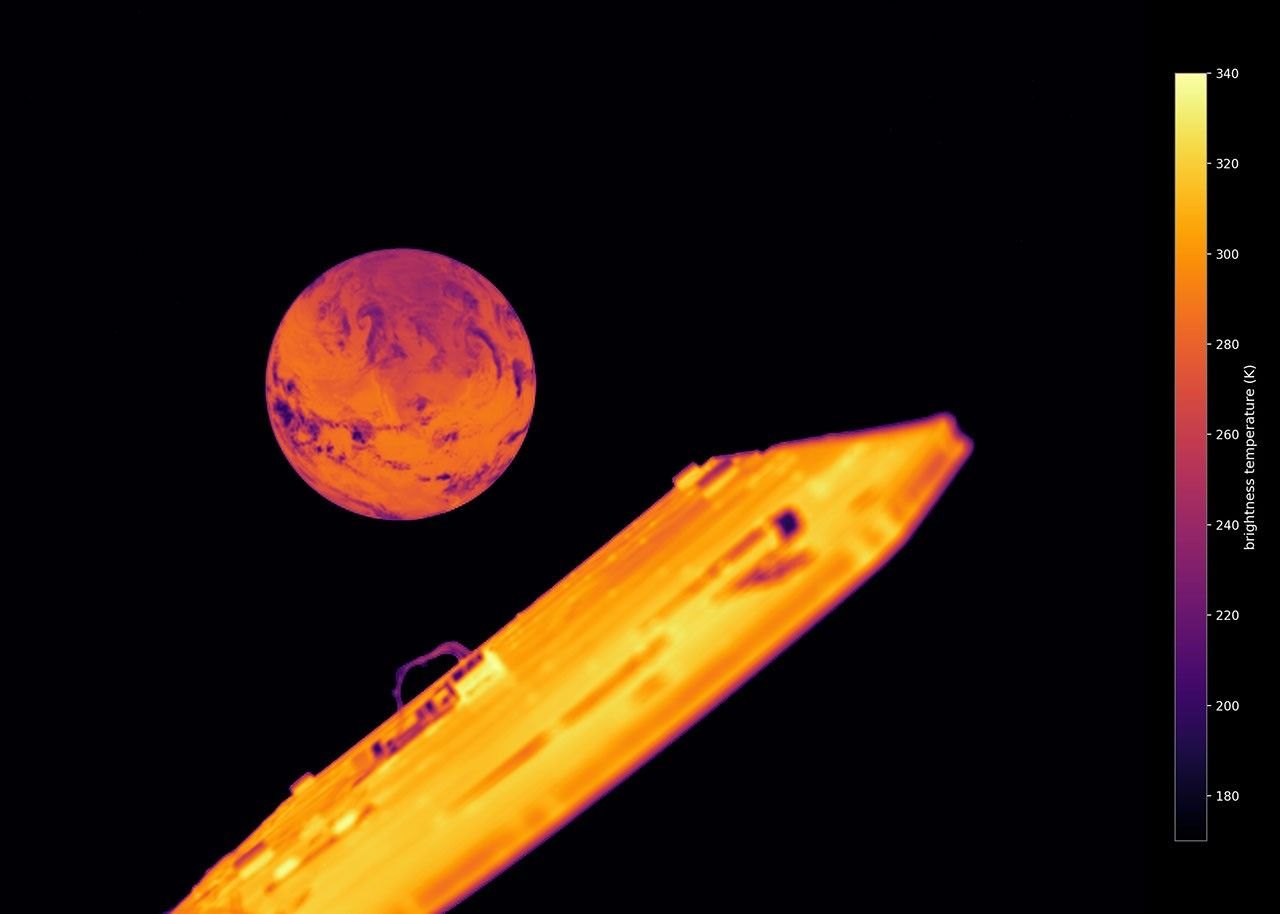
One of NASA’s twin ESCAPADE spacecraft turned its camera back on Earth on Nov. 9, 2026, about three hours after a powered flyby that flung it toward Mars. The pictures NASA released show the planet from 38,500 miles away in visible and infrared light.
A farewell portrait, in two kinds of light
The spacecraft took the images at around 9 a.m. EST on Nov. 9 (14:00 UTC), using its Visible and Infrared Observation System camera, provided by Northern Arizona University. At that distance it could see the Western Hemisphere. A solar panel sits in the foreground of each frame.
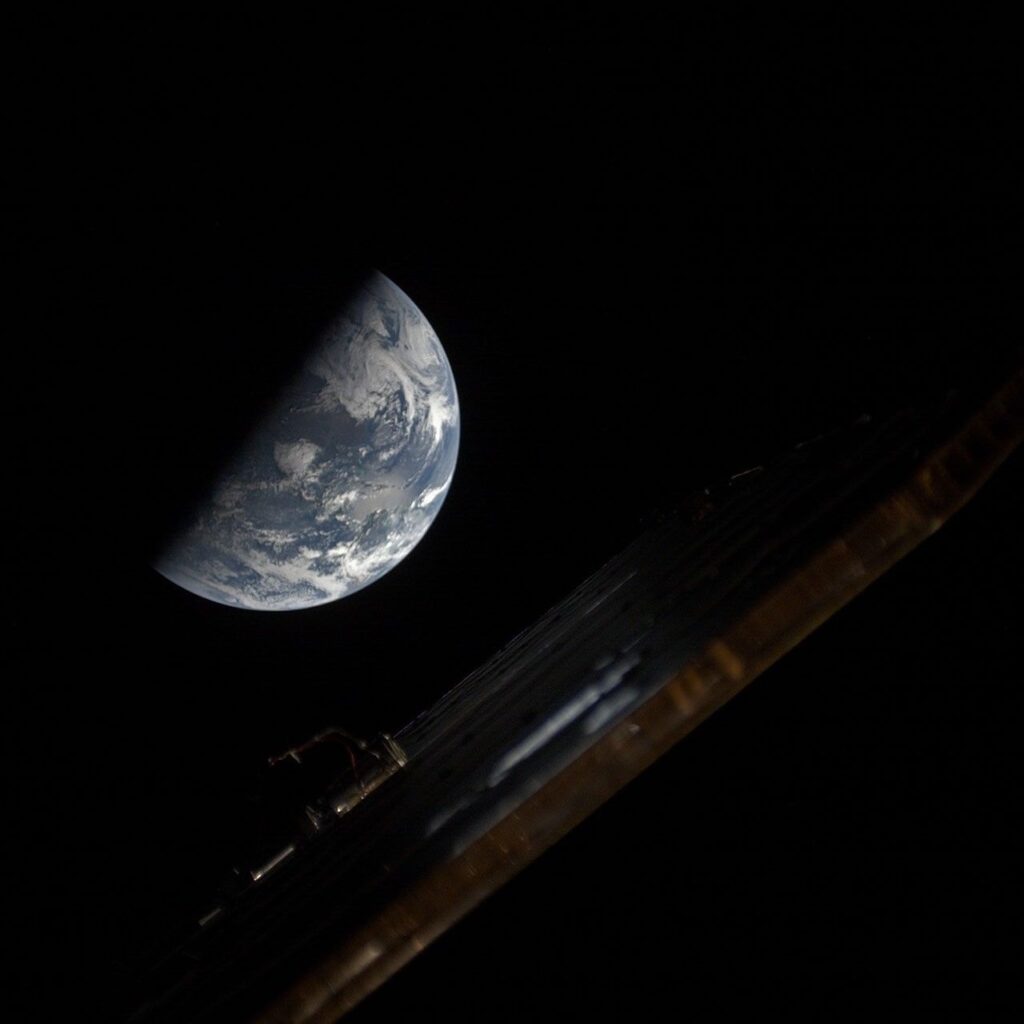
The visible-light view shows a half-lit Earth in blue and white. The infrared views show heat instead of reflected sunlight. In NASA’s colored versions, areas in white, yellow and orange are warmer than areas in blue and purple. In the black-and-white version, brighter areas are warmer than darker ones. Infrared cameras are useful on a Mars mission because they can measure surface temperatures, so Earth makes a convenient test subject.
The images come from the second of the two spacecraft to fly past Earth this month. Both used a powered flyby: the spacecraft fires its engine while passing close to a planet, and the planet’s gravity adds to the push, which saves fuel. The pair, flying two days apart, are now on a 10-month journey to Mars.
Watched from orbit and from a Los Angeles backyard
As each spacecraft made its closest approach, a commercial Vantor WorldView Legion satellite photographed it from roughly 3,000 miles away. The first set of three images was taken between 4:41 and 4:44 a.m. EST on Nov. 7, from 3,380 to 3,480 miles. The second set of four was taken between 5:42 and 5:45 a.m. EST on Nov. 9, from 2,910 to 3,640 miles. Each spacecraft shows up as a bright dot with faint features around it.
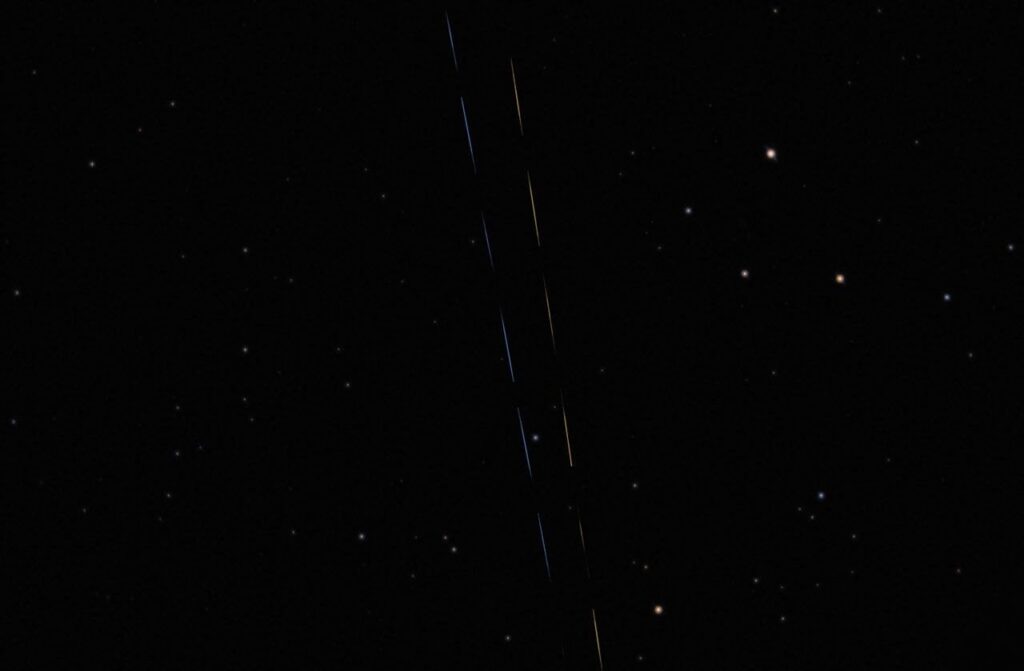
The mission’s chief engineer from Rocket Lab, where the spacecraft were built, also photographed both from the Los Angeles area. His composite of 5-second exposures shows the two spacecraft as streaks against the stars. The first, which finished its flyby on Nov. 7, is colorized blue, and the second, on Nov. 9, is gold. The faint streaks were enhanced in processing.
Why the detour past Earth saves money and time
Mars missions normally launch when Earth and Mars line up, a window that, according to NASA, opens only about every 26 months. ESCAPADE took a different route. According to NASA’s mission pages, the spacecraft launched on Nov. 13, 2025, on a Blue Origin New Glenn rocket, at a time when Earth and Mars sat on opposite sides of the Sun. They then waited in a loiter orbit around the Earth-Sun Lagrange point 2, about a million miles from Earth, before returning for this flyby.
The trade is patience for flexibility. NASA says the Earth flyby burn raises each spacecraft’s speed from about 6.3 miles per second to about 6.7 miles per second. A small mission can then launch when a rocket is available rather than only when the planets cooperate. ESCAPADE is part of NASA’s SIMPLEx program, which NASA describes as a line of missions with smaller budgets. That makes launch timing a cost lever, since a mission that can fly almost any time does not have to buy its way into a narrow window.
Mars arrival in September 2027
NASA’s mission pages put the Mars orbit insertion burns, each lasting about 11 minutes, on Sept. 7 and Sept. 9, 2027. The spacecraft first enter capture orbits of about 60 hours each, then shift into science orbits. Science operations are expected to begin in June 2028.
The goal is to study how the solar wind, a stream of particles from the Sun moving at about a million miles per hour, interacts with the Martian environment and strips away atmosphere. The mission is funded by NASA’s Heliophysics Division. The University of California, Berkeley’s Space Sciences Laboratory leads it, with partners Rocket Lab, NASA’s Goddard Space Flight Center, Embry-Riddle Aeronautical University, Advanced Space and Blue Origin.
For another spacecraft heading for a close pass of our planet, see our report on Europa Clipper’s road to Jupiter.