Treble Clef radio shape traced to a black hole outburst and a cluster collision
A radio formation shaped like a musical symbol sits in two merging galaxy clusters behind the Milky Way, and a black hole outburst followed by a collision may explain it.

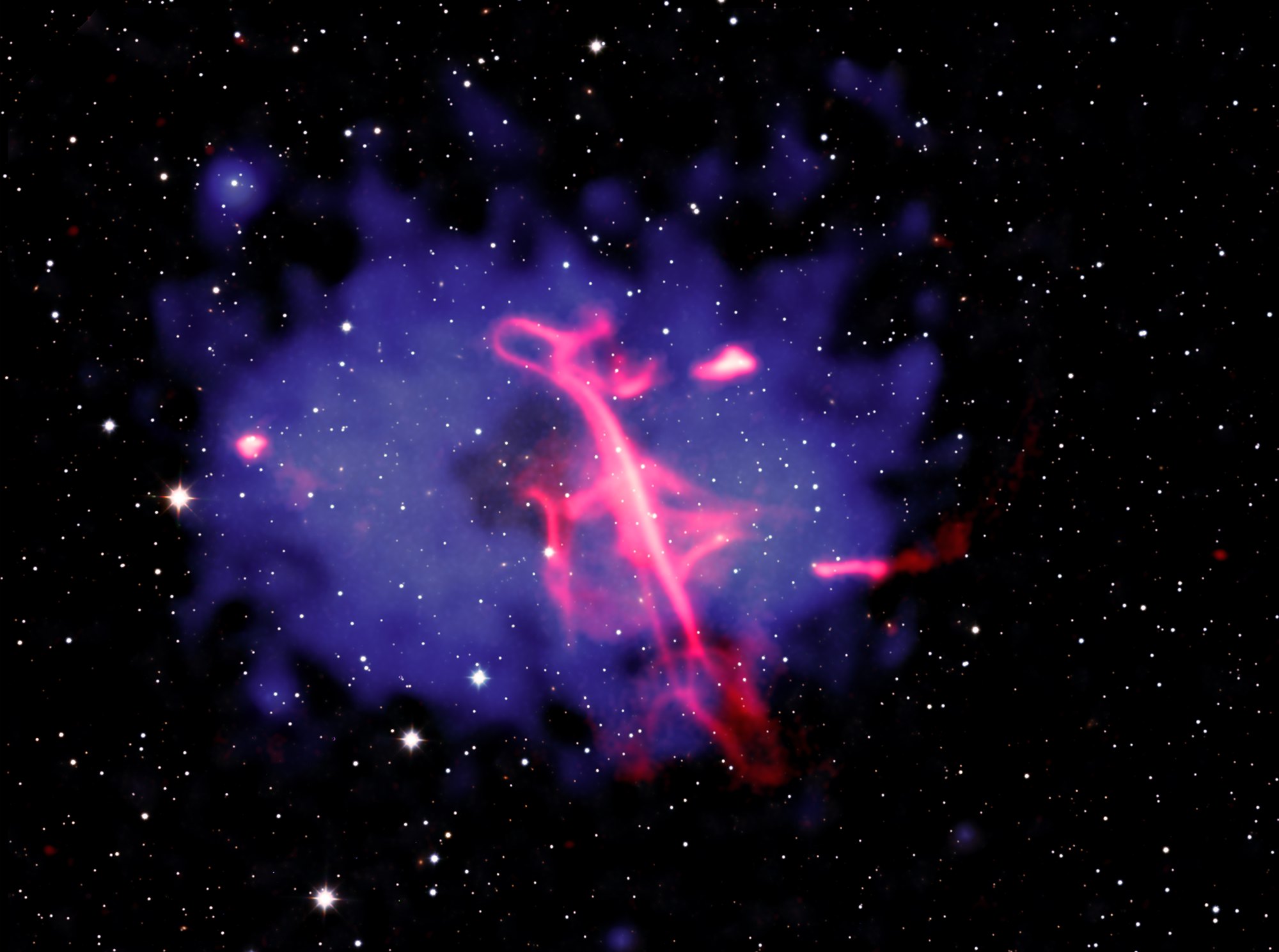
Astronomers using NASA’s Chandra X-ray Observatory say the radio structure nicknamed the Treble Clef was likely created by a black hole outburst, then revived when two galaxy clusters collided.
A radio shape hidden behind the Milky Way
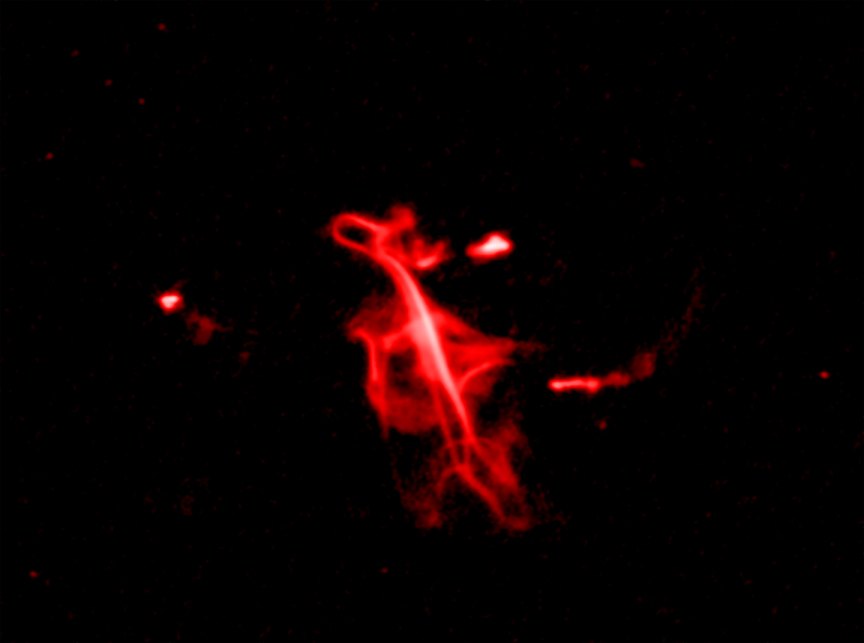
The Treble Clef earned its name from a radio-wave pattern that closely resembles the musical symbol. A paper led by Andrea Botteon of Italy’s National Institute for Astrophysics (INAF) was published on Oct. 14 in Astronomy & Astrophysics. Finding an explanation was hard, NASA said, because the object lies almost directly behind the plane of the Milky Way, where stars, gas and dust from our own galaxy block much of the view.

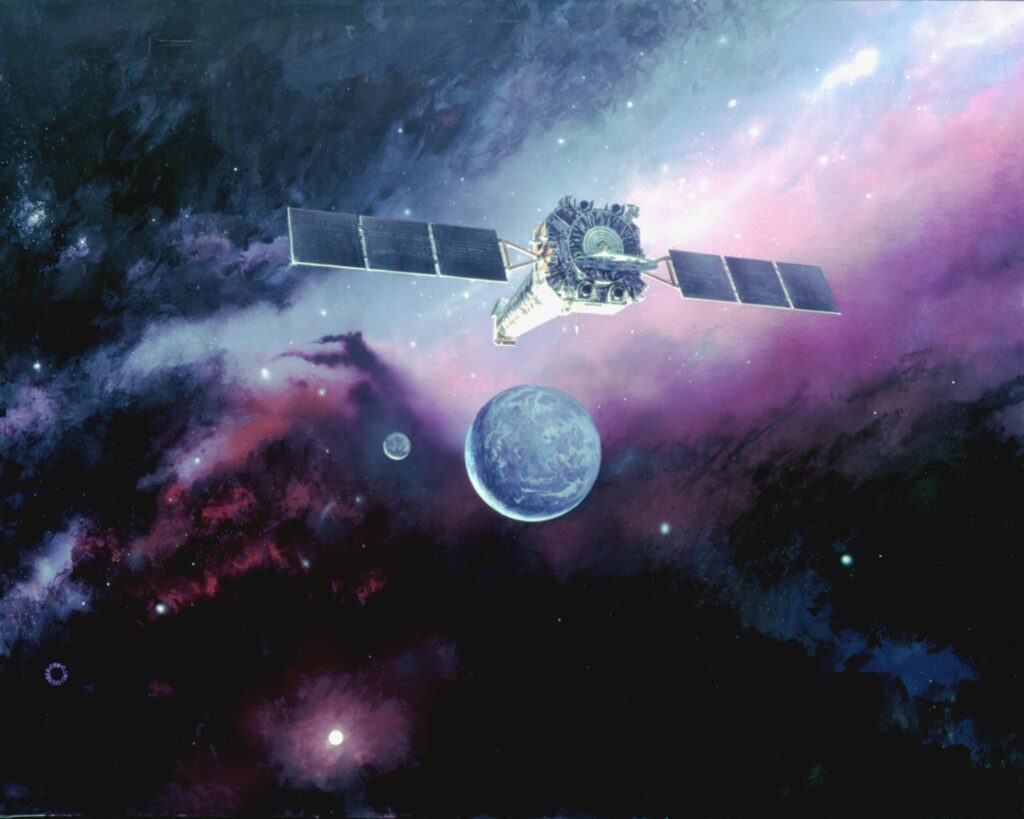
X-ray telescopes helped get around that. Chandra and the German eROSITA instrument both found diffuse, hot gas at the position of the radio shape, showing it sits inside a galaxy cluster, a huge group of galaxies bound together by gravity. The team then determined that this is really two clusters in the process of merging.
The composite image shows the hot gas in blue from Chandra and eROSITA, radio data from the LOFAR network of telescopes in Europe in red, and infrared data from the United Kingdom Infrared Telescope appearing mostly white.

Two stages: A black hole’s burst, then a cluster crash
According to NASA, the radio structure formed in two steps. First, an outburst from a supermassive black hole at the center of the cluster drove clouds of charged particles and magnetic fields outward at close to the speed of light. These produced bright radio waves that later faded as the particles lost energy. Then the clusters collided, compressing or re-energizing the cloud so it brightened in radio again. Shock waves from the collision, similar to sonic booms from supersonic jets, may have helped.
To find evidence of the merger in the X-ray data, the authors subtracted the symmetrical, roughly oval part of the hot gas from the Chandra image. The leftover emission is brightest to the left and right and faintest in the center, which suggests the clusters collided along the left-right direction in the image. The direct collision is thought to have happened a few hundred million years ago, and the clusters are now moving apart.
NASA also stressed that the resemblance to a treble clef is pareidolia, the human habit of seeing familiar shapes in random data. There is no scientific link to the music symbol.
One object, four telescopes on three continents
The result is a good example of how modern cluster science is assembled from facilities built by different countries. The Chandra X-ray Center, which publishes the image, lists the object by its catalog name, VLSS J0318.9+5755, and places it in the constellation Camelopardalis at a redshift of 0.117, a measure of how much the expansion of the universe has stretched its light, which puts it about 1.55 billion light-years away. The image spans roughly 6 million light-years. The Chandra data came from four observations in April 2026 totaling 13 hours 34 minutes with the ACIS camera, according to the center.
The preprint of the paper, posted on arXiv, adds radio follow-up from India’s upgraded Giant Metrewave Radio Telescope (uGMRT) alongside the European LOFAR surveys. It reports an extremely steep radio spectrum, with a spectral index above 4 between 400 and 650 MHz, meaning the emission falls off very sharply toward higher frequencies. That steepness is typical of a so-called radio phoenix, a fossil radio cloud revived by gas motions, which is how the authors classify the Treble Clef. The paper also notes that a possible radio halo in the cluster center may be present, and calls the source a strong target for follow-up with the planned LOFAR2.0 upgrade.
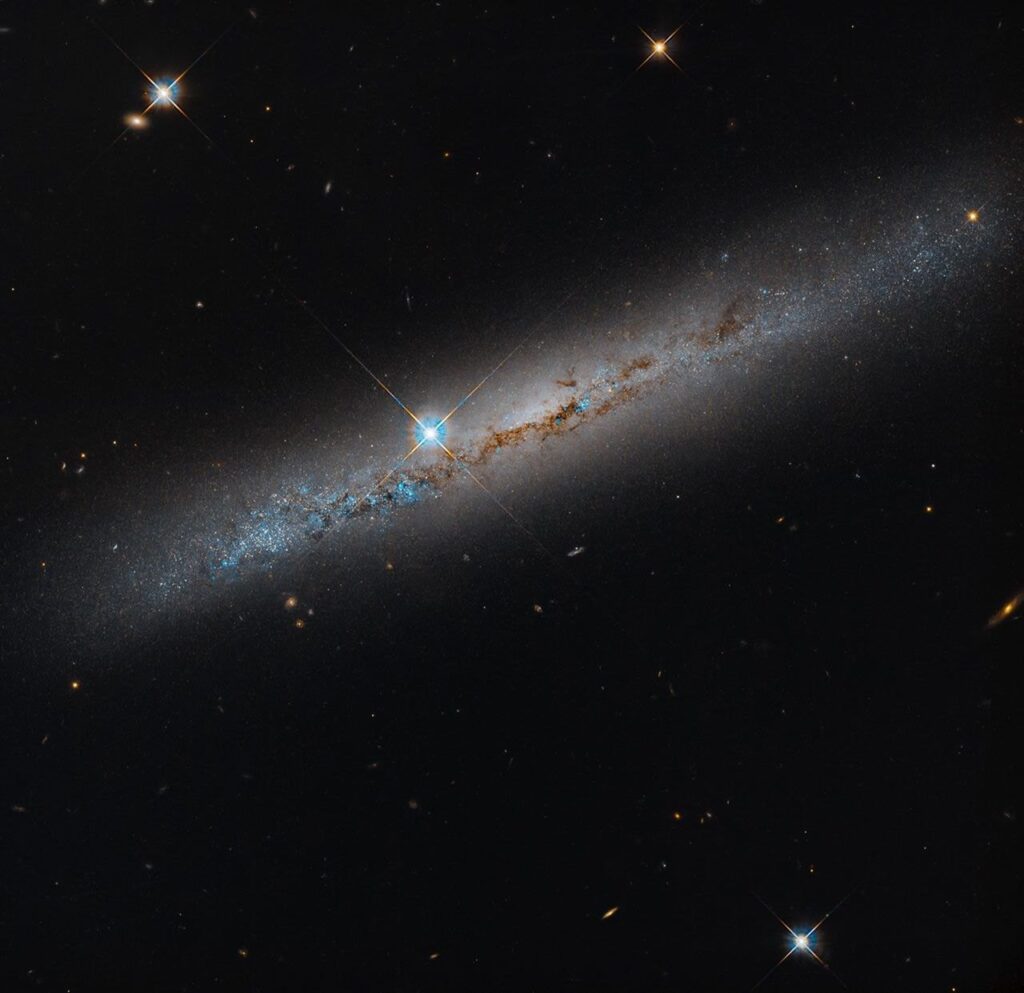
For comparison, our recent coverage of Hubble’s survey of 260 galaxies, including the dust-lined galaxy NGC 1827, shows the same pattern from the optical side: single images are the visible end of programs that need many instruments and partners. Here, X-ray, radio and infrared data each supply a piece that none of them could provide alone.
NASA’s Marshall Space Flight Center in Huntsville, Alabama, manages the Chandra program, and the Smithsonian Astrophysical Observatory’s Chandra X-ray Center in Cambridge, Massachusetts, controls science operations.