Most of the gas feeding giant black holes is recycled from the galaxy’s own stars
A simulation study of 30 massive galaxies finds that stellar winds and supernova debris, not mergers or fresh intergalactic gas, supply most of what central black holes consume.

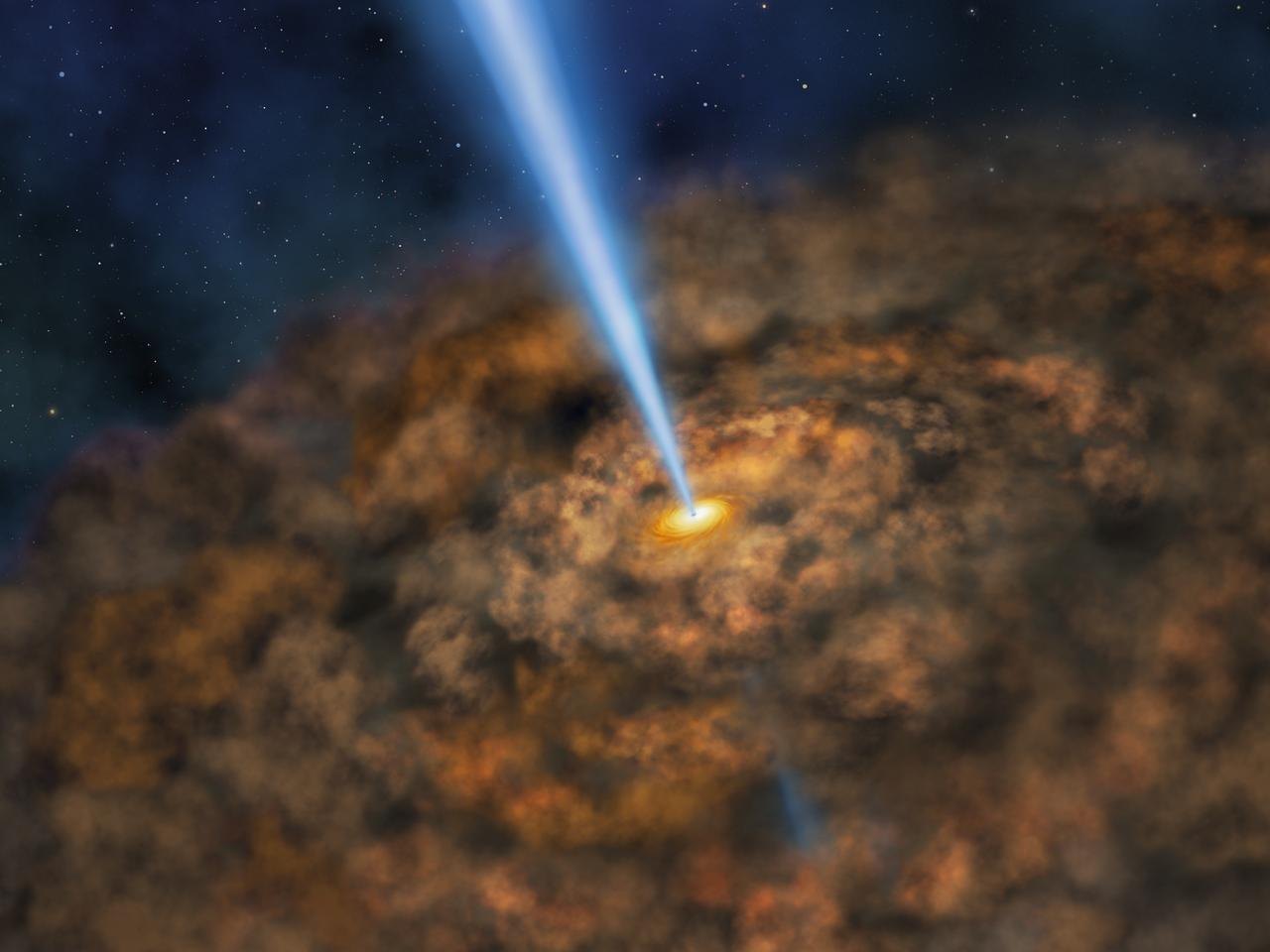
A team led by researchers at the University of Seoul reports that recycled gas, material shed by a galaxy’s own aging stars, makes up the largest share of what supermassive black holes swallow. In 30 simulated massive galaxies, it supplied 58.70% of the accreted mass on average, according to the paper in The Astrophysical Journal, highlighted by AAS Nova.
Four routes to a black hole’s meal
The authors (Dongyun Kwak, Ena Choi, Hannah Jhee and colleagues) ran 30 high-resolution cosmological “zoom-in” simulations. These recreate the growth of one galaxy and its surroundings from the early universe to today, at much finer detail than a whole-universe model. The galaxies end with stellar masses of 1010.9 to 1011.9 times the Sun’s, and central black holes of 108.5 to 109.7 solar masses.

The key step was to follow every gas particle that was eventually swallowed by the black hole back through cosmic history, and sort it into one of four groups:
- Recycled: gas released by stars inside the main galaxy, through winds from aging stars and supernova explosions. Average share: 58.70%.
- External: gas that once belonged to another galaxy or smaller halo, typically delivered by mergers. Average share: 19.76%.
- Smooth: gas that was not bound to any halo and fell in from intergalactic space. Average share: 11.76%.
- Early: gas that first entered the main halo at redshift 3 or earlier, during the galaxy’s initial assembly. Average share: 9.77%.
The split varies a lot from galaxy to galaxy, but recycled gas is the biggest slice in most of them. The authors say this suggests mergers are not the main source of the long-term fuel supply in these galaxies.

Why the fuel is already rich in metals
Astronomers call every element heavier than helium a “metal”, and metallicity is the share of such elements in a gas. Stars forge these elements, so gas that has just come out of stars starts out enriched. The paper shows that recycled gas is metal-rich from the moment it is released and gains little more before it is accreted. Gas from the other three routes is enriched gradually while it drifts inward, mixing with material that stars have already polluted.
That matters because the glowing gas clouds around luminous quasars, which are black holes feeding at high rates, have long been measured to have metal contents above the Sun’s, even in the very distant early universe. Many surveys also see little change with cosmic time. The simulated accreted gas shows only weak evolution in its abundance ratios and is broadly compatible with those quasar measurements, the authors write. Their conclusion is that metal-rich fuel “arises naturally” from galaxy evolution and stellar recycling, with no special mechanism needed.
A big engine in a small package
The recycling supply is large because massive galaxies are full of old stars that keep shedding mass. In the simulation model, roughly 30% of the mass of newly formed stars returns to the surrounding gas over about 13 billion years. Yet the fuel itself is tiny next to the galaxy: AAS Nova notes that local supermassive black holes are typically about 1,000 times less massive than their host galaxies, so even a modest fraction of a galaxy’s recycled gas can feed a black hole for a long time.
The study also helps frame a debate about the early universe. In a separate AAS Nova post, astronomers describe how the James Webb Space Telescope has found supermassive black holes in galaxies when the universe was less than a billion years old, some with masses reaching a tenth of their host’s. Those cases are hard to explain with ordinary growth. The Seoul study covers a different regime, massive galaxies with old stellar populations at redshift zero, so it does not address those extremes. It does show that, in mature systems, the black hole’s diet comes largely from its own galaxy’s stellar life cycle.
The simulations carry assumptions. Black holes are seeded in halos above a set mass and calibrated to reproduce the observed local relation between black hole mass and stellar velocities, and the sample covers massive group-scale galaxies only. The paper reports results from these 30 systems rather than a survey of real galaxies, and compares them with quasar observations only in broad terms. The paper was published on 4 September 2026 and is open access.