A hidden black hole or neutron star may be behind a star’s 113-day eruptions
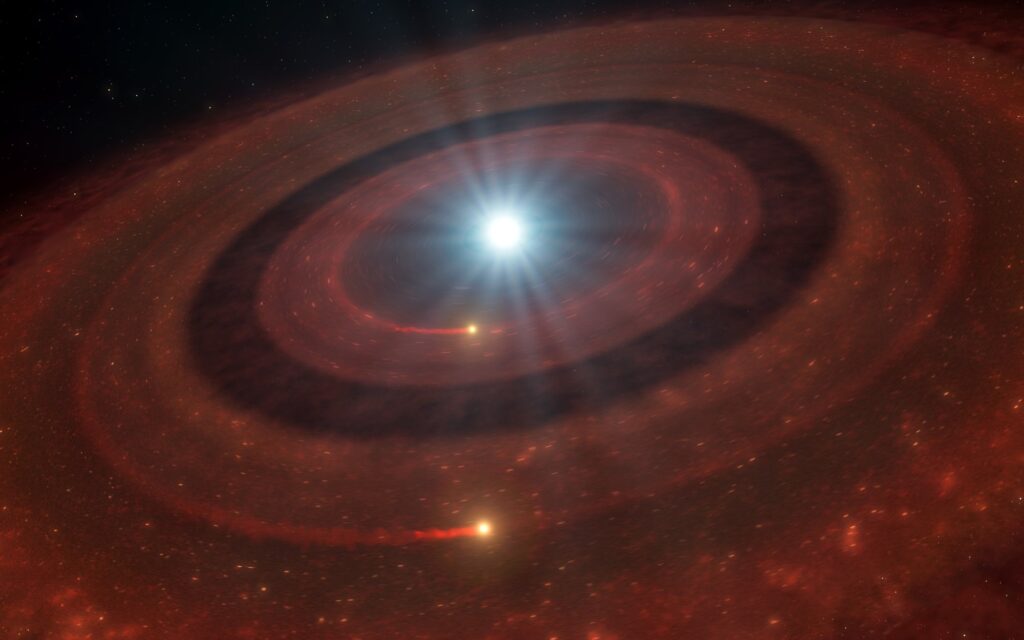
Chandra's first X-ray detection of a star that mimics supernovae points to a hidden black hole or neutron star pulling gas from AT 2016blu every 113 days.

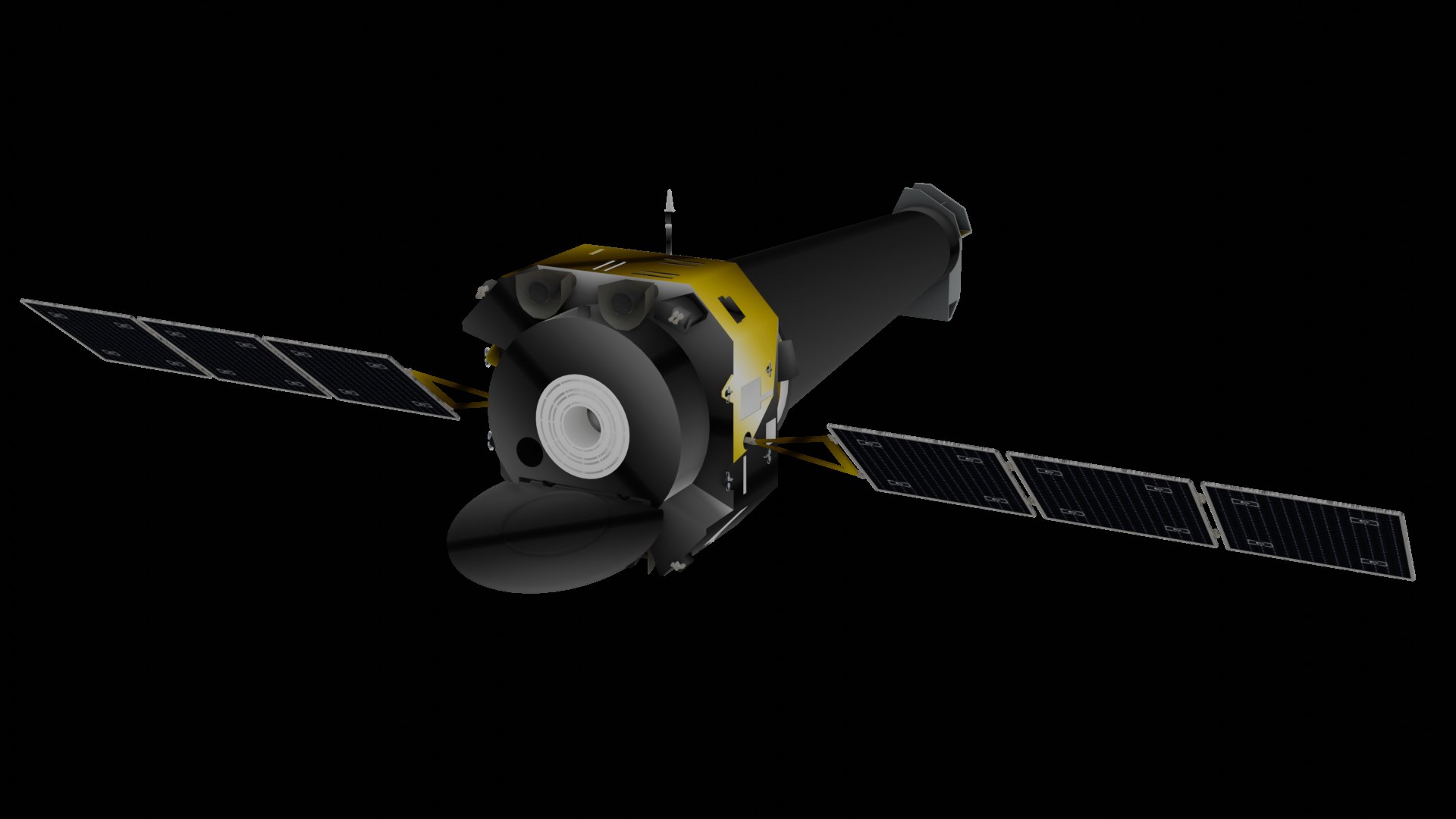
Astronomers using NASA’s Chandra X-ray Observatory have found what drives repeated outbursts from the giant star AT 2016blu: a hidden companion, either a black hole or a neutron star, that strips gas from it every 113 days.
The study, led by Mojgan Aghakhanloo of the University of Virginia, was published in The Astrophysical Journal. NASA says it is the first X-ray detection of this class of erupting star, and the first such star found with a black hole or neutron star partner. A neutron star is the dense collapsed core of a massive star.

A star that fakes supernovae but survives them
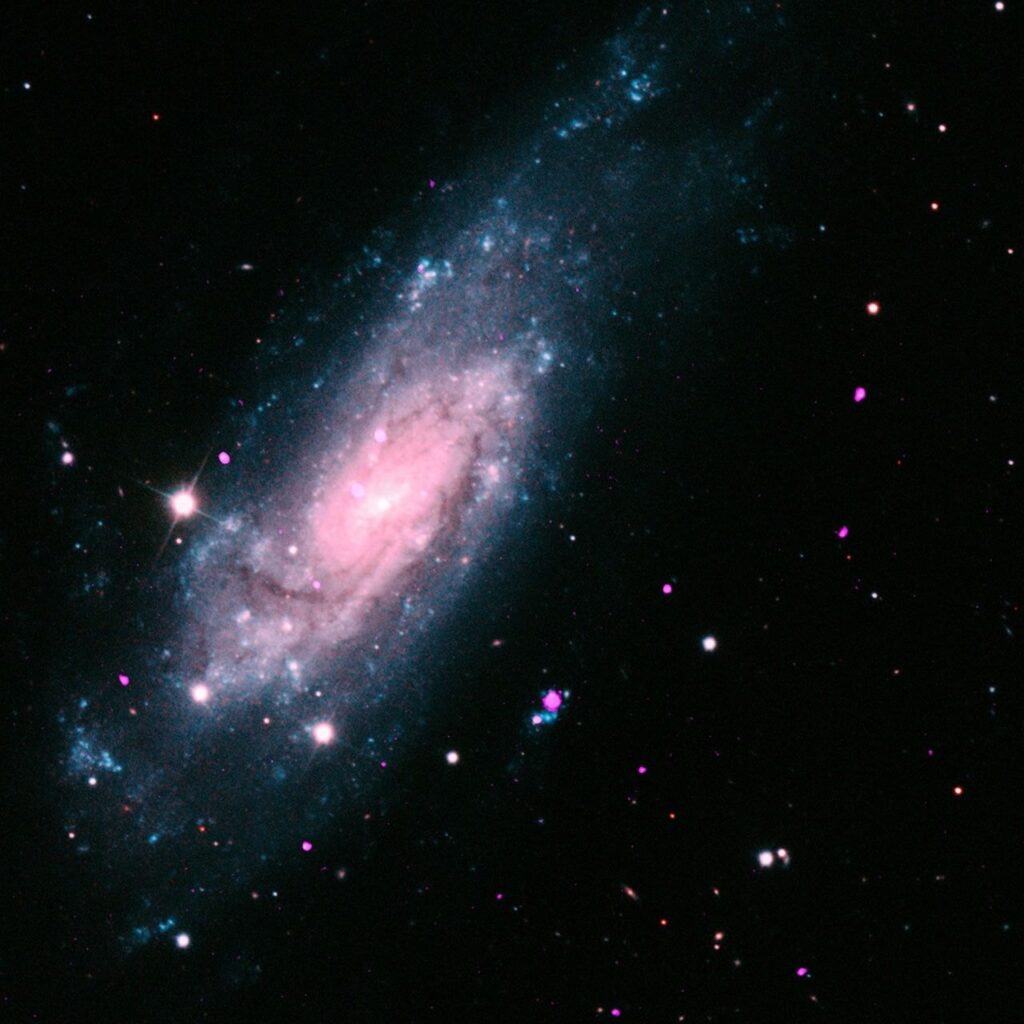
AT 2016blu lies in the spiral galaxy NGC 4559, about 30 million light-years from Earth. Astronomers estimate its mass at no less than 33 times that of the Sun. It is a luminous blue variable, a hot, massive star whose brightness changes. Its flares are so extreme that they resemble supernova explosions, in which a massive star collapses and hurls material into space. Because AT 2016blu is not destroyed, it is called a “supernova impostor.”
Between 2012 and 2026, astronomers recorded at least 27 bursts of visible light from the star, roughly every 113 days. “This star’s behavior was confusing at first because it kept acting like a supernova, but clearly it’s not because it keeps surviving these outbursts about three times a year,” said co-author Núria Torres-Albà, also of the University of Virginia.
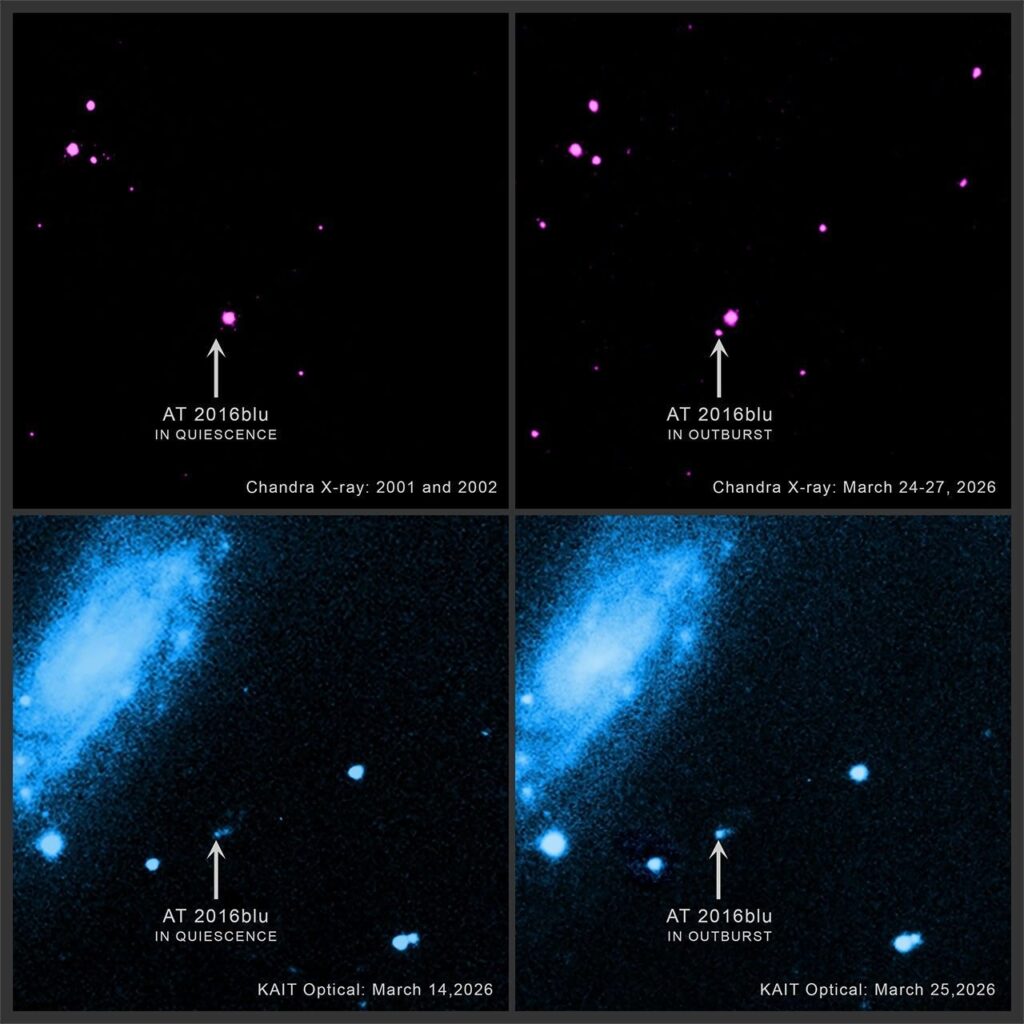
Timing an X-ray telescope to catch a flare
The team suspected that the visible flashes were powered by bursts of high-energy X-rays heating the dense gas around the system, which then glows. Testing that meant observing in X-rays while the star was in outburst. The Katzman Automatic Imaging Telescope, the Las Cumbres Observatory Global Supernova Project and more than 30 amateur astronomers reporting to the American Association of Variable Star Observers tracked the star’s brightness. When it flared in early 2026, Chandra was triggered under its Target of Opportunity program, which is built for unplanned events, and observed in March 2026.
Chandra is the only X-ray telescope sharp enough to separate AT 2016blu from another bright X-ray source nearby, according to NASA. The March data showed the star at least 100 times brighter in X-rays than in Chandra images from 2001 to 2002, before the outbursts began in 2012.
The best explanation is an oval-shaped orbit. At closest approach, gas thrown off by the star is captured by the black hole or neutron star and spirals in at speeds approaching that of light. It gets hot enough to shine strongly in X-rays.
“For 15 years, astronomers have been watching this star get really bright and then dim again on a regular basis.”
How it compares with Eta Carinae, the best-known example
NASA names Eta Carinae as the classic luminous blue variable. It lies about 7,500 light-years away in the southern constellation Carina, according to NASA’s Scientific Visualization Studio, and between 1838 and 1845 it went through a period of unusual variability in which it briefly outshone Canopus. Astronomers still cannot say for certain what triggered that eruption, according to a NASA release on observations by its NuSTAR telescope. AT 2016blu behaves differently: it erupts about three times a year on a steady clock, and the clock now has a physical explanation.
That regularity is what let the team plan a Chandra observation in advance. It also matters because Chandra is a rare instrument for the job. Launched on July 23, 1999, it follows a highly elliptical orbit of about 63.5 hours, according to the Chandra X-ray Center, and few other X-ray telescopes can resolve a source this close to a neighbor in another galaxy.
The star is also bright enough in X-rays to count as a candidate ultra-luminous X-ray source, a rare class of objects that astronomers do not yet fully understand. Some are thought to hold neutron stars and others black holes, and many change sharply in X-ray brightness. NASA says the new result hints at a link between those sources and violent stellar eruptions like this one.
The finding may also help with studies of stars that vary in brightness before they explode as supernovae. Astronomers suspect that much of this behavior comes from a massive star orbiting a compact object or another massive star. The team has not yet said whether the companion is a black hole or a neutron star.
Chandra’s program is overseen for NASA from Huntsville, Alabama, by the Marshall Space Flight Center. Day-to-day science work is directed by the Chandra X-ray Center, part of the Smithsonian Astrophysical Observatory, in Cambridge, Massachusetts, with spacecraft flight operations handled from Burlington in the same state.