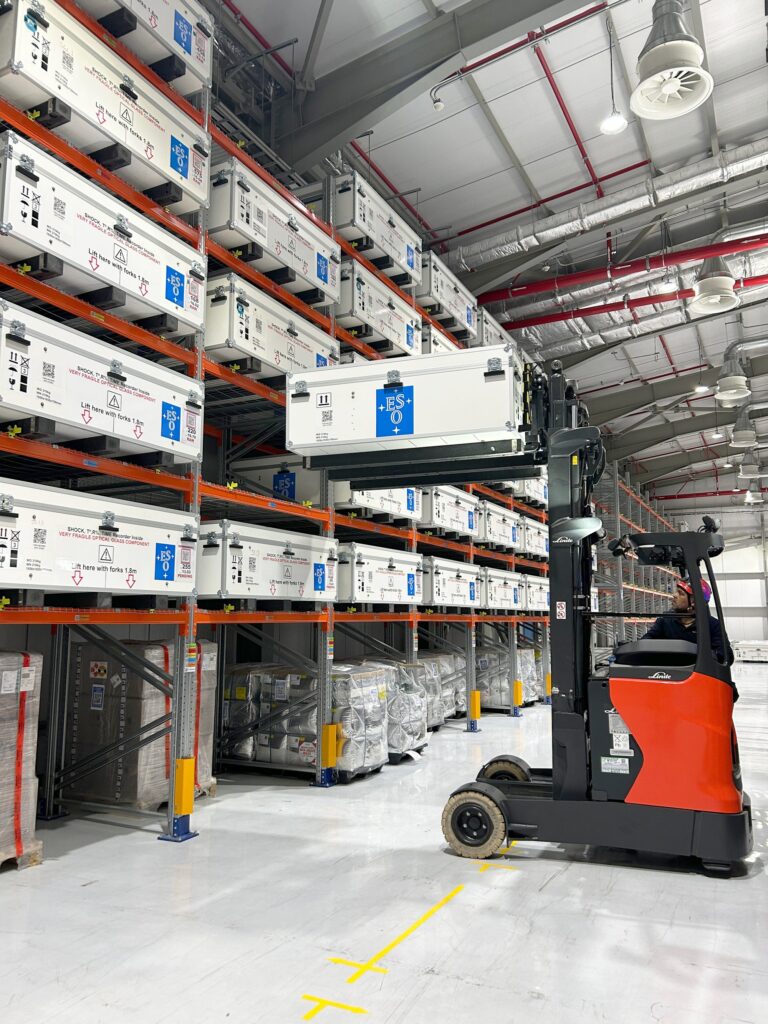
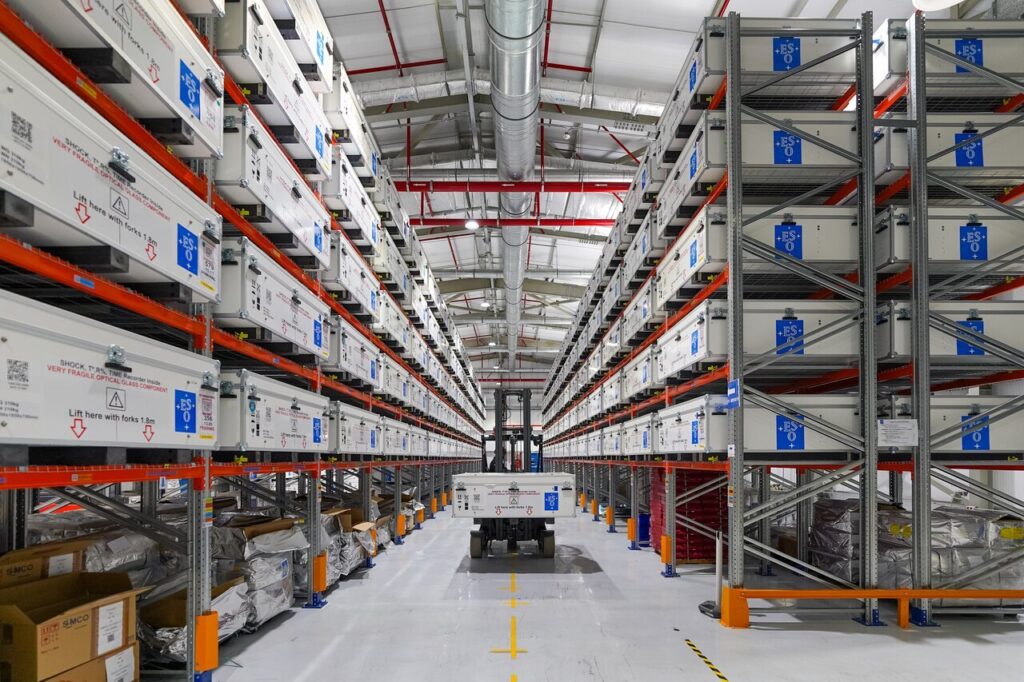
More than half of the segments for the main mirror of the Extremely Large Telescope have reached Chile, ESO announced on Oct. 14. Nearly 500 of the 931 segments are at Paranal, and the last one has entered production at Safran Reosc in France.
798 segments, plus 133 spares
The ELT’s main mirror, called M1, cannot be cast as one piece of glass. ESO says it is built from 798 hexagonal segments that work together as a single 39-metre mirror. A further 133 segments have been made as spares, bringing the total to 931. The spares allow a segment to be removed for recoating and replaced immediately, so the mirror never has a hole in it.
Image: P. Conceicao/ESO
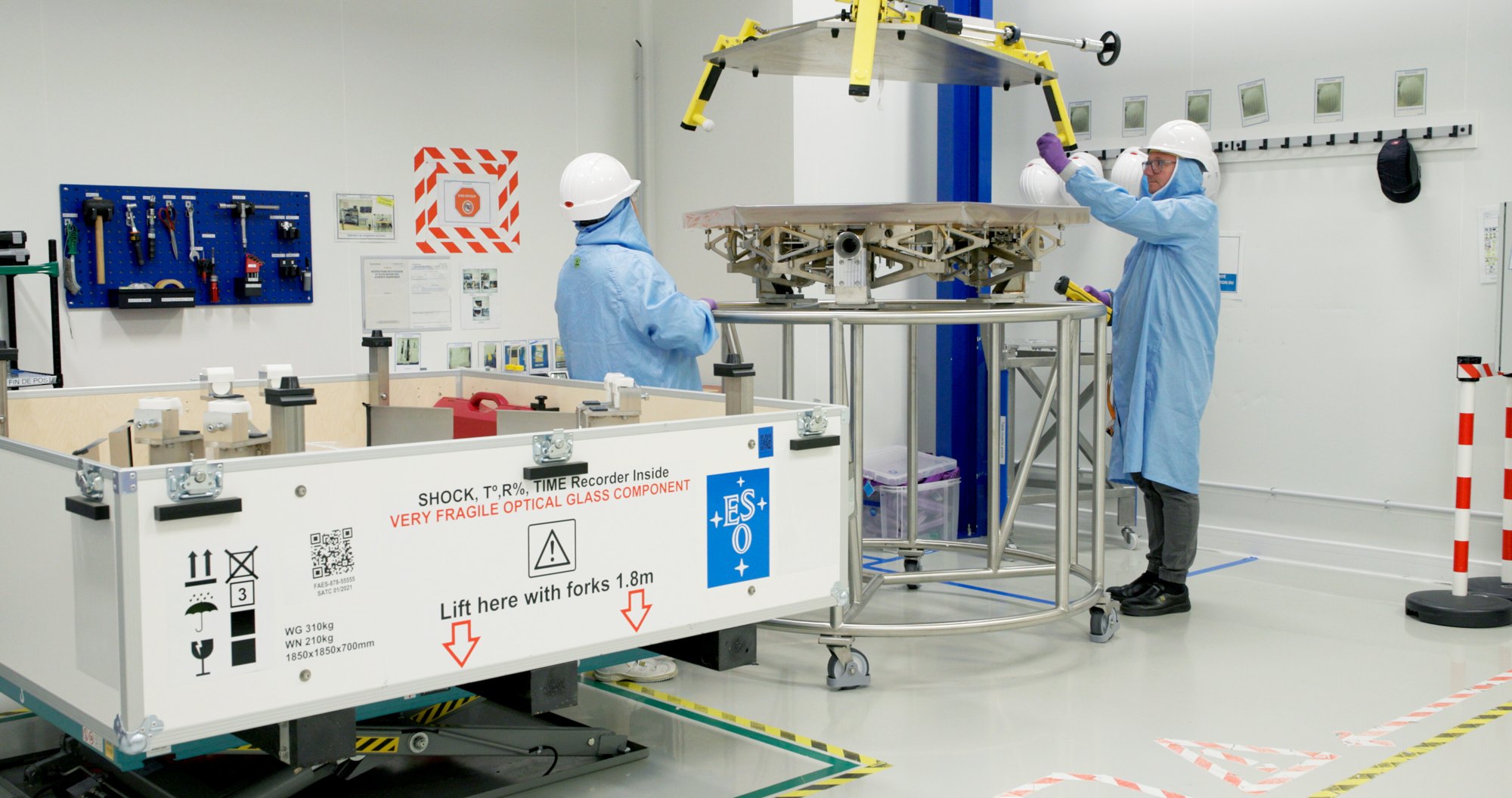
The segment blanks are made from Zerodur, a glass-ceramic that barely changes shape as temperatures shift, by SCHOTT in Germany. They then go to Safran Reosc near Poitiers, France, to be figured (shaped to the exact optical curve), polished and mounted on supports. Those supports were designed by the Dutch company TNO and produced by VDL ETG Projects BV. The FAMES consortium (Fogale of France and MicroEpsilon of Germany) built the sensors that monitor the position of each segment relative to its neighbors, and Germany’s Physik Instrumente made the actuators that keep the segments aligned.
It is not possible to make a mirror this big from a single piece of glass.
Image: ESO/A. Russell
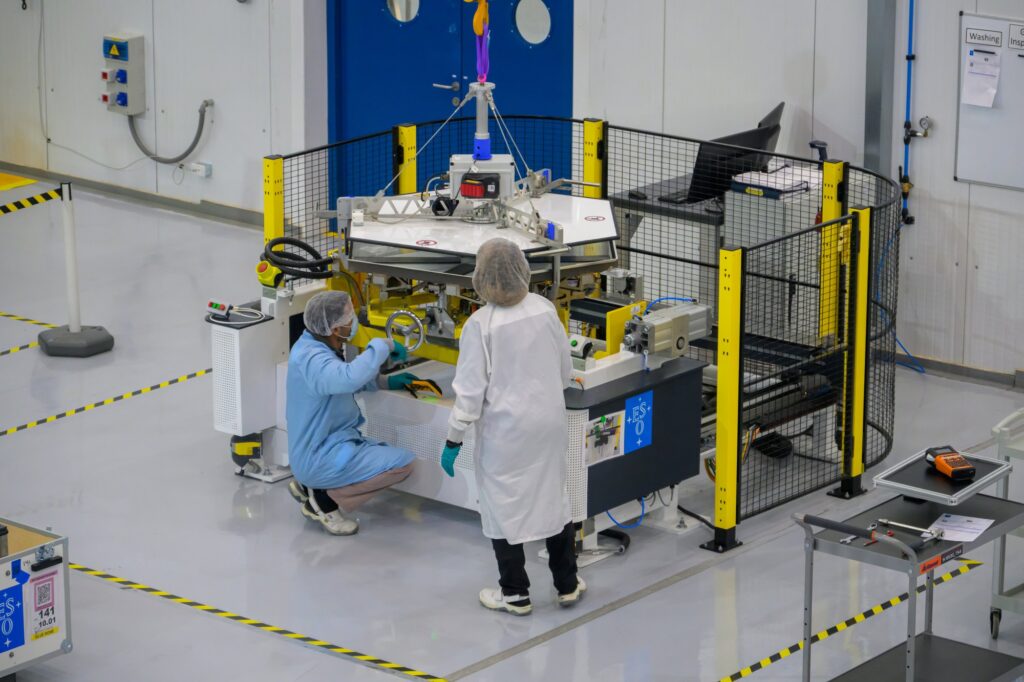
The last leg is a 10,000-kilometer journey by road and by ship to the Atacama Desert, handled by the Danish company DSV. Most assemblies have now completed it. At the ELT Technical Facility, ESO engineers and technicians inspect each segment and coat it.
From a seven-year wait to a segment a day
The first segments reached Chile in early 2024, roughly seven years after the initial industrial production contracts were signed. ESO now says Safran Reosc has reached a production rate of one segment per day. Most of the remaining segments are either on their way or packed and ready to ship, and a few are still in production. ESO expects all M1 segments to be in Chile in the coming months.
Image: ESO
The announcement also says the ELT project is more than 75% complete. The first observations with scientific instruments are planned for late 2030, from Cerro Armazones near Paranal.
The cost of keeping a mirror clean
The most revealing number in the announcement is not the daily production rate but the maintenance plan. The reflective coating wears out, and ESO says two segments a day will need to be swapped out for a fresh layer once the telescope is operating. The Paranal team will carry out this work for the entire operating life of the ELT.
That turns the 133 extra segments, about 17% on top of the 798 in the mirror itself, into a standing operational cost rather than a one-time purchase. Each spare must be made to the same polish, fitted with the same supports, sensors and actuators, and shipped across the same 10,000 km route.
Each exchange also means a coating run. According to the caption of an ESO photo, a segment receives a reflective silver layer plus nickel chromium and silicon nitride, which limit tarnishing and help the coating stick, and the whole process takes about two hours. With two segments changed a day, the coating line at the ELT Technical Facility becomes part of the telescope’s daily routine.
The same ESO caption notes that the telescope itself is being built in the Atacama Desert about 20 km from Paranal Observatory, where the Technical Facility is located. That separation means every refreshed segment also has to make a short trip to the mountain. A line that delivers a segment a day can finish the remaining batches within months, and a supply chain spread across Germany, France, the Netherlands, Denmark and Chile can keep pace with the long-term demand for refreshed segments.
Once observing begins, ESO says, the ELT will probe the atmospheres of rocky exoplanets, look back to the earliest galaxies and stars after the Big Bang, and check whether physical constants have drifted over cosmic time.
To provide the best experiences, we use technologies like cookies to store and/or access device information. Consenting to these technologies will allow us to process data such as browsing behavior or unique IDs on this site. Not consenting or withdrawing consent, may adversely affect certain features and functions.
Functional
Always active
The technical storage or access is strictly necessary for the legitimate purpose of enabling the use of a specific service explicitly requested by the subscriber or user, or for the sole purpose of carrying out the transmission of a communication over an electronic communications network.
Preferences
The technical storage or access is necessary for the legitimate purpose of storing preferences that are not requested by the subscriber or user.
Statistics
The technical storage or access that is used exclusively for statistical purposes.The technical storage or access that is used exclusively for anonymous statistical purposes. Without a subpoena, voluntary compliance on the part of your Internet Service Provider, or additional records from a third party, information stored or retrieved for this purpose alone cannot usually be used to identify you.
Marketing
The technical storage or access is required to create user profiles to send advertising, or to track the user on a website or across several websites for similar marketing purposes.
To provide the best experiences, we use technologies like cookies to store and/or access device information. Consenting to these technologies will allow us to process data such as browsing behavior or unique IDs on this site. Not consenting or withdrawing consent, may adversely affect certain features and functions.
Functional
Always active
The technical storage or access is strictly necessary for the legitimate purpose of enabling the use of a specific service explicitly requested by the subscriber or user, or for the sole purpose of carrying out the transmission of a communication over an electronic communications network.
Preferences
The technical storage or access is necessary for the legitimate purpose of storing preferences that are not requested by the subscriber or user.
Statistics
The technical storage or access that is used exclusively for statistical purposes.The technical storage or access that is used exclusively for anonymous statistical purposes. Without a subpoena, voluntary compliance on the part of your Internet Service Provider, or additional records from a third party, information stored or retrieved for this purpose alone cannot usually be used to identify you.
Marketing
The technical storage or access is required to create user profiles to send advertising, or to track the user on a website or across several websites for similar marketing purposes.
To provide the best experiences, we use technologies like cookies to store and/or access device information. Consenting to these technologies will allow us to process data such as browsing behavior or unique IDs on this site. Not consenting or withdrawing consent, may adversely affect certain features and functions.