Curiosity’s navigation cameras catch twilight clouds drifting over Gale Crater
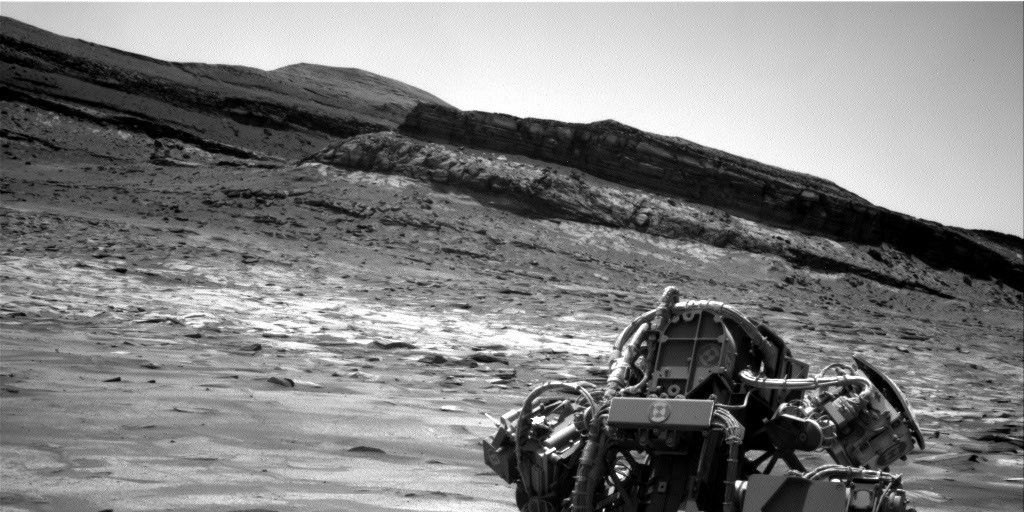
A black-and-white image from sol 5,061 shows clouds glowing after sunset over Gale Crater, a sight Curiosity has only a short window each fall to record.


NASA’s Curiosity rover has photographed drifting twilight clouds over Gale Crater on Oct. 31, 2026, the 5,061st Martian day of its mission. The black-and-white images were taken with the rover’s navigation cameras after sunset.
Clouds that glow after the Sun has gone
The picture shows wispy clouds against a dark Martian sky, brightest near the horizon. NASA calls them twilight clouds: clouds that are visible after sunset, and which, according to the agency, appear for only a short time each fall over Gale Crater. The release is an animated GIF built from the images, so the clouds can be watched as they move.

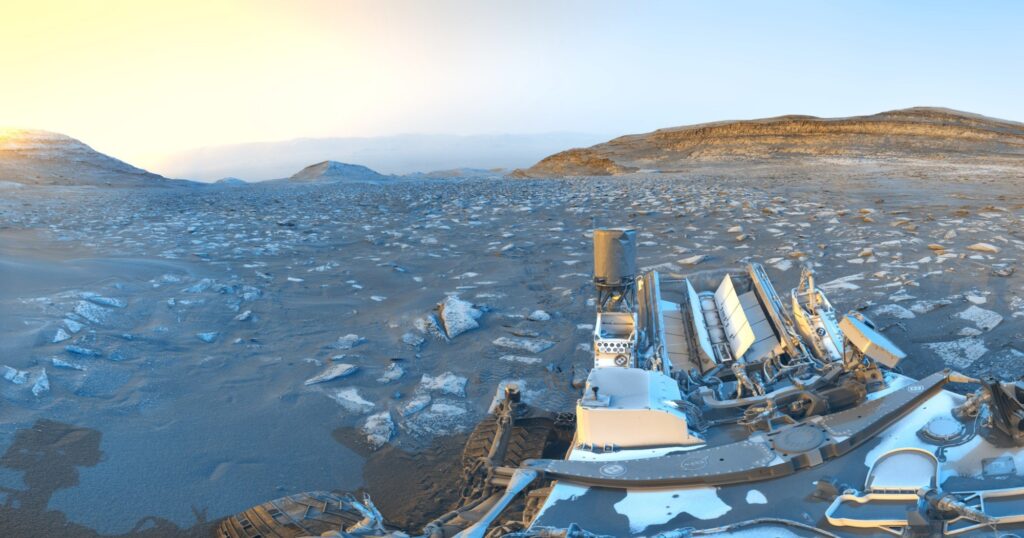
The rover took the images on sol 5,061. A sol is one Martian day, which lasts a little longer than an Earth day, and NASA counts the mission in sols. Curiosity has been exploring Gale Crater, the giant basin it landed in, for more than 14 years.
The navigation cameras are the rover’s pair of black-and-white cameras normally used to look at the terrain for driving. That is why the image has no color: nothing has been enhanced or tinted. NASA’s caption does not give the clouds’ height or size.

Why this sky matters to Mars science
Clouds are a direct record of what the thin Martian atmosphere is doing. Each time Curiosity records them in the same season, scientists get another data point on how the atmosphere behaves from one Martian year to the next. The caption itself does not discuss the science, so what the clouds are made of remains outside this release.
The sighting follows our report on the first twilight clouds of the new Martian autumn. That means the rover has been watching the same evening sky for weeks, and the Oct. 31 pictures are part of an ongoing series rather than a one-off.
A long-lived rover while other missions struggle
Curiosity is built by NASA’s Jet Propulsion Laboratory, which Caltech manages in Pasadena, California. JPL leads the mission for NASA’s Science Mission Directorate in Washington, as part of the agency’s Mars Exploration Program portfolio.
That portfolio has had a rough week. We reported that Perseverance’s radios failed and Odyssey lost a wheel, pausing science on both. Against that, Curiosity is still returning routine observations after more than 14 years, which makes it a steady anchor of NASA’s Mars work.
Its recent releases show the mission’s pace. A postcard marked the rover’s 5,000th day on Mars on Sept. 16, 2026, and a panorama of 95 Mastcam images looking back across the crater floor was taken on Sept. 5, 2026, sol 5,006, after the rover reached an elevation milestone. For where the rovers are now, see our guide to the Mars rovers and their latest pictures.
What the rover is doing now
NASA’s caption says only that the cameras capture these clouds after sunset each fall and that the rover continues to explore Gale Crater. It gives no plan for further cloud observations or a drive schedule. NASA’s Curiosity mission page carries the newest images.