Tiny asteroid 2025 UK9 to pass closer than the Moon on Oct. 31
NASA/JPL lists the small asteroid 2025 UK9 passing 314,648 km from Earth on Oct. 31. Sentry also tracks it, with a cumulative impact probability of about 1.59 x 10^-4 over 2025-2125.

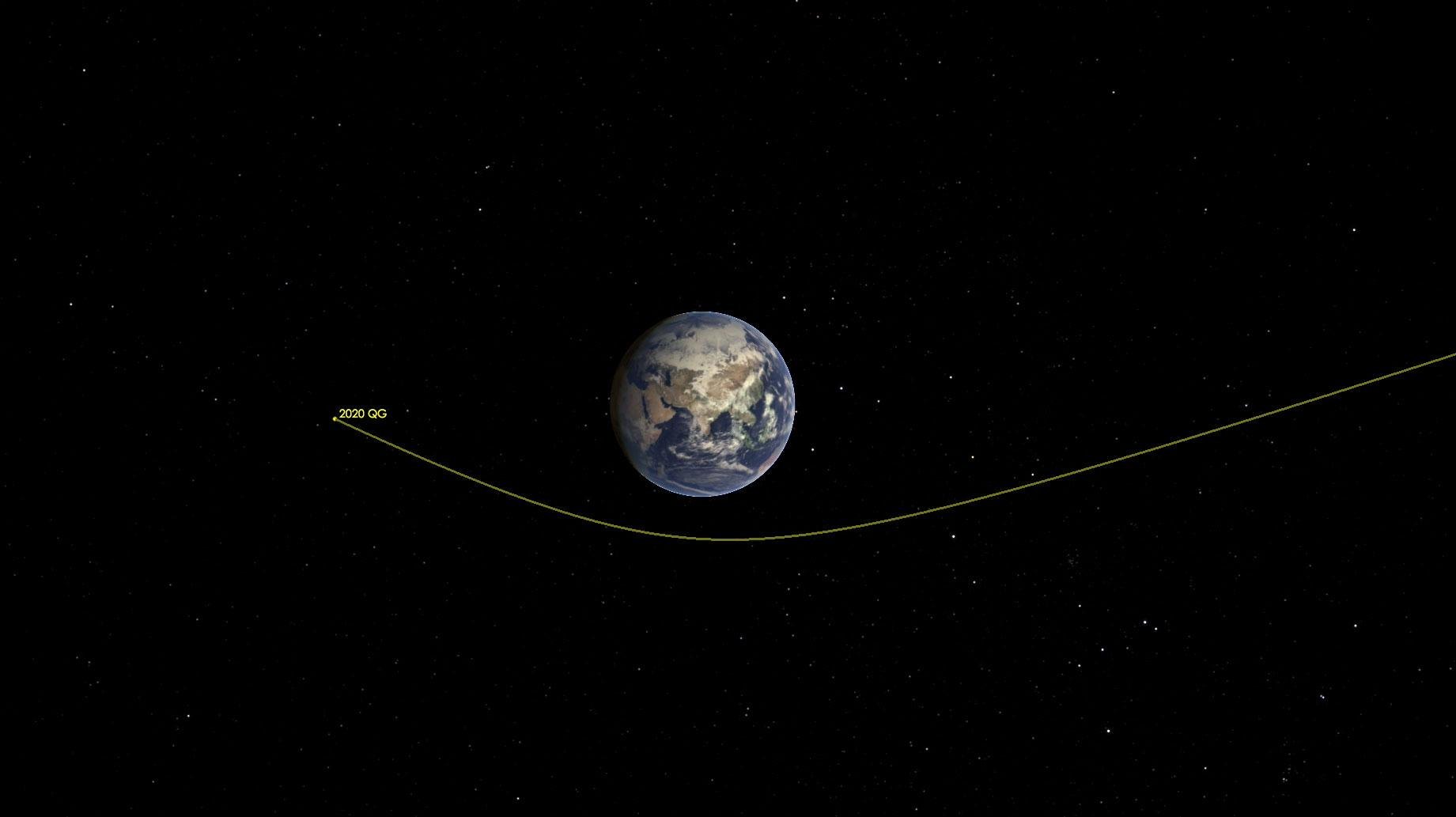
NASA’s Jet Propulsion Laboratory lists asteroid 2025 UK9 passing Earth on Oct. 31, 2026 at 02:35 UTC, at a nominal distance of 314,648 km, or 0.82 lunar distances, according to NASA/JPL’s Center for Near Earth Object Studies (CNEOS).
What the close-approach data says
The CNEOS close-approach table gives the time as 02:35 on Oct. 31, 2026, with an uncertainty of about one hour. The nominal miss distance is 0.0021032915876806 astronomical units, which CNEOS converts to 314,648 km, or 0.82 lunar distances. The asteroid moves at 7.83 km/s relative to Earth, and its speed at infinity is 7.67 km/s.

The distance is a best estimate, not a fixed number. CNEOS publishes a 3-sigma range, meaning the true distance very likely falls between 0.0005765819642422 and 0.00377866262208323 au. Converted with the standard value of about 149.6 million km per au, that is roughly 86,000 km to 565,000 km, or about 0.22 to 1.47 lunar distances. The wide range reflects how little tracking time the object has had.
CNEOS lists no measured diameter. It does give an absolute magnitude (H) of 29.83, a measure of how bright the object would look at a standard distance; a higher number means a fainter, usually smaller object. The JPL Small-Body Database reports the same value, 29.83, with an uncertainty of plus or minus 0.37. NASA’s Sentry impact-monitoring system, which JPL runs, lists an estimated diameter of 0.0037 km, about 3.7 meters, and an estimated mass of 6.82 x 10^4 kg. Sentry works from a slightly different H of 29.80.

A recent discovery
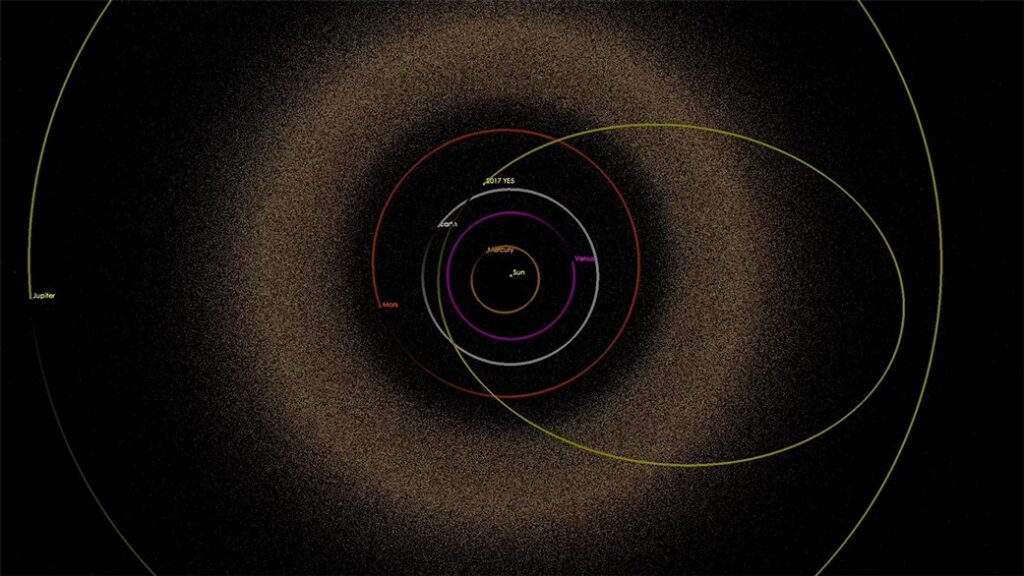
2025 UK9 is a new object. JPL’s database shows its first observation on Oct. 28, 2025, and Sentry gives its last observation as Oct. 30, 2025. The Small-Body Database classifies it as an Apollo-type near-Earth asteroid and not a potentially hazardous asteroid. It has no discoverer or discovery site in the database entry we read.
The orbit rests on only 21 observations over about three days, according to Sentry. That is why the Oct. 31 flyby is still uncertain by several hundred thousand kilometers at the 3-sigma level.
Why 2025 UK9 sits on NASA’s risk list
The flyby is notable mainly because the orbit is so loosely pinned down, and 2025 UK9 is one of the objects on NASA’s Sentry risk list.
Sentry lists 89 possible impact scenarios between 2025 and 2125 for 2025 UK9. The cumulative impact probability is about 1.59 x 10^-4, or roughly 1 in 6,300. The cumulative Palermo scale value, which compares an impact risk with the background risk from all asteroids, is -6.33. The most significant single scenario, dated Oct. 31, 2106, has a Palermo value of -6.68 and an impact probability of about 9.4 x 10^-5. Every listed scenario rates 0 on the Torino scale, the rating NASA describes as no hazard. A Palermo value below -2 is generally considered below the background level of risk.
Sentry entries like this one are common for small objects seen over a few days. A short tracking arc leaves a large region of possible future positions. Some of those positions overlap Earth years from now, even when the real chance is tiny. Further observations normally shrink that region, and objects are then removed from the list. NASA has not said that is expected here, so the status can change when the asteroid is tracked again.
The size is a second open question. The 3.7-meter figure is an estimate derived from brightness. JPL’s Asteroid Watch page says near-Earth objects range from about 10 feet (a few meters) to nearly 25 miles (40 km) across. On that scale 2025 UK9 sits at the small end. NASA’s Asteroid Watch page also says that there is “no known significant threat of impact for the next hundred years or more” from the objects it tracks, and the Sentry numbers for this asteroid are consistent with that.
More observations could change the risk table
The asteroid will be in the sky near the Moon’s distance on Oct. 31, so observatories with the right sky position can add measurements. New data would tighten the 3-sigma range and could change the Sentry entry. Updated figures will appear on the CNEOS close-approach page and in the Sentry table.