ISS at 25: How MIT-trained astronauts and engineers helped build and use the station
Twenty-five years of continuous crews on the ISS were marked in November 2025, with MIT-linked astronauts and researchers behind assembly, early experiments and still-running science.

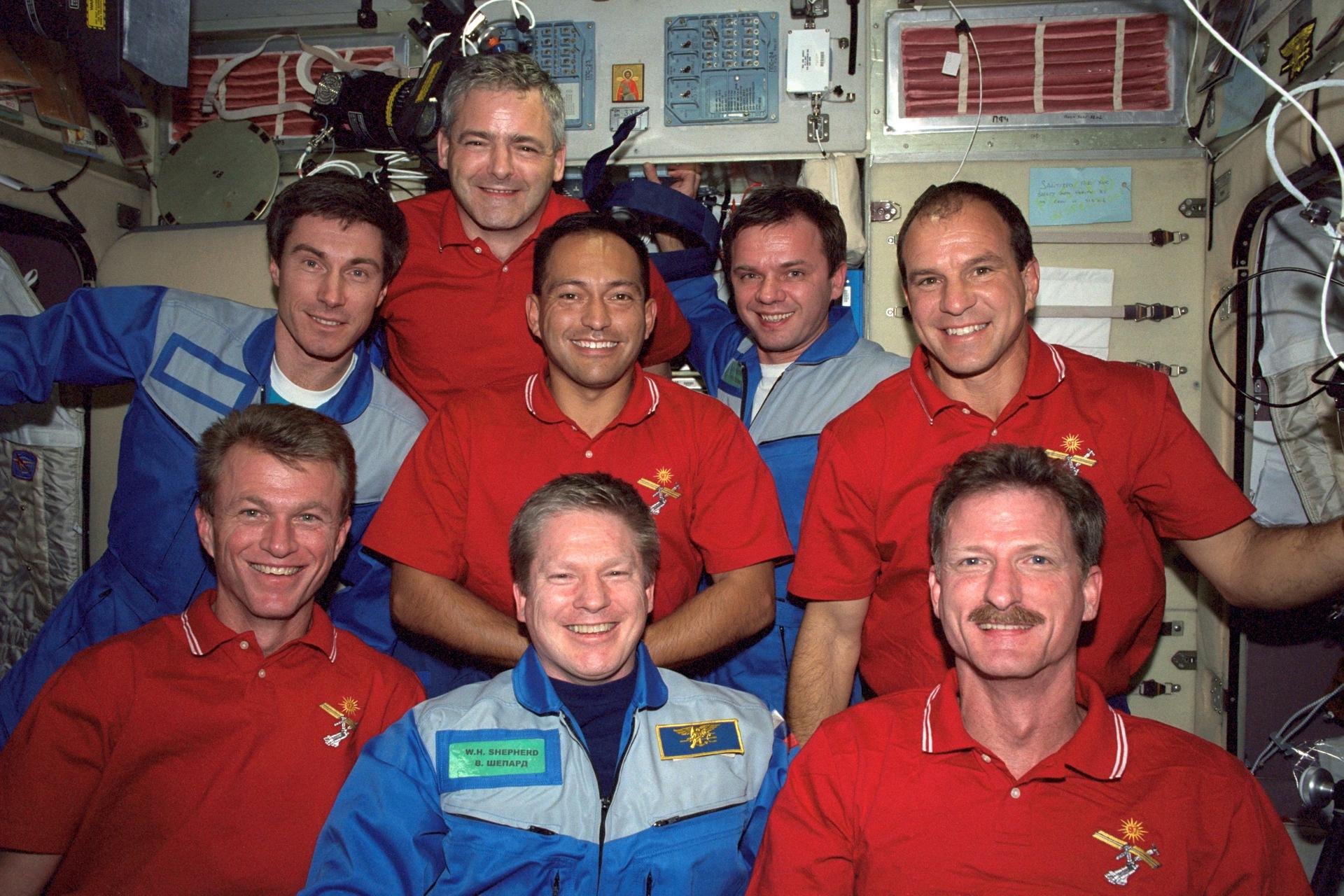
NASA marked 25 years of continuous human presence aboard the International Space Station on Nov. 2, 2025. Seven people now live there as Expedition 75, and MIT-linked astronauts and researchers shaped much of the station’s first quarter-century.
Three men and a station with no worktable
The count starts on Nov. 2, 2000, when Bill Shepherd, Sergei Krikalev and Yuri Gidzenko docked their Soyuz with the station. According to a feature by MIT alumnus John Tylko in MIT Technology Review, republished by MIT’s Department of Aeronautics and Astronautics, Shepherd (MIT master’s degrees in 1978) commanded Expedition One. The Russian service module had no worktable, and he was told one would arrive six months after his crew left.


The crew instead cut, drilled and threaded a table from the frames of scrap aluminum carbon-dioxide absorber canisters, using tools they had brought aboard. That table is now in the Smithsonian. Shepherd calls it, in the feature, “definitely an MIT-designed table.”
The crew’s work came after the first assembly flights. Pamela Melroy, who holds an MIT master’s degree from 1984, flew STS-92 in October 2000, which installed modules that prepared the station for that arrival. She flew three assembly missions in all, and credited the Shuttle-Mir program: “We learned a tremendous amount from the Shuttle-Mir program.”

Ten astronauts, 13 shuttle flights, 18 long stays
The feature counts 10 MIT astronauts who flew 13 shuttle missions to assemble and resupply the station through 2011. Twelve MIT alumni and one affiliate of the Whitehead Institute have since logged 18 long-duration missions between them.
Mike Fincke (class of 1989) had logged 381 days on three earlier missions before returning on Aug. 1, 2025, as part of Expedition 73. Cady Coleman served as lead robotics and science officer on a 159-day expedition in 2010-2011, and Woody Hoburg flew a 186-day mission in 2023. Greg Chamitoff, who has an MIT doctorate from 1992, became the first principal investigator, the scientist who leads an experiment, to carry out his own research on the station, according to the same account.

Experiments that started on the ground at MIT
Several lines of research trace back to MIT labs, per the feature:
- MACE-II (Middeck Active Control Experiment), developed by David Miller and the Space Systems Laboratory, was described as the first active US scientific investigation on the station. It tested ways to predict and control structural dynamics, meaning how a structure flexes and vibrates, in microgravity. Miller says the techniques were later used to test the James Webb Space Telescope.
- SPHERES, three free-flying satellites used inside the station from 2006 to 2019, let researchers study dynamic control of satellites flying together. It began as an undergraduate capstone project.
- Zero Robotics grew from SPHERES. Nearly 20,000 middle and high school students wrote algorithms to steer the satellites in competitions run on the station.
- ILLUMA-T, from MIT Lincoln Laboratory, demonstrated high-bandwidth laser communication between the station and a NASA relay satellite in 2023.
MACE-II and SPHERES were returned to Earth. The feature says they will go on display in the National Air and Space Museum’s “At Home in Space” gallery, slated to open in 2026.


What 253 billion cosmic-ray events and 2 billion base pairs show
Two results show how far station science has moved from the early years. The Alpha Magnetic Spectrometer, led by MIT physicist Samuel C.C. Ting, was delivered in 2011 on one of the last shuttle flights. The feature describes it as a $2 billion international effort to search for antimatter, probe the origin of dark matter and study cosmic rays. It reports that the instrument has measured more than 253 billion cosmic-ray events, with energies up to multiple tera-electron-volts, a unit used to measure particle energy. NASA’s image library places it on the station’s starboard truss, where it is still photographed in 2026.
In biology, Kate Rubins, then a Whitehead Institute fellow, became the first person to sequence DNA in space during Expedition 48 in 2016. She used a commercially available sequencer rather than a custom one. NASA says she went on to sequence more than 2 billion base pairs, the paired chemical units that make up DNA, that year. She also coauthored a 3D microbiome map of the station. In January 2021, NASA photographed her sequencing DNA again, this time for work to diagnose medical conditions and identify microbes.
Not everything is settled. The AMS figures and the claims about MACE-II’s later use come from the researchers and the alumni feature, not from a peer-reviewed summary. Whether antimatter or dark matter signals will emerge from the data is not stated in any of the sources.
A partnership that began as a budget rescue
The station’s international shape came from politics as much as engineering. President Reagan challenged NASA in 1984 to build a station within a decade. By the early 1990s Space Station Freedom was over budget and behind schedule, according to the feature. President Clinton asked MIT President Charles Vest to lead an advisory committee, whose recommendation to pursue cooperation with Russia led Roscosmos to join the coalition. The station is now run by NASA, Roscosmos, JAXA, the Canadian Space Agency and ESA.
NASA says more than 280 people from 26 countries have been aboard, and 259 spacewalks have taken place since December 1998. The station flies about 250 miles above Earth. Congress designated it a U.S. National Laboratory in 2005.
The station today and its planned end
Work continues. On Oct. 16, 2026, according to NASA’s station blog, the Expedition 75 crew opened the SpaceX CRS-35 Dragon and began activating experiments, including artificial retina creation, heart tissue growth, protein crystal growth for cancer treatment research and a study of plant genetic responses in microgravity. We covered the delivery in Dragon’s 6,300 pounds of cargo opens a science rush on the space station. NASA astronauts Anil Menon and the CSA’s Joshua Kutryk are scheduled for spacewalks on Oct. 29 and Nov. 5 to finish installing roll-out solar arrays.
The MIT feature says the station is slated to operate through 2030. NASA has selected SpaceX to develop a U.S. Deorbit Vehicle to bring the station down in a controlled way into a remote ocean area after its operational life. NASA’s own analysis says that if no commercial destination is ready to support its needs by 2030, an extension is possible. Those NASA plans date from 2022 to 2025.