Webb finds a galaxy with 1/240th of the Sun’s oxygen, the most primitive yet
Astronomers using Webb and a natural cosmic lens measured LAP1-B, a tiny galaxy with the lowest oxygen level ever found in a star-forming galaxy, and call it an ancestor of the Milky Way's fossil dwarfs.

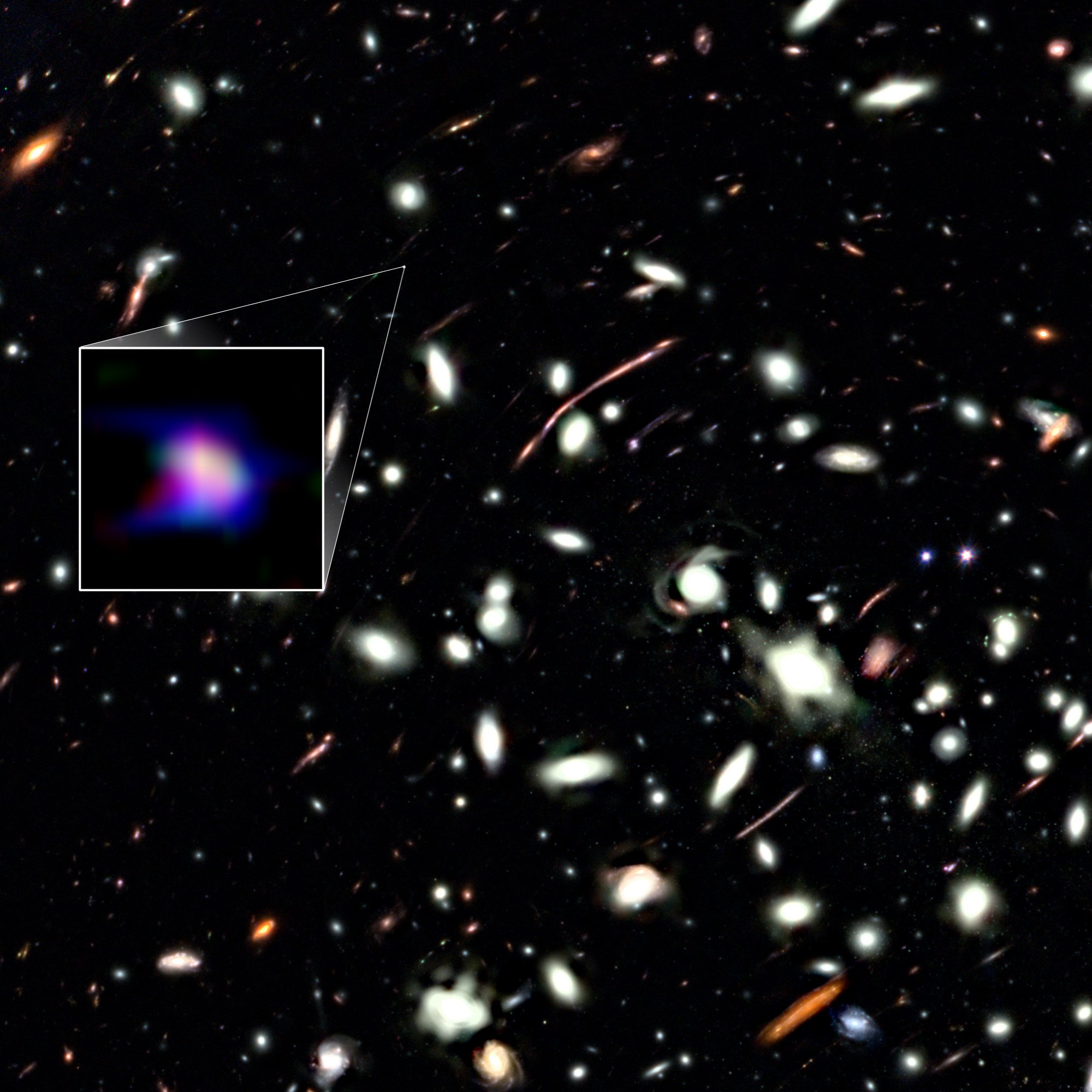
An international team led by Kimihiko Nakajima of Kanazawa University has used the James Webb Space Telescope to measure LAP1-B, a tiny galaxy whose gas holds just 1/240th of the Sun’s oxygen, the lowest level yet seen in any star-forming galaxy, according to a paper in Nature.
A galaxy caught almost before it had any heavy elements
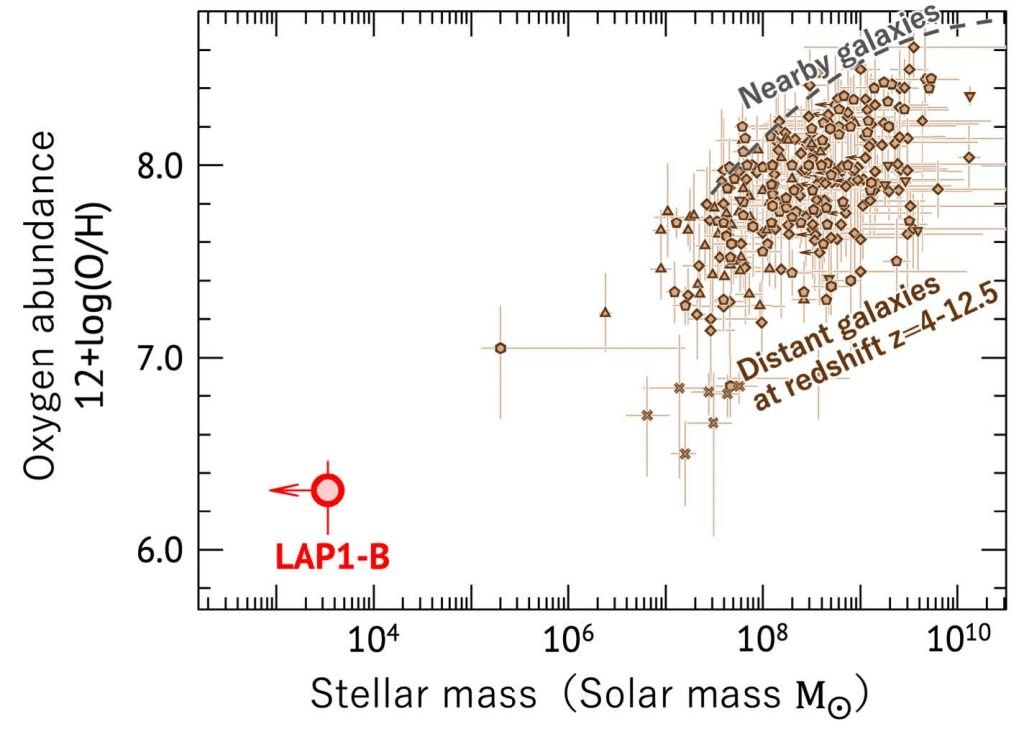
Astronomers call every element heavier than hydrogen and helium a “metal”. None of these existed after the Big Bang. They were made later inside stars and spread by stellar explosions, so a galaxy’s oxygen level works as a clock for how much star formation has already happened there. LAP1-B sits near the bottom of that scale. The paper gives its oxygen abundance as about 0.0042 times the solar value, which matches the 1/240 figure in the press releases from Japan’s National Astronomical Observatory (NAOJ) and the University of Tokyo’s Institute for Cosmic Ray Research.

The galaxy is seen as it was about 800 million years after the Big Bang, according to the paper’s abstract, an era known as reionization, when the first stars and galaxies were turning the hydrogen gas between them from neutral to electrically charged. The press releases describe the light as roughly 13 billion years old.
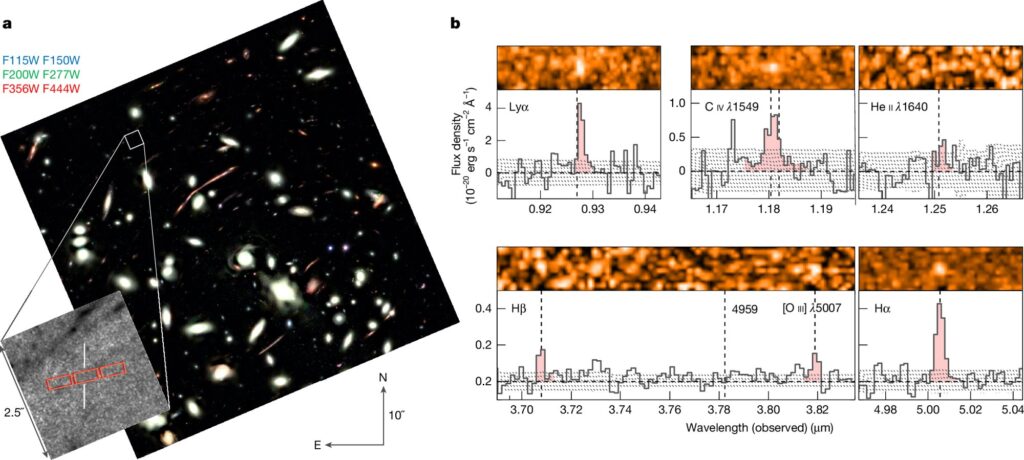
Such galaxies are normally far too faint to study. The team relied on gravitational lensing: the mass of the galaxy cluster MACS J0416 bends and magnifies the light behind it, and here it boosted LAP1-B’s brightness by 100 times. Webb then stared at the spot for more than 30 hours with its infrared spectrograph, which splits light into its component colors so that individual elements can be identified.

Signs of the very first stars in its chemistry
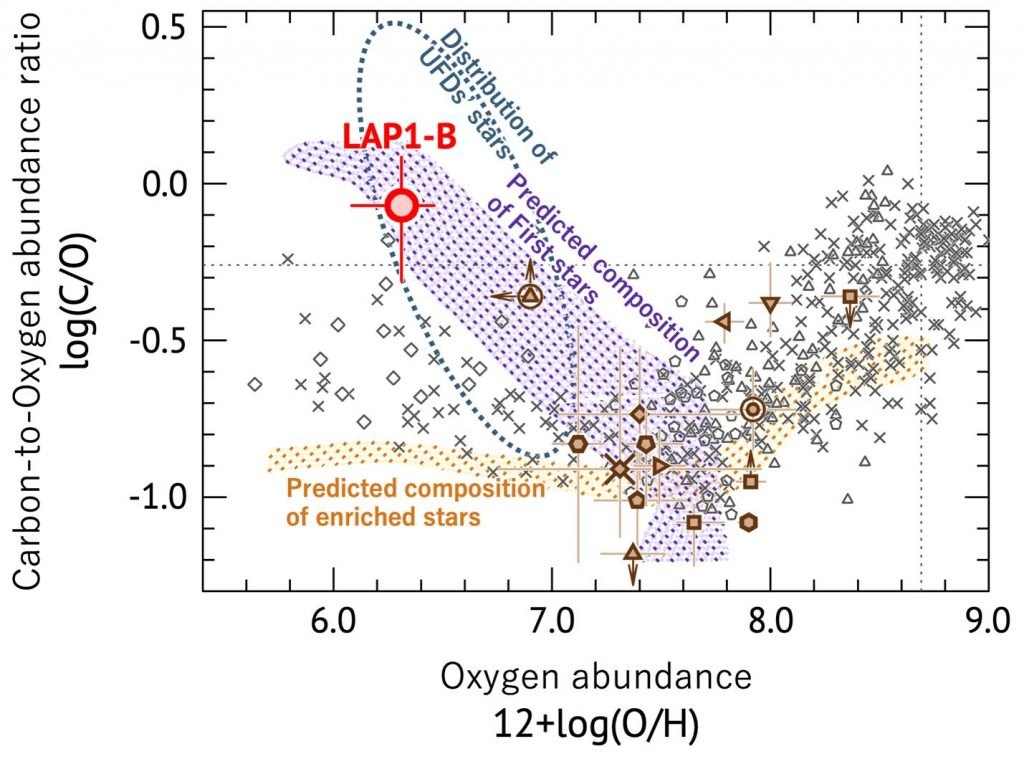
The spectrum showed an unusually hard, energetic radiation field. The authors say this does not fit stars enriched with heavy elements, or a growing black hole, and instead matches a stellar population with almost no metals at all.
The ratio of carbon to oxygen is also higher than expected for such a low oxygen level. The releases say this closely matches predictions for material thrown out by the explosions of the first generation of stars, known as Population III stars. The paper itself words it as consistent with stars formed without initial metals.

The galaxy shows no detectable starlight in the continuous part of its spectrum, which puts its stellar mass below 3,300 times the mass of the Sun. That is tiny: the Milky Way holds many billions of solar masses in stars. The motion of the gas implies a total mass larger than the stars and gas combined, so most of LAP1-B is dark matter, the invisible material that provides most of a galaxy’s gravity.
Why a fossil in the making matters for dwarf galaxies
Near the Milky Way sit ultra-faint dwarf galaxies, whose stars are all more than 12 billion years old, according to the NAOJ and ICRR releases. They are often called fossils of the universe because they seem to have stopped forming stars very early. Until now astronomers had no direct observation linking them to galaxies of the early universe. The paper calls LAP1-B “a direct high-redshift progenitor of the ancient ultra-faint dwarf galaxies observed in the local Universe”.
This is the science payoff, and it explains why the result was hard to get. Researchers usually reconstruct the past from the oldest stars in nearby dwarfs, which Nakajima compares to the work of “cosmic archaeologists”. LAP1-B lets them read the chemistry of gas as it was, in a galaxy that looks like the theoretical ancestor of those dwarfs. Co-author Masami Ouchi of NAOJ and the University of Tokyo said it was “a profound surprise” to find that LAP1-B looks exactly like the ancestor imagined in theory.
Two further numbers set the result apart from many early-galaxy finds. First, the exposure of more than 30 hours is long for one faint target, and it was possible only because the lens already amplified the light 100-fold. Second, the paper reports the redshift, a measure of how far light has been stretched by cosmic expansion, as 6.625 with an uncertainty of just 0.001. That precision comes from the sharp emission lines of hydrogen and oxygen. The study sits alongside Webb’s wider census of the earliest galaxies, but it differs in aim: it measures chemistry in a faint, low-mass system, not the brightest distant object.
The search for even more primitive objects
The team says it will keep using Webb to look for galaxies that are even more primitive, with the long-term aim of reaching the very first galaxies. Nakajima said he hopes the discovery marks “a historic step” in understanding how the elements that make up our bodies were first made and spread through the universe. The work was funded in part by Japan’s JSPS KAKENHI program and by the Italian national institute INAF, according to the ICRR release.