Perseverance passes 28.10 miles on Mars, beating Opportunity’s record in a third of the time
NASA's Perseverance rover logged 28.10 miles (45.22 kilometers) on sol 2,006, passing Opportunity's 28.06 miles after about 5½ years on Mars instead of almost 15.
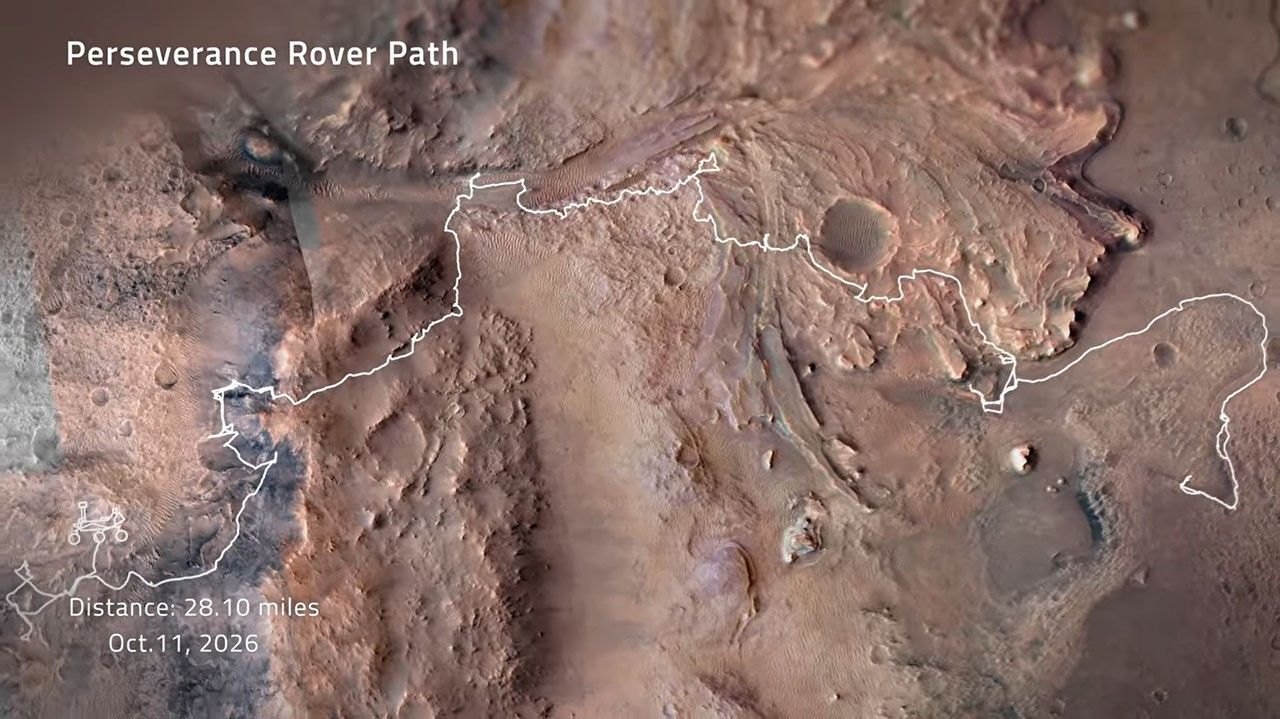
NASA’s Perseverance rover passed the off-world driving record on Oct. 11, 2026. Its odometer read 28.10 miles (45.22 kilometers), just ahead of the 28.06 miles (45.16 km) set by Opportunity, according to NASA’s new path animation.
A record broken on sol 2,006
The record fell on sol 2,006 of the mission, when Perseverance drove 299.6 feet (91.31 meters), according to a NASA mission blog post. The new animated orbital map traces the whole route from the 2021 landing to that day, with the rover icon and a “28.10 miles” counter at the end of the line.
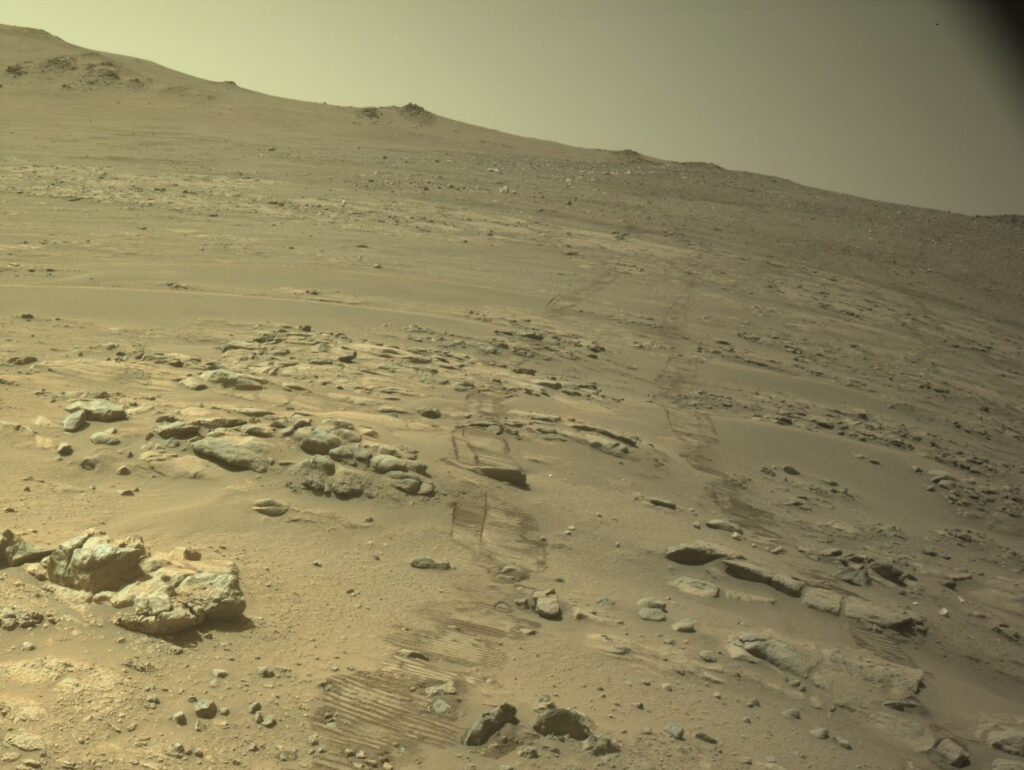
The rover covered the distance in about 5½ years. Opportunity, which worked on Mars from 2004 to 2018, needed almost 15 years for its total, NASA said. At the time of the record Perseverance was heading for a spot called “Idubi” in an area off the western rim of Jezero Crater nicknamed “Lac de Charmes.” The team is studying some of the oldest terrain explored in the solar system and hopes Idubi holds traces of ancient hydrothermal systems, where hot water once moved through rock, according to the blog.
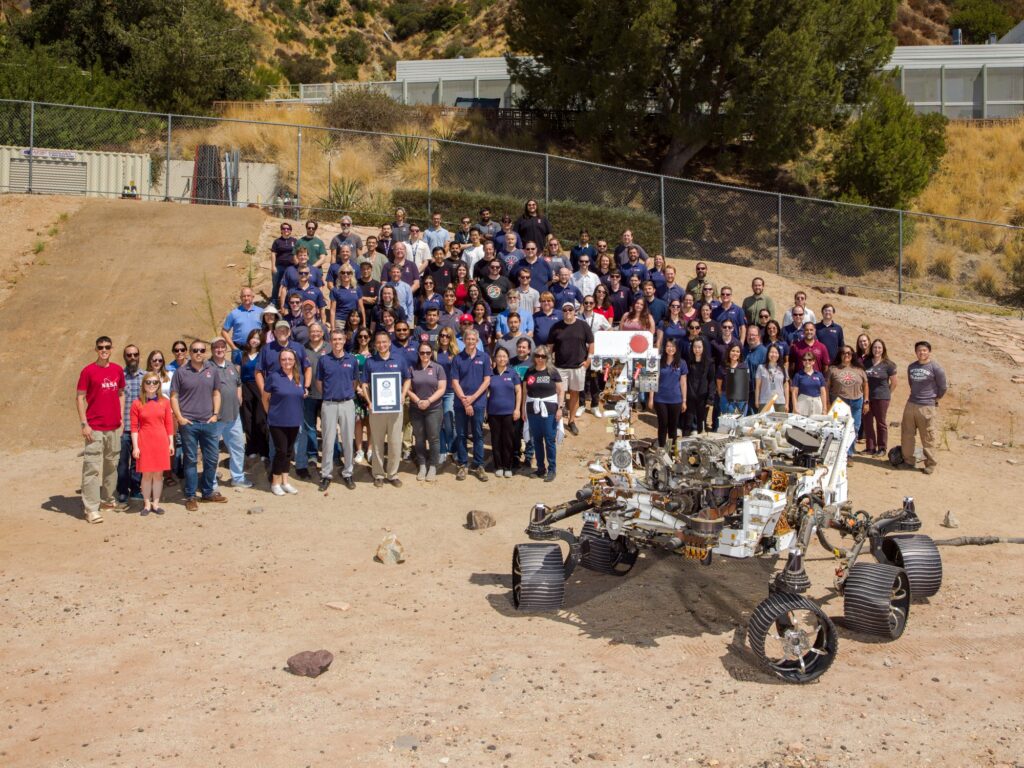
NASA also released a team photo taken in the Mars Yard at the Jet Propulsion Laboratory in California. About 100 team members stand beside OPTIMISM, a full-scale rover model engineers use to plan driving routes, holding a Guinness World Records certificate for the distance.
Thinking while driving: Why this rover is faster
The key is AutoNav, the rover’s autonomous navigation. While it moves, Perseverance photographs the ground ahead, builds a 3D map of hazards and chooses its own path between waypoints set by planners on Earth. The team calls this “thinking while driving.” The rover can do it at or near top speed and cover up to 1,351 feet (412 meters) in a single sol.
NASA says more than 90% of Perseverance’s total distance used AutoNav terrain evaluation, against about 5% for Opportunity and its twin Spirit. Mark Maimone, deputy team chief for robotic operations, put it this way in the blog: “The rover that broke this record did so by making its own decisions about the path.”
How the record stacks up against other rovers and the Moon
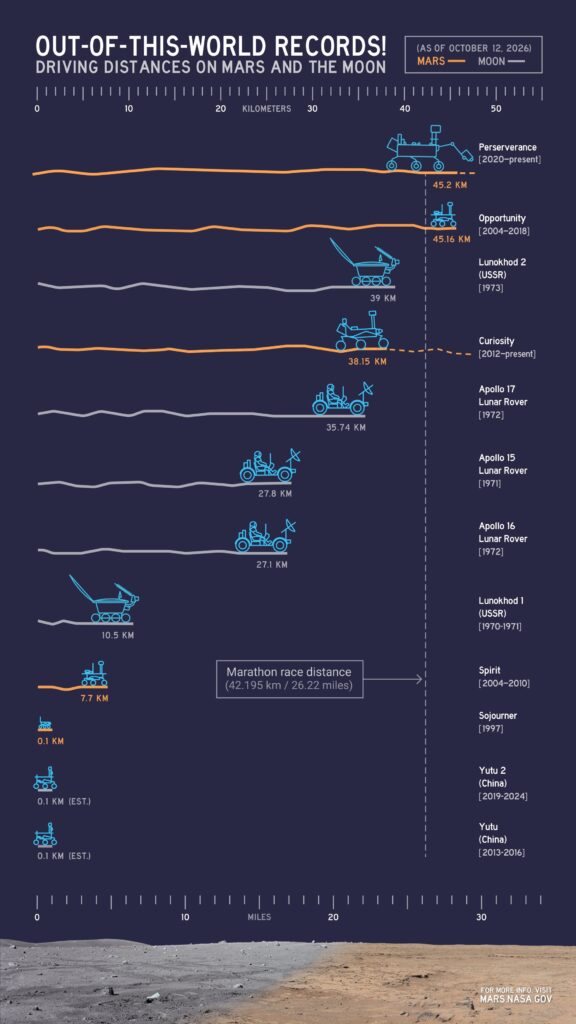
NASA’s figures put Spirit at 4.8 miles (7.7 km) before its mission ended in 2010 and Sojourner at about 330 feet (100 meters) in 1997. Sojourner used 20 measurement points to judge the path ahead, while Perseverance processes 600,000 per look.
Its sister rover is still driving too. Curiosity has logged more than 23.65 miles (38.07 km), according to NASA. Perseverance has also passed the lunar marks: Apollo 17’s 22.2 miles (35.7 km) and the Soviet Lunokhod 2’s 24.2 miles (39 km). The design target was modest. Steven Lee, project manager for the Curiosity and Perseverance rovers at JPL, noted that “The original mission called for no more than 12.4 miles of driving.” Perseverance has more than doubled it.
For readers following both active rovers, our guide to Mars rovers today tracks where each one is.
Extended mission and a glare problem to solve
NASA has approved the mission’s first extension, running from October 2026 to roughly the end of 2028. After Lac de Charmes, the rover will continue along the crater rim and head south toward Rainbow Falls, a 328-foot-wide (100 meters) block of ancient crust uplifted by the impact that formed Jezero. The mission has so far collected 29 samples of rock and regolith, the loose dust and broken rock covering the surface, and its findings include a potential biosignature, a possible sign of past life, at a feature called Cheyava Falls, according to NASA.
One obstacle remains. Maimone said glare in the navigation cameras forces the team to park by mid-afternoon when driving toward the Sun, so teaching the rover to see past it would lengthen each working day. He said the newest software “teaches Perseverance to steer less and roll more.” Lee said the team expects the rover “to keep adding to this record for many years to come.”