UK sets lunar rules for operators: A disposal plan before any licence, and no keep-out zones
The UK Space Agency's new technical framework tells British operators what regulators expect for missions to the Moon, from disposal plans to nuclear power and radio use.


The UK Space Agency has published a Technical Framework on Lunar Operations for British companies planning Moon missions. Every lunar mission must hold a disposal plan when its licence is granted, and the UK does not treat lunar safety zones as keep-out areas.
Who the rules cover, and what they do not change
The framework applies to operators licensed under the Outer Space Act 1986 or the Space Industry Act 2018. It covers flights through the space around the Earth and Moon, including flybys, orbiters and CubeSat constellations, along with static landers and rovers. It applies to missions that have not passed a Concept Design Review, an early engineering checkpoint, by 23 November 2026. The regulator is the Civil Aviation Authority (CAA), which can consult Ofcom, the UK Space Agency and the UK Planetary Protection Advisory Panel.


The document says it creates no new requirements. It explains how existing law applies on the Moon, in line with the 1967 Outer Space Treaty. It also says the UK is not a party to the 1979 Moon Agreement, so that treaty plays no part. The Artemis Accords, which the UK signed as a founding member in 2020, are described as a political commitment that adds no legal duties beyond those already in UK law.
A disposal plan on day one
Post-mission disposal means what happens to a spacecraft when its work ends. The framework states: “All lunar missions must have a PMD baseline plan in place at grant of licence.” Plans must show acceptable risk to other operations. A spacecraft that is deliberately crashed should avoid crewed surface operations, permanently shadowed regions (craters that never see sunlight) and, as far as feasible, the polar regions south of 79° S and north of 86° N. It should also keep clear of human heritage sites.

Operators must register their objects on the UK national registry, which passes details to the United Nations. For an orbiter that means its initial lunar orbit. For a lander it means nearby geographic features, such as the south-western Sea of Tranquility for Apollo 11. Operators must also share ephemeris data, the position tables that let others predict a spacecraft’s path, with existing lunar coordination efforts. The document names JPL’s MADCAP and the Open Lunar Foundation’s Lunar Ledger, and notes that both are limited by who takes part.
Safety zones: Consultation, not exclusion
The framework says the UK “does not view Safety or Notification zones as keep-out zones.” It treats them as areas where others should consult the operator. An operator wanting one must show it complies with international space law, is sized to its real activity, and is temporary and proportionate. The document also notes that not every member of the UN Committee on the Peaceful Uses of Outer Space supports such zones.


Nuclear power gets case-by-case treatment. Radioisotope heaters, radioisotope generators and fission reactors are expected to follow UN principles from 1992 and a 2009 safety framework. For background on one such project, see our report on NASA’s plan for a nuclear reactor on the Moon. Planetary protection, meaning limits on contaminating other worlds, is mandatory, and radio use is coordinated through Ofcom and the International Telecommunication Union.
What is still open
Several parts of the framework are explicitly unfinished. On mining and using lunar resources, the UK will consider reflecting its principles only “once the workplan of the SRU WG concludes in 2027”. That refers to a UN working group on the legal aspects of space resource activities. The radio section is due for review ahead of the 2027 World Radiocommunication Conference.
Liability is the clearest cost question. The framework says that for licences issued from 1 December 2026, liability and insurance requirements are waived for lunar missions launched before the end of 2030. That relates to the orbital operations phase, and other cases are assessed individually. A separate Liability and Insurance Technical Framework is due by December 2026, so operators cannot yet see the full picture. The waiver was announced with the Space Strategy on 8 September 2026, according to the document.
The text also shows how far coordination still depends on goodwill. Tracking objects around the Moon is harder than around Earth because there is no shared ephemeris, and the uneven mass distribution of the Moon makes some orbits unstable. The framework asks operators to prove they can support conjunction assessment, the check for close approaches, but it does not name a single mandatory system.
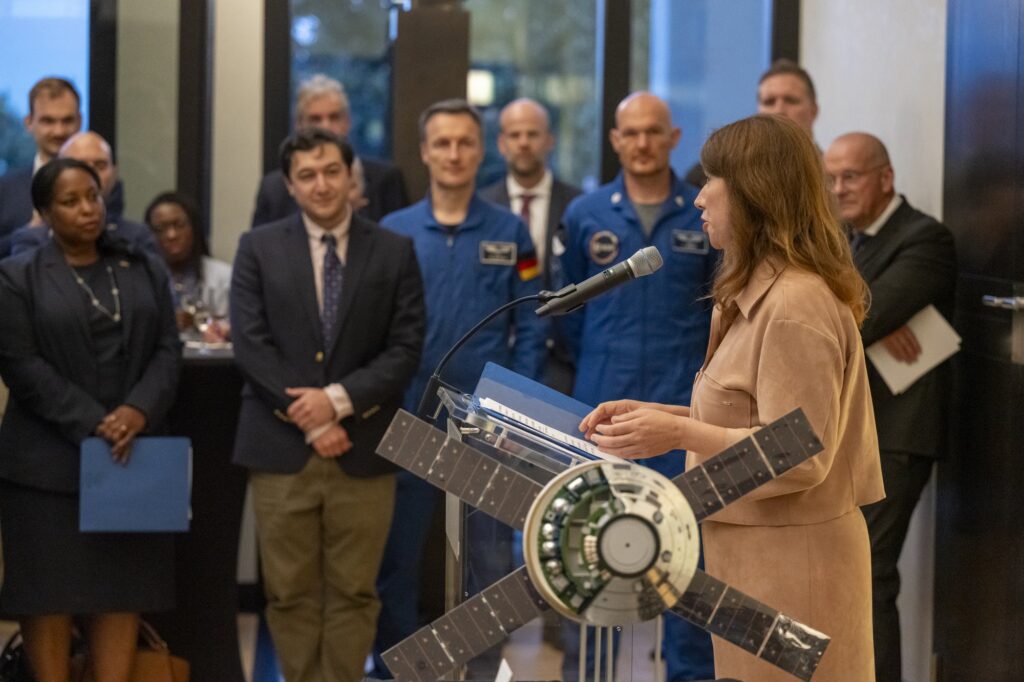
The Artemis Accords, which the framework leans on, keep growing. NASA’s image library records Germany signing on 14 September 2023 and Jordan on 23 April 2026. That growth is the international backdrop to the UK’s approach, though the Accords themselves remain non-binding.
Operators with commercial landers, such as those flown to the south pole region in programs like Blue Ghost, will be watching how the polar disposal limits are applied in practice. The framework asks them to talk to the CAA early.