Artemis III rocket is stacked in Florida, with a fueling test at the pad next
NASA technicians have set the 212-foot Artemis III core stage between its two boosters at Kennedy. After checkouts, the stack rolls to Pad 39B for a fueling rehearsal.

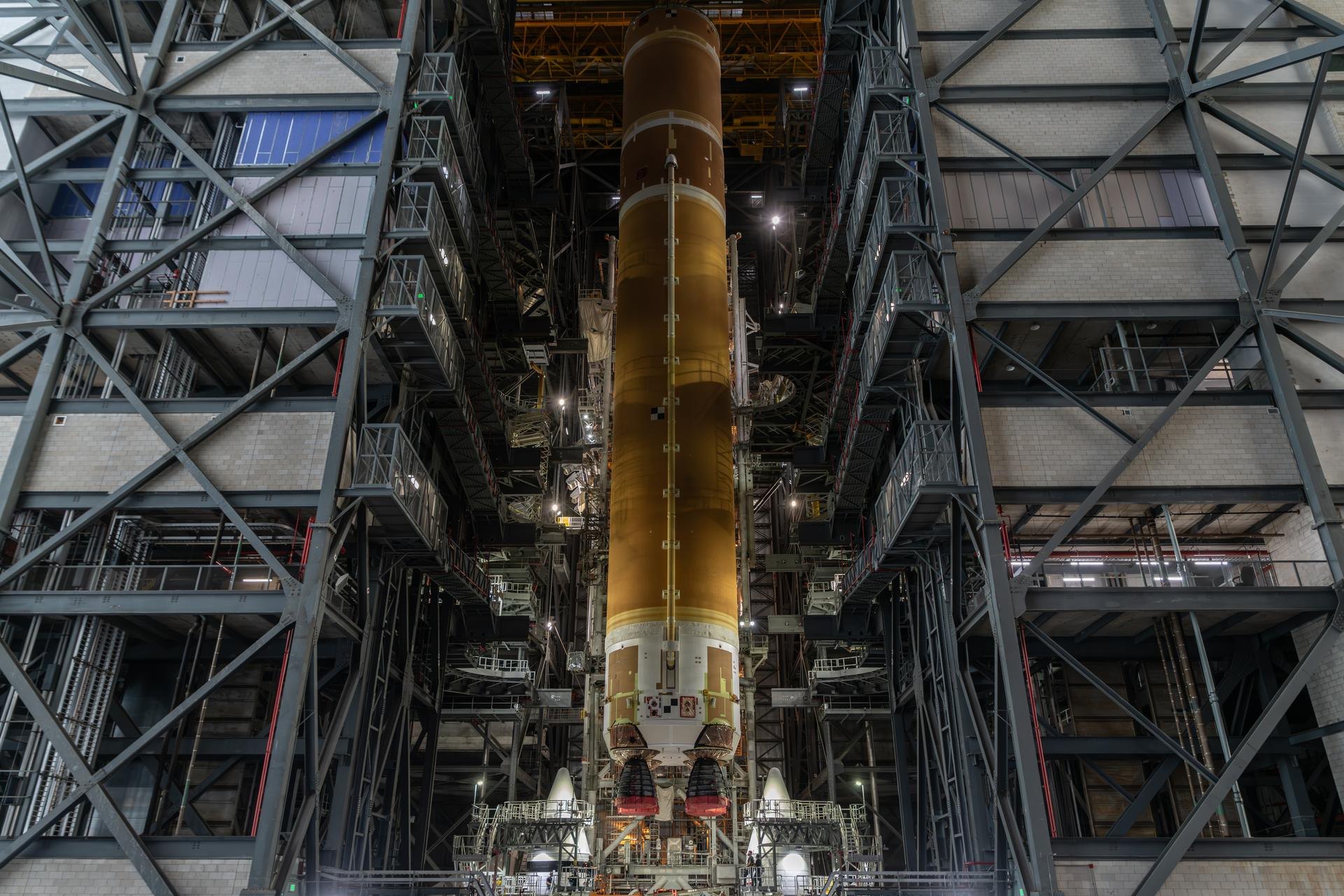
NASA has joined the 212-foot core stage of the Artemis III Space Launch System rocket to its two solid rocket boosters inside the Vehicle Assembly Building at Kennedy Space Center, the agency said on Oct. 28. The next step is a fueling test at Launch Pad 39B.
One crane lift, from High Bay 2 to High Bay 3
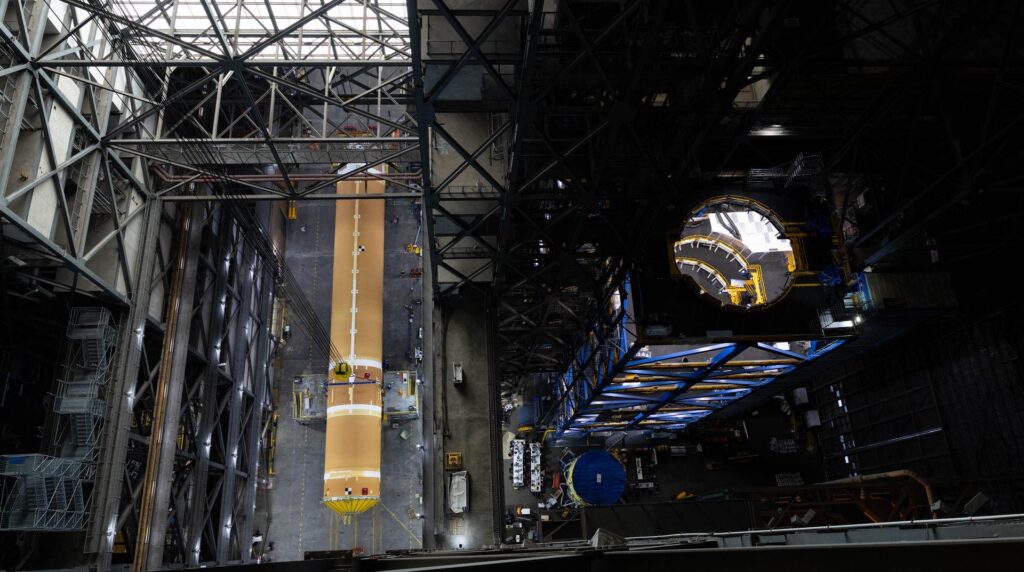
The core stage is the large orange tank-and-engine section that forms the center of the rocket. NASA’s photo captions show it being lifted from the building’s transfer aisle on Oct. 22, laid out in the aisle on Oct. 23, and set between the boosters on Oct. 25. That placement completed what NASA calls the short stack: core stage and boosters, without the upper stage or the Orion capsule on top.

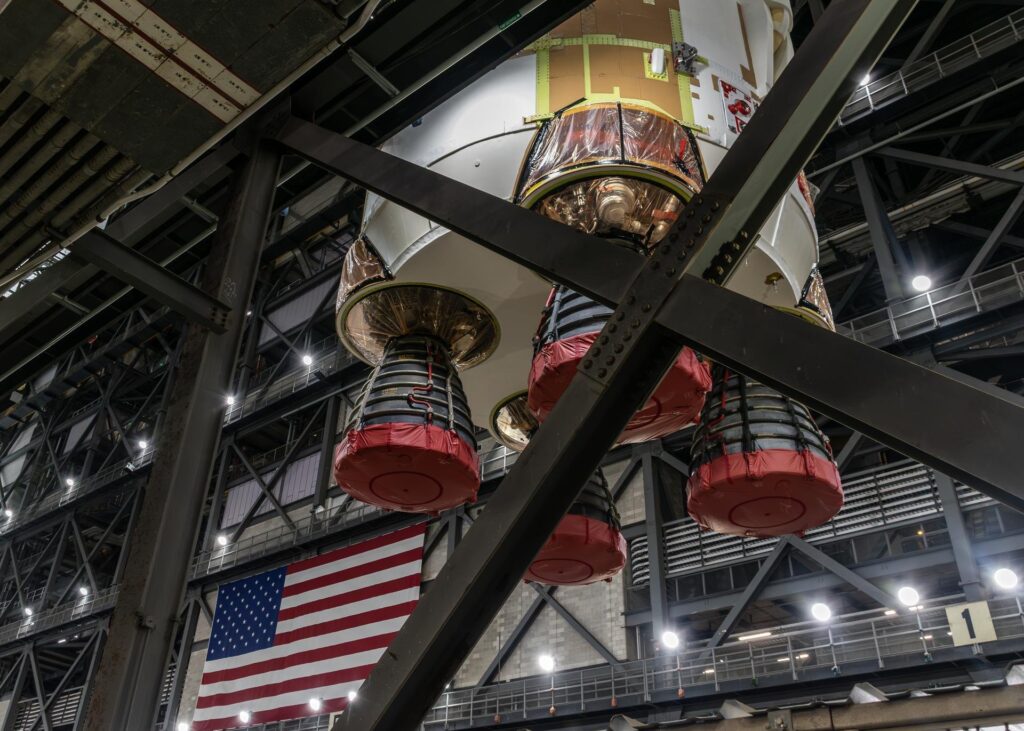
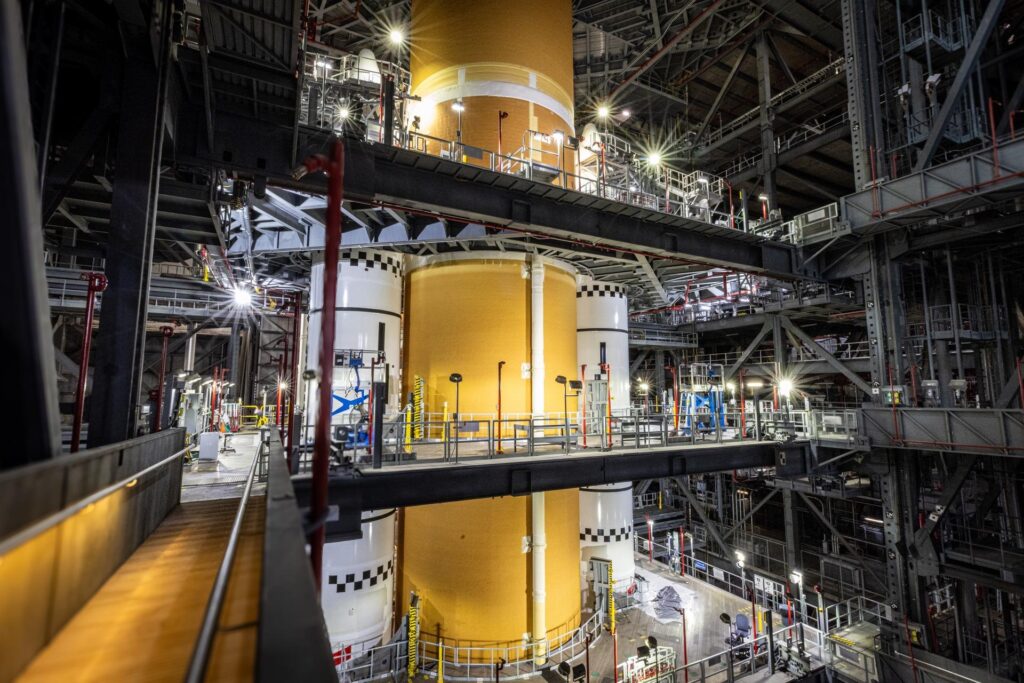
Technicians moved the stage from High Bay 2 to High Bay 3 with a one-of-a-kind lifting beam built to place it on the mobile launcher, the platform the rocket stands on and rolls out on. The boosters were already in place on the launcher, and the crane lowered the core stage between them.
A fueling rehearsal before any launch
Once testing and checkouts are done, teams will roll the stack out to Pad 39B for a tanking test. Liquid hydrogen and liquid oxygen, the rocket’s two propellants, will be loaded into the core stage only. Launch teams will use the test to practice countdown procedures and timelines. NASA did not give a date for the rollout.

The same kind of rehearsal matters because the core stage holds most of the rocket’s propellant, so it is where fueling problems tend to show up. Finding them with no crew aboard and no launch at stake gives engineers time to fix them. The pad test also lets the launch team practice the countdown in full before a crew is involved.
A test flight in Earth orbit, not a landing
Artemis III will not go to the Moon. In NASA’s mission description, the flight is planned for 2027 and will last 14 days in low Earth orbit. NASA astronauts Randy Bresnik, Frank Rubio and Andre Douglas will fly with ESA (European Space Agency) astronaut Luca Parmitano. They will test how Orion meets and docks with test versions of two commercial landers, one from Blue Origin and one from SpaceX. Crewed landings near the Moon’s South Pole are planned for 2028.

Crews gained their first experience of flying Orion beyond Earth orbit on Artemis II; our overview of that mission and what follows covers it.
Two landers, two ways of docking
Competition is the clearest angle here, because NASA is testing two different designs against the same spacecraft. According to NASA, the Blue Origin test article, a Blue Moon Mark 2, launches first into a circular orbit about 273 miles (237 nautical miles) up and can stay there for up to 30 days. Orion launches only days later, and only after the lander is confirmed healthy.

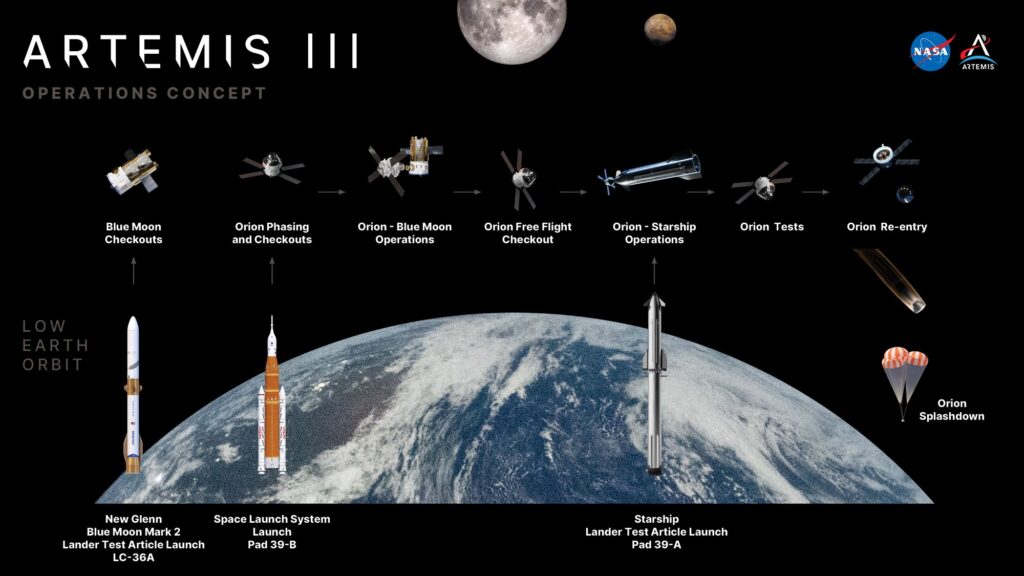
The two docking tests are not alike. At Blue Moon, Orion connects to a port beside the lander’s crew cabin, and the crew spends about two days inside it, checking the cabin environment, controls and life support. SpaceX’s Starship Version 3 test article sits in a lower orbit of 206 nautical miles. Orion lines up its forward docking system with Starship’s nose for a docking of up to two hours, and the crew does not go inside.
The difference shows how far apart the two landers are in layout, and the flight lets NASA check each approach before anyone tries it near the Moon. Both test articles launch on their own heavy-lift rockets, so the mission depends on three separate launches, with Orion’s tied to the health of the Blue Moon test article.
NASA’s Artemis program manager Jeremy Parsons said: “Every lesson we learn here gets us closer to landing on the Moon in 2028.”
What the crew checks beyond docking
NASA lists further tasks for the 14 days. They include up to five extra days in orbit after the Starship test, evaluations of the Orion Crew Survival System suits, docking sensor tests, and acoustic and thermal measurements. There is also a study of health assessments when the crew cannot talk directly to mission control, a cellular biology experiment, and tests of concepts for returning lunar samples to Earth. The mission ends with a splashdown in the Pacific Ocean off California, with recovery by NASA personnel and the U.S. Navy.