Jupiter slows the solar wind in stages, unlike Earth, Juno data show
University of Iowa physicists report the most detailed look yet at Jupiter's bow shock, where the solar wind is slowed in steps through regions called shocklets before it reaches the planet.

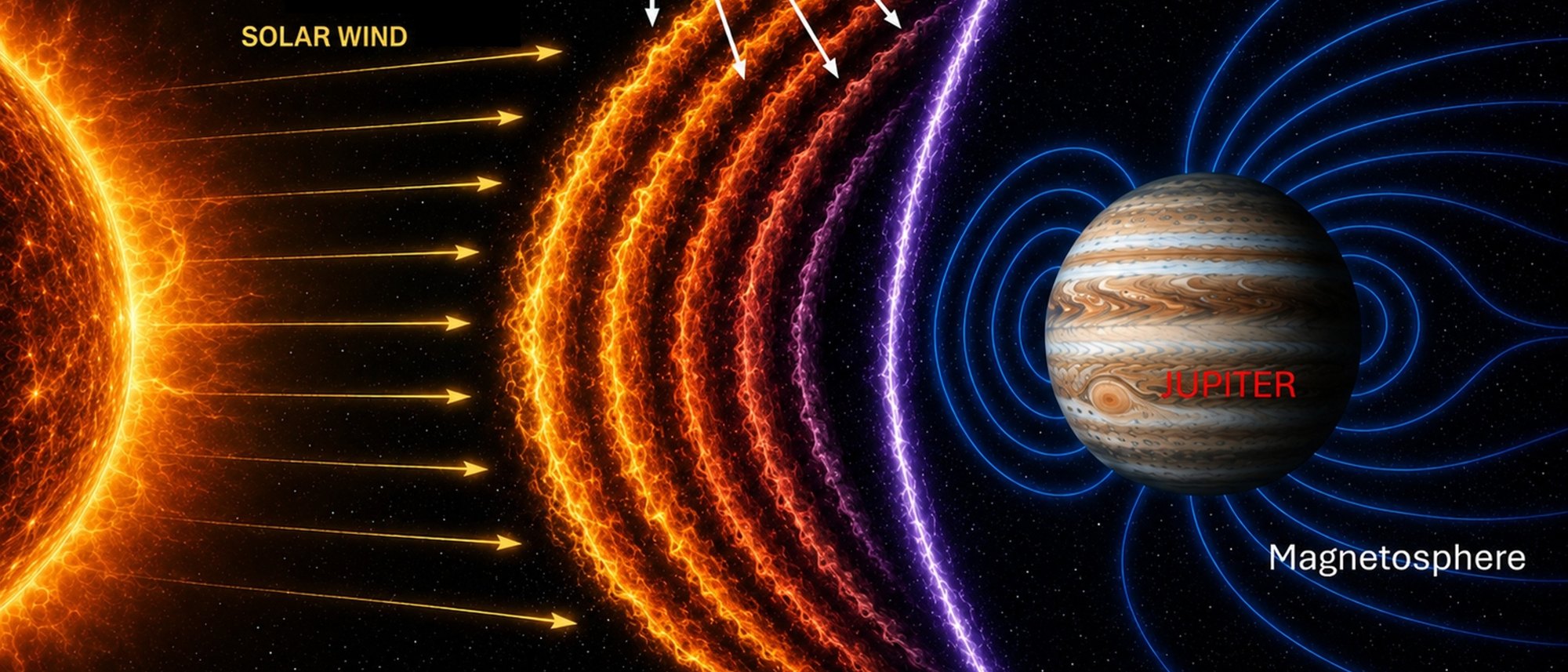
Physicists at the University of Iowa have made the most detailed observations yet of Jupiter’s bow shock, the boundary that deflects the sun’s charged particles, the university said. Jupiter uses several steps, where Earth uses one.
A bow shock in several layers
The solar wind is a constant stream of charged particles flowing outward from the sun. A planet with a strong magnetic field pushes against that stream, much as a boat pushes against water. The sudden slowing and deflection of the particles happens at a boundary called the bow shock.

The Iowa team, working with colleagues at several US institutions, found that Jupiter’s version is more elaborate than Earth’s. According to the university, Jupiter uses a series of regions called shocklets to slow the solar wind before it reaches the main bow shock. Earth relies on its bow shock alone.
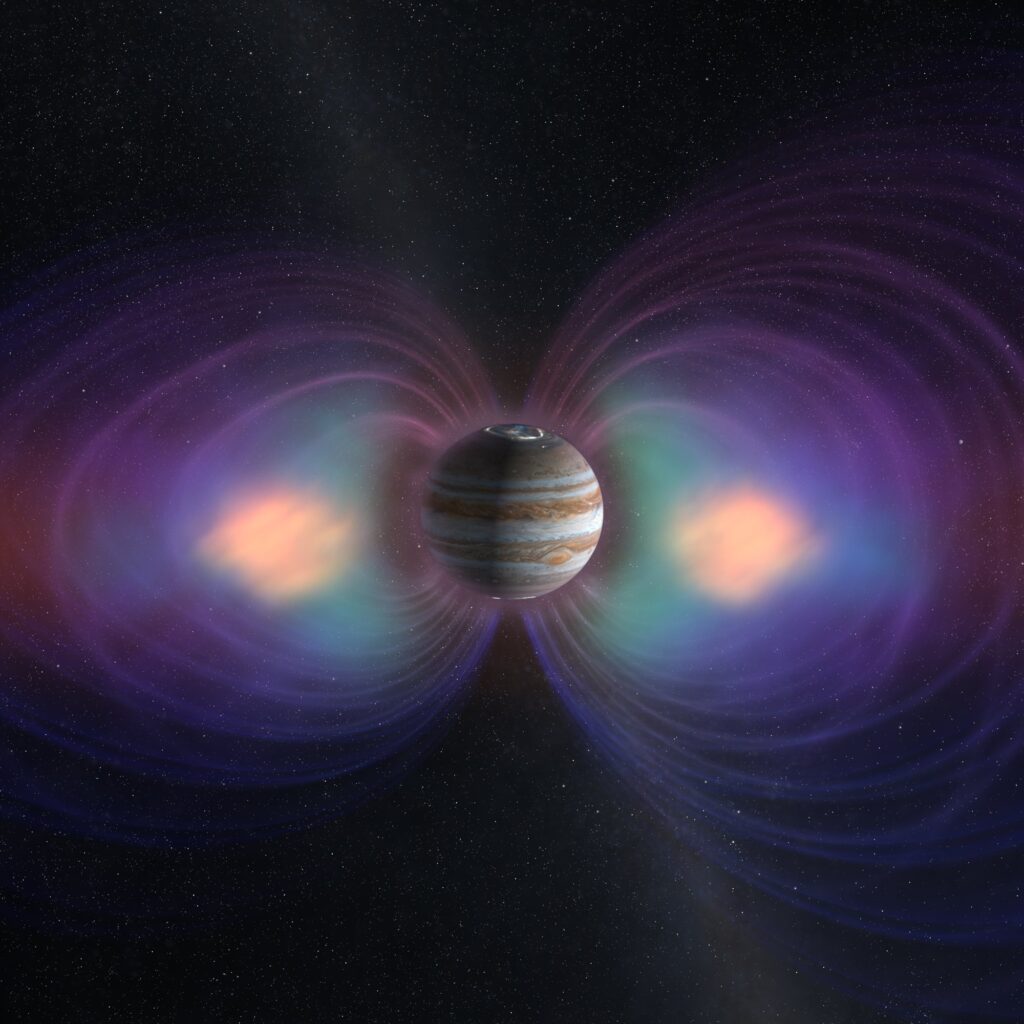
The plasma waves at Jupiter’s bow shock also differ. Plasma is gas made of electrically charged particles, and it carries waves, much like sound waves in air. The researchers found that Jupiter’s waves occur at several frequencies, which they call harmonics. Earth’s bow shock mostly uses a single frequency.

“Jupiter has found its own way to deal with the solar wind.”
That is how Jayasri Joseph, a postdoctoral researcher at Iowa and corresponding author of the study, described the result. Co-author Bill Kurth, a research scientist at Iowa, added: “Earth does not need to take these extra steps.”
Data from Juno’s December 2024 pass
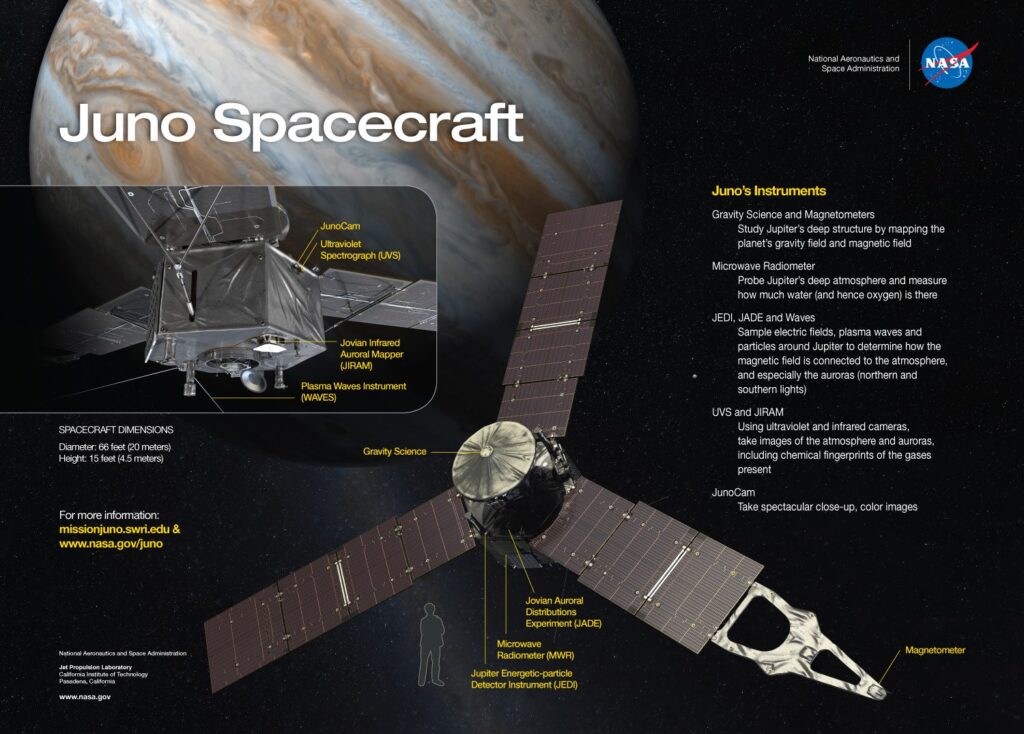
The study, titled “Plasma wave observations from Juno spacecraft at the Jovian bow shock,” was published online on July 31 in Nature Communications. It uses data collected in December 2024 by the Waves instrument aboard NASA’s Juno spacecraft, an instrument designed and built by Iowa physicists. NASA funded the work.
Juno launched on August 5, 2011, on an Atlas V rocket from Cape Canaveral, Florida, and has orbited Jupiter since July 2016, according to NASA’s mission page. Its orbit began at 53 days per loop and, after flybys of Ganymede, Europa and Io, settled into a 33-day orbit. Because the shape of its path changes, the spacecraft can sample the region where Jupiter meets the solar wind.
Iowa contributors included Allison Jaynes, Jeremy Faden and Chris Piker alongside Joseph and Kurth. Other authors came from NASA Goddard, the Space Research Corporation, Southwest Research Institute, the University of Texas at San Antonio, the University of Colorado Boulder, the University of Minnesota and the Johns Hopkins Applied Physics Laboratory.
What a giant planet’s shield can teach about exploding stars
The authors say Jupiter’s bow shock could help explain how the remnants of supernovae, the explosions of dying stars, turn energy into heat and fast-moving particles. Those remnants cannot be visited, but their shocks work on the same basic principle. A nearby shock that a spacecraft can cross repeatedly serves as a natural laboratory.
The comparison with Earth comes with limits. The university describes Jupiter’s approach as different from Earth’s, not better, and the two planets sit in very different surroundings. The release gives no count of bow shock crossings behind the analysis and no figures for shock distance or wave frequencies, so those details await the full paper. Whether other giant planets such as Saturn use the same staged approach is also not addressed.
Jupiter is also the destination of other recent missions: on October 28 Lucy became the first spacecraft to enter the Jupiter Trojan asteroid region, which shares the planet’s orbit around the sun.