Three solar eruptions merge into one in the first 3D simulation of the full process
A team led by Lijun Cai has modeled three coronal mass ejections from the Sun's surface to their merger in one simulation, with the last eruption reaching 3,230 km/s.

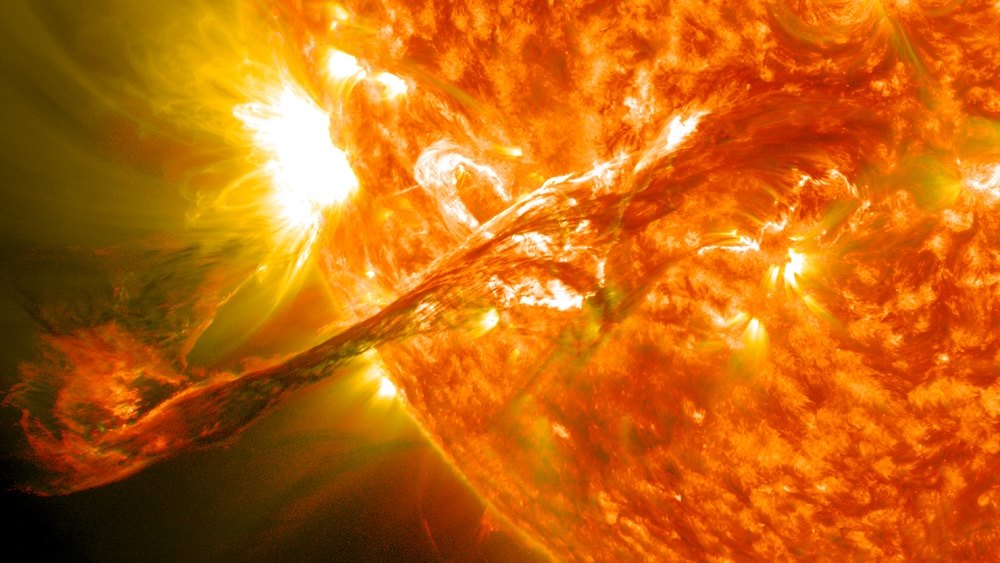
Astronomers led by Lijun Cai of Harbin Institute of Technology have run the first global 3D simulation that follows solar eruptions from launch to merger. In it, three coronal mass ejections combine into one, as AAS Nova reports.
Why one eruption can swallow another
A coronal mass ejection (CME) is a tangled cloud of hot gas and magnetic field thrown out of the Sun’s outer atmosphere, the corona. At the peak of the Sun’s activity cycle, there can be several in a single day. Sometimes they leave the same region one after another, on nearly the same path and with similar magnetic fields. A later eruption can then catch an earlier one and absorb it. This is called cannibalism, and it may produce a stronger and more destructive event than any single CME.

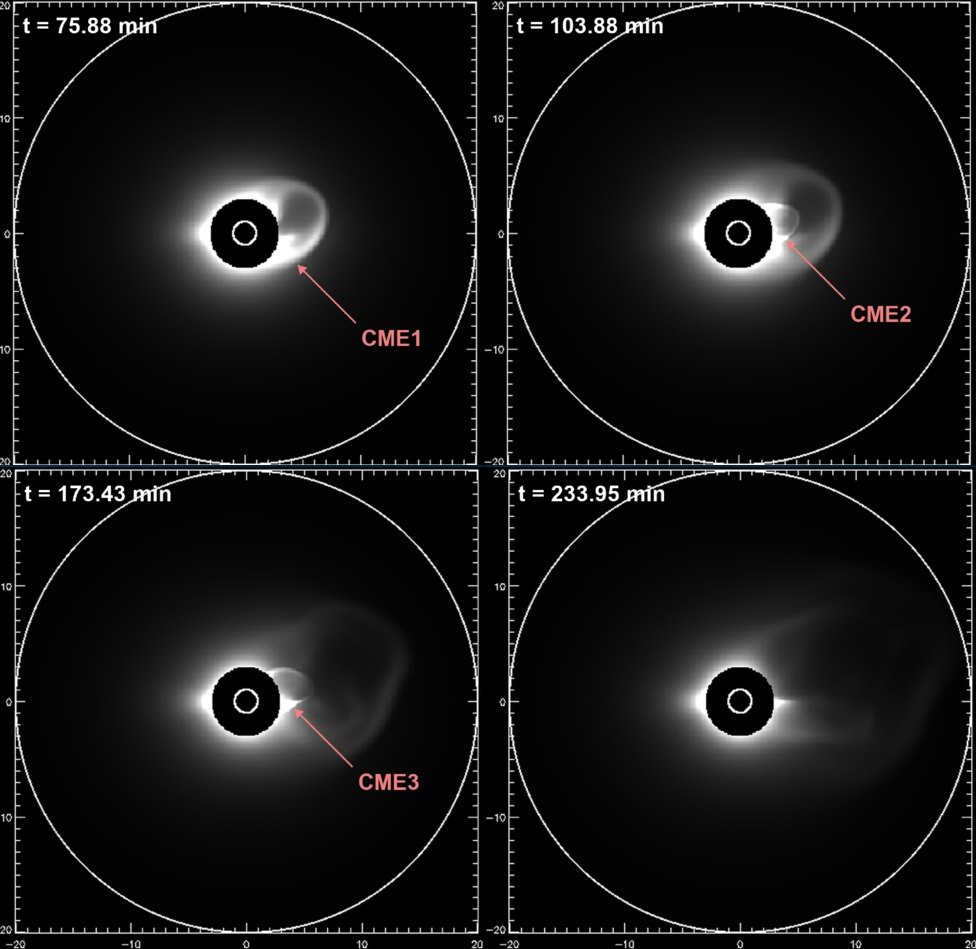
Until now, the two halves of the story had been studied separately. Some simulations launched several CMEs from one area of the Sun but stopped before the eruptions caught up with each other. Others set eruptions on a collision course but started long after launch. Cai and colleagues joined the two phases in one run, published in The Astrophysical Journal Letters (2026, volume 1011, L46, doi:10.3847/2041-8213/aeb88d).
Speeds of 770, 2,480 and 3,230 km/s
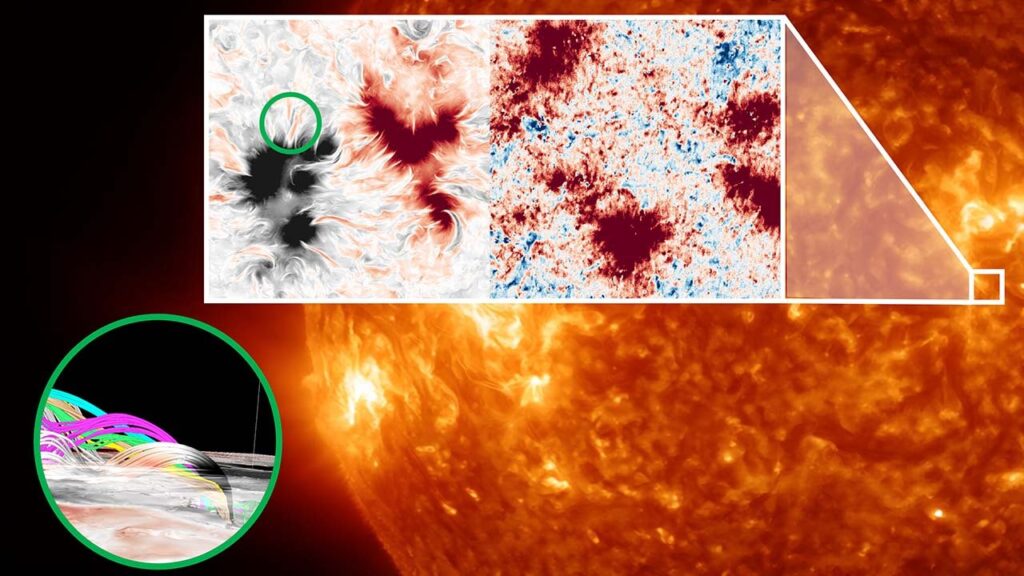
The team started three CMEs in quick succession from one spot on the photosphere, the Sun’s visible surface. Each was triggered by shearing: plasma motions drag the footpoints of magnetic field loops sideways. Magnetic energy builds up until it spills over and the CME is released.

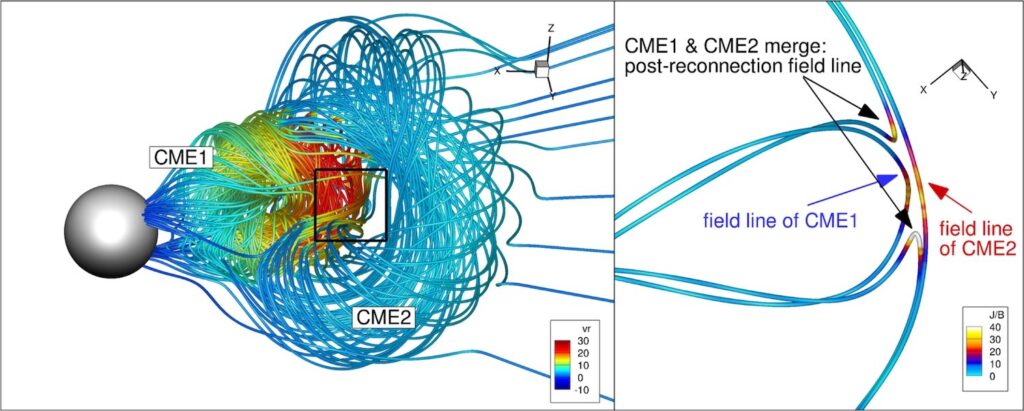
Each eruption was faster than the one before. The shocks, the pressure fronts that run ahead of the plasma, were clocked at 770, 2,480 and 3,230 kilometers per second for the first, second and third CME. AAS Nova gives two reasons:
- The first CME cleared the path. Its passage lowered the density of the surrounding plasma by an order of magnitude, so later eruptions met far less resistance.
- The second and third eruptions released more magnetic energy than the first, so they started with more kinetic energy.
When one CME reached another, a thin layer of electric current formed between them. In that layer the magnetic field lines of the two eruptions reconnected: they broke and rejoined in a new arrangement. This merged the two magnetic structures into one and let their plasma mix. The team also produced synthetic white-light images, which imitate what a coronagraph (an instrument that blocks the Sun’s disk to show the corona) would record. They show the three eruptions coalescing.
What a merged CME could mean for Earth
The simulation stops short of Earth, but the stakes are practical. NOAA’s Space Weather Prediction Center says CMEs travel outward at speeds from below 250 kilometers per second to nearly 3,000 kilometers per second. The shocks in this model, at 2,480 and 3,230 kilometers per second, sit at or beyond the upper end of that range. NOAA adds that the fastest Earth-directed CMEs can arrive in as little as 15 to 18 hours, while slower ones take several days (NOAA SWPC).
NASA lists three ways a CME that reaches Earth’s magnetic environment can affect people:
- It can induce electrical currents in power grids, damaging transformers and causing outages.
- It can heat and swell the upper atmosphere, which increases drag on some satellites so that they slow down and lose altitude.
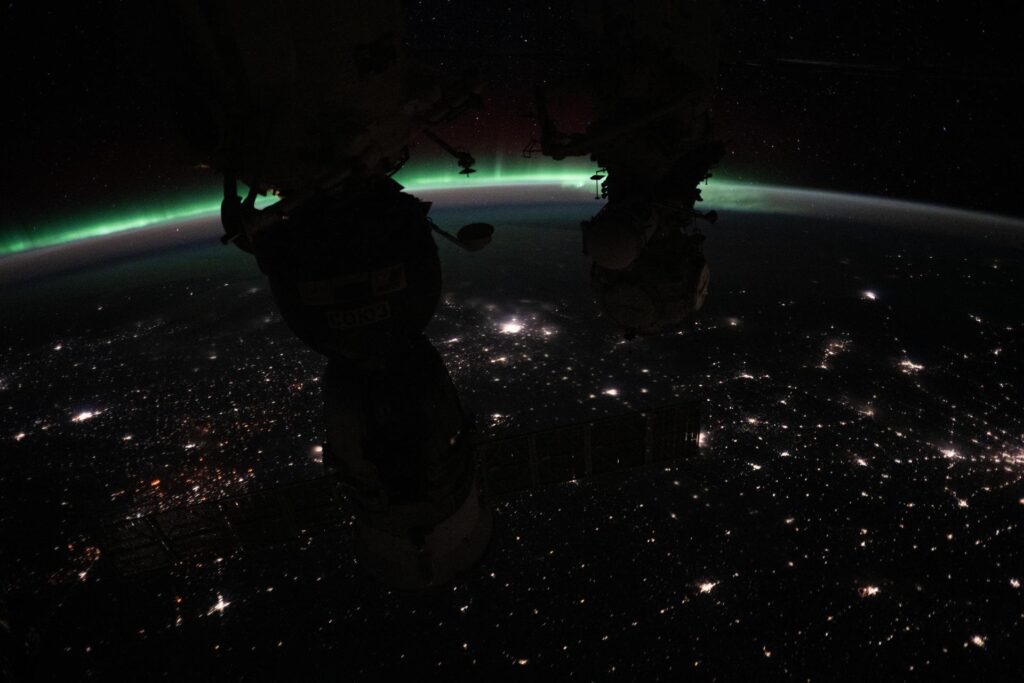
- It sends charged particles toward the poles, where they produce the aurora (NASA).
Forecasters have limited warning once a CME is on its way. NOAA says the DSCOVR satellite, positioned between Earth and the Sun, can often give 15 to 60 minutes of notice before a shock arrives. A forecast built on a single CME can therefore be wrong if a second, faster one is chasing it. Models that show how merging changes a CME’s speed and magnetic structure are a step toward closing that gap. Skywatchers who follow the northern lights forecast rely on the same kind of forecasting.
The magnetic orientation inside a CME matters too. NOAA notes that a CME is likely to cause a geomagnetic storm when its magnetic field points in the right direction relative to Earth’s. Reconnection between merging eruptions rearranges that field, which is one reason the team wants to follow the process further.
The next step: From the Sun to Earth
Cai and collaborators plan to extend the simulations to follow cannibal CMEs all the way from the Sun to Earth. They aim to learn how a merger changes the strength of a CME’s effects on our planet. The images in AAS Nova’s post include a real example: a series from NASA’s STEREO spacecraft showing several CMEs erupting within a few days in 2013.